

Some historians would say that “thinkers” are behind the ideas
and mythologies people live by. I think it also goes back to maize,
reindeer, squash, sweet potatoes, and rice. — Gary Snyder
Our farm is in the Winooski River valley in Vermont, perched on the lip of an old riverbed, on piles of sediment dumped here when the glacial meltwaters, and the ancient river, receded. The house faces an open floodplain and, rising behind it, a chain of mountains, with the bony summit of Camel’s Hump appearing out of the foothills as if in the crook of an arm. A ribbon of headlights hems the base of the mountains where a road follows the river, blinking through the night, and behind us, more mountains, but closer, the hills appearing rounded and soft, like the swells and curves of a body in repose. Along the first ridgeline, a brown-dead swath cuts across the forest canopy, a corridor for the power lines that repeat themselves like an echo over mountains and valleys and coastlines, until they reach the distant tundra plains and canyons of the northlands.
Before I moved to Vermont I lived most of my life in cities— in London, England, and Brooklyn, New York, but also, for a time, in Portland, Oregon, and Paris, France. I moved to Vermont around the same time as the man who would become my husband, in the early nineties, though we didn’t meet until a decade later. He was raising sheep and chickens here, but had no vegetable garden, no flowerbeds and only one old but productive apple tree. Neither was he processing his sheep’s wool into yarn and rovings, tapping maple trees, or keeping bees— all of these we would do together in time.
We are learning just how much this three-acre plot of land can give— fiber, food, both foraged and cultivated, beauty, and in the woods and meadows behind us, space for our rambles, as necessary as bread and bone. It gives us a structure for our lives, animal companionship, a relation with the wild creatures who visit our gardens and pastures, our trees, rock wall, and wood pile, a life of infinite inquiry into what it means to live as a human being inside a greater community of life.
When I left New York for good— having given up my rent-stabilized apartment, and most of my things, except what I carried on my back, I did not know where I was going. I lived for a time in a chambre de bonne, in a houseboat, in a sugar shack and a shepherd’s hut, and moved from rental to rental once I came to Vermont, until I met Art and moved in with him here. Both of us came to this life with the innocence of city people (though my husband was raised in the suburbs) in search of some vague idea of the pastoral, mine formed out of reading Anna Karenina, with images of Levin and his scythe. That idea did not include invasive grasses or late blight or day-old lambs dying in my arms.
I suppose my ancestors who left the Old World also had little idea of what they were emigrating to, but they knew they had to leave, even though they carried no maps of where they were going. It is in the DNA of the settler colonist, to pick up and leave, and to give oneself the license to do so— again and again. But I have lived here now longer than I have lived anywhere. I have taken root here, but like a tree with roots that will hold it in place, the winds still want to take it away. I still feel those winds. But I remain— we remain. In Homer’s Odyssey, the hero’s marriage bed is carved out of a great olive tree, rooted in the center of their world; it is the one thing that remains when everything else has been looted or abandoned. I would still be living a wandering life if not for this olive tree, this partnership we have in caring for this place, in learning from the land and the animals as we go.
My childhood was not a happy one, but I was raised by a mother and in a culture that valued the life of the mind and the imagination. For my first two decades of life my teachers were my books; it would be books, then, who would eventually lead me to discover other kinds of teachers— to learn from trees and grass, caribou and salmon, seeds and compost and domestic animals. A poem, said Robert Frost, begins in delight and ends in wisdom, and so does a garden, and in between the delight and the wisdom are many losses, plagues of flea beetles and varroa mites, the weeding and all the mucking out.
I have lived here long enough to have seen the land change: the trees we planted now fill in what were once open spaces; the old elm is gone, leaving behind a great hole in the sky; the floodplain across the road that was for all those years planted with industrial corn is now a hayfield; and the largest remaining tract of unbroken farmland has been subdivided, the meadows turned into lawn. Mary Jo and Everett Andrews, the elders of the oldest farm family in town, no longer wave to us from their front porch as we pass. We have also seen the educational farm, which set up next door in the newly renovated West Monitor Barn, restore the lands around us and bring this community new life.
Ecological succession is the process through which biological communities evolve over time, passing through the stages of initiation and disturbance before reaching a steady state. Those stages also describe our own experience over two decades of living on and working this land. The early years of a garden are like the halcyon days of the first farmers, when our tomatoes, squashes, and beans spilled from the vines before the arrival of pests and diseases that we have had to manage ever since, before the invasive plants spread over the pastures like spilled ink on the page.
We have tempered our early ambitions, given up on bees, after losing two hives in a row; on strawberries, which we could not keep weeded; on blueberries, which the birds always got first; and have come to accept that much of our time must be devoted to cutting back thistle, poison parsley, and knotweed. We would, in time, let our ewes live out their lives but no longer have lambs. But as we settle down to accept our limits, the basis of our lives grows more and more unsettled with a changing climate.
I am reluctant to call myself a “farmer” because we grow food only for ourselves, and the surpluses that we give away, not for a larger community. We are not professionals. “Hobby farmer” isn’t right either, as for several years, we sold some lamb at harvest time, yarn and rovings, dried flowers, and, while we were raising bees, a honey-sweetened homemade ice cream, at our local farmer’s market, in an earnest effort to reduce our need for wage employment.
I am well aware that the skill and technology applied by the farmers next door to us—who produce some fifty thousand pounds of food in a season— are well beyond those of this home gardener. Sharon Aysk and Aaron Newton, authors of A Nation of Farmers: Defeating the Food Crisis, remind us that this is what farmers always did— they didn’t just produce one or two crops for market but also kept a cow and some chickens, grew beans and potatoes for their own kitchen. A half a century ago, in our parents’ lifetime, almost half of Americans had vegetable gardens, producing much of the food they ate at home. We need a million of these farmers, Aysk says, because this is how to feed the world. We cannot count on Monsanto (or Bayer, as it is now named); we will have to do it ourselves, saving our seed and raising animals who will renew themselves, generation after generation. Acting as part-time farmers is to practice what human beings practiced for thousands of years before they invested in “serious” farming, write David Graeber and David Wengrow in The Dawn of Everything.
Farming was one among a variety of subsistence activities that together gave people flexibility and resilience, in the same way that a diversified farm is more resilient than a monoculture. “The ecology of freedom (‘play farming,’ in short) describes the proclivity of human societies to move (freely) in and out of farming; to farm without fully becoming farmers; raise crops and animals without surrendering too much of one’s existence to the logistical rigours of agriculture.”
You can’t do just one thing is a premise of ecological farming, as it is a principle in an ecology of freedom, where the wholeness of the human being is restored, and where my freedom, security, and prosperity are dependent upon yours.
And for most of that history, human beings lived in community with one another and with other creatures by participating in a gift economy. To harvest food from a garden, to shear wool from sheep, is to experience life as gifting, and this is no less true because we might sell some of our wool or produce at a farmer’s market, nor is it less true because the beans and tomatoes I harvest require a lot of work from me in return. But to experience the proliferation of fruits from the vines, the miraculous abundance, the metamorphosis of nothing but grass, water, and sunlight into the most useful fiber humanity has ever known— I cannot help but feel that I am the recipient of a gift. I might have prepared the soil, weeded, thinned, and weeded again, but this cannot explain it, the gifting nature of soil and sunlight. Gifts occur in “a realm of humility and mystery,” Robin Wall Kimmerer writes. This is why the food we grow ourselves is so deeply satisfying. This is why a bowl of beans, as Kristin Kimball writes in her memoir, The Dirty Life, and someone to share it with, is enough.
In the early days of living here, we spent so much of our time in the garden and fixing up the house that we found ourselves getting out less and less to ramble in the mountains like we once did. One day I came to miss this— as someone who spent years advocating for wild forests and wild rivers, spending weeks at a time in the back country, sleeping in a tent and cooking over a stick fire. It is true that as human beings domesticated plants and animals, we in turn were domesticated: our range of movement contracted, our senses dulled, and we lost the participatory alertness characteristic of wild creatures. “As our domestic animals settled in for a life of reduced activity and stimulation, so did humans,” Carl Safina writes in Beyond Words.
“As people provided safer, more sedentary conditions for their livestock, they did the same for themselves. The confinement was mutual.” I worried that this was what was happening to us, as our world retracted and our engagement with a wider world of wildness grew dimmer. We know that food crops do better in proximity to forests and healthy grasslands, and I believe that it true for us, too, who as domesticated animals thrive better in proximity to wild forests and the nonhuman animals who are not born and bred for our use. We would learn to scale back our ambitions as growers who in our enthusiasm wanted to do it all— beekeeping, fiber arts, agroforestry— who wanted to grow every vegetable that was possible in our climate. Applying the permaculture principle of self-regulation, we would need to draw and accept our limits.
I have never felt that the pleasure or joy I get from flowers, or from the meals we make from the food we grow, are irrelevant to my activism, or to my writing life. George Orwell, near the end of his shortened life, lived on an island in the Hebrides where he grew fruit trees, all kinds of flowers, and vegetables. He shot rabbits, he milked goats, he fished, he cut his own peat for fuel. He had to walk eight miles from the nearest road, which he did often. He was raising his son, on his own, after his wife died. Orwell himself was dying, but before he would die, he would plant lupins, roses, apple trees, cherries. He would write 1984.
Though we may not think of roses when we think of Orwell, Rebecca Solnit wrote a whole book on Orwell and his roses, Orwell’s Roses. She attributes his fidelity to the concrete and the particular, his abhorrence of ideological abstraction, and his commitment to independent thinking to his milking goats by hand and tending roses. In planting his roses in a very particular soil, Orwell is rooting himself in the specific and the concrete, which is the basis of writing well. He would teach generations of writers to use concrete language as a guardrail against the vagueness and insincerity of inflated speech. Solnit also wants us to see that Orwell, while enduring illness, while mourning the death of his young wife, while living through the London Blitz, and while thinking and writing about Stalin’s gulags, made room in his life for joy and the pleasures of growing roses. “Our job,” Orwell wrote in his essay on Gandhi, “is to make life worth living on this earth, which is the only earth we have.”
To say that humans have always lived this way is not to deny the benefits of modern technologies. I, for one, would not want to do without antibiotics, vaccines, or the washing machine, nor without a way of knowing the world that modern science has given us. Our state-of-the-art woodstove is vastly more efficient than that old pot-bellied stove or the open hearth. But to live with more simplicity and closer to the basis of our lives is one way to investigate what it means to be human, and it is to recognize that the benefits of technologies that depend on resource extraction come with substantial penalties.
Conditioned as we are by the myth of human progress, we put too much faith in futuristic, unproven technologies when there may be answers right there for the taking in our past— even our recent past— because we have known how to live with less complexity, with less (or no) dependence on fossil energy. For all but a few seconds before midnight in the scale of time, human beings produced their own food. And we— not everyone, but many more of us— will have to do so again.
“Cities are the solution,” I heard a panelist say, in a discussion of environmental writing. Learning to green our cities and to humanize them will be necessary as we face a future of ten billion and counting, but the migration from the countryside to the city over the last century has come at the expense of the deliberate devastation of rural places. Cities cannot feed themselves, thus people who live in cities will be forever detached from the problems that come with extracting the resources they depend on and producing the food they eat. There can be only so many backyard chickens or kitchen gardens—which will be, in my mind, a key part of the solution— in dense urban centers.
The countryside cannot be made a sacrifice zone for the city, with industrial feedlots confining animals twenty-four seven, polluting the air and water and killing the life of soils, with migrant laborers held enclosed on the farm. The countryside, at least here in the United States, has a car dependency problem it has not even begun to address, but the future of our life on earth will depend on the countryside also being “the solution,” as Gandhi saw village life, rather than urban development as the future for nonindustrial nations. I am, at heart, a city person as much as I have learned to be a rural one; cities have made me who I am, a person who chose to live this life— but I will invest my hope in the village and the country as the solution, as the future of wilderness, on the one hand, and cities, on the other, will depend on us taking care of the countryside between.
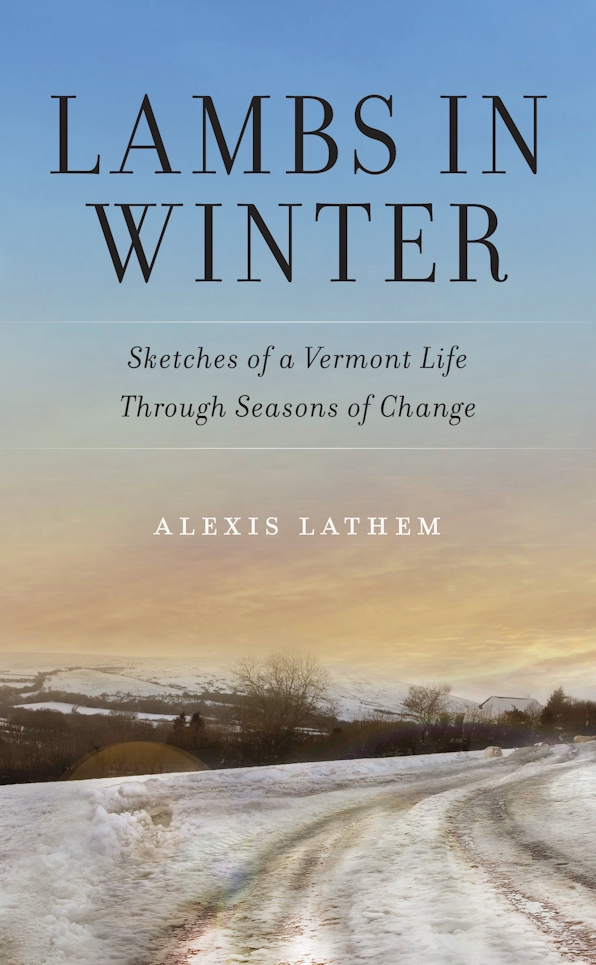
This is an excerpt from Alexis Lathem‘s recently published book Lambs in Winter: Sketches of a Vermont Life Through Seasons of Change (Bright Leaf & University of Massachusetts Press, 2025).


Comments
We changed commenting systems on September 10, 2026 as part of a site-wide functionality and security upgrade. Your past comments have not disappeared, and you can still log in with your old Disqus account credentials if you wish. Contact us with any questions.
My oh my–I found myself in vehement agreement with practically everything in this essay. Yes–a good marriage is the bedrock of a good lifer. If I ever get uprooted from my homestead, as long as my husband and I go together, it won’t be so bad.Yes, diverse gardens are important for resilience, because one thing I’ve learned in 50 years of gardening is that every year, one crop does surprisingly poorly while another does unexpectedly well. If you only grew a couple of staple crops you’d be at risk of having no harvest. Yes, the foundation of good writing is the use of the particular, whether fiction or nonfiction–when I read a few paragraphs and it’s all abstractions (sometimes on this site) I stop reading because I don’t know what it means, seems like it doesn’t mean much of anything.
I do disagree about the “ten billion and counting”–we’re well beyond sustainable levels now, and things are beginning to come apart–how likely is it that we can keep adding people and growing our economies. And I completely reject the notion that city living is an answer, at least as far as the megacities. Towns can be sustainable, trading with the surrounding farms on a fair basis.
In reply to M Wildfire (why has this obvious facility been deleted?)
Couldn’t agree more. We would struggle goodlife-ing if we weren’t a couple. And human overshoot is one side of the biggest predicament; resource draw-down being the other.
No city of over 1 million, has proven the ability to exist ex fossil energy support. There are currently hundreds of them.
Azby Brown, who wrote, Just Enough, about the 200 year Edo period of organic agrarianism in Japan, showed how a city of a million people could live sustainably. It’s a great book. However, I think our techno-fantasy-industrial society will one day, by necessity, have to become a post-techno-fantasy-industrial-organic-agrarian society, and that takes a lot of planning and forethought, which we don’t seem capable of at this time.