

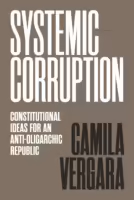
 There are many reasons why constitutional democracies around the world are faltering and authoritarian nationalism rising. Professor Camila Vergara, a Chilean political philosopher and scholar of constitutional law, has one powerful, audacious explanation: Constitutions offer no meaningful political role for ordinary people in democratic governance, and so oligarchic institutions take root that privilege the domination of the few over the many.
It is the conceit of liberal constitutionalism that the will of the people will be robustly expressed through elections, for example, and representative legislatures. Such systems, in theory, will express the popular will and give the state legitimacy and stability.
But as Vergara brilliantly argues in her book Systemic Corruption: Constitutional Ideas for an Anti-Oligarchic Republic (Princeton University Press, 2020), corruption is inherent in representative democracy. Oligarchs and other political elites nearly always capture modern republics unless ordinary people have substantive constitutional powers of their own.
Professor Vergara boldly argues for new/old types of “plebeian republicanism” such as citizen assemblies with real authority. This is the only way that constitutional systems can renew themselves and banish systemic corruption.
Systemic corruption is not about a few venal politicians who take bribes or bureaucrats who collude with wealthy corporations. It’s about the systemic oligarchization of power within a general respect for the rule of law. Elites come to dominate the state political apparatus and warp the law to suit their interests and desires, betraying the promise of democracy. That’s why plebeians must have explicit constitutional powers, says Vergara.
In Systemic Corruption, Vergara opens up a new kind of conversation that I have never heard before in political circles or the news media. She proposes new types of constitutional power for plebeian institutions so that the interests of ordinary people will be baked into modern constitutional systems.
I wanted to learn more about this compelling idea because it has obvious relevance to commoners struggling against the powerful market/state alliance. So I interviewed Professor Vergara on my latest Frontiers of Commoning podcast (Episode #52).
As a financial journalist in Chile, Vergara learned firsthand about the political power wielded by oligarchs and their ability to thwart democracy. She later studied political philosophy and constitutional law at the New School in New York City and got a PhD in Political Theory at Columbia University. She is currently at the University of Essex Business School in the UK.
By Professor Vergara’s reckoning, plebeians – citizens without wealth or official power – should be formally authorized to convene local citizen assemblies, make and veto political appointments, and propose and veto legislation. They should be able to curb elite power and punish its abuses.
These types of plebeian republicanism are necessary if a nation hopes to counteract the systemic corruption that naturally emerges in constitutional systems. The problem is not confined to small, remote, poorer nations. It’s equally a problem in wealthy, liberal, representative democracies. Constitutional republics invariably decay and grow corrupt through oligarchic capture. Plebeian institutions are needed to give political power to ordinary citizens and thereby renew the democratic ethos and render material outcomes fairer.
It’s a masterstroke that Vergara makes her case by relying not only on political theory from ancient Greece and Rome, but by invoking four respected philosophers of the modern western canon – Niccolò Machiavelli, Nicolas de Condorcet, Hannah Arendt, and Rosa Luxemburg – whose writings about plebeian institutions have been largely overlooked. Vergara offers fresh interpretations of these four philosophers to recover and revive their ideas about plebeian governance.
Political theorists may object that constitutional checks and balances are the brilliant innovation that prevents abuses of power in the US and other liberal democracies. But Vergara points out that “in a postliberal world, elitist thought has embraced proceduralism as a way to justify the rule of the few on democratic grounds.” A neutral proceduralism is said to be enough to yield the best outcomes. Freedom of expression and universal suffrage, for example, are seen as procedural guarantees fairness and consensual results.
But this claim ignores how elites, being rich and powerful, can organize themselves more effectively than plebeians, and therefore, preserve corrupt systems and the benefits that flow from them. Plebeians, by contrast, have little constitutional power to ensure that everyone can enjoy the same liberties and fair outcomes, or to stop systemic corruption.
What about constitutional checks and balances of power? They may constrain some conflicts among elites, but checks and balances mostly apply to the exercise of power among elites themselves, as state actors. Checks and balances don’t authorize or enlarge plebeian power, let alone stop abuses by elites.
Given power imbalances between oligarchs and citizens, law is not a force that truly curbs the powerful. Rather, it enables and legalizes their abuses. In this fashion, relying on legal proceduralism becomes a clever ruse: “the burden of the maintenance of liberty is placed on individuals, which is…practically equivalent to leaving the system to its own devices,” Vergara writes.
She contrasts the tradition of “elitist-procedural republican thought” with “the materialist plebeian strand that developed from Machiavelli’s assessment of the Roman republic.” Like Machiavelli, Vergara argues that the rich see, think, and behave very differently from you and me – a something that might be called the “socio-ontological” divide between the rich and everyone else.
While Vergara does not propose doing away with representative legislatures, she does argue that modern democracies need local citizen assembles and other plebeian innovations if they are going to confront, reform, and punish oligarchical power. To this end, she argues for “a mixed constitution in which the few would govern within limits and the many [plebeians] would be active guardians of liberty.”
There is much more to be said about Professor Vergara‘s audacious ideas and their relevance to commoners. For a deeper account, chase down Systemic Corruption – and listen to my podcast interview with her.





Comments
We changed commenting systems on September 10, 2026 as part of a site-wide functionality and security upgrade. Your past comments have not disappeared, and you can still log in with your old Disqus account credentials if you wish. Contact us with any questions.
Systemic Consensus is a very interesting system of governance for this. As it can bridge multi-party differences and generate widely supported proposals. Watch Christian Felber use it at 12:00 > https://www.youtube.com/watch?v=dsO-b0_r-5Y&list=PL7pjVBO0Oar7TJovpbfSRCLOf-_4uzWF0&t=9s
As it scales really well, also digitally on Apps, I even could imagine it to bring us direct (post-representational) governance in the near future.
Because power concedes nothing there is no possibility of implementation.
The problem of constitutions being written by and for the ruling class is a problem not addressed. Agitation by plebians may lead to new social contracts but they are synthesized to ensure rule by the class agreeing to the theses of change demanded. Maoism could be considered a success because the elites, landlords and capitalists were excluded from the Chinese communist party's rule, which, ostensibly, represented the plebs. Compared with the Indian social contract since liberation from colonial rule, Chinese governance has been much more effective for the plebian class.
Vergara's thesis is to die for. But where is the evidence of, in her words, the emergence of "new types of constitutional power for plebeian institutions so that the interests of ordinary people will be baked into modern constitutional systems."
I agree with Tony: "…there is no possibility of implementation".
Vergara’s bold vision is the thousand-pound gorilla in the room – we live in a collapsing, broken society where the human right to self-governance is a sham. True self-governance requires that power, the ability to organize and wield collective action, must remain concentrated on the local level (community and work place) as expressed in direct democracy. In large, complex societies like nation states, representative governing institutions should not be primarily decision-making bodies, but serve the function of coordination and communication among the local councils. For more on how Vergara’s vision is already being implemented world wide see Marina Sitrin and Dario Azzellini’s They Can’t Represent Us, Vandana Shiva’s Earth Democracy and John Holloway’s Change the World without Taking Power.