

I’ve been anti-war as long as I can remember. When I got a call from a military recruiter in high school, I already had the clarity of conviction to give him an unambiguous no, and he didn’t have any chance of budging me (although he tried). Everything I’ve learned about war since then only increased my dedication to the principle.
As the song goes: “War can’t give life. It can only take it away.”
I’ve also been a tree-hugger for as long as I remember and for me, my anti-war ethic resonates in harmony with my opposition to the needless killing of any living creature, including plants.
The human toll of warfare is tragic beyond accounting in lives brutally cut short, grievous injuries suffered, cultural heritage lost (museums, religious structures, libraries, schools) and to vital infrastructure destroyed (hospitals, power plants, reservoirs). War as now fought has been with us at least since the establishment of agriculture, and as technology has advanced, its devastating abilities have escalated. Last century was the bloodiest in human history and we must make sure that record stands. Armed conflict at that scale with the current arsenal would be nightmarish beyond reckoning.
Less spoken of, but gaining increasing attention, are war’s effects on the environment. Not just active war-making, but the consequences of all the industries, institutions and infrastructure that supports it; what we could put together under the heading of militarism. Effects include the ruination of habitat and farmland by battle, the killing and disruption of wildlife, the release of lethal pollutants, the damaging processes of weapon manufacturing, and the large-scale release of carbon emissions. Over all this hangs the threat of a nuclear winter, the worst environmental disaster imaginable.
The act of war makes hell out of the landscapes it smashes, sometimes as collateral damage and sometimes as an intentional tactic. The earth is ripped opened by explosives, trampled by tanks and heavy machinery, strung with barbed wire, riddled with mines, littered with bullet and shell casings, contaminated by toxins, burned and desertified.
In Laos and Cambodia to this day, farmers are injured or killed when they run across old bomblets from cluster munitions dropped on their country in the millions by the United States during the Vietnam War, fifty years ago. Cluster munitions are bombs or shells that contain dozens of small bomblets intended to scatter and cut a wider swathe of damage. But they don’t all explode upon impact, especially when landing in soft soil like a cultivated field, and they end up lying in wait to be set off. Perversely, they are often painted bright colors and children have mistaken them for toys, to their own demise or crippling. Last year, the prime minister of Cambodia publicly besought NATO and the US not to send cluster munitions to Ukraine (where there were plausible accusations of prior use by both sides, but why make it worse?). Laos issued a similar plea. Unfortunately, they were unheeded. Much of Ukraine’s agricultural land, whose richness bestowed upon it the title of “Europe’s breadbasket,” will be dangerous for generations.
The US (and the UK) also sent artillery shells tipped with depleted uranium to Ukraine. “Depleted” is a misnomer; as a byproduct of the nuclear industry it is still radioactive enough to be harmful. As an environmental toxin, depleted uranium can cause cancer and birth defects, among other problems. The United States struck Fallujah, Iraq, with depleted uranium weapons and white phosphorus in the early 2000s, and results were horrific. The birth defects, like deformed limbs and skulls, or organs misplaced on the outside of the body, have been documented in gruesome photography that every US American should look at to see what our government is inflicting. The effects can be lasting.
“Salting the earth,” a technique of conquering armies in antiquity who sowed salt on the fields of their enemies, might have been more symbolic than an actual attempt to prevent crops from growing, but as a metaphor, it holds truth; intentionally ruining arable land is a common practice of warfare. We have been witnessing a contemporary example in Gaza, where the IDF has sprayed herbicides on Palestinian crops and outright destroyed ~40% of farmland and thousands of greenhouses, bombing the areas and then bulldozing them for military use. Palestinian olive orchards are particularly targeted so, though Israel’s Prime Minister justified killing Gazan civilians by referencing the Biblical 1 Samuel—“Do not spare them, but put to death men and women, children and infants, oxen and sheep, camels and donkeys”—he is ignoring Deuteronomy: “When you besiege a city for a long time, making war against it in order to take it, you shall not destroy its trees by wielding an axe against them. You may eat from them, but you shall not cut them down. Are the trees in the field human, that they should be besieged by you?” As with the conflict as a whole, the damage is exceedingly disproportionate.

Aerial view of the village of Passchendaele, before and after the Third Battle of Ypres, 1917. Note all the farm fields destroyed. Credit: Public Domain.
In war, wildlife is slaughtered both intentionally and accidentally, threatening endangered species like the Snow Leopard in Afghanistan. Birds and their migrations are disrupted. Poaching can increase as war-related food shortages lead to illegal hunting.
The World Federation for Animals recounts some historical incidents of animal death in conflict zones: In the Vietnam War, Agent Orange wiped out the jungle habitat of Asian elephants gibbons, civets, leopards and other animals, and animals continued to be killed for twenty years after the end of the war from landmines. In Mozambique, 90% of the giraffes and elephants in a national park did not survive the hostilities of the country’s 15 year civil war. During the Iran-Iraq War in the ’80s, populations of wolves, wild goats, otters, pelicans, hyenas and river dolphins were greatly reduced, sometimes to the point of local extinction. In the Sudanese Civil War (1983-2005), the elephant population was hammered, falling from 100,000 to 5,000. In the ’90s Afghan War, more than half of the livestock population was killed, and in the first Gulf War (1990-1991), more than 80% of the livestock in Kuwait. When oil was deliberated leaked into the Persian Gulf by Iraq, an estimated nearly quarter million aquatic birds and animals died.
The UN Environment Program estimates that, over the last sixty years, “armed conflicts have occurred in more than two-thirds of the world’s biodiversity hotspots.” As examples, the program cites: deforestation and harmful mining practices during the Congolese civil wars since the ’90s; the draining by Saddam Hussein’s troops in the early ’90s of over 90% of the marshes at the confluence of the Tigris and Euphrates rivers in southern Iraq, formerly the largest wetland ecosystem in the Middle East; pollution of soil, water and the air by burning oil wells torched by the Islamic State in 2017 in the same country; rates of deforestation reaching 95% in some parts of Afghanistan over the many years of fighting; and the illegal exploitation of wildlife and plants in the forests of Nepal between 1996 and 2006, when the army was taken off the duty of protecting natural reserves to address internal conflict.
As a testament to how much animals and plants can thrive when shielded from war, the Korean peninsula’s 440 square mile demilitarized zone, where the exclusion of human activity has been strictly enforced for 70 years by bristling armies along its northern and southern borders, has become a thriving reserve for wild plants and animals, many of them rare elsewhere on the peninsula.

The Battle of Passchendaele: A group of horses are led down a muddy road near Zillebeke. In the left foreground is a large puddle in a shell crater. In the distance, a shell burst can be seen in the sky and a few damaged trees are visible on the skyline, 22 August, 1917. Credit: Public Domain.
Off the battlefield, Pentagon activities also jeopardize wildlife habitat. Nineteen million acres of land in the United States are taken up by military installations, over 4000 total. These areas are subjected to vegetation removal, earth moving, heavy equipment (tanks etc.), munitions testing, and very substantial pollution.
According to Mint Press News, the Department of “Defense” (DOD) produces “more hazardous waste than the five largest U.S. chemical companies combined” including “depleted uranium, oil, jet fuel, pesticides, defoliants like Agent Orange and lead.” Newsweek reported that military bases are often dumping grounds for “DDT, cleaning fluid, batteries, transformers, vehicles” and can harbor “groundwater deposits of gasoline.” Of the ~1200 Superfund sites in the US, about 900 are abandoned military installations or related sites. The Environmental Working Group revealed that over 700 US military bases are “likely contaminated” with PFAS—known as “forever chemicals”—with 78 sites “confirmed” to have leeched into local drinking water supplies. In a 2022 report, the Pentagon concluded that over 175,000 service members were served water containing forever chemicals. Further, more than 600,000 more may have been exposed.
Some biologists point out that US military bases can act as de facto preserves for wild animals and plants due to the prohibition of any other activity there, but the bottom line of the balance sheet is surely deeply in the red. My own conversations with desert botanists suggest that the bulk of protective benefit is due to the unused buffers set aside around the edges of bases for public safety and military security. But these areas can be repurposed at any time, like when a base is enlarged. As I wrote about in 2017, the then proposed expansion of a Marine base in southern California would inevitably result in the killing of many Desert Tortoises, who are are listed as “threatened with extinction,” and whose history of habitation in the area goes back over 15 million years. (Talk about “prior use” property rights!)
Both on base and off, radioactive pollution from the production and testing of nuclear weapons is one of the worst environmental legacies of the Cold War. Between 1945 and 2016, over 2000 detonations were set off around the world, about a quarter in the open air. Cancers and chronic illness followed. Large areas of land were poisoned with radioactivity.
Perhaps hardest hit by the tests were people living on or near Pacific islands, where over a hundred bombs were detonated by the US and about 200 by France. Consequences included “cancers, leukaemias, still births, thyroid tumours, and ‘jellyfish babies’—infants born without bones and with transparent skin, who usually died within a day or two.”
Fallout circulated through the atmosphere and is found everywhere on earth. Future geologists will be able to identify our layer in the sedimentary layers by the presence of isotopes otherwise rare in nature. Particles of plutonium are still circulating in the upper atmosphere. A 2021 study found that honey in the United States today contains “detectable traces of radioactive isotopes” from the tests [video].
Besides nuclear weapons themselves, the extraction and processing of uranium is incredibly dangerous to humans and wildlife and wreaks havoc on the environment.
Three methods are used. With open-pit mining, the surface of the land is scraped off to expose the ore, which is mixed into the soil and rock. Forty tons of waste, or “tailings,” are produced for every one ton of uranium extracted. Tailings, which can remain radioactive for thousands of years, are heaped in big piles, usually exposed to the elements. Open-pit mines can be hundreds of thousands of acres in size. With underground mining, the ore is accessed through shafts and tunnels where workers are exposed to radon and other hazards. Much of this work was done by Diné (Navajo) people during the Cold War, leading to a host of health problems for a nation who’d already gotten a raw deal from Uncle Sam (to put it mildly). With in-situ leaching, chemicals are pumped into the earth above a uranium deposit. The chemicals travel through the groundwater and dissolve the uranium from its surroundings. The groundwater, now contaminated with uranium, is pumped up to the surface for processing [see illustrations].
“Milling” is necessary to purify the uranium, which involves crushing it and adding more chemicals. This produces more tailings, which are piled up or mixed with water into a slurry and stored in tailing ponds. These ponds leach radioactivity into the surrounding groundwater.
Cancer, reproductive deformities, and kidney disease are among the dangers posed by uranium mining and processing to humans, both workers and nearby residents alike. Animals, including fish, suffer similar issues. (Given all this, how any power-generating solution dependent on uranium can be considered “green energy” is beyond me, but that’s a subject for another essay.)
The Hanford nuclear site in southern Washington, where plutonium was produced for the Manhattan project—and was used in the bomb dropped on Nagasaki—is considered to be the most radioactive place in the United States. Clean-up, if even possible, is far from complete. (For an interactive world map showing nuclear sites around the world, including mines, see Hibakusha Worldwide. “Hibakusha” is a Japanese word (被曝者) first used for the survivors of Hiroshima and Nagasaki, now expanded to apply to all victims of nuclear disasters.)
The US is currently spending nearly half a trillion dollars on “modernizing” its nuclear weapon arsenal, so this is not just history. More plutonium will need to be processed, more uranium mined, and more people exposed to danger throughout the process.
“Nuclear winter” is the ultimate danger. It is projected that the smoke and dust pumped into the atmosphere by a nuclear exchange would block so much sunlight that the consequent drops in temperature and rainfall would decimate agriculture. In the mass starvation that follows, an estimated two to five billion humans would die. Innumerable animals and plants, perhaps the majority, would also fall victim.

First World War, Western Front, 1917 Credit: Public Domain
The manufacturing of conventional weapons and war machinery also comes with a high environmental price tag. Think of the ores and metals that are mined, the plastics produced, the toxic waste inevitably generated by industrial processes, and the numerous habitats disturbed or wiped out for all of it. Because the Military Industrial Complex distributes its facilities among as many Congressional districts as possible in order to ensure continued funding, the environmental damage is everywhere too.
In terms of climate, war and militarism are a major source of carbon emissions. First because during warfare carbon is released when soil is disturbed (something we know from the effects of agricultural tilling) and when forests, grasslands and other vegetation are razed (because they sequester carbon). Fires, explosives and building demolitions all emit carbon. (See research that attempts to quantify emissions for the current conflicts in Gaza and Ukraine.)
Besides these direct effects on the ground, the upkeep of militarism is harmful. The Pentagon is the largest single institutional emitter in the world. Its carbon footprint is bigger than 140 countries. Since 2001, DOD fuel use has comprised about 80% of all government fuel consumption. Yet, under the current terms of global climate accords, nations are not required to report military emissions to the UN Framework Convention on Climate Change (at the insistence of the US).
As time goes on, higher temperatures threaten to expose and disperse radioactive contaminants through rising sea levels compromising nuclear waste storage facilities in the Pacific and the melting of ice in Greenland and elsewhere that contains isotopes from fallout.
The solution is not a “green military.” If the Pentagon weren’t running on fossil fuels, most of the other problems listed in this article would still be in full force. Most importantly, its role in perpetuating conflict around the world would remain intact. The only answer is to dismantle the war machine.

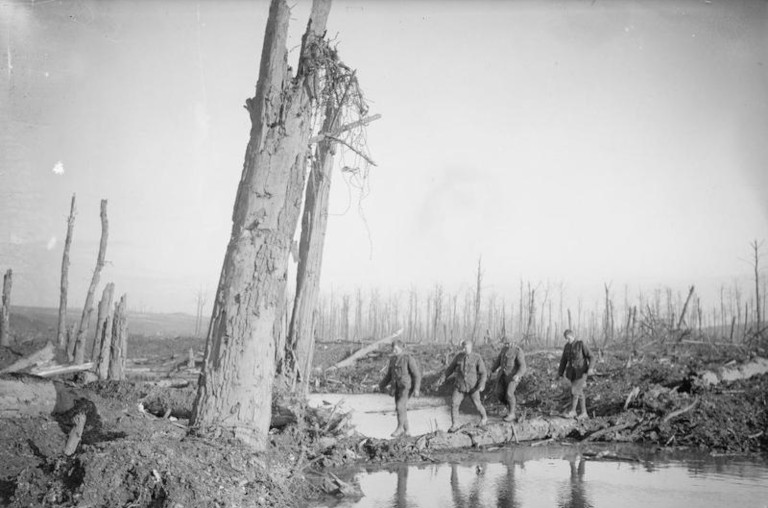
Soldiers crossing the River Ancre, France, during World War I. This photograph depicts four British soldiers using a fallen tree-trunk as a temporary bridge over the River Ancre. They do not appear to be in a danger area as only one man is wearing a steel helmet. The landscape is bleak, full of war-blasted trees. The River Ancre is one of the tributaries that feed the River Somme, passing through the main Somme battlefield area. This picture of devastation illustrates the shattered landscape that remained after the war. Credit: Public Domain
Which brings me to the final topic: “opportunity cost.” This is an economic term describing the fact that money spent on one thing can’t go to something else. The proposed budget for the DOD for fiscal year 2025 is about $850 billion dollars. In 2022, US “defense” spending represented almost 40% of the worldwide total and exceeded that of the next 10 highest spending nations combined (which includes both Russia and China). The DOD budget does not include all outlays for war, as the nuclear arsenal is funded by the Department of Energy, for example. When counting everything, the total cost to US taxpayers is around an astonishing $1.5 trillion. What incredibly wasted opportunity! Eisenhower said it well in 1953:
Every gun that is made, every warship launched, every rocket fired signifies, in the final sense, a theft from those who hunger and are not fed, those who are cold and are not clothed. This world in arms is not spending money alone. It is spending the sweat of its laborers, the genius of its scientists, the hopes of its children. The cost of one modern heavy bomber is this: a modern brick school in more than 30 cities. It is two electric power plants, each serving a town of 60,000 population. It is two fine, fully equipped hospitals. It is some 50 miles of concrete highway. We pay for a single fighter plane with a half million bushels of wheat. We pay for a single destroyer with new homes that could have housed more than 8,000 people. This, I repeat, is the best way of life to be found on the road the world has been taking. This is not a way of life at all, in any true sense. Under the cloud of threatening war, it is humanity hanging from a cross of iron.
And that man was a general dedicated to capitalism, not a peace activist or a socialist!
I would also speak of another “opportunity cost” of militarism: our sacrifice of cooperation for conflict. The more the world focuses on war, the less room there is for anything else, like finding ways of working on environmental challenges together. Climate gets the most press, but a host of other topics must be addressed: unsustainable agriculture, fresh water depletion, topsoil loss, pesticide use, toxic waste cleanup, microplastics, deforestation, ocean dead zones, over-fishing, endangered species, mine remediation. The list goes on. It’s not like we don’t have better things to do together than fight!
Whatever one’s personal stance in a given conflict—whose side you’re on—the fact remains that war inflicts catastrophic and often long-lasting damage on the environment, to both wild places and agriculture, affecting both humans and more-than-humans, both on the battlefront and far away from it. Calamitous outcomes are inevitable. In the end, “who started it” doesn’t matter. Only stopping it does. The solution is always to press the warring parties to put down their guns and take a seat at the negotiating table, the sooner the better. Arming either side only prolongs suffering and devastation, both human and environmental, as we are seeing today in Gaza and Ukraine.
I believe that the anti-war and environmental movements would benefit from cross-pollination. Each has something to inform the other. Some environmentalists fail to speak out on the ecological effects of war either out of ignorance or because they are invested in nationalist narratives about perceived enemies and falsely believe militarism is a necessary evil. Some anti-war activists have not realized that accomplishing true and lasting world peace ultimately involves embracing values that reconnect humans with the more-than-human world. As someone who has long been both pro-environment and anti-war, I hope that my words can play a part in providing a bridge between the two movements.

The morning after the first battle of Paschendaele, Australian Infantry wounded around a blockhouse near the site of Zonnebeke Railway Station, 12 October 1917. Credit: Public Domain





Comments
This article does not mention what I see as the very worst environmental consequence of not just war itself, but the entire military-industrial-think-tank complex that maintains it. The MITTC will of course go out of business if war is stopped, and they use all their massive political clout, painstakingly nurtured over many a well-funded generation, to not merely prevent peace, but to actively instigate wars. And you don’t need a PhD in history, ancient or contemporary, to know of many examples of that.
Just as important is the fact that you CANNOT wage a modern (non-nuclear) war without access to cheap and abundant oil-based fuels. This is because there is nothing available or on the drawing board that comes close to the internal combustion engine in terms of its power-to-weight ratio. The Allies defeated the Axis powers in WWII by cutting off their access to oil, and the military’s top brass has not forgotten this fact. See e.g. https://defense.info/wp-content/uploads/2018/10/Oil-War-by-Captain-Paul-E.-Mawn-USN-Ret..pdf
In fact, there is no industry out there, not steel, cement or even energy itself, that harder to decarbonize than the “defense” industry. And there is no constituency out there that is more dead set on keeping society as whole from decarbonizing than they are. They also, as pointed out above, have a lot more political clout than the oil industry, by far (although, as argued above, the latter should really be viewed as an integral part of the former). And that may prove to be the worst thing yet about war!
For historical documentation of these claims, i recommend “Oil, Power and War: A Dark History” by Matthieu Auzanneau: https://www.chelseagreen.com/product/oil-power-and-war-paperback/
Yes, the Pentagon certainly is the elephant in the room too much of the time. I understand the motivations of some environmental organizations to “stay on message” but I’d say that leaving out militarism is itself getting *off* message.
So glad you appreciated it. Thanks!
Yes, as a longtime supporter of the Green Party in the US, I was also quite disappointed by the German Greens.
It is just laughable that you think the Pentagon is democratically controlled. The bipartisan war party rules the US.
Maybe actually look at what the US military has been doing over the last 30 years.
If you don’t want the ‘bipartisan war party’ then vote for someone else. A party calling for dismantling the Pentagon certainly wouldn’t get many votes. If the US were to withdraw its nuclear umbrella from Europe and Asia, you’d just get all these smaller countries like South Korea and Poland rushing to get their own bomb. I never said the current situation was perfect, just that the alternative would be worse if we’re just waiting for Kim Jung Un and Putin to voluntarily give up their nukes and sing Kumbaya.
The US has spent ~14 trillion dollars since 9-11 going all over the world attacking and killing people in its disgusting Global War of Terror.
Iraq, Afghanistan, Syria, Libya, etc. etc.
It is not defending the country it is out in the world inflicting huge suffering on people all over the earth.
I simply thought the article described the problem pretty well but gave short shrift to any solution beyond laying down our weapons. Why did Putin go after Ukraine instead of the Baltics? Because the baltics are part of Nato and backed by America’s nukes. I would love to have a ‘world government’ that could impose a low carbon future and nuclear disarmement. I just don’t see how to get there and apparently neither does the author.
Russia intervened in Ukraine after the US helped overthrow the democratically elected government in 2014. We helped put the Banderites (very violent scummy people who hate Russians) in charge of the illegitimate government. And those people attacked the Russian speaking areas of Ukraine. And it has been an ongoing civil war ever since.
Great job parrotting Russia’s propaganda. A pro-Putin pacificist. Sounds likes an oxymoron! So basically Russia gets to keep the 7% of GDP it spends on its army to invade its neighbors but everyone else has to lay down its arms. Try starting a Green Pacifist Party in democratic Russia and let see how long it takes for you to fall out of a window…
Please stick to the issues.
Personal attacks sidetrack the discussion
Well, about all I can say to that is “What’s a hard-headed realist like you doing on a site like resilience.org?” You’re certainly welcome to try and educate all of us environmental wack-jobs on the necessity of pouring all our resources into the “defense” establishment, in the process stymying the admittedly unprecedented degree of international cooperation that would be needed to solve the climate (or any of the many other global) crises, but I fear you won’t be having much luck.