

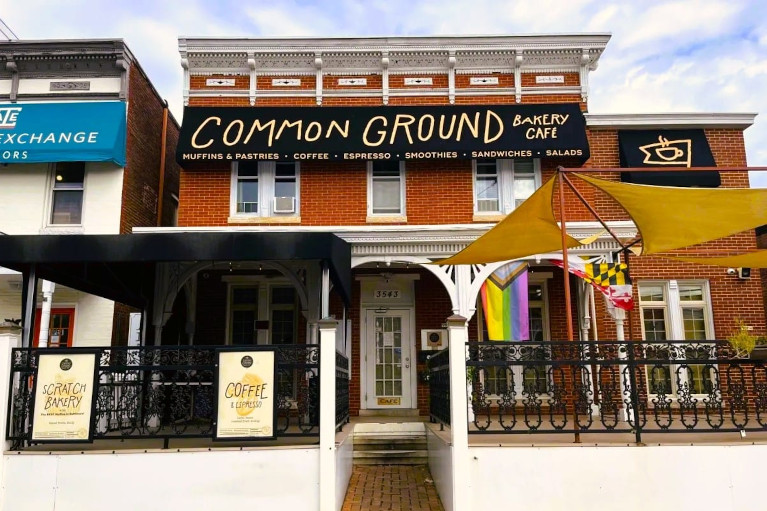
Sierra Allen, 21-year-old barista, had just ended their shift at Baltimore’s Common Ground Cafe on July 2, 2023, when a co-worker texted them the shocking news: Owner Michael Krupp was unceremoniously closing the beloved coffee shop for good and laying off its 30 employees, effective immediately. “It was a moment of shock. I was in a grocery store, and I burst into tears, because no one knew what was going on.”
Allen was devastated by the news that they were losing a job that provided stable employment and a supportive community. The layoffs left them struggling financially—to get unemployment and to keep up with mounting bills. But Common Ground’s workers are a tight-knit group who became even closer as they weathered the challenges of seeing the profitable business through a pandemic. They weren’t ready to give up the shop.
The 20- and 30-something-year-olds relied on each other to endure the sudden job loss, raising thousands of dollars to help each other pay their rent, buy food, and support their families. The staff had already begun working to form a union to fight for better wages and rights in their workplace, and didn’t want another owner taking over. They believed they could reopen Common Ground in a way that gave the workers the power and ownership in the workplace that they felt they deserved.
“‘Making it’ is when we get to a point in our lives where we can take care of our friends,” says 30-year-old Common Ground barista Jacqueline Du.
Two days after the closing was announced, their lives upended, the workers shared that they were exploring the possibility of reopening Common Ground as a worker cooperative—a business owned and democratically operated by its workers. They found support from the loyal customer base built by the business in over 25 years as a fixture in the Hampden neighborhood.
Over the next two-and-a-half months, the former employees worked tirelessly to make the transition happen. Their journey provides lessons for community members who see worker-ownership as a potential tool to preserve and enhance their livelihoods as a flood of small business owners reach retirement age. Some 24 million United States workers could be affected by the coming “silver tsunami,” which refers to business owners of the baby boomer generation retiring without a succession plan for their businesses.
“The minute that I found out about [the closure] was also the minute we started to organize,”
says Nic Koski, a Common Ground employee who emerged as a leader in the effort to turn the business into a worker-owned cooperative.
Community Support
Common Ground’s workers fought for a vision of prosperity at odds with the popular definition of success, in which entrepreneurs accumulate vast fortunes through others’ labor. At co-ops, workers decide how to run the business and keep the profits, which is shown to lead to better pay and working conditions, and increased productivity over traditional businesses. But like most working people, baristas typically lack access to the capital needed to buy a business or the resources and training required to manage it.
In response, a growing number of cities are recognizing the benefits of worker cooperatives by investing millions of dollars in their growth. Baltimore, though, has spent hundreds of millions of dollars subsidizing large corporations, but has yet to invest in supporting worker cooperatives through financing or training.
Instead, Common Ground’s workers found the embrace of Baltimore’s thriving cooperative ecosystem, which had grown significantly in recent years and was prepared to provide the resources the transition would require. For the past decade, Baltimore Roundtable for Economic Democracy (BRED), a local cooperative incubator, along with its national partner Seed Commons, has provided 100 cooperatives with technical assistance. Seed Commons has also loaned out more than $53 million dollars through its revolving loan fund, for which the incubator does not require personal collateral and asks for repayment solely from business profits.
BRED was born from the frustration of worker-owners at Red Emma’s coffee shop and bookstore, and the city’s oldest co-op, when trying to finance its expansion. The incubator has since become well known in Baltimore for growing the city’s worker cooperative ecosystem from a handful of cooperatives a decade ago to more than two dozen today.
After the acclaimed Joe Squared pizzeria closed in March 2020 due to the pandemic, BRED provided the guidance that allowed the workers to reopen it as a worker co-op. This allowed the worker-owners to collectively make decisions like raising wages, equally distributing pay, and opening only for take-out dining when COVID-19 restrictions were lifted but transmission rates remained high. However, in November 2023, the worker-owners announced they would be closing their doors at the end of the year, citing a drastically altered post-pandemic restaurant landscape, lower turnout, and higher expenses. Co-ops are not fail-proof, but their benefits are real.
When BRED learned that Common Ground’s workers wanted to buy the business, they quickly moved into action, using the lessons they had learned from previous transitions.
“BRED has been … the driving force behind how we were able to do this,” Du says. “They gave us the education and the resources to be able to achieve our goal.”
One of the first steps was to acquire financing to purchase the businesses assets from the previous owner. This alone can often seem like an insurmountable challenge for workers.
“We’ve literally had owners who wanted to sell to their workers, and the workers refused,” Kate Khatib, a worker-owner at BRED and Red Emma’s, says, “because they were too scared about what it would mean to take on that much debt.”
BRED gave Common Grounds employees access to financing through their revolving loan fund, and supporters donated more than $26,000 to a GoFundMe to support the conversion to worker ownership. The workers also brought critical assets to the table: They shared the trust needed to open a business together, and they were confident in their ability to manage the shop.
“The owner had very, very little involvement in the daily operations of the business,” says 32-year-old barista Shelby Munson, a full-time student at the University of Maryland, Baltimore County. The job provided Munson the flexibility to pursue a math degree with a focus on finance—expertise BRED has helped her to harness at Common Ground.
“BRED provided us with the structure for us to not have a boss but still make sure that everything gets done and everyone has a fair vote in the major decisions of the business.”
Examples Elsewhere
Even as Common Ground’s workers have found a path to restart their business as a co-op, the U.S. lags behind many wealthy countries in its number of worker cooperatives.
“I think the biggest challenge I have noticed is really structural obstacles to the transition to worker ownership,” Koski says.
Small businesses that have been built up over decades have served as anchors in their communities, providing important services and stable employment. Some retiring business owners will sell to their children, but four out of five don’t have a plan for what will happen next.
The silver tsunami has brought renewed urgency to this work, as jurisdictions seek to preserve local businesses that have an outsize impact on local communities and economies. The number of worker cooperatives in the U.S. has increased rapidly in recent years, buoyed by mounting evidence that they can create good paying jobs and support community wealth-building.
Now, when business owners are ready to retire, cities are seeking to incentivize business owners to sell their business to their workers, instead of selling to private equity or simply closing them.
After investing more than $1 million annually to support worker ownership for the better part of a decade, New York City had 91 worker co-ops at the beginning of 2022, and that year reported spending $3.8 million dollars to provide capital and wide-ranging technical assistance to launch or convert nine more worker-owned businesses, with another nine in the pipeline.
New York’s success inspired Madison, Wisconsin, to invest $1 million annually in cooperative businesses, which by 2022 helped launch nine local co-ops, with a dozen more in the process of launching or transitioning to worker ownership.
Local foundations and anchor institutions in Cleveland helped launch Evergreen Cooperatives in 2008. The group now employs 110 worker-owners in traditionally low-wage sectors with the goal of providing wealth-building opportunities in historically excluded communities in the city. They sustain and grow their co-ops by securing major procurement contracts to provide energy solutions, fresh produce, and laundry services for the city’s hospitals and universities. Their Fund for Employee Ownership acquires local businesses, such as the regional coffee shop chain Phoenix Coffee, and transitions them to worker ownership.
These successes in the U.S., though notable, lag far behind Spain’s Mondragon Corporation, which employs 80,000 people across 90 autonomous worker co-ops. Each co-op has an executive whose pay is capped at six times its workers, and major decisions are made democratically. The collective of cooperatives was founded 70 years ago by a Spanish priest as an answer to the region’s extreme levels of poverty and inequality, and lack of social mobility.
Today Mondragon is a North Star for advocates of worker-ownership, who hope to replicate its success to help revitalize postindustrial cities also facing high levels of inequality and a lack of social mobility. In Cincinnati, that movement is laser-focused on raising awareness that it is possible for small business owners to sell to their workers.
“Mondragon has the lowest level of poverty and the lowest level of income inequality in Spain … and we would like to see that here in Cincinnati,”
says Kristen Barker, co-founder and co-director of Co-op Cincy—a local cooperative incubator. Seeds Commons has supported Co-op Cincy’s multi-million-dollar Business Legacy Fund, which thus far has provided three business owners with the financing and support to sell to their workers, and supported a fourth business that did not require financing for its transition.
Veteran early childhood educator Trisha Hay had struggled to find a workplace that empowered teachers to address the needs of their students until she began working at Shine Nurture Center. When founder and owner Katie McGoron announced in 2022 that she was exiting the business, Hay was relieved to learn she would sell to the workers, with Co-op Cincy’s help.
Hay says worker-ownership has since strengthened the business.
“We really listen to each other’s ideas and can come to each other with problems,” she says. “When you have a sole owner, you don’t have that capability.”
In April 2023, Co-op Cincy organized a trip to Mondragon as part of its plan to expand local worker-ownership by 80,000 people over the next 50 years. Forty people from Southwest Ohio, including 7 worker-owners, toured Mondragon’s large cooperative ecosystem and met with local leaders.
“It was really inspiring to see kind of an economic model that really worked for everyone there,” says Hays, after witnessing how deeply embedded the cooperative ethos was. “Everyone knew what cooperatives were, and it was just a normal part of life and model for their businesses.”
On her return, Hays lobbied local government officials, who she said were excited by the potential benefits of worker-ownership. Representatives from Mondragon then visited Cincinnati for the 2023 Union Co-op Symposium, which took place in Cincinnati in October, to raise awareness of the benefits of worker-ownership and what steps could be taken to increase democratic control of local economies. Attendees said the conference raised awareness of the benefits of expanding worker-ownership in Cincinnati.
“There’s more dialogue happening, especially post-COVID, and we’re talking about worker rights and worker exploitation—that there’s got to be more creative ways of thinking about how to empower the workforce,”
says Cincinnati business owner Brandon Z. Hoff, who founded the Black apparel company Heritage Hill in 2019, and received the assistance of the Business Legacy Fund to transition the business into a co-op in 2022.
A Successful Transition
On Sept. 18, 2023, just 11 weeks after Common Ground closed down, dawn was breaking at the coffee shop. Allen and half a dozen co-workers, equal parts nervous and excited, came together and grasped the red handles of an oversize pair of scissors. In unison, they began counting down to open for the first time since the beloved café closed abruptly this summer.
“Three, two, one, community!” they shouted as they cut a large red ribbon draped across the entrance to the shop, acknowledging that they could not have done it alone. They were met with cheers, hugs, and tears from supporters. A sign outside read, “We’re back baby. Your local fav, now as a co-op. Thank you for all your support!”
Customers lined up to order their favorite food and drinks, and to express gratitude the business reopened as a worker co-op.
“I don’t even drink coffee,” said one customer, who contributed to a GoFundMe to support the conversion to worker-ownership. “I want to support businesses that treat their workers well, and worker-ownership is a great way to do that.”
In the first six weeks of operation since the café’s reopening, Common Ground has raised wages for its 17 worker-owners by as much as 25%, and is seeking to expand its staff to keep up with demand.
To finally reopen as a co-op “was the best feeling in the world,” Allen says, “because we get to see our customers, we get to spend time with one another, and when we see issues, we can fix them the way we see fit.”
This story was funded by a grant from Kendeda Fund, as part of the YES! series “Redefining Prosperity.” While reporting and production of the series was funded by this grant, YES! maintained full editorial control of the content published herein. View our editorial independence policies here.
CORRECTION: This article was updated at 11:30 a.m. on December 8, 2023, to include Kate Khatib’s full name and title. Read our corrections policy here.




Comments
This is both a very important piece, and one of the few uplifting reports that give hope. Worker run co-ops, according to Marxist economist Richard Wolff, are the missing link socialism needs to become meaningful to a broad base. It isn’t enough to do away with oligarchs, bosses, profiteers etc. and hand over power to state authorities. If democracy doesn’t also exist in the workplace, it essentially doesn’t exist at all.
Here is Wolff to explain it:
“Now is the time to expose and attack capitalism’s deprivation of democracy in the workplace and the resulting social ills (inequalities, instabilities, and merely formal political democracy). Workers’ goals never needed to be and should never have been limited to raising wages, important as that was and is. Those goals can and should include a demand for full democracy inside the workplace. Otherwise, whatever reforms and gains workers’ struggles achieve can subsequently be undone (as happened to the New Deal in the United States and social democracy in many other countries). Workers have had to learn that only democratized workplaces can secure the reforms workers win. What is to be done in the old, declining centers of capitalism is for class struggles to include the democratization of enterprises. A transition toward economies grounded on worker-cooperative enterprises is the strategic target. (https://www.counterpunch.org/2024/01/11/what-is-to-be-done-8/)
Wolff also explains how worker run co-ops provide an antidote to consumerism.
Yes! This!
DEMOCRACY: There are many co-ops, employing about 10% of the global workforce. But I want to focus on a *Democratic Worker’s Co-op* which is only 1% of the workforce. It’s a worker owned firm. Where a Corporation like Amazon or Walmart works to create profits for shareholders, workers in a true DWC get a share in the profits. The workers have democratic representation with in the firm. They get to vote on a board that elects the CEO, or vote on the CEO directly.
They vote on important policies. They tend to have a fairer pay ladder with less wage inequality. EG: The CEO might have a maximum allowable salary of maybe 8 times the cleaner – not 351 times the average worker. https://www.cnbc.com/2021/09/15/in-2020-top-ceos-earned-351-times-more-than-the-typical-worker.html
IN FOR THE LONG HAUL: Research shows DWC’s create more worker engagement and commitment, even voting to cut their own salaries to get the firm through a financial crisis or recession. As a result, sometimes DWC salaries can be a little lower. Yet the firms survive longer and are more stable. The focus is not on perpetual growth and aggressive manoeuvres to maximise shareholder profits. Where Corporations can suddenly have a firing blitz to raise profits that quarter, DWC firms are investing in their workers for the next quarter century.
Their stable staffing maximises these gains from investing in their human capital for the long term. They have time to nurture the firm’s culture with true engagement and democratic focus. Ultimately these firms can be more PRODUCTIVE than normal business firms. https://en.wikipedia.org/wiki/Worker_cooperative They also seem kinder on the environment.
BUT CAN THEY BE SCALED UP TO RUN A NATION? I guess the next best thing to compare this to is the similar characteristics of the family owned business model of the Germany’s Mittelstand system. Huge firms like Miele are family owned rather than the giant impersonal stock-market owned corporations. Again, family owned firms are not looking for frenzied stock-market growth – or even the appearance of growth. They take German High School graduates and give them a few days a week work in a junior role while they get 3 days a week Technical Training from the government. These kids are still living at home but earning some great pocket money. It’s like a Germany-wide apprenticeship that can go from the mailroom into sales, engineering, or even on the Board. Many employees stay for life! Contrast that to 60% of University graduates in Australia or America who do not end up using their degree in their career, yet are saddled with university debt. Mittlestand bypasses that. Many German’s of course still go to University – 30% compared to Australia’s 25%. But they don’t have to. If you’re interested I enjoyed these shortish introductions: https://youtu.be/D1ToUl4AY9k and https://youtu.be/CAbcHMOwobg
“*Mittelstand firms clearly form* *the backbone of the German economy*.[[13]](https://en.wikipedia.org/wiki/Mittelstand?fbclid=IwAR06dTYPDZjIk9y4Om3q76M-Zp7BR28_k8UrCx6y0l6fQecIunT3oIgocWM#cite_note-13)”
https://en.wikipedia.org/wiki/Mittelstand