


This article was produced by Earth | Food | Life, a project of the Independent Media Institute.
The numbers are in. Last year was the hottest on record by a wide margin. The planet is now 1.48 degrees Celsius warmer than it was before the fossil fuel revolution. Global heating is accelerating. This year (2024) is likely to set another record because the latter half of last year featured an El Nino climate pattern that continues to influence global weather. The last colder-than-average year, according to NOAA, was 1976.
The United States experienced a record number of billion-dollar weather disasters in 2023. Canada’s wildfires in June resulted in an unprecedented flurry of air-quality alerts in the Northeast and Midwest of the U.S., with New York temporarily suffering the worst air quality of any city in the world. Wildfires also devastated Maui.
Elsewhere in the world, Libya, Guam, Malawi, and Peru experienced horrific floods. According to the United Nations, drought now affects a quarter of humanity. Developing countries were stuck with proportionally higher recovery costs on a per-capita basis.
The solution to climate change is to reduce and reverse the decades-long trend of annually increasing greenhouse gas concentration in the planetary atmosphere. So, let’s see what the numbers tell us on that score. The carbon dioxide (CO2) level in Earth’s atmosphere is now over 420 parts per million, up from 315 ppm in 1958 when the first direct measurements commenced. The atmospheric CO2 concentration has been increasing at over 2 ppm per year for the past several years.
This added CO2 in the atmosphere comes from human activities that release carbon dioxide (and other greenhouse gases) into the air. U.S. carbon emissions were down 3 percent in 2023 due mainly to an ongoing national switch from burning coal to burning natural gas for generating electricity. But worldwide carbon emissions were up 1.1 percent compared to 2022. Since climate change is a global problem, it is the global statistic that matters.
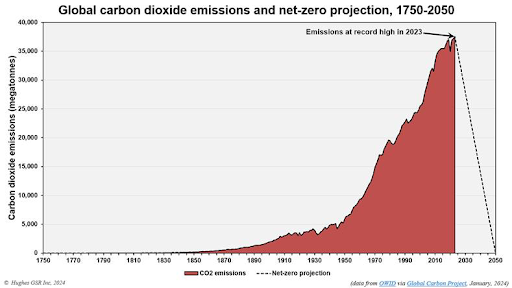
Most emissions are energy-related, so phasing out fossil fuels in favor of low-carbon energy alternatives is critical. While it’s too early to report final data for renewable energy additions in 2023, last June, the International Energy Agency (IEA) forecasted that global renewable energy generation capacity would increase by a record 440 GW for the year (total world renewable energy generation capacity, including hydropower, stands at about 4,500 GW).
However, confusion sometimes results from failure to distinguish production capacity from actual generation since solar and wind installations typically generate only 20 to 50 percent of their theoretical capacity due to variations in sunlight and wind.
So, let’s look at the actual generation numbers. Of the roughly 30,000 terawatt hours of electricity generated globally in 2022, 8,500 terawatt hours (29 percent) came from renewables—over half of that from hydropower.
We must be careful to distinguish between “electricity” and “energy”—another frequent source of confusion. Electricity’s share of all end-use energy usage remains stable at about 20 percent. After accounting for conversion factors, renewables (including solar, wind, hydro, geothermal, biofuels, and traditional biomass—i.e., burning wood for cooking and heating) provide about 16 percent of total world primary energy.
Nuclear energy also entails relatively low levels of carbon emissions, but its share of world energy fell to a multi-decade low in 2023, and nuclear projects are notoriously slow and expensive to bring online.
To reach net zero emissions by 2050 (which the IPCC considers necessary to cap warming at 1.5 degrees Celsius) by providing 100 percent of total global energy from renewables, we would need a nearly ten-fold increase in renewable energy production, even assuming zero growth in overall global energy demand during that time.
Annual additions of solar and wind capacity would have to increase by well over an order of magnitude (10x) compared to the current record rate. Electrification of transport, manufacturing, agriculture, and other sectors would also need to accelerate dramatically.
In its Net-Zero Roadmap report published in September 2023, the International Energy Agency (IEA) recognized the extreme difficulty of achieving these increases in renewable energy and suggested instead that 19 percent of final energy will still come from fossil fuels in 2050 and that final-energy consumption will be reduced by 26 percent.
To remove the resultant emissions, the IEA estimated that one billion metric tons per year of carbon dioxide would need to be captured by 2030, rising to 6 billion tonnes by 2050. Mechanized technologies for carbon capture and storage (CCS) and direct air capture (DAC) that would be required to do this have been criticized as being too expensive, too energy intensive, and underperforming in terms of their goal.
Currently, about 2 billion tonnes of carbon dioxide is captured annually, nearly all by forests; only 49 million metric tons are being removed from the atmosphere by carbon removal technology projects across the world. About 80 percent of that captured carbon is used for “enhanced oil recovery.”
Meanwhile, over 37 billion metric tons of carbon dioxide are being released by human activities, primarily from the burning of fossil fuels.
We can conclude from these scorecard numbers that, as of the start of 2024, humanity is not on track to avoid catastrophic climate change. The likelihood of limiting warming to 1.5 degrees Celsius (the goal stated in the Paris Accords of 2015) is now extremely remote. Indeed, that threshold may be exceeded within just the next few years.
If world leaders genuinely hope to change these trends, dramatic action that entails reevaluating current priorities will be required. Not just fossil fuel subsidies but also continued growth in global energy-tied economic activity must be questioned. Otherwise, we may be destined to fulfill the old adage: “If you do not change direction, you will end up where you are heading.”





Comments
We changed commenting systems on September 10, 2026 as part of a site-wide functionality and security upgrade. Your past comments have not disappeared, and you can still log in with your old Disqus account credentials if you wish. Contact us with any questions.
There’s a lot of equivocation in carbon capture science.** Yes; temporary, but it’s also a rate thing – if forests are increasing, the total (annual) capture increases, until they decrease (as is the Amazon), and the numbers are quite soft. So far, nobody has any idea how to capture faster than mankind is releasing, despite all the BS, and it may not be thermodynamically possible, so figures on capture only serve to illustrate the magnitude of the approaching disaster…
There’s a fair-to-good chance we have about 7 years left until things get bad. (That’s not a lot of time in the world of science.) The data (IPCC SR15 and Anderson, for instance) robustly indicate that only large-scale collapse can avoid a global worst-case scenario now.
___________________
Notice what happens in about 7 years… and this is simpler than reality:
http://yavapaiweathertracks.org/2030_Summers_Prediction_JUL2023.png
http://yavapaiweathertracks.org/PIOMAS_ModelE_08-2021.png
Although, I must admit that the NASA AOGCM model runs in the latest CMIP also indicate that so-called Arctic Amplification has already stopped. However, this seems quite odd, and so may suggest problem(s) there.
______________
** Maybe the coming generation of scientists, in trying to increase their carbon footprint (as educated people do), are being less honest than the generation of scientists which created the IPCC? For instance “net zero” is an utter red herring, since it’s essentially thermodynamically impossible to capture faster than we’re emitting.
“it’s essentially thermodynamically impossible to capture faster than we’re emitting.”
You keep making this claim. Do you have any actual support for it?
Well, sure. It’s a fairly easy thing to consider if you understand thermodynamics a bit. Basically there are two big bugaboos. You can calculate the Gibbs energy of dilution when concentrated CO2 comes out of a tailpipe (or whatever) and is massively diluted to the PPM level. The entropy gained has to be removed from it when it is captured/reconcentrated. For the entire atmosphere (a known/fixed amount) this is a lot of work. So to get a lower bound on that amount, assume a perfect thermodynamic process to do so. (This must be a so-called “thermodynamically reversible” process.) Then you can calculate the energy you’d have to put back into the CO2 which turns out to be something like the annual planetary electricity production. So I’m basically stating that nobody is going to be able to divert the entire planetary energy production to doing this task. (also remember all real-world processes are only about 10% efficient, max, so the energy needed is actually 10x that amount) But this is strictly a verboten topic among scientists.
The other big bugabo is related to this – you have to pump the entire earths atmosphere through your apparatus in order to capture the CO2. This invokes the so-called “volume purge” equation, which is exponential. If you could somehow get the energy to do the above, and also build something much bigger than humans have ever built – like a square-mile aperture (or a bunch of small ones adding up to that) then it would still take 100+ years to pump the atmosphere through that. (meaning, actually, pump enough atmosphere to draw down to about 250PPM) We don’t have 100 years, or enough resources, or enough energy. But Hey!! Fun ideas as long as you don’t think too realistically/deeply about them.
And don’t forget you have to power these air pumps for a hundred years… You can also calculate this and it’s much bigger than the Gibbs energy needed.
This is basically the reason that “gold isn’t mined from seawater” – although gold is much more dilute in seawater than CO2 in air – but also the reason we don’t mine, say, sillicon or aluminum from dirt, even though there’s lots of it there. Too much energy is needed. We always use so-called “ores.”
Oh, and there’s no place to store CO2 and no use from it or profit in it.
But, really, what will matter first is feeding people through crop failures, even though Climate Breakdown will increasingly destroy infrastructure and cripple the global Insurance biz, without which nobody will build anything…
Several have said that “The future will look nothing like the past.” I think this is what they were alluding to.
Here’s a pretty good description of the thermodynamics of the problem from the perspective of available resources to humans in order to perform an expensive “human-engineering-based CO2 drawdown” operation.
https://www.pnas.org/doi/full/10.1073/pnas.1508353112
http://yavapaiweathertracks.org/remaining_phytomass.png
__________________
And, of course, this completely ignores the rapidly intensifying Climate Breakdown, the theme of my original post, which will derail food supplies. No known planetary-scale human project could withstand massive food shortages, period. Right? Food shortages usually entail the collapse of civilizations, although, in truth, we have not yet seen how Western Civilization (e.g., Tainter/Patzek) will act (or not) in the face of all this.
Okay, first, ZJ? When your numbers drift into Zetta- territory, that’s a pretty good indicator you picked units that were way too tiny. (eg. distance to Sun = 1.47 zetta-angstroms) And second, the max recoverable nuclear energy potential is 500 ZJ? Where did *that* number come from?
Let’s say the best utilization from natural uranium we ever get is around 50%, and let’s say we only pull 1% of the uranium out of the oceans. That would be 22 million tonnes that we can actually fission, which would produce 56,000 terawatt-years of heat–more than three times their estimate of 500 ZJ (15,844 TW-years of heat). That’s assuming it will be impossible to get better than 50% utilization, or to pull more than 1% of the uranium out of the oceans, or to do any more extraction on land, or to do anything with thorium, or fusion, or to use the uranium we already have in storage. And I don’t see what would be impossible about any of those.
But even if we take their roughly 16,000 TW-year figure at face value without questioning it, compare that to all the energy we’ve ever gotten from burning peat, lignite, coal, oil, and natgas–which is around 700 TW-years of heat. We could literally produce ten times the energy of all the fossil fuels we’ve ever burned in history, and still not have reached the half-way point of what they claim is our nuclear energy supply.
Or that you’re an actual, y’know, scientist who routinely uses standard SI units.
Here’s one of the better studies I’ve seen on the removal effectiveness of some DAC systems.
https://pubs.acs.org/doi/10.1021/acs.est.1c03263#
They found highly varied efficiencies–which is not surprising for a technology still in its infancy–but even so, every system they looked at managed to capture more than they released, and most were better than 80% efficient, with three achieving 94% or better efficiency. The embodied CO2 in building the DAC facilities themselves was very low (usually less than 1% efficiency cost) and the largest determinant was the CO2 of the energy source–with waste energy producing the best capture ratios. And they didn’t even look at next-gen nuclear energy sources–which several of the DAC developers are investigating. How much atmosphere will have to be pumped will depend on how much extraction can be achieved in each pass through. If you can take the CO2 levels down way below target levels, you won’t have to pump the whole atmosphere. Adding other methods of carbon recapture can also lower this amount.
Our first full-scale prototype DAC facilities will be roughly in the megaton (million-tonne-per-year) scale. Oxy is laying the groundwork for a 30 megaton hub in South Texas. Where we need to be is at least 30 gigatons, and preferably more like 60 GT, so that one hub would need to be replicated between one and two thousand times (less if we can develop a lot of other methods of recapture besides DAC). On the one hand, that’s a lot. On the other hand, we’ve accomplished much larger scaling than that, multiple times before. Regarding the energy this would need, some DAC systems are already down to around 1.5 MWh (thermal) per tonne CO2 captured, so a megaton-scale plant would need an average of 171 megawatts of heat energy. A modular nuke rated for 300 MW electricity would have around 700 MW of waste heat energy available, so it could, conceivably, power as much as 4 megatons per year of capture with modest reduction in its available electrical power. So capturing 30 gigatons per year might require 8000 modular reactors of this size. (For scale comparison, there are more than 35,000 dams in the world, and over 60,000 power plants of all kinds.) And we’ve found geologic sites that could hold billions of tonnes of CO2, and we’ve just barely started looking. Below-ocean-bottom storage might be good for hundreds of billions of tonnes (the oceans currently hold around 38 trillion tonnes dissolved in their waters). As for profit, this won’t be able to fund itself if we want to build this out quickly. There will need to be a hefty injection of public money–same as happened with roads, rail, air travel, the auto industry, fossil fuels, renewables, pharmaceuticals, healthcare, education, research, finance, agriculture, telecommunications, the internet, and many large tech industries. Will it be totally fair, equitable and just? No. The rich will capture most of whatever profits there are–as usual. But any solution we come up with will have that problem. That’s not an argument against developing solutions we desperately need.
Trees and other deep rooted plants actually can actually put a lot of carbon in the ground where it remains for generations in the form of “soil.” But how much and how fast depends a lot on the details, of which there are obviously a lot. Unfortunately, the current trend is towards deforestation.
I’ve lived off-grid for more than 20 years – but on a fraction of what you have. Our family did a year on 20 watts, once (afloat). We started here with 50 watts; tilting and rotating the panel to optimize. Nowadays we run 300 watts, fixed – and a 72 watt micro-hydro. Never use the generator for the house; I have two workshop machines needing it, almost never used.
A passive-solar house helps (not passivehaus; that’s German overcomplexity overkill) as does some self-discipline; we run the washing machine on sunny days; hang it out to dry ditto. We do direct solar water-heating too.
But 11,000 and having trouble? Methinks you need to re-think your consumption.
Well, maybe you can convince my 86 year old father in law who lives with us he isn’t cold. He has to have it 84 degrees. We live in a 43 year old mobile home, these are not noted for being energy efficient. I can probably reduce my usage some if needed but for now I have grid power and enough money to pay for it. Why be uncomfortable if I do not have to.
The universal acclaim of the privileged.
Don’t expect this comfort to last for many more years.
Nice charts, how do get the information? This morning the sun is shining and I am putting 7000 watts into my batteries.
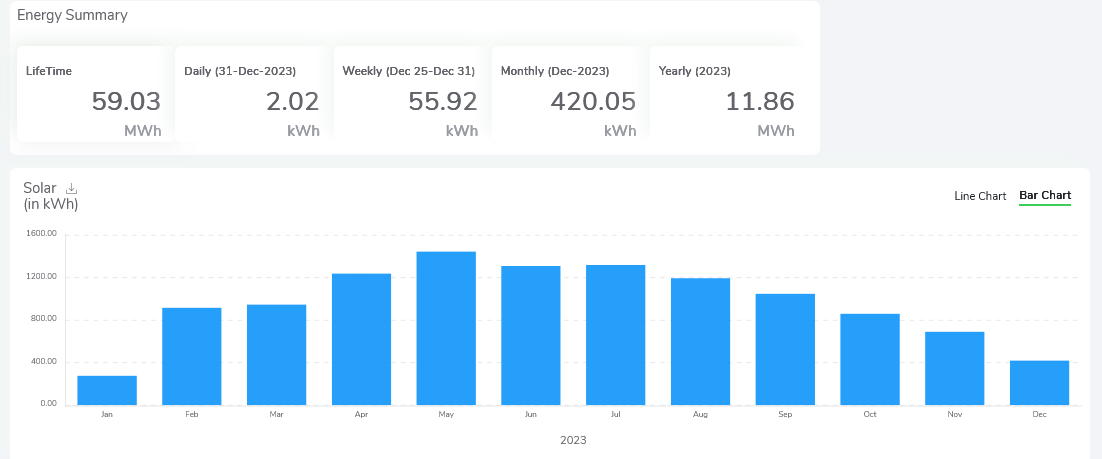
Our inverters were manufactured by Schneider Electric and they host a website where we can check on our system’s performance and print out charts like these. Someone told me that there are apps for your phone that can track your home’s energy use but I’ve never tried them.
We have 30 solar panels (for an 11kW system) for our home and are connected to the grid with net metering. We live in Indiana and there is big difference between summer and winter solar energy production, as well as a big difference in annual temperatures. Heating and A/C for most homes uses about 60% of the energy consumed. We have a ground source heat pump and it uses more energy to heat than it does to cool. But after we replace our windows that difference dropped. In summer we generate excess energy that we ‘export’ to the grid. In the winter we don’t generate enough energy and we ‘import’ from the grid. We have done everything we can to improve our energy efficiency so that the difference isn’t as large as it was when we bought our earth-sheltered home.
You can see from the charts below our load and solar production for 2023.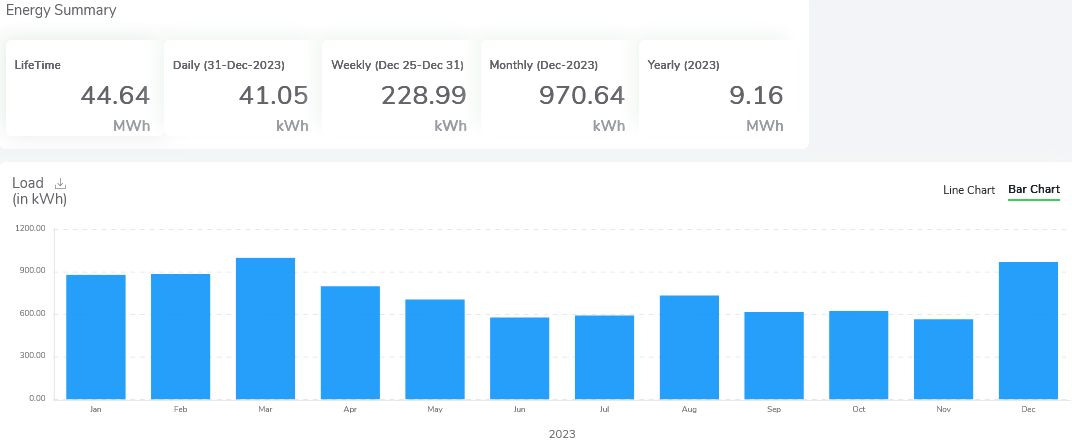
Exude gratitude.
Yep – this is wonderful for the Affluent. But it will only last years (not decades) before you have to buy everything again. That’s when the SHTF because the last of the Affluent will be fighting (possibly in a capitalist/Market system?) for the last of the resources. Long before this, famine will again stalk the land. But hey! Technooptomism is wonderful. (I have only enough solar to keep my food storage systems running. And this is not “survivalism” – this is only to survive shorter-term food “shocks” – I know I can’t feed myself long-term in any full-scale collapse. And in a decade solar cells may not be available to people like me.)
So? What else is extra money good for? I was without power for two weeks from a hurricane in 2004, no natural gas line near me and gasoline is always in short supply in those conditions so a generator is not a good option. In case you do not watch the news some powerful people want to ban fossil fuels thinking renewables will be enough. Well, if you have 11,000 watts of panels maybe, I am adding 4000 watts more for the winter months. Most people will not have that many or any at all so what ever gets produced by utilities will be rationed.
I work very hard to keep my income level low enough to minimize my impact. You can, too!
(Naw, I didn’t really think so…)
Ah, but ignoring the facts is what Americans do best!!
Dude! Really?
Was there something you wanted sources for?
The first “R” is “reduce.”
No one will be living at your energy usage level in ten years. Better get ready.
Simply untrue!
I think that honour (for a commercial reactor) went to Fermi I, in Monroe, Michigan, for the liquid-metal-cooled fast breeder reactor that melted down in 1966, and which was then decommissioned.
There have been government-owned sodium-cooled reactors at the Hanford atomic reserve in Washington, for decades, notably the Fast Flux Test Facility (FFTF). And there was also a sodium-cooled reactor at Clinch River, Tennessee.
The NRC didn’t issue it’s “build permit,” but the French Superfenix was also a sodium-cooled reactor, I believe the only one to last more than ten year and that actually produced net power. Unfortunately, it never produced more that 0.1% of design capacity, and it, too, was scrapped.
Looking at the Kairos website, they seem sold on liquid metal fast breeders. This is 50-year-old technology, hardly “advanced.”
Here’s a good read on the Fermi 1 melt-down.
“The public was never in any danger,” and yet the father of someone I was in a band with died a decade or so after being involved (as a nuclear engineer) in the Fermi 1 melt-down. No, you can’t prove Fermi killed him, but not many people die in their early 50s from leukemia.
Construction on Fermi 1 began in 1956. The NRC was founded in 1974. So does it seem likely that it could have been the NRC which issued the build permit for Fermi 1?
“There have been government-owned sodium-cooled reactors at the Hanford atomic reserve in Washington, for decades,”
And how many of them got their permits from the NRC?
“Looking at the Kairos website, they seem sold on liquid metal fast breeders. This is 50-year-old technology, hardly “advanced.””
There are three noteworthy points of distinction between the Kairos design and a liquid-metal cooled fast breeder reactor. 1) The coolant isn’t liquid metal. 2) It isn’t a fast reactor and 3) it isn’t a breeder reactor. About all they have in common is that they are both nuclear reactors.
Did you perhaps accidentally look up the TerraPower Natrium reactor instead of the Kairos reactor? (And that possibility of meltdown is a major reason I oppose the Natrium design.)
My turn to be pedantic: the joule is the “SI” unit of energy, which is exactly what I was claiming. SI units are preferred in most sciences, whereas things like horsepower or by barrels of oil or even kilowatt-hour are more likely to be used by the popular press.
BTW: your pedantic point that the NRC did not exist when Fermi I received permission is well taken. But it did receive a permit from the Atomic Energy Commission, the precursor of the NRC. In reality, the same bureaucrats were issued new name badges, and their mandate was adjusted slightly.