

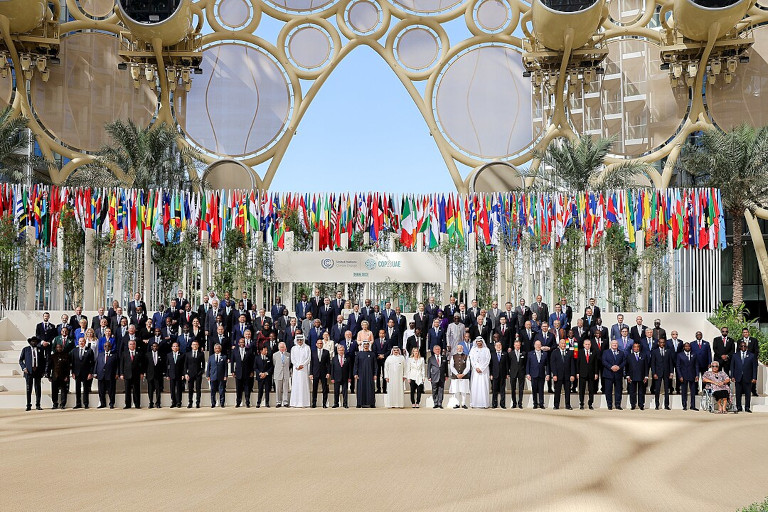
So the endgame of Cop28 has ended. What did we get?
The much-vaunted highlight is the text actually stating the obvious. Which, admittedly, has never happened before.
The real danger of the way CoP28 ended with a ‘positive’ outcome is that it makes it seem as if something has been achieved. Whereas all that has been achieved, after 28 years, is a toothless statement of the obvious: that we need to transition away from fossil fuels.
So the size of it is that it has only taken delegates 28 years to actually mention the source and scale of the much-more-than-problem.
Well whoop-y-doop. At that rate, by 2051 maybe they will agree a (non-binding) pledge to phase out fossil fuels…
My great colleague Bill McKibben famously says that winning slowly on climate is the same as losing. Well, this sure is the quintessence of SLOWLY!
What that is concrete, that actually means something, has come out of this CoP? Well, nothing. Only a few more unbelievable, unenforceable voluntary pledges. (There was that early success on loss and damage – but even that achievement melts almost into thin air when one actually scrutinises it.)
Should I be kinder to this agreement? After all, there is, famously, some reasonably decent novel language in the agreement they managed to reach at CoP28, language that speaks of “transitioning away from fossil fuels in energy systems”. Good. But look closer: “in energy systems”. What do they mean by this slightly odd, rarely used phrase? It is not interpreted in the agreement. Which in this crucial sense is therefore deliberately ambiguous.
The most plausible interpretation – the one that will certainly be in the minds of the likes of Sultan Jaber – is that they mean power (I.e. power-stations) and heat (as in for instance combined heat-and-power plants, or home-heating). I.e. “Energy systems” mean the generation of electricity and of heating. So let’s be clear: CoP28 did NOT even actually ‘call on’ countries to transition away from fossil fuels. They only called on countries to transition away from fossil fuels in the generation of electricity and of heat for heating purposes. (This helps explain the otherwise-odd way in which the key part of the agreement is constructed: talking about achieving full transition in ‘energy-systems’ and then going on to speak about having more EVs etc, without asserting that there must be a full transition away from petrol cars etc.)
CoP28 did not ‘call on’ countries to transition away from fossil fuels in their use in transportation, and certainly did not call on them to effect such transition in heavy industry (eg chemicals or steel production), or in the food system. Only in the production and transmission of ‘energy’: I.e. basically electricity (plus heating).
And there is in any case a big loophole left for the continued use of fossil gas as a ‘transition fuel’, and for the unicorn of ‘carbon capture and storage’.
(And why did I scare-quote the phrase “call on”, above? To draw attention to how weak this term is. There is no legal insistence here. Countries are merely invited to try to do something.)
Let us put the matter bluntly and clearly. This just is not the breakthrough that some are inadvisedly and rather desperately trying to convince themselves (and the less well-informed) that it is. It is a loophole ridden, small, merely rhetorical advance, without teeth.
CoP in anything like its present form has, inevitably, categorically failed us and is never going to effectively deal with this more-than-emergency.
The most powerful, transformative thing that CoP delegates could do as they leave Dubai and trail home is to admit – to proclaim – exactly this.
They need to do so, to counter the impression that the CoP PR machine is giving: that this is summit has been a success that has put the world on the path to salvation. On the contrary. This is yet another power-less sticking plaster. A mere rhetorical flourish.
The CoP system is moribund. It needs to end.
What is actually needed is smaller, nimbler, bolder coalitions of the willing, collaborations of countries (and businesses, and other entities) willing to go much further toward what actually needs to be done, if we are to have a future.
Meanwhile, in lieu of that, we in the Climate Majority Project (CMP), seeking to help represent the majority who want real climate action and are determined to bring it so long as governments and diplomacy continue to fail us, are working on an alternative ‘bottom up’ approach that could really get somewhere. The ‘Regulate Us’ campaign we are now beginning is actually much stronger as a prospect for making real progress on climate than anything coming out of Dubai. Our view is that business, the most powerful force in our neoliberalised world, can conceivably switch from being merely self-interested to becoming a force for good – if it turns to seeking to force governments to provide it with a decent regulatory and policy environment.
Because governments are not going to lead; they need to be led, by lobbies (and voters) who get it.
I am not asserting that business can fix this, through the ‘magic of the market’ or through the ESG agenda. Far from it! The greatest power that business and finance now has, I would argue, is to confess its own powerlessness to ‘fix’ the desperate climate situation. This would be a true man-bites-dog moment: when business, the ultimate positive ‘can-do’ force in society, precipitates change by facing up to its own incapacity to bring sufficient change about.
Business’s lobbying-strength is more important than its self-starting reductions of scopes 1-3 emissions. Business’s true power now is to admit it can’t solve this by itself, but to lean on governments to actually start to move to do so.
Business and finance could then effect a historic shift:
From the norm being that businesspeople look for self-interested regulatory loopholes, taxbreaks, and quick bucks to the norm being that they lobby together to have a future in which they can do business without being driven to the bottom by the short-termistic and unenlightenedly selfish.
(The same goes, incidentally, for AI, and in fact for all existential threats. In AI as with climate, the only way to prevent things spinning further and further out of control is for business to insist upon government acting to prevent uncontrolled escalation of AI across the piece.)
We don’t tend to think of businesspeople and big financial interests as powerless; they certainly don’t like to think of themselves that way! But, much as civil society in 1980s Eastern Europe spoke the taboo truth about the failing regimes there and so paved the way for the tipping point of 1989, so now civil society, including the part of it governments these days really tend to listen to — business and financial interests — needs to do the same vis a vis the climate more-than-emergency and the deep failure of nations and CoPs alike to address it even remotely adequately.
A transformation along the lines that I have been sketching is not about to be brought in at the coming general election. That just shows how the transformation that is required is going to take a little longer than that, and is going to need the tectonic plates of politics to shift. We in the CMP believe it is business that can shift those tectonic plates.
Furthermore, the process of such shifting can happen stepwise; there are steps (eg a Better Business Act; an Ecocide Law) that can be taken along the way to an economy that adequately prices carbon and so looks very different from our current one.
So, to sum up: now that CoP28 has dribbled to its false-positive end, the terrifying question facing us all is whether humanity is now facing its endgame. This civilisation certainly is.
If this civilisation is going to manage to morph into something that can survive, then that is going to need a dramatic change on the part of business. Stepping into its full power, which happens to be what Vaclav Havel famously called the power of the powerless. Any business that is serious about being green / progressive / compatible with us having a future (and remember: no profits on a dead planet!) needs to demand of governments, “Regulate us, for the common good.” Because governments are not going to move until their chief lobbyists and paymasters do. And they – business and high finance – cannot do this by themselves. They cannot become sustain- able without significant help: a levelled-up, raised playing field; rules set by the national and international rule-setters. The mind-set of business is invariably a positive ‘can-do’ spirit. It is immensely challenging to the self-image of business to admit that this predicament, the climate crisis, is just too big for them to deal with by themselves. But it is.
Business admitting this, and starting to force governments to step up in a way that they cannot do through the lowest-common-denominator CoP process, is the one credible way that we actually start to get somewhere. Faster. As we must, if we are not to go the way of the dodo.
The tragedy of the outcome at Dubai is that it will be spun as a excuse to put off what needs to happen: the CoP system needs to end. And all the energy that gets pointlessly poured into it needs to get invested instead into smarter, wiser efforts – diplomatic, political, and more, from citizens and business leaders upwards – to achieve a future.



Comments
We changed commenting systems on September 10, 2026 as part of a site-wide functionality and security upgrade. Your past comments have not disappeared, and you can still log in with your old Disqus account credentials if you wish. Contact us with any questions.
I’d say 28 years is time enough to run the experiment which asks, “Can a leopard change its spots?”
In this case, the leopard is government and governments. Presently, far too much of humanity has confused and conflated governments with governance, and so if any of us points out that governments really aren’t our friends we tend to hear such a claim as crazy talk — especially if they go on to propose that we try to bypass governments in getting some governance happening. But this is precisely what I’m proposing. As the poet Audry Lorde so aptly put it, “The master’s tools will never dismantle the master’s house.” But dismanting the master’s house we must. So let’s not even try using the master’s tools to do the job. It hasn’t worked, and it never will.
Overwhelmingly most of us associate governance with government to such a degree that it seems like plain nonsense to suggest that when governments so utterly fail to adequately address the word’s mega-crisis, metacrisis, polycrisis (choose your brand) … for so long … in a mega-crisis which has a time limit on response … we should perhaps put down the master’s tools and take up our own tools, make our own institutions of governance, and ignore the governments to the point that they must dissolve in the solvent of their own absurd irrelevancy.
But to do what I’m proposing fundamentally requires that we understand the institutionalization of power to an extent which, presently, is extremely rare. That collective ignorance of the institutionalization of power is no mere coincidence. It was deliberately cultivated by those who wished to hold power over us, rather than share power with us. Think of Walter Lippman’s words about how governments ought to shape world events.:
from – https://en.wikipedia.org/wiki/Walter_Lippmann#Influence_on_mass_culture
Now, of course, Lippmann was far from alone in advocating for this management of us from “above” through propaganda and other means of domination and control. But Lippmann put it plain. Ordinary people are not to mess with the agenda of the rich and the powerful. They are to be governed from above.
Well, I’m not liking how they govern. And I say it’s time we try to govern ourselves! And so it’s time to put down the master’s tools.
In summary, I think we should create a new planetary process for addressing the climate and ecological (etc.) crises of our time — the metacrisis (or polycrisis, or mega-crisis) — for it is far more than merely a climate crisis. Notice I said “planetary” rather than global. We don’t live on a spherical map, which is what a globe is. It would be a planetary movement for self-governance of by and for all of life, including people. It would be overwhelmingly local and regional, but there’s certainly no reason we couldn’t also deal with planet-scaled problems also at a planetary scale, in an internationalist frame, until which point as we dissolve all nations (in the form of states) by ignoring them to death.
Fossil fuels enable food production and distribution, especially in ultra-unsustainable places like UAE. The author is from England where they fly vegetables from Kenya to help keep grocery stores full of fresh food.
Overshoot is the real issue, climate is a symptom.
PS –
For what it is worth, merely transitioning away from petrol cars — by replacing them with electric cars — is NOT a solution. It is cars we need to transition away from.
Here’s why: https://rword.substack.com/p/visualizing-all-of-the-cars-in-the
Keep in mind that at least 1/3 of all of the energy which an electric car will use in its cradle to grave life will be used during manufacturing, while roughly 84% of that energy will be fossil sourced.
I can agree that COPs are a complete waste of time and we need to walk away from them. But Read’s counter proposal makes little sense to me. As for JRiver Martin’s it isn’t really clear what his proposal is other than giving up on governments.
Read seems to be saying that since governments are too bound by their enslavement to corporations, the solution is to have corporations directly govern, after they have a–surely highly unlikely–conversion experience, see the error of their ways, and beg governments to regulate them in the common interest.
Never mind unlikely. This CAN’T happen. Corporations aren’t wayward people. They’re machines.