

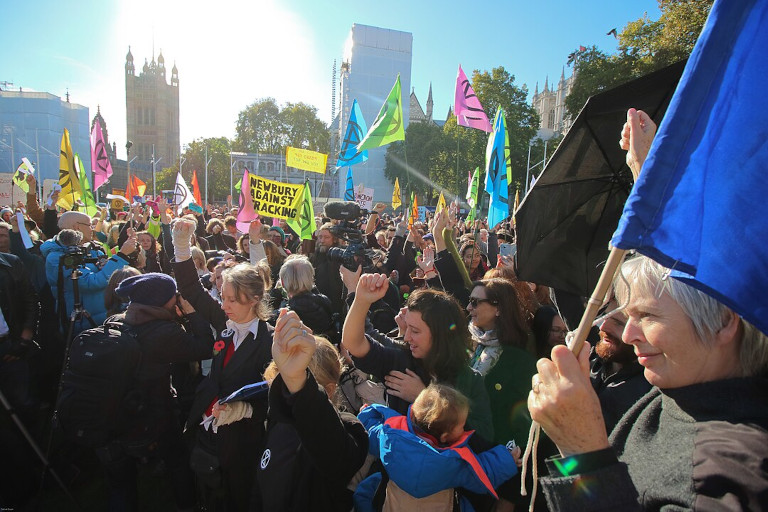
Ed. note: This piece is reposted from Brave New Europe with the permission of the author.
Great change is coming. The only question is: will it finally be inspired and initiated by us? Or will we let it be brutally imposed upon us by the power of a cruelly disrupted nature?
Five years ago precisely, Oct. 31 2018, we launched Extinction Rebellion.
It is worth recalling that one of the main terms of criticism frequently used of us then (and since) was ‘alarmist’. Now, at the end of October 2023, and especially with #StormChevron (aka Storm Ciaran) threatening to maybe mark XR’s fifth anniversary with hurricane-force winds here in Britain this very week, it is farcical and risible that in 2018 we were accused of ‘alarmism’. The world’s climate and ecology has palpably continued going off the rails in the last five years. Worse still, that process has dramatically accelerated in the past few months.
That is the tragic reality. Our climate is spinning out of whack. While our oceans are acidifying in a deeply worryingly way. And much, much more.
Then-colleagues alongside whom I co-launched XR have recently issued a very thoughtful piece, looking back five years. I would echo their gentle invitation to apologise: I mean, an invitation issued to all those who wrongly and recklessly dismissed us as alarmists.
For the record-shattering last few months have underscored a point I’ve made a number of times over the last few years, a point whose basic correctness is now becoming starkly visible to all those who have eyes or active braincells: that, far from the critique we offered of the mainstream as unduly complacent or reticent being somehow suspect, it has on the contrary, tragically, been vindicated. It turns out that climate science itself, certainly in its IPCC incarnation, has tended to under-state the truth, to down-play the full horror of the situation.
We are exceeding supposed worst-case-scenarios laid out in models. We are hurtling through 1.5 degrees of global over-heat, and much more, long before most seemingly well-informed people thought we would. (I note that 70 scholars from around the world have recently called on those climatologists who publicly denigrated climate activists to apologise, and learn their from mistakes.)
As a result of all this, our children in particular are now horribly unsafe. At the Climate Majority Project, we sometimes get ‘insiders’ – current and retired insurance executives, researchers, civil servants, military people – coming to us and sharing with us privately their evidence-based fears. That in England, for instance, we are astoundingly ill-prepared for an unprecedented drought. The kind now quite (and increasingly) likely to happen within a decade. That such an event could be not just uncomfortable, but catastrophic. It could cascade into partial societal collapse with surprising rapidity.
When I contemplate these hard truths, I feel many things. I feel angry. Desperate. Determined. Energised. But especially, at the moment, I feel sad. Because there is going to be so very much suffering. Most people have barely begun to grasp how tough things are now going to start to get. I feel desolately sad. Being proved right can be a terrible thing.
The questions opened up for experts, the media and society at large are substantial:
How is the climate science/action space in the broadest sense dealing with the horrific news emerging this year? Is there reassessment going on?: Of the epistemic authority of the IPCC? Of the attacks there have been on activists etc. for ‘alarmism’? Etc.
So far I see virtually zero sign of such reassessment, in the mainstream / among establishment cli-scientists / among armchair critics. This itself is a very bad sign. It suggests an unwillingness to be humble. Elementarily, to learn from mistakes.
So the fundamental truth-telling orientation of XR, the spirit of authenticity and warning we brought to this country and (along with the school strikers) to the world, has been fundamentally vindicated. …But of course that so far implies little about what people should now do.
Looking back to 2018, I’m struck naturally by the fertility of what XR began. Different figures in that movement have moved in different directions (and some, of course, in broadly the same direction), since. But how effective are those various directions? How wise are they? These again are open questions.
What a number of us who stepped up in those heady days five years ago have realised is that the most important achievement of XR may turn out to be the space it opened up for a new moderate flank, by virtue of its conversation-forcing and consciousness-raising effects. For, talking as I did above of mistakes, we need to be honest enough to declare that sometimes the radical flank has erred between 2019 and the present: in being too polarising, too angry or negative in energy, too alienating, and/or too classically ‘activist’.
We need to invite millions upon millions into the difficult space of truth, and of action. This invitation, this welcome, would make real the spirit that XR sought to offer, but was in the end unable to deliver: of going beyond ideology, beyond party politics, into full spectrum citizen-activation.
An absolutely key legacy of what happened on and from Oct 31 2018 is then for people to be taking part in (or forming!) organisations like Wild Card and Switch It Green and Community Climate Action and MPWatch and People Get Real and Lawyers For Net Zero and Purpose Disruptors…and so on… for these are a crucial set of exemplars of the form that the emerging moderate flank are taking. (And of course XR itself has paid a kind of subtle compliment to this emerging activation of the climate majority: in its new policy, as of 2023, of not disrupting the public.)
In responding to the desperate situation in which we now find ourselves, a situation which millions are gradually waking up to, it is crucial that the incipient climate majority truly be welcomed, resourced, activated, networked. The bitter truth is far too important to be sequestered away by and in an elite. To handle it, what people need is: well, help handling it; and meaningful opportunities to act together on it; and a growing sense that in this transformation they are very much not alone.
Those of us who stood up and were counted at the launch of XR on October 31, 2018 can be justly proud. But of course, XR’s main objectives were hardly achieved (XR’s second demand was for carbon net-zero by 2025!). If there is to be any chance of achieving a transformative adaptation to the growing self-imposed ecological threat, it’s going to require not just a minority of us, but most of us. To step up.
Now is the hour for the climate majority to start to make itself well heard. The off-the-charts climatic variation of 2023 is a herald. Over the next five years and more, in our workplaces and where we live, in our professions and our places of worship, and ultimately in our politics, we need to be agents of nothing less than the greatest change the world has ever seen.
Because great change is coming. The only question is: will it finally be inspired and initiated by us? Or will we let it be brutally imposed upon us by the power of a cruelly disrupted nature (not to mention, by the often-cruel powers that be)?
And this is the only question about us that our children will have any real interest in. Once you knew, what did you do.
The matter is before you, colleagues. Fellow citizens. The matter is before you.



Comments
We changed commenting systems on September 10, 2026 as part of a site-wide functionality and security upgrade. Your past comments have not disappeared, and you can still log in with your old Disqus account credentials if you wish. Contact us with any questions.
How about these truths:
Billions of people depend on fossil fuels to provide food and clean water.
Renewable energy is a poor replacement for fossil fuels.
The problem we face is far deeper than just climate change, we are in serious ecological overshoot.
Any real solution requires a fundamental change in the way we live,
maybe if the XR focused on showing us how to live a sustainable life rather than just yelling at people and in general being a pest they would actually do some good.
And no, just because you get some media attention doesn’t mean that mean that you have done anything good. ( i mean seriously, grow up. the stupid antics of XR are just an ego stroke for activists.)
As sad as this article may be, I fear it understates the challenges we face considerably. Ask yourself “why have none of the things XR has advocated for been done?” despite the fact that the exigent necessity thereof is well known and undeniable by any rational human being (since decades now).
There are many reasons, of course, but there’s just one overriding one: It’s because our leaders regard winning our eternal wars as an infinitely higher priority. In fact, the only reason they are our leaders is because they take that stance. The oil companies are aught but a part (albeit an essential one) of the military (industrial complex), and the tail does not wag the dog. Or, as the sign I carried at the recent NYC Climate March said “You can’t wage war without oil. To stop oil you MUST stop war!”
For a detailed historical account, read “Oil, Power and War: A Dark History” by Matthieu Auzanneau.