


Welcome to Writing Home, a series of letters and essays from me, Dougald Hine, author of At Work in the Ruins, co-founder of the Dark Mountain Project and a school called HOME. A special welcome to those of you who found their way here in recent days thanks to Warren Ellis’s newsletter or the roundtable I took part in with Nate Hagens.
Today’s instalment brings news of this autumn’s online series with our school, Regrowing a Living Culture. Yet you will understand when I say that it is hard to write of such things, against the background of the news from the wider world, these past eleven days.
Thank you for reading.
Yesterday, I started the morning by looking over a text written by a friend whose career has meant that he has a lot of contacts in the worlds of diplomacy, policy and defence. The text was his attempt to contribute to de-escalating the conflict in Israel and Gaza, to interrupt the cycle of vengeance and prevent it spilling over into a regional war. I doubt my input made much difference to his draft, but it sharpened my sense of helplessness. Because, unlike my friend, I don’t have the contacts or the skills to try to do anything that might make a difference.
Last week, I wrote about guarding our capacity for joy and for care. After talking about this further in Sunday’s conversation with David Cayley – which is now available on YouTube or as a podcast – it seems to me that there is a third term worth emphasising: let us guard our capacity for horror.
It’s there in the words from Ivan Illich that I shared last week, but it bears underlining: ‘I want to experience horror,’ Illich tells Cayley. ‘I do not want to escape my sense of helplessness.’
Today, I started the morning with a group of friends who gather once a fortnight to read old stories and see what they do to us. We started by sharing where we were arriving from, and several of the others spoke of people in their lives who have been directly caught up in the horrors of the past eleven days.
Probably all of you reading this have felt helpless, during that time – and for some of you, the fear will be direct and personal, for yourselves or for people you love, in ways the rest of us can barely imagine.
A few of you will have things that you can do, like the friend whose draft I was reviewing. For most of us, the truth may be that there is little we can do, but we can still choose how to be. We can stay with the horror, let the tide of our helplessness wash over us for a time, refuse to harden ourselves against this awareness.
There’s a poster that travelled with me for years, tacked up on the walls of bedrooms or workplaces. It came from the World Court of Women Against War, For Peace in Cape Town, where I volunteered when I was half the age I am now. Printed on that poster are the closing lines of Adrienne Rich’s poem ‘From the Prison House’:
This eye
is not for weeping
its vision
must be unblurred
though tears are on my faceits intent is clarity
it must forget
nothing
That could be an image for what it means to stay with the horror.
For most of us, the truth may be that there is little we can do about the horrors that fill the news feeds and command our attention. Our helplessness is real – but it is not the whole of the story.
Away from the news, in the mostly un-newsworthy places where we find ourselves, there are things to be done, places where our skills and callings meet the needs of the world. They may feel humble, unheroic, unlikely to make a difference in the long run, especially when set against the larger events of our time. But we don’t get to see the long run.
In a recent conversation with Nate Hagens, Chris Smaje and Pella Thiel, I quoted a line that gets attributed to Martin Luther: ‘Even if I knew that tomorrow the world would go to pieces, I would still plant my apple tree.’ The earliest source for this line dates from 1944, so my guess is it was made up to offer hope in dark times. Yet it carries an echo of a saying of Yohanan ben Zakkai, a Jewish religious leader who survived the sack of Jerusalem in 70AD: ‘If you are standing with a sapling in your hand when they tell you that the Messiah has come, first plant the sapling and then go out and greet the Messiah.’ A similar saying is recorded of the Prophet Mohammed.
All autumn, I’ve been sitting with this image and the way that it echoes, across the centuries, between the three religions of the book. Like any image worth its place in a human culture, you can turn it at different angles and it will catch the light in different ways.
One thing I catch sight of in that image is an attitude to the work that is ours to do. It’s an attitude that is not enslaved to instrumentality, not attached to outcomes. Of course, we can have an outcome in mind, we can think of the apples that this tree may one day bear. But we don’t need to convince ourselves or pretend to others that there is any guarantee – because we go about the work in a way that brings life, here and now. Approached in this way, such work is worth doing, whatever happens tomorrow.
The work that is yours to do – the place where your skills or callings meet the needs of the world – may have no connection to the larger horrors that command our attention in days like these.
And still, as we sit with the horror and the helplessness, perhaps we notice something else. A longing for what is absent from the acts of terror and retribution. A quiet determination to contribute to the possibility that humans can be more than this, that we can and often do show up with grace and kindness and care.
This is the place, I want to say, where work which has no obvious or direct connection to the suffering, cruelty and injustice in our news feeds may nonetheless be part of what is called for in response.
For five years now, Anna and I have been on the slow journey of creating a school called HOME. It’s a school that starts from the conversations that we bring together around our kitchen table. It’s the fruit of the work that each of us was part of in earlier chapters of our lives, from Anna’s experiences setting up children’s libraries around the Arab world and supporting grassroots women’s organisations in Israel and Palestine, to my role in founding Dark Mountain and Spacemakers.
When people ask about the school, there’s a description we keep coming back to: it is, we say, ‘a gathering place and a learning community for those who are drawn to the work of regrowing a living culture’. Part of that is the work we do within our local community in this small Swedish town. But a couple of times a year, we make an open invitation to a series of gatherings over Zoom, to share what we are learning and what we are working on, and to bring together people who are drawn to this work.
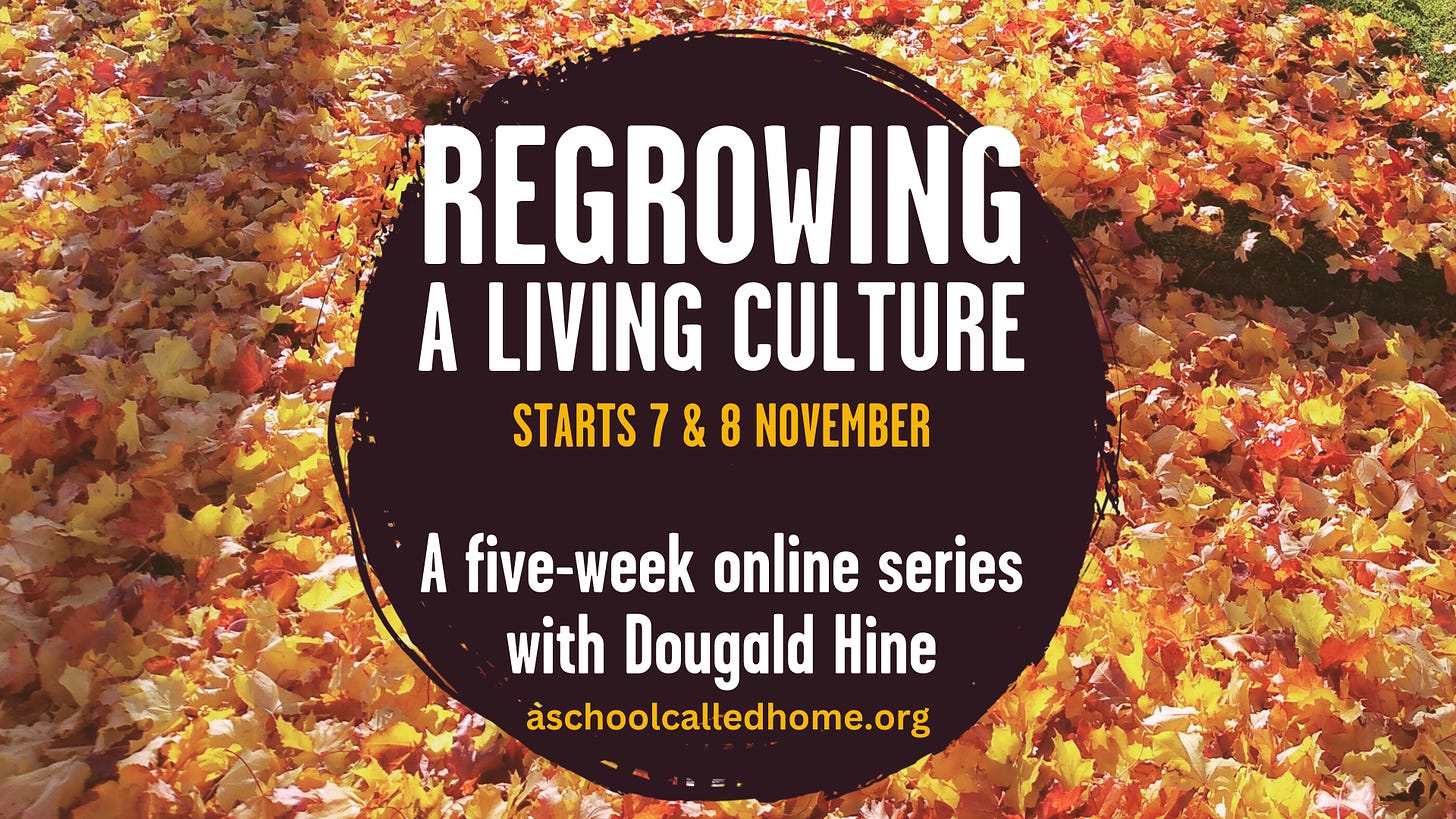
In this autumn’s series, the invitation is to join us on a deeper exploration of this language of ‘regrowing a living culture’. What comes into view when we talk about the work that is called for in these terms? What are the small steps of regrowing, the simple practices that we could weave into our lives, starting from where we find ourselves? And what are the daring moves that are called for now, the places where it might be possible to intervene within existing systems and contribute to the conditions of possibility for the ‘presently unimaginable futures’ which Vanessa Machado de Oliveira encourages us to work for?
People arrive at these series from different directions, from different corners of the world, but mostly because they have found a connection to something in my work. Each session starts with a short talk, followed by an open time for questions and reflections, and an afterparty for those who want to stick around and get to know each other better. The whole thing is designed so that you can choose to sit back quietly and listen, or lean in and get involved. There are recordings of each session, so if you can’t join us live in a particular week, you are able to catch up. Over the weeks, the attention begins to shift, as connections spark within the group, conversations come alive and, in some cases, deepen over time into friendships and collaborations that none of us could have foreseen.
So if this sounds like what you need, in the darkening weeks of the northern year, then let me extend a warm invitation to join us for Regrowing a Living Culture, starting on the 7 & 8 November 2023.
And wherever you are, I wish you peace and all good things.




Comments
We changed commenting systems on September 10, 2026 as part of a site-wide functionality and security upgrade. Your past comments have not disappeared, and you can still log in with your old Disqus account credentials if you wish. Contact us with any questions.
Thank you for this gentle reminder to tend to the world where we are… without turning away… even as we hold the heavy news of the world in our hearts.
Nice article – open and honest about the uncertainty of the human condition. One thing I’ve noticed is that people really come to causes from different places.
EG: I came to New Urbanism out of a sense of desperation that we were running out of oil – and back in 2004 – nothing seemed able to replace it. Renewables were well over 10 times what they are today, and EV’s were almost unheard of and also super-expensive. But now as both of these scale and EV’s are growing exponentially in the family car sector (now at 14% of all new cars and growing by about a third each year), EV’s may just offer a pathway to continue servicing suburbia. I’m in my mid 50’s now. But my kids and their generation? They all seem to hate cars, and hate traffic, and hate the car dependent life. My nephew is constantly raving about his hatred of EV’s, with the tyres bearing extra weight they kick off so much rubber-dust they’re almost as bad as gasoline cars for pollution. But it’s worse – he wants to live in Amsterdam. He hates traffic chocked cities that much. Also, my daughter’s boyfriend was determined to study science teaching – but has switched to working and slowly studying New Urbanism and town planning at night school! He makes my daughter read these books on curbing traffic etc.
My point? I was a scared peak oiler that is now almost relieved to see the growth in EV’s on the world stage – just to alleviate my anxiety about how bad things could have got if transport systems broke down. But while I might be relieved to see even giant mining companies starting to convert to giant 400 ton EV’s and planning how to “Electrify Everything” in the industrial ecosystem – my kid’s generation are coming to similar conclusions about the need to make our cities more liveable, more pedestrian, more human-friendly. But they’re coming at it from a different angle. Rather than just trying to survive peak oil, they want to thrive. And that means cute, walkable, human centred neighbourhoods. Cycling. Human interaction. Third Places. They know all the terms. And the fact that they got there from a totally different direction gives me hope!
They’re exceptional kids. Not all youth in their early 20’s care about such things. But the fact that there is the smart minority thinking through these things might give hope to the bored majority that are just consuming reality TV and planning their next holiday. As Margaret Mead said, ” Never doubt that a small group of thoughtful, committed citizens can change the world; indeed, it’s the only thing that ever has.” They give me hope. And that’s just this statistically weird group of young people I happen to know who care about town planning. There are others that are more focussed on climate change, animal protection, Koala habitats, rivers, oceans, whales, trees, forests, ecosystems, valleys, reefs, people, truth, reality, State Capture, Corporate Accountability, Worker’s Co-ops, indigenous communities, AI security, social justice, space, viruses, Mars colonies, etc. Each with their own whole communities online – each specialising knowledge yet getting the potential benefits of their passion out there. What an amazing time to be alive – with exponential threats such as energy depletion and climate change and viruses and ecocide – and exponential opportunities such as wind and solar doubling every 4 years, and possibly Precision Fermentation scaling up to feed the human race from solar-powered hydrogen farms and a little mineral fertiliser! George Monbiot – 6 minutes. https://youtu.be/6eaTIe_TBZA
Exponential times. Let’s encourage those who dream big for success and applaud their hope as they try to swing these exponentials in the right direction.