

Debra David is mad:
“I know this a money thing, but my health is more important than money.”
In the North Carolina county she calls home, one-third of the residents are African American and one in four live below the poverty line. It’s also the home to an industrial wood pellet plant that is pumping tons of pollutants into the local air.
“I have two asthma pumps myself,” said David at a recent demonstration against Enviva, the world’s largest pellet manufacturer. “One I take every day, and the other I take as needed. This should not be happening to our community.”
But the plant is threatening the community in another, less direct way. Cutting down trees and turning them into pellets to be burned in power generating stations is leading to increased carbon in the atmosphere. And it is environmental justice communities like David’s that are least able to withstand the challenges of climate change.
Wood pellets are a form of biomass that is versatile, concentrated and easily transportable. But making wood pellets is dirty and energy-intensive. After tree wood is dried and ground into sawdust, it is heated and pressed through molds to form small, cylindrical chunks of dense wood fiber.
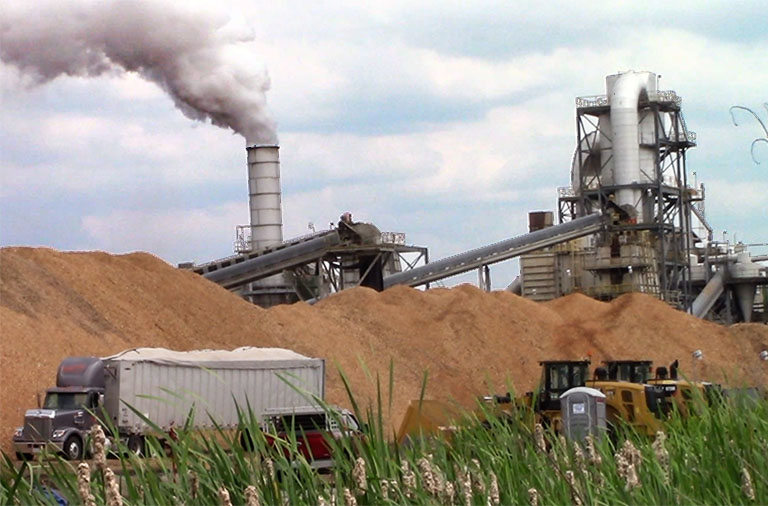
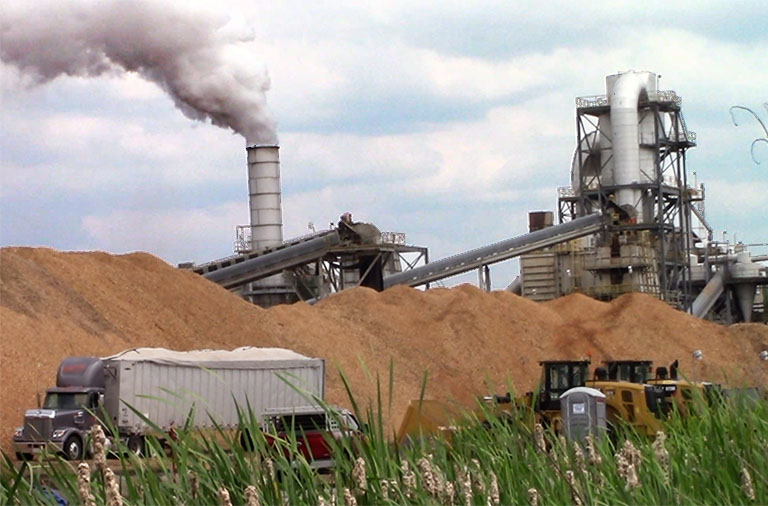
Mountains of wood chips at the Enviva pellet plant in Ahoskie, NC
This form of biomass offers a least two advantages for energy producers. First, converting coal-fired power plants to burn wood pellets is relatively easy. Second, with much of the moisture removed, pellets are more economical to transport than raw wood. This is a significant benefit, since virtually all the industrial pellets made in the US are shipped overseas.
Carbon-neutral?
Exporting pellets from the US has become a growing business. That’s because countries in Europe and Asia are desperate to meet their climate goals, and using wood-based fuel like pellets is widely considered a way to make electricity without releasing any carbon into the atmosphere.
What magical process makes this possible, despite the fact that wood pellets, when burned, emit more CO2 than coal?
It’s not a magic trick. It’s an accounting trick, and it’s endorsed by international climate bodies like the UN Framework Convention on Climate Change and written into the EU’s Renewable Energy Directive. Consequently, signatories to the Paris Climate Agreement can classify woody biomass as carbon neutral, in effect pretending they are fixing the problem of climate change while actually making it worse.
The scheme goes like this: When a forest is cut down in the US it’s considered a carbon debt. So, to avoid counting the debt twice, the pellets produced from that forest can be burned in say, the UK, without emitting any CO2 at all—at least according to the carbon ledger sheet. The carbon was already supposedly emitted when the trees were cut down back in the US.
When the forest is replanted, we have theoretically generated electricity using a carbon-neutral system. Unfortunately, all too often the forests are not replanted. And even when they are, it may take decades before the new trees are back to sequestering as much carbon as the ones that were cut down.
The fact is, cutting down trees and burning them is not, as the pellet industry claims, fighting climate change, but rather accelerating it. Still, massive government subsidies are propelling manufacturers to aggressively expand production. Enviva, for one, announced last year it hoped to double output by 2027 by building two new mills a year.
Targeting Low-wealth Communities
Currently, all of the wood pellets made in the US come from the southeastern states. That’s because the region is heavily forested, environmental regulations are often lax, and there are many poor, rural towns without the resources to fight against the invasion of polluting industries.
Sam Davis, a scientist with the environmental group Dogwood Alliance, did a study that examined the demographics of counties where plants were located.
“We looked at the locations of all the wood pellet mills and found that they were twice as likely to be located in environmental justice communities versus affluent white communities,” Davis said in an interview.
That means more often than not, pellet plants are located in Black or minority counties. Compared to their state averages, more residents in these counties live in poverty, are unemployed or receive SNAP benefits.
Air Pollution
Because pellet facilities release tons of pollutants into the air, they bring with them health risks for neighborhood residents. The gritty wood dust that settles on cars and outdoor furniture is something locals complain about most often because it’s the most visible discharge from the plants. But the air they are breathing also contains a witches’ brew of other far more dangerous pollutants.
“The pellet making process can release carbon monoxide, nitrogenous gases and other hazardous air pollutants, including things that are naturally in wood, like formaldehyde and other volatile organic compounds,” says environmental scientist Davis.
Some of these chemicals can be toxic or carcinogenic, even in small amounts. Residents are also breathing what scientists call PM2.5, a pernicious dust so fine that it can lodge in the lungs and enter the bloodstream, aggravating asthma and causing heart attacks.
When asked about the pollution toll on local neighborhoods, pellet manufacturers like Enviva say they comply with all air quality regulations. But in truth, they don’t.
Despite somewhat lax standards in many southern states, pellet companies have been caught multiple times exceeding their allowed emissions. Three of the four Enviva facilities in North Carolina have been cited in recent years for air quality infractions. One plant in Sampson County has been found in violation of pollution standards at least five times since 2017.
Drax, the world’s second largest pellet maker, is not doing much better when it comes to complying with its emissions limits. The British company’s facility in Mississippi was fined $2.5 million in 2021, and just this year admitted to discharging more than double the allowable limits of “hazardous air pollutants,” or HAPs. Neighboring Louisiana doesn’t even test for HAPs, but the two Drax plants in the state were each fined $1.6 million last year for releasing excessive amounts of another class of hazardous chemicals called “volatile organic compounds,” or VOCs.
Health Effects
The noxious gasses emanating from the mills are just one of the health challenges facing residents in these neighborhoods. Debra David lives in a tiny African American town in North Carolina called Dobbins Heights. Exhaust-belching diesel trucks roar past her house twenty-four hours a day, carrying wood chips or logs to the nearby Enviva plant.
“Mostly, there is never a cover on these trucks…” she said in a phone interview. “And all this sawdust and stuff is blowing out onto the cars and onto you. Supposedly 200 trucks a day—that’s what they said but it feels like more than that.”

Dust on a vehicle near the Enviva plant in Garysburg, NC
The truck traffic and plant emissions are taking their toll on the health of David’s neighbors.
“In the area where I live, we got eight people on one side where I stay. Six of them have albuterol pumps,” says David, referring to an inhaler used to treat lung diseases. “A one-year-old shouldn’t come here and have breathing issues after he’s here seven or eight months.”
David’s complaints reflect a long established pattern of inequality in the US. A report from the Environmental Defense Fund found poor people were 49% more likely to live in places that exceeded federal pollution standards, and older African Americans were three times more likely to die from exposure to fine dust particles than older white people.
A Two-pronged Attack
People who live near these plants are being assailed on two fronts. First, they face health challenges stemming from the noise, dust and pollution. Second, cutting down forests and burning pellets is accelerating climate change, which disproportionally affects these underserved communities.
Poor, rural communities are more likely to struggle when confronting extreme weather events like tornados, hurricanes and floods. Heatwaves are especially deadly in places where people are less able to afford air conditioning. Excessive heat is the leading cause of weather-related deaths in the US, and a California study found a correspondence between higher temperatures and infant mortality, especially among Black babies.
In these communities, poverty is the unifying threat factor. Their marginalized status makes them more likely to attract polluting industries, even as the lack of resources makes resilience more challenging in the face of escalating climate change.
On a deeper level, the same instrumental mentality that disregards the health of the planet also devalues the health of local residents. As history has shown, the leaders of extractive industries view people, especially people of color, as objects to be subjugated to the goal of making money,
Similarly, the natural world is seen as a thing to be exploited in pursuit of profits. The roots of climate change are inherent in our culture of conquest and domination, a culture that valorizes both power over people and power over nature.


Comments
We changed commenting systems on September 10, 2026 as part of a site-wide functionality and security upgrade. Your past comments have not disappeared, and you can still log in with your old Disqus account credentials if you wish. Contact us with any questions.
Wasn’t McKibben (350|dot|org) championing a biomass approach? Maybe as some sort of stopgap? About 5 – 10 years ago? Of course, no decrease in the mean increase of CO2 has been observed despite many “global alliances” purportedly acting on this. Human beings are certainly subtle – and more than anything, quarrelsome and often wrong in choosing courses of action.
This all pisses me off. And it doesn’t even mention that a cut forest being replanted is probably NOT the best scenario. A small clear cut or selective cut will self-seed and grow back in native woods, but if humans replant they’ll probably plant a tree plantation with just one or two species, not necessarily native, picked for fast growth. This becomes a biological desert; loss of biodiversity is just as serious a crisis as climate change, But what does it tell us, that this goes on despite the fact that it’s OBVIOUSLY bullshit? All this harm, including the exacerbation of climate change, because someone can make money and replace coal with another available fuel. They’ve got their accounting trick written into law. But then, we have similar shenanigan here, with all those ethanol plants making money for corn farmers, thereby increasing the agricultural toll on the land without providing food. It wasn’t long before it was shown that it took approximately a gallon of gasoline to produce a gallon of gasoline-equivalent ethanol–pointless, but once you have a money spigot operating it’s very hard to shut it off (another example is toll roads that keep collecting long after the road is paid for).
wood pellets is frankly no pollution alternative choice for customer, that’s why a lot european countries choose this as their fuel resource, and as a pellet machine manufacturer in China we get a lot order from europe. http://www.tcpel.com
Money always trumps health and mankind’s continued existence. You know this! How else can the wealthy buy all the worthless trash they need to feel validated as a successful person? What? You think they just give away a new S-class Mercedes? They can’t swim, but why should that stop them from having an infinity pool? People only exist to grow fat and rich.