

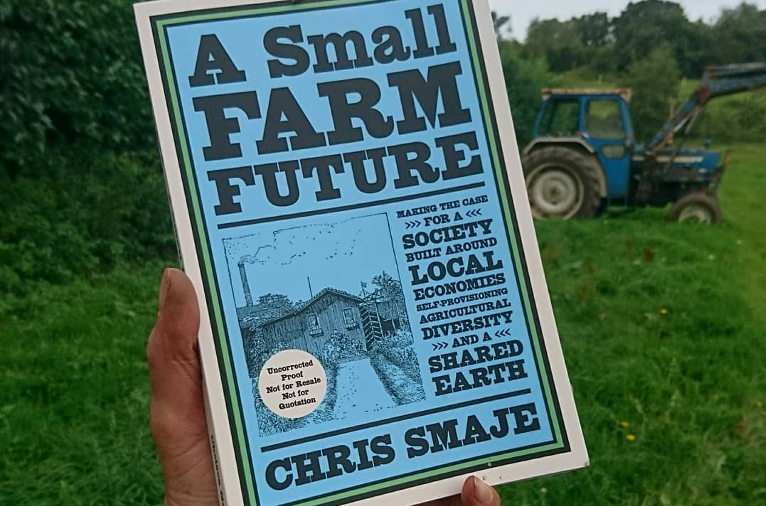
I mentioned in my last post that I think we’re heading into new arenas of class conflict with the unfolding polycrisis, conflicts that threaten the chance of finding a way out via agrarian localism or a small farm future. I’m going to explore some of these arenas of class conflict in this and the next couple of posts. I should probably be blogging instead about my new book Saying NO to a Farm-Free Future, but I’ll get to it soon and ultimately I think this class dimension is relevant.
Still, if you’re spoiling for a bit more action in the bacterial factory food wars, this smorgasbord in the new issue of The Land Magazine should keep you entertained. If you click on the link then download the pdf and scroll down, you’ll find my article ‘Seven fantasies of manufactured food’ which trails some key arguments from my book. But have a look too at the exchange between George Monbiot, Mike Hannis and Simon Fairlie. It’s quite informative.
If, on the other hand, you’d like some reading recommendations to give you a more rounded appreciation of alternatives to the crazy world of food techno-fixes, I’m also your man. Have a look at this feature on the Shepherd site.
But let’s turn now to this business of class conflict, agrarian localism and the polycrisis. In this post, I’m going to address what’s probably the least threatening of these conflicts to a small farm future, albeit the one that raises the most interesting issues. This is the threat to agrarian localism from Marxism and the far left.
There’s some personal backstory here. Many years ago, I was taught agrarian sociology mostly by Marxists. I counted myself among their number for a while, although those days are long past. I still think you can understand a lot about history through a Marxist lens, but I consider the career of the regimes operating in the name of Marxism to have been … uninspiring as a political project, to say the least. And I consider the critiques of Marxism developed long ago by the likes of Marshall Sahlins, Jean Baudrillard and Alisdair MacIntyre pretty devastating to it as an intellectual project.
An important part of those critiques involved showing the extent to which Marxism shared with its capitalist adversary a whole series of assumptions grounded in modernist thinking. “Each of Marx’s major positions…are…revealed as mirror images of capitalist society. Marxism emerges…not as a radical critique of capitalism, but as its highest form of justification or ideology”1.
Alasdair MacIntyre wrote (apologies if this is all a bit academically abstract, I’ll try to ground it soon),
When Marxism does not become Weberian social democracy or crude tyranny, it tends to become Nietzschean fantasy …. Marxism is exhausted as a political tradition … but I believe that this exhaustion is shared by every other political tradition within our culture …. What matters at this stage is the construction of local forms of community within which civility and the intellectual and moral life can be sustained through the new dark ages which are already upon us2
I’m with MacIntyre. While, like him, I still consider Marxism to be “one of the richest sources of ideas about modern society” (albeit partly because it’s very much of the modern society we’re leaving behind), and while I still consider myself in some sense on the left, my book A Small Farm Future was an attempt to help in that work of constructing local forms of community in the context of our new dark ages. This involved drawing on political traditions like the civic republicanism that MacIntyre explores, but it also involved putting agrarianism front and centre – something that I believe has been neglected in contemporary political debate. To do so, I drew on agrarian and agrarian populist traditions that in my opinion have a lot of important things to say about farm livelihood as a value in itself which stands against anti-agrarian ideals of modern ‘progress’. I believe it has important things to say too about property, family and household composition.
On page 267 of that book I tried to encapsulate a ‘progressive’ agrarian populist sensibility in a suitably sombre way for present sombre times. Such an agrarian populism, I said, lacks,
a utopia or a vision of an ultimately perfected political society …. It’s progressive in the sense that it believes people should be able to achieve self-realisation unlimited by gender, economic class or other political identities that might otherwise constrain them, but it doesn’t necessarily believe in progress as an intrinsic value. The ideal citizen of its imagining spends a good part of their day striving for flourishing and livelihood. The next day, they do the same again, probably in the same way. There’s no higher political purpose.
Cue a bad (in several senses of the term) review of my book by avowed Marxists Alex Heffron and Kai Heron. Quoting a part of the passage from my book I’ve just cited, they wrote, “This is an unusual definition of flourishing. A patriarchal monotony. A post-political vision of the laborer, tied to the land, constrained by market forces, indebtedness, and the individualized labor of the patriarchal family farm.”
Then at the end of their review, they characterized my book as “patriarchal disaster feudalist politics”.
That was some years back. But after my recent interview with Oli Dugmore, Alex Heffron popped up again on my Twitter timeline trailing that review and reviving the accusations of my supposed conservative, patriarchal, disaster politics. This led to a brief and sharp exchange of views on Twitter between me, Heron and Heffron before I blocked them.
So yeah I should probably have just ignored them, but in fairness they’re the first people I’ve blocked after 10 years on Twitter (to add to the one person I’ve blocked after 10 years of blogging) – which isn’t bad going, I submit.
Still, I can’t say I enjoyed the interaction. The experience gives me a vague inkling of what it must be like to have a vengeful ex turning up at a social occasion, loudly proclaiming one’s unforgivable no-goodness to the assembled group. I don’t think H&H really want a debate with me despite their claims, any more than a vengeful ex does. An opening to good faith debate might go something like “I think there are insufficient defences against patriarchy in your vision for a small farm future”, rather than bandying around labels like patriarchal disaster feudalism.
So despite the comic potential in debating patriarchy with aggressive men who insist they know what I think better than I do myself, I’m not going to further engage with people who mangle my words this badly, whose invitation to dialogue involves such a closed reading of what they think I say, and who insult so casually the lives that billions of humans have lived as mere ‘patriarchal monotony’. Antonio Roman Alcalá wrote a Twitter thread attempting to mediate between the two positions, providing more promising grounds for a debate, so perhaps something will emerge out of that.
On the upside, I posted this Twitter thread about the overlaps and dissonances I perceive between my position and ecosocialism in the aftermath of my interactions with H&H, and it led to some genuinely interesting conversations. In the rest of this post, I’m going to touch on a few points about patriarchy and property arising out of them, before closing with some thoughts on Marxist class struggle – that is, on how there may be a need in the future for good people to struggle against Marxist positions on class in the countryside.
The ‘patriarchal family farm’
Let’s start with this issue of ‘the patriarchal family farm’. A large part of my argument in A Small Farm Future is not that societies built around small-scale kin-based farming is what I necessarily want to see in the future (though I’m less dismissive of it than most modernists), but it’s what I think we will see in the future – therefore it’s a good idea to think about how to minimize patriarchy and other forms of domination in small farm societies. I’m happy to concede that my proposals might not be massively convincing, my only defence there being that I’m not the only person who’s failed single-handedly to think of a way to abolish patriarchy.
If I were writing A Small Farm Future again now, I’d probably frame some of my anti-patriarchal arguments about kin-based farming a little differently – as they stand in that book, I daresay they’re vulnerable to the critique of liberal individualism. But ‘liberalism’ and ‘individualism’ are not the same thing. Individualized labour on kin-based small farms has been a ubiquitous feature of livelihood-making worldwide for millennia, and efforts to mitigate the personal domination involved in forms of power like patriarchy also operate at individualized levels of inter-personal micropolitics.
As I see it, a lot of modern far left politics wishes to abolish individualism without understanding its many forms. It typically involves sweeping modernist dismissals of past societies in favour of a bourgeois collectivism that it believes will magically abolish domination because … y’know … class liberation, democratic collectivism or [insert favoured slogan here].
But if you want to talk about ‘the patriarchal family farm’, I’ll raise you ‘the patriarchal democratic collectivist farm’ where aggressive entrepreneurs of social power – men, often – hold sway. In their review, H&H mention various cooperative and collective agrarian initiatives that inspire them. Some have already folded due to internal power politics, while others that I’ve been involved in personally, believe me, offer no passports to collectivist bliss. It’s not ‘the family’ that’s the source of patriarchy. The possibilities for patriarchy and other forms of domination are latent in all human relationships, especially the intimate relationships of day-to-day life – as much in a ‘democratic collectivist’ agrarian commune as in a family farm.
The last two centuries have been littered with left-inspired efforts to abolish structures like kinship with supposedly more fair and rational collective arrangements. A lot of them have foundered under the weight of their own implicit injustices and irrationalisms, or alternatively under the weightlessness of their rationalism. But despite their best efforts (and, let me be clear, I’m not opposed to all these efforts) they haven’t shifted the needle an awful lot on kin-based motivation. It’s a big deal socially if you walk out on your family. If you walk out on your cooperative, not so much. Why? Instead of simply castigating the enduring, thick-or-thin ideology of kinship with skin-deep dismissals that leave it open to conservatives (like me?) to make hay with it, I think those on the left would do better to try to understand sympathetically its deep power, the better to channel it in benevolent directions as a long-term cultural project, not a short-term political one. On that note, I’m very much in favour of people experimenting with different ways of building larger, non-kin-based farmsteading communities (I’m involved in some such experiments myself). I’m not in favour of a politics that dictates what kind of household structures are permissible on the basis of its a priori theories about liberation.
A final observation on ‘family’. One of the interesting discussions I’ve had emerging out of my Twitter thread is (if you’ll excuse the anthropological jargon) the tendency of some traditional horticultural societies to adopt matrilineal and matrilocal kinship structures. We’ve touched on this before on this blog, but I don’t think I’ve given it the attention I should have done in thinking about kinship structures in a small farm future – something that I aim to put right as soon as I can. What’s for sure, though, is that nobody’s just going to draft up some ideal matrilineal horticultural society, press ‘Send’, and abolish patriarchy at a stroke. It can only be a matter of somehow trying to prefigure cultural change towards better social arrangements in the long-term, even as the existing ones crumble in the short. I made some point along those lines in the exchange of tweets with H&H, to which one of them asked rhetorically how the patriarchal family that he apparently believes I support could possibly contribute to such change. Sigh. It can’t. Next.
Property
Next is the question of property, another arena of widespread and depressing leftist confusion when it comes to a small farm future. On this question, I’d commend the discussion between Frankie McCarthy and Nicholas Blomley on Adam Calo’s Landscapes podcast – partly for the clarity of their exposition about property concepts, but also for some important things I think they miss.
In brief, a regnant conception of private property in the ‘western liberal’ tradition is a depoliticized one in which a person (a man, usually) can have almost exclusive rights of disposition over a defined area of land, usually by paying for it. This draws our attention to the relationship between a (gendered) person and land. And it draws our attention away from the intensely political nature of the way that money and land tend to accumulate in particular hands in this process. But as McCarthy and Blomley neatly explain, property is always a collective political relationship. It bears on who is accorded the right by the wider community to appropriate resources from an area of land, what responsibilities they might also have in respect of the land, and what collective political processes are in place to determine these rights and responsibilities.
This political and collective understanding of property rights is the basis of my own analysis of property in A Small Farm Future. And, I’m sorry, but anyone who thinks my analysis involves support for a depoliticised monopoly landlordism just hasn’t understood what I’m saying.
What I do say in A Small Farm Future is that it’s common in agrarian societies for the right to appropriate resources from land to be accorded by the wider political community on an exclusive basis at a given time to individuals, households or families. There are good reasons for this which have to do with well understood problems about emotional load, transaction costs and commons failures (a point that, for the avoidance of doubt, has little to do with the so called ‘tragedy of the commons’).
The discussion in the Landscapes podcast focused quite rightly on critiquing the familiar private ownership model in western legal traditions, but it didn’t address the existence of widespread de facto private property rights in respect of access to land in agrarian societies outside those traditions. Blomley mentioned the expropriative and ecocidal exploitation of the tar sands in Canada – a public-private property model which surely doesn’t say a lot for the intrinsic capacity of public ownership to mitigate exploitive property regimes. He also mentioned the activism of indigenous peoples, basically around reclaiming land appropriated through colonial public-private property regimes. But he didn’t mention that the property regimes of indigenous people often themselves involve de facto private rights of appropriation.
As I see it, and as I further explain in A Small Farm Future, there isn’t one type of property regime – public, common or private – which is intrinsically better or less exploitive than every other one. It all depends on the wider collective politics installing a given regime – or, as usually happens, installing a mix of regimes. In A Small Farm Future, I argue that a regime of distributed private property (distributed private property being a very different beast to monopoly private property) set within wider regimes of common property in a political community oriented to the generation of renewable local land-based livelihoods is a good thing to aim at on the basis of what we know about past agrarian societies and about where we’re currently headed. I’ve not yet come across any convincing analyses to suggest to me why that’s wrong.
Pie and the sky
The historian Norman Cohn argued there are continuities between the revolutionary egalitarians of medieval Europe and communists of the modern period. This manifested in a practical politics geared to securing a fair share of the pie, but also in more emotionally charged political imaginaries – expressed in the former case through the medium of Christian millenarianism, and in the latter through a secular millenarianism involving “phantasies of a final, exterminatory struggle” and “a perfect world from which self-seeking would be for ever banished”3.
In Cohn’s view, the practical politics of pie-sharing appealed to a wide section of working people in both the medieval and modern periods, whereas emotionally-charged millenarianisms of the medieval religious or modern secular varieties have had a more restricted appeal. In modern times, he says, mass movements organized around these ‘phantasies’ of a perfect world emerged largely within peasant societies undergoing problematic transitions to modernity, but also appealed to intellectual dissidents in wealthy industrialised countries.
This pretty much encapsulates my take on contemporary Marxism. I’m very much in favour of everybody getting their fair share of the pie, although I believe that under the pressure of climate change (the sky…), energy futures, nature loss and so forth, the overall pie is going to have to get smaller, which will sharpen distributional conflicts. But I don’t buy the ‘Nietzschean fantasies’ – or the bourgeois collectivism – of exterminatory struggles and perfect worlds without self-seeking that too easily invest Marxist political imaginaries. What H&H call my disaster feudalist politics (I don’t consider either word a remotely accurate or fair characterization of my analysis), I see as a kind of practical rearguard politics fitted to present times. The real disaster, in my opinion, would be to follow dogmatic class politics and millenarian political imaginaries of the Marxist kind in the belief that short-run collectivist pie-and-the-sky politics can liberate people from present biophysical threats and social inequities.
The chances of that kind of Marxist politics happening in contemporary Britain seem to me pretty low, which is why I said I consider the class politics of the far left unthreatening to a small farm future here (other countries may be different). But there’s possibly a danger that a vulgarized class politics emerging from a resurgent Marxism (which does, after all, provide a reasonably good general analysis of the mess we’re in) will connect with anti-‘elite’ aspects of right-wing populism in the context of present crises.
This could generate a latter-day purge of local agrarian property-owning kulaks in favour of agricultural collectives under the thumb of abrasive commissars and their highly theoretical ideas about the benefits of their ‘democratic collectivism’ for the production of food and other forms of human wellbeing. I think this would probably turn out even worse than its predecessors in communist history, foisted as they were upon people who at least knew how to farm, and were probably better versed in collective organisation than the ‘democratic collectivists’ of today. So the challenge is to defend distributed property, commons, kinship, human neighbourliness and renewable local agrarianism against the blank certainties of new-old Marxist categories of class struggle. Unlike Marxist millenarianism, I think this agrarian populist-inspired vision offers some glimmer of hope for constructing local forms of community and civility to sustain us through the new dark ages.
Notes
- Mark Poster. 1988. Introduction to Jean Baudrillard: Selected Writings. Stanford University Press, p.4.
- Alasdair MacIntyre. 1984. After Virtue. University of Notre Dame Press, pp.262-3.
- Norman Cohn. 1970. The Pursuit of the Millennium: Revolutionary Millenarians and Mystical Anarchists of the Middle Ages. Paladin, p.28.



Comments
We changed commenting systems on September 10, 2026 as part of a site-wide functionality and security upgrade. Your past comments have not disappeared, and you can still log in with your old Disqus account credentials if you wish. Contact us with any questions.
Hope this isn’t too presumptuous Joe Clarkson but I’m interested in sending you a message re your posts I’ve seen on various sites. If you’re game send me a contact. My email is [email protected]. Thanks.
We have something the first Marxists did not have, AI. Resources can be quickly tabulated and equitably distributed. We can not predict the far future but will have to set a goal (five years worked before) and work toward that. With AI any problems will quickly become apparent and changes can be made on the fly.
In the US much of what has to be done is unconstitutional and will require more thought then other countries. If you think the last six years have been divisive you haven’t seen nothing yet.
I would like to understand more of what you mean by saying that much of what has to be done is unconstitutional. I assume you are talking about the inability to limit what property owners do with their property without it being deemed a “taking.”
Posting a comment for Piers Maddox who is having trouble with Disqus:
Thanks Chris for all that you’ve written and what you do. I recommend your book often.
I’m prompted to ask, is there something to be learnt from China?
You talk about Marxism, but perhaps socialism is the word you mean. China talks of itself as in the first stage of socialism…the development of productive forces. One of Chinese socialism’s unique characteristics is its opening to the capitalist West. China and Europe have similar sized public sectors (US 14%, UK 23%, China 28%, Norway 32%, Russia 41%). But the big difference is that financial interests haven’t been allowed (at least so far) to capture power. Also, having constitutionalised the socialist path, the government seeks to represent all classes … symbolised by the four small stars on the flag.
Another point…China defines itself as socialist, but Keynes had in mind the same key feature…for the state to control investment rather than leaving it to the private sector. As the Wall Street Journal said, ‘Most economies can pull two levers to bolster growth – fiscal and monetary. China has a third option … accelerate the flow of investment projects.’
On financial capitalism Michael Hudson makes the point that even if US wage earners were given everything they buy at the stores for nothing, all the food, clothing, transportation, they still couldn’t compete with foreign workers, because housing takes 30-40% of their income, medical care 18%, plus monopoly fees for technology and so on. In The Destiny of Civilisation Hudson lists the steps that a government needs to take to escape financial capitalism…including control of money and credit creation, keeping essential infrastructure in public hands, public ownership of natural monopolies, taxing economic rents…and a land tax ‘to collect the site value that results from infrastructure spending and general prosperity, not the landlord’s own investment. This will limit real estate asset price inflation’.
I thought that A Small Farm Future made the point well about the need to move to lower per capita energy consumption. Alice Friedemann makes the point even more strongly…as she says, ‘once the oil is gone we’ll be back in the age of wood’. It seems to me that a healthy way forward is to plan for many more people working the land, with some de-urbanisation, and creation of more self-sufficient local communities.
Perhaps there’s something to be said for breaking up the largest landholdings (presumably by compulsory purchase) and developing agricultural cooperatives around new eco-villages and eco-towns. The land doesn’t have to be publicly owned, so long as it’s taxed. But on the other hand, under neoliberalism, since the 1970s, 10% of UK total land area has been sold. So an aim to purchase 20% of land for public or cooperative ownership would seem a reasonable initial target for a socialistic government.
I liked what you said about class in Small Farm Future…as I read it you said that as events unravel the middle classes would see that their interest lay in alliance with the poor and working classes rather than the wealthy. There’s certainly some truth in that.
But on the other hand people can be conditioned to do things against their own interest, as Derren Brown and Stockholm syndrome show. The basic issue is the rich/poor camel and eye of the needle thing…we want the rich and the ruling class to act in the interest of all. That’s been the governance situation in China for 1500 years. Until we in the West find a way to get to that there’ll inevitably be an underlying class conflict. But climate change potentially makes all rational people allies, of whatever class. And once a socialistic way forward has been embarked on, once we have a system that acts for long-term good of humanity rather than short-term profit and warmaking, then class conflict would fade, and win-win mentality prevail, as China has shown.
I’d be interested on your thoughts.
When the collapse of industrialism necessitates local agrarian communities and peasant life, an inevitability about which I wholeheartedly agree with Smaje, the transition will involve so much death and social disruption that the ensuing chaos will likely result in every form of political organization possible, but with some forms, like warlordism-feudalism, much more likely than others. One only has to look at the variety of social structures in indigenous cultures to see what is likely to happen.
The bottleneck will be so turbulent that nothing we do now in political preparation can possibly affect what comes out the other end. Speculation about what the politics of a small farm future should be is interesting, but it will have no effect on what results. This means that such speculation, while perhaps entertaining, is just a waste of time.
I suspect that, as has always always been the case in the past, strong territorial interests will be a part of whatever societies form after collapse. Unless population decline reaches extremely low levels, inter-tribal conflict will be common, regardless of the politics of conflicting tribes. The maximum power principle will still prevail no matter how societies are organized.