

I’m often told that degrowth, the planned downscaling of production and consumption to reduce the pressure on Earth’s ecosystems, is a tough sell. But a 36-year-old associate professor at Tokyo University has made a name for himself arguing that “degrowth communism” could halt the escalating climate emergency.
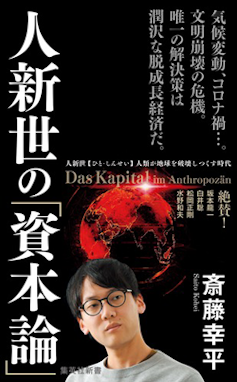
The first edition cover of Capital in the Anthropocene, published in 2020.
Kohei Saito
Kohei Saito, the bestselling author of Capital in the Anthropocene, is back with a new book: Marx in the Anthropocene: Towards the Idea of Degrowth Communism. The book is dense, especially for those not fluent in Marxist jargon who, I suspect, care little about whether or not Karl Marx started worrying about nature in his later years.
And yet, the way Saito mobilises Marxist theory to make a plea for “the abundance of wealth in degrowth communism” (the title of the last chapter of his book) is as precise as it is gripping. This is what attracted my attention as an economist working on degrowth: Saito’s attempts to reconcile Marxism with newer ideas around alternatives to economic growth might bring critiques of capitalism to an unprecedented level of popularity.
Economic growth creates scarcity
Saito turns the concept of economic growth on its head. Many people assume that growth makes us richer but what if it did the precise opposite?
Gross domestic product (GDP), a monetary measure of production, can rise because someone privatises a common good – what British geographer David Harvey calls “accumulation by dispossession”. Fence a resource that people could previously access for free and start selling it to them.
This rent extraction might inflate GDP but it doesn’t create anything useful. In fact, by preventing people from accessing the means of subsistence it creates an artificial scarcity.
The more money accumulates, the more these snatch-and-sell tricks become possible, whether it’s for natural resources, knowledge or labour. In a world where everything becomes a potential commodity (in other words, something which can be bought and sold), the ruling rationality favours lucrative activities over others.
Why would you lend your apartment to someone for free if you can rent it on Airbnb? And that’s the catch: once you need money to satisfy your needs, you are forced to play like a capitalist.
An emergency brake
This self-perpetuating striving for moneymaking pushes us to turn more and more of nature into a commodity. The money companies can make is infinite while the quantities of nature at disposition are getting scarcer.
There may be no clearer illustration than the record profits of fossil fuel companies amid worsening climate conditions.
Degrowth could act as an emergency brake on this vicious cycle, Saito argues, by “terminat[ing] the ceaseless exploitation of humanity and the robbery of nature”.
Academics define degrowth as a democratically planned effort to downscale levels of production and consumption in order to lighten environmental pressures. The democratic part is important: the idea is to do this in a way that reduces inequality and improves wellbeing for everyone.
It’s difficult to imagine this happening within capitalism, a system which must continually expand and generate more. And that’s Saito’s point: communism is much more likely to achieve these objectives.
He reasons that an economy concerned with meeting human need is more likely to avoid producing junk. Without the get-rich-or-perish imperative, many nature-intensive goods and services would cease to be necessary or desirable.
Saito calls this “a conscious downscaling of the current ‘realm of necessity’”. This Marxist term describes what we consider our essential needs. Under degrowth communism, this realm would shrink to exclude things and activities which don’t benefit human wellbeing or contribute to sustainability.
Suddenly, it’s possible to organise work differently. Gone is the industrial model of producing something as cheaply as possible while sacrificing safety and the pleasantness inherent in a shared effort.
Instead of competing for market share, companies could cooperate to achieve common goals like restoring biodiversity. Reducing the importance given to moneymaking would free societies to improve all these things we today trivialise because they aren’t profitable.
Such an economy might be slower and smaller money-wise but it would be more sustainable and more effective in delivering wellbeing, which is all we should be asking from an economy anyway.
Towards a post-scarcity society
Saito’s book is refreshing because it helps end an old feud between socialists who trust that new technologies and the automation of work can deliver an expanding economy with greater leisure time and those who argue for a socialism without growth.
Instead of perpetually growing the economy by making more things private property and saleable, Saito proposes sharing the wealth we’ve already created. This could usher in a new way of living, where people can afford to spend less time and effort producing commodities and turn their attention towards things that really matter to them, what Marxists call the realm of freedom. This should start, Saito argues, with restoring the health of Earth’s ecosystems, on which everything else relies.
No longer forced to obsess over money, people could enjoy the abundance of social and natural wealth outside of consumerism. Imagine trading the new smartphones which arrive yearly for luxuriant ecosystems, thriving communal spaces and vibrant democracies we finally have time to explore and participate in.
Saito breathes new life into Marxist ideas with his book by presenting evidence of life beyond endless extraction, production and consumption. As the author himself argues, this could not have come at a better time:
Although it was never recognised during the 20th century, Marx’s idea of degrowth communism is more important than ever today because it increases the chance of human survival in the Anthropocene.

This article is republished from The Conversation under a Creative Commons license. Read the original article.
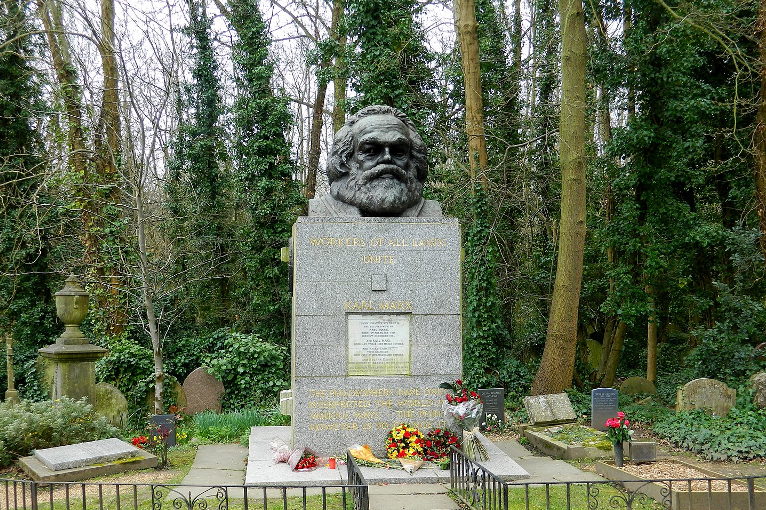
Teaser photo credit: Tomb of Karl Marx, East Highgate Cemetery, London. By Paasikivi – Own work, CC BY-SA 4.0, https://commons.wikimedia.org/w/index.php?curid=47981028



Comments
We changed commenting systems on September 10, 2026 as part of a site-wide functionality and security upgrade. Your past comments have not disappeared, and you can still log in with your old Disqus account credentials if you wish. Contact us with any questions.
I think I’d use the more generic term “socialism”. “Communism” has been used more specifically, to refer to Marxism-Leninism as practiced by the USSR, Eastern Europe and China.
There will never be any label for a school of thought that opposes the ruling system that will not be smeared. Each new term you come up with will soon be a “bad word” as well. Might as weill stick to the ones you have – a long history of writing is attached to each of them.
Degrowth is already a very difficult sell, calling it Degrowth Communism makes it even worse!
(note* – the limits to growth ensure a shrinking economy and admitting that is the first step in responding to the predicament we are in, but labeling it degrowth communism is a poor idea.)
Three kinds of people get into government service, those who just want an easy job, those who want to help people, and those who want to power to control people. With environmentalist in charge it will be a government of “you can’t”. You can’t travel, you can’t eat what you want, you can’t live or work where you want. Abortion will not only be legal and free, for most women it will be mandatory.
Hopefully this time not too many millions of people will starve to death when the agriculture commissar misjudges how much grain to plant or he decides to punish a disobedient region. Then of course is forcing the entire population to agree to this. Most countries will not have much trouble but Americans are extremely well armed, specially the ones who will not want this imposed on them.
It’s been said people are “bastard-coated bastards with bastard filling.” (bebbf)
The problem is you can’t legislate people to be “good,” or “altruistic,” or “cooperative,” or “fair” (…or whatever). Capitalism appears to tolerate the bcbbf folks, and can prosper, because they can become slumlords, or cheats, or tobacco pushers, or whatever (many such “bad” things are perfectly legal). But this evidently can’t happen in “pure” communism because it turns into a Mafia state. Lack of “rule of law.”
NO, not an end to money. Replace the centralizing private for-profit monetary system we have, used to control governments and industry, with a public monetary system that creates money as an asset, not a debt, and issues it into the real economy for the general welfare as its first use. monetaryalliance.org