

Climate breakdown is beginning to destroy our agriculture. Rising temperatures and changing weather patterns are pushing the stable, predictable climate needed for farming into new, uncertain states. Low-lying nations, such as Bangladesh, are already seeing mass migration as farmlands are lost to collapsing coastlines. Herders in the horn of Africa are suffering after repeated droughts destroy their pastures, and even industrialized agriculture is not escaping the effects of climate breakdown. Winter wheat harvests in the US fell by a quarter in 2022, and heatwaves in India, France, and Spain did much the same, exacerbating the shortages created by the Ukraine war. This decline is becoming more palpable to consumers, with UK supermarkets suffering vegetable and fruit shortages.
But is there a silver lining to the effects of climate change on food production? Though locally damaging, could the global effects of climate change open up new agricultural opportunities? Some suggest they could.
This argument contends that whilst southern breadbaskets will decline or collapse, land in the warming Northern Hemisphere — lands previously too inhospitable for agriculture — will open up to compensate for this loss. These new farms, concentrated mainly in Russian Siberia but also in the Canadian far north, are one of the ways we can avoid global famine as the effects of climate change bite. Co-chief investment officer of Value Partners Group has predicted:
“All these vast lands [Russia has] in Siberia will be the biggest, most productive farmlands in the world in the next three decades. They will be a food superpower”
So the theory goes.
Though this line of reasoning has been a bit less popular as of late, owing to the fact that much of this theoretical farmland sits in Russia, it has not gone away. Indeed, given the massive spike in food prices and the annual decline in breadbasket productivity, this question of northern farmland is all the more pertinent.
Could the northern wastes prove to be agricultural havens? Will this save us from a global famine? There remain a huge number of unanswered questions, we can not know how productive this farmland will be, or if it could ever compensate for losses in the south. But there are also deeper, darker questions. Even if these farms do work, could their creation further risk destabilizing our climate? Could the cure, despite its seeming necessity, be worst than the disease?
Farms of the Future
The Ukraine war has shown us how volatile food prices can be. The rapidity with which the grain disruptions caused chaos, and led to the collapse of governments, was striking. A foreboding sign of things to come. Yet an agreement between Russia and Ukraine allowed the export of some of the region’s grain, helping alleviate the worst of the global crisis. The effects of climate change on food security, however, are not something we can negotiate our way out of.
This poses a challenge to the idea of new northern farmlands from the get-go. How quickly could we convert the necessary acreage? When should we start? Will the north ‘warm’ enough before more southerly breadbaskets collapse? And would they even be suitable if they did warm? It’s all a question of timing and scale. Climate change has shown that, at a global level, we are exceptionally bad at coordinating these factors.
But these questions ignore the first hurdle for these vast Siberian farmlands: Who will farm them? These theoretical farms have no existing farming culture, and no long-term infrastructural basis to draw from. In Russia in particular, this poses a major problem, as even its existing farmland is shrinking for a lack of people to farm it:
Some 20,000 Russian villages have been completely abandoned in recent years, and 36,000 others have fewer than ten inhabitants left and will follow them soon. A third of land once farmed in the former USSR has now been abandoned.
These are not insurmountable problems on their own. In the Russian Far East, significant numbers of Chinese farmers are already taking advantage of rising temperatures to cultivate southern Siberia. But so far these new farms are pushing into and improving land that, whilst marginal, already had a long history of cultivation. It is also unclear how much of this agricultural improvement is down to weather patterns, and how much is simply a matter of using new, industrialised farming methods in these regions. However, the expectations of those who advocate this push to the north are far more ambitious than improving marginal lands:
“From 50 to 85% of central Siberia is predicted to be climatically suitable for agriculture by the end of the century, and only soil potential would limit crop advance and expansion to the north. Crop production could increase twofold. Traditional Siberian crops could gradually shift as far as 500 km northwards (about 50–70 km/decade) within suitable soil conditions”
Yet even if the average temperature becomes more hospitable, the other impacts of climate breakdown on Siberia are anything but.
Fires of Siberia
“If we don’t get a handle on climate change, it’s going to be grim for billions of people. But as we fail to get a handle on [climate change], Russia and Canada will probably be in a more beneficial position in terms of their own agricultures, as the climate moves north, so to speak”
The above quote is by Paul Rogers, Professor of Peace Studies and International Security Advisor to Open Democracy. This comment is illustrative of the main misunderstanding about Siberia’s climate changed future. This idea that existing climactic bands will simply advance north assumes the planet is warming evenly, or that the increased energy in our complex climate system will have stable, predictable effects. Rather, the temperature increase is uneven (the artic warms four times faster than the tropics) and its effects are unpredictable. Any new Siberian climate will be unstable by nature.
This is why the term climate breakdown is more appropriate than climate change. It evokes more accurately the reality that, as average global temperature increases, the predictable truths of our previous climate regime apply less and less. As futurist Alex Steffen explains:
The true measure of the seriousness of the planetary crisis is not destruction but discontinuity. My most succinct working definition of a “discontinuity” is a watershed moment, one where past experience loses its value as a guide to decision-making about the future.
This is especially true when it comes to agriculture, a paper by James Hansen shows that: “Farmers experience climate change not as a shifting [average] but as climatic variations”. Unpredictable variations in precipitation, temperature, and weather will wrack the far north as much as the rest of the earth. Agriculture is dependent upon the stability and predictability of seasonal averages, and as Siberia warms, its climate conditions will vary wildly.
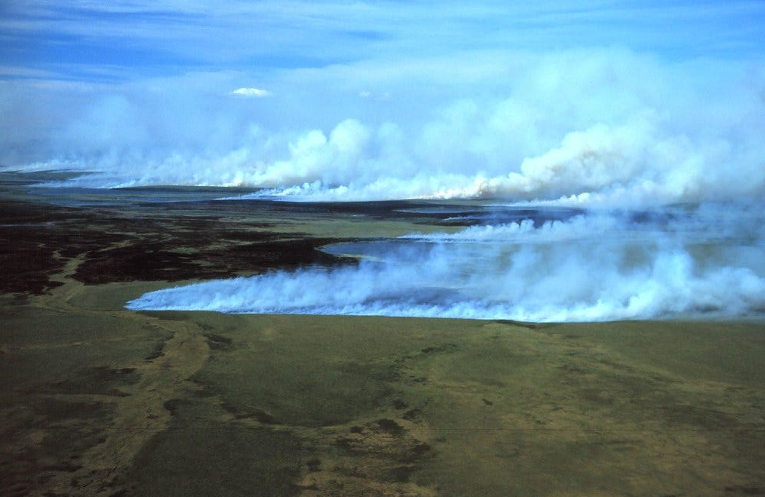
Already, intense and unusually strong wildfires sweep across the world’s northern Tundra every summer, burning millions of acres. In winter, large smoldering pits burn carbon-rich peat beneath the snow, these so-called ‘zombie fires’ bursting into next summer’s infernos. In the globe-spanning Taiga forests of the far north, the situation is little better. Between January and August 2022 alone, 7.4 Million acres of Russia’s taiga woodland burned. Of the 23 Million acres burned in wildfire between 1982 and 2020, half was burned between 2019–2020. In a lesson that Californian farms are already painfully learning, wildfire is not the friend of agriculture.
Siberia’s warming does not merely create fires, but can cause the earth itself to collapse. As permafrost begins to thaw, the wet, loose soil left behind contracts and deforms. This can lead to the creation of thermokarst, craters formed when the ice supporting the soil melts, causing it to fall in on itself. Though a natural phenomenon, the world’s warming permafrost regions have seen a vast increase in their frequency, and in their size. In one study of the Canadian far north, authors found hundreds of new craters in the permafrost, one over 300 acres in size. In the same study, they found a 60-fold increase in the rate of thermokarst emergence between 1984 and 2015. Even without such dramatic collapses, disruption to permafrost leads to landslides and deforming soils, damaging infrastructure and increasing costs. A warming north is one that is unstable, dangerous, and unsuited to any agricultural gold rush.
Even in more moderate estimates of how far north these new farms will go, climate change is proving anything but a blessing. Most of Russia’s existing wheat belt is in the forest-steppe zone, a transitional ecosystem between central Asia’s vast grasslands and the great forests of the north. The forest-steppe zone, however, is drying out. In some regions, drought has led to 70% of their steppe zones becoming unviable for farming. Just as temperate zones are expected to creep north, so are the (increasingly) dry, harsh conditions of the steppe, consuming the farms that currently exist — and making land eyed for new farms even more precarious. Even studies that expect massive potential for far northern agriculture admit that the existing farms to the south will collapse without irrigation.
The Carbon Bomb
Should pioneering farmers brave the fires, risk their fields unceremoniously falling into a giant crater, and avoid aridification, there is another danger lurking in the black soils of Siberia. Cultivating the northern wastes would release a carbon bomb.
The marginal steppe-forest zone, predicted to be so fruitful for northward agriculture, holds a huge amount of carbon. The dark, peaty soils of this region accumulate organic matter over long periods, locking carbon out of the atmosphere. If brought under cultivation, one study found up to 177 gigatons of CO2 could be released, 120 years’ worth of domestic US emissions. And this is before we consider the loss of the permafrost. Whilst the loss of permafrost is more due to global heating than human activity, there is good evidence to suggest that changes to surface usage significantly affect the temperature of the frozen soil below. Globally, the permafrost holds 1,400 gigatons of carbon, roughly four times the entire emissions footprint of humanity. When thawed, this carbon-rich sediment is broken down and released into the atmosphere by microorganisms. These emissions are often methane, which has 80 times the warming potential of carbon dioxide. If even a fraction of the permafrost was released, it could push us into dangerous runaway warming — which human decarbonization could do nothing to limit.
The potentials of Siberian farmlands are vastly overrated, and their risks are dangerously understated. Though the future of agriculture must adapt to overcome the challenges of climate change and avoid famine, our savior does not lie in the far north.
Teaser photo credit: Western Arctic National Parklands



Comments
We changed commenting systems on September 10, 2026 as part of a site-wide functionality and security upgrade. Your past comments have not disappeared, and you can still log in with your old Disqus account credentials if you wish. Contact us with any questions.
Thanks David!
It’s appreciated if you can add some text to links like this, explaining a little about what it is.
Thanks
This doesn’t address the Canadian tundra at all, but I once read that the soils there are not suitable for farming. And likely much of available newly warm land there is now tree covered–cutting the boreal forest to farm the land would surely release a great deal of CO2.
Another problem: what exactly could be grown in the types of nutrient-poor, acidic soils common in tundra and taiga? About nothing. Soil remediation in these places would take years. Maybe decades. And would probably necessitate pasturing animals for some time.
So I farm Alaska, in the Interior. I’ve found the soils to be capable of growing forage and food crops pretty good. With limitations. This past year we had drought conditions severe enough to limit germination of the barley that was planted, then an early frost in July, which reduced yield and quality of the feed barley such that average yield was cut to 15 bushels per acre. The drought conditions affected forages, making for a short first hay crop, and then, later, the weather turned and near constant rain made hay drying difficult. So being a remote from the rest of the country state, we had to import bulk feed from the lower 48 states, with many herds being reduced due to high feed costs.
We have experimented with growing artichokes successfully, and a local farmer is growing sweet corn as well. Potatoes grow well. A farmer from Bethel, AK, Tim Meyers, has good success as a commercial vegetable farmer. Check YouTube to see his success.
Any land with permafrost, has issues when cleared, with the thawing of ice lenses causing subsidence, often taking 40 years or more before the ground is stable.
Forest fires are always a concern, the black spruce tree, a staple succession tree in the boreal forest, is born to burn, dense stands are like gasoline on a stick when they torch off. Having a half million acres burning in your neighborhood is nerve wracking. On baited breath wondering what this coming El Niño will bring weather wise.
https://m.youtube.com/watch?v=FivWaJT5bdk