

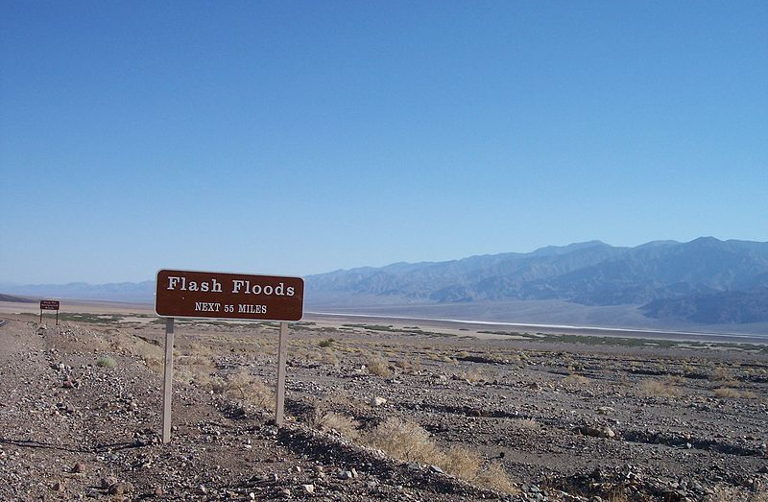
I visited Death Valley in August 2008 shortly after rare, plentiful rains (at least by Death Valley standards) had turned one of the Earth’s hottest and driest places into a riot of yellow, blue, red and pink color as wildflowers bloomed across the valley. The day I visited was a clear one and not at all unusual for Death Valley at that time of year. When at midday we tourists climbed off the air-conditioned bus, it felt as if I had just stepped into a pre-heated oven. It was 112 degrees F.
I had no thoughts of climate change that day. This was just the way Death Valley was and had been for a very long time. However, reading about recent heavy rains in Death Valley twice in the last week—rains so heavy that they trapped automobiles and closed roads due to mud and debris—I took note that in a place where dryness and heat are normal, water suddenly became a dangerous hazard, one that resulted in the closing of all roads in and out of the national park that comprises Death Valley. (Something similar happened in nearby Las Vegas, Nevada the week before as water flooded streets and gushed through roofs flooding casinos and frightening visitors. This in a city that gets less than 5 inches of rain a year.)
Drought has been getting almost all the media coverage in the American Southwest. That’s in part because the drought story persists over long periods and becomes a story whenever fear of water restrictions or actual restrictions surface or when it looks like rain might bring relief.
Floods, however, come and go. But they are just as much a part of the perturbation and intensification of the hydrological cycle.
Just as climate models predicted, rains are becoming more frequent and more intense as the hydrological cycle speeds up due to greater evaporation resulting from warmer temperatures across the Earth. Simply put, a warmer atmosphere can hold more water vapor and that means there is more available for rain. But the strange result is that dry areas will tend to get drier while many wet areas may experience even more precipitation. That’s a generalized expectation that varies according to specific circumstances. And, of course, recently we can see how devastating rains in dry places NOT built to handle such a large amount of water can be.
[slide-anything id=’3472166′]
These recent heavy rains will do little to relieve the ongoing megadrought in the American Southwest. Some 22 years of less than normal rain is difficult to reverse in a short period. I first covered this drought when it was in its 10th year. It seemed dire to me then, but did not appear to arouse much worry among the residents of Las Vegas at the time as my title, “The show must go on,” indicated.
There is a little more alarm now as mandated reductions in delivery of Colorado River water to the states along its banks have taken place and must now be deepened. Sometime this month how the new and increasing pain of reductions will be spread among those served by the Colorado will be announced.
Death Valley is looking more and more like the future of the American Southwest, hotter, drier and punctuated by an occasional catastrophic rainfall that nevertheless fails to make much of a dent in the long drought.
Do those living inside the drought boundary generally understand the trajectory they are on? Does the outside world? It’s hard to answer the first question. But the second one may be easier. In the 22nd year of the drought, more people moved to Arizona than left it. More people moved to Utah than left as well. As of 2019, Nevada was still attracting new people from around the country. Only California has been losing population over the last two years.
Why people move is a complex question to answer. Increasingly, I believe, one answer will be water, both for those leaving these states and for those considering a move to these states but who end up choosing to move elsewhere rather than take their chances on increasing water restrictions as the area’s megadrought continues to bear down on its residents.
Photo: Death Valley National Park. National Park Service sign warns of flash floods over a vast area (2004). By Draxfelton. Via Wikimedia Commons https://commons.wikimedia.org/wiki/File:Death_Valley_flash_flood_warning_sign.jpg




Comments
We changed commenting systems on September 10, 2026 as part of a site-wide functionality and security upgrade. Your past comments have not disappeared, and you can still log in with your old Disqus account credentials if you wish. Contact us with any questions.
As a long time resident of the American SW the threat of diminishing water supplies is very meaningful. Unfortunately, the development of the urban areas has taken water from reservoirs as unlimited and so no infrastructure to capture runoff and guide it into the falling water table was built. Mostly, the rainfall that does grace us is treated as a nuisance and drained into the dried up river running out of town. Some communities are trying to improve but for the most part development is about profit taking rather than working towards resilience.
The thing is, Las Vegas uses a small fraction of the water – or rather, they recycle water back so efficiently that it’s basically not an issue. Agriculture and upstream users are the problem. I know this doesn’t fit the “cities bad” narrative popular here, but it’s not cities that are using the bulk of the water.
According to the Southern Nevada Water Authority, “Approximately 40 percent of the water in the Water Authority’s service area is used indoors. Of that, about 99 percent is recycled, either for direct or indirect use.”
So 60% is used outdoors. Outdoor water is difficult to recycle at any kind of scale above a homestead. Las Vegas uses a LOT of water so that outdoor amount used per capita is HUGE. Here is the link to the SNWA.
https://www.snwa.com/water-resources/current-water-supply/index.html#:~:text=Reuse%20and%20recycling,golf%20courses%20and%20other%20uses
Yes, per capita consumption had gone down to 124 gallons per day by 2018, but this is still three times the per capita rate of the whole of France, at 150 liters per day.
Is there any reason why Nevada in general, or Las Vegas in particular, situated in the semi-arid American SW with normal temperatures that if they were inflicted on France the citizens would probably die in en masse, should be equivalent? England got hit with 100F+ temperatures for a day and it was presented as a situation where the world had ended as they knew it, as opposed to a normal warm day in most of the American West.
The people in southern France are as hardy in hot temperatures as the Spanish and Portuguese. They actually do quite well without air conditioning. The Tour de France just raced through a heatwave in the Pyrenees. The UK and Ireland have a problem with heatwaves because they are used to a maritime, rather than a Mediterranean climate. By the way, the Yorkshire Dales, where I spent a couple of months a few years ago, have incredibly fertile soils because of all the sheep shit everywhere. As the Olde Sod changes from a maritime to a Mediterranean climate, there is great potential for food production in The North. Long days too, like the famous Matanuska Valley in Alaska.
As for using French water consumption as a comparison to Las Vegas or the US in general, don’t forget the structural parameters. Smaller toilet tanks, less water waste in farming and construction, etc. The US in general and Las Vegas in particular are like a neon billboard promoting waste in water, food, fossil fuels, constructed highways and buildings. France in particular and Europe in general seems to manage just fine by consuming less on a daily basis. Hmmmm.
Hey! I had a good response to this one, what happened to it! 🙂
Religious discrimination!!!! 🙂
Trying to avoid food fights
By restricting freedom of religion!!! How is that fair! What would all the Muslims say! The Druids! The Born Agains and Heaven’s Gaters? Scientologists! Is it a rule that the first, and only the first religious expression is safe from a riposte? 🙂
Well, I guess let the French continue to manage better than Vegas because…well…they are, and Vegas is.. VEGAS!. Promoting waste, as you’ve noted, is what they DO. American largesse at its most obvious. As far as the Mat-Su Valley, that place ROCKS. As far as I’m concerned the L48 can sink into the sea as long as I can live there for the rest of my days. Wife would never allow it though.