

Advocates for a Green New Deal are for a collection of admirable goals which it is usually taken for granted can be achieved within a capitalist economy and while the pursuit of economic growth continues. Here is an indication of the main reasons why these assumptions are totally mistaken.
The fundamental assumption underlying these beliefs is that economic growth can be “decoupled” from resource and ecological demands and impacts. That is, it is claimed that the rate of production and consumption can continue to increase while the resources needed to do this can be reduced to sustainable levels, along with the environmental damage it causes. This comforting faith is widely held, including by major global institutions.
It is disturbing that this tech-fix faith persists despite the mountain of evidence that it is wrong. Anyone still unaware of this should consult the massive studies by Hickel and Kallis, Parrique et al., and Haberle et al. The second lists over 300 studies and the third lists over 850.
There are some areas in which production is being achieved and/or could be with reduced impacts, and transition to renewable energy is an important instance. But what matters is whether the overall output of an economy can be reduced as its GDP rises, which is “absolute” decoupling. The above reviews conclude emphatically that despite constant effort to increase efficiency and cut costs absolute de-coupling of resource use and environmental impact from GDP growth is not occurring, and that greater recycling effort and transition to “service and information economies” are not at all likely to achieve it. Despite constant effort to improve productivity and efficiency, in general growth of GDP is accompanied by growth in resource use.
The reviews emphasisze that there are not good reasons to expect absolute decoupling in future; in fact the trends are getting worse. Diminishing resource sources, falling mineral grades, rising energy costs, rising environmental costs etc. are requiring more effort and resources to maintain output levels.
The demolition of the decoupling faith has been central in the rise of the Degrowth movement. This has emerged from the basic “limits to growth” argument put by Meadows et al fifty years ago yet largely ignored until recently. There is now a large literature and many agencies and conferences are working on the fact that levels of resource use and environmental impact and thus production and consumption are now far beyond sustainable levels, and thus that the only viable solution has to be significant reduction in these levels and in GDP. Capitalism cannot do this.
What very few realise, including most within the Degrowth movement, is the magnitude of the reduction required. My study of the issue arrived at the conclusion that if by 2050 all the expected 10 billion people were to rise to the GDP per capita we in rich countries would have assuming 3% economic growth, then rich world per capita consumption would have to be reduced by more than 90%. That’s a measure of how grossly unsustainable our present ways are. But it’s worse than that because the arithmetic does not take into account the deterioration in resource availability and environmental conditions that will have occurred by 2050.
So how likely is it that tech fixes could cut impacts to around 10% of present levels while GDP rises to about 2.5 times its present level by 2050?
If these kinds of studies and numbers are at all valid then there can be no solution but to dramatically reduce rich world levels of production and consumption and GDP. That would mean astronomical change in our present economic, political social, settlement and cultural systems. It is not possible to imagine social systems that enable satisfactory quality of life on extremely low per capita levels of material consumption unless we accept that most of us must live in communities that are small, highly self-sufficient and self-governing, very collectivist and above all content with very simple materially lifestyles. It is not difficult to design a viable alternative Simpler Way of this kind … but it could not work unless there was general willing acceptance of far simpler systems and lifestyles and thus the abandonment of the pursuit of monetary wealth, property and ever-rising GDP.
This is the general goal that many are working for now, for instance within Degrowth, Ecovillage and Transition Towns movements. The Dancing Rabbit ecovillage in Missouri provides an example project, with people living on 5-10% of average US resource consumption enjoying a higher than us average quality of life index.
Obviously at present it is extremely unlikely that we could get average Australians to listen to any of this, but their problem is to come up with an alternative analysis of the situation and the way out. And let’s see what they think when the limits to growth noose tightens and the coming mega depression hits. They might then realise that they had better start building local resilience.
Capitalism cannot do any of this. Growth is one of its defining characteristics. It is about the owners of capital constantly looking for investment outlets for their ever-increasing volumes of capital. They have no choice about this; it’s grow or die. If a capitalist doesn’t try to take or generate more sales opportunities then his rivals will do it and drive him bankrupt. Capitalists are trapped in capitalism like the rest of us.
But could capitalists compete within a capped system? Firstly that would not be capitalism; it would be a kind of socialism, and it would soon lead to one firm in a domain killing the rest. If the state intervened to stop that it would be managing the economy, deciding which firms should have which shares, setting up a cosy mutually beneficial arrangement with a favoured few. That is how fascism operates.
Capitalism is about competing in the market place. A substantially degrown economy would have to prevent the market from being able to determine any important functions. Markets always allocate scarce resources to the rich, simply because richer people can pay more and capitalists therefore develop the industries that will produce what they want. Markets never develop the right industries and never distribute according to morality, justice, or the most urgent needs of people, the environmental or society. (However I argue that a good economy could have an unimportant market sector and could leave most activity to small private family firms, farms and co-ops, operating within strict socially set guidelines.)
And hardly anyone realises that a stable economy let alone a shrunken one can have no place for interest payments. If at the start of a year money is lent and at the end of it more must be repaid in principle plus interest, then the economy must have growth to enable accumulation of the increased sum. It’s the same with investment. Capital is invested in developing an enterprise only if an owner of capital expects to get more money back from the venture than he invested in it, so if there is more investment than is needed to maintain productive stock then capital will accumulate and its owners will seek further investment outlets for it. In a stable economy capital would only be invested in maintaining productive capacity, or changing its composition. There goes almost all of the finance industry, recently making 40% of US profits.
In an economy that had undergone the required huge level of degrowth there would be very few opportunities for owners of capital to invest, and most of the productive projects to be invested in would be decided by local communities. There could still be a (minor) place for investment of savings in private ventures, but this would be within an economy that was not capitalist. (I argue at considerable length that it would not be a socialist society; it would be an anarchist society, mostly made up of the small self-governing communities indicated above, and including mostly privately owned and cooperative productive units operating within strict constraints.)
Thus the goals proposed by GND advocates fall far short of being capable of solving our problems. They are admirable but constitute mere reform proposals for social, economic, political and cultural systems that are committed to continued growth and affluence. That commitment is the basic cause of our accelerating descent to self-destruction. Increasing numbers are recognising this, and working for transition to a simpler post-capitalist way.
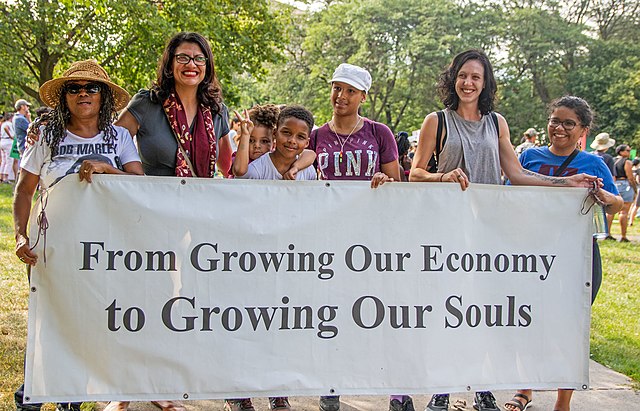
Photo: “Make Detroit the Engine of the Green New Deal!” rally (2019). Photo by Becker1999 via Wikimedia Commons https://commons.wikimedia.org/wiki/File:Make_Detroit_the_Engine_of_the_Green_New_Deal!_img_100_(34)_(48422992952).jpg




Comments
We changed commenting systems on September 10, 2026 as part of a site-wide functionality and security upgrade. Your past comments have not disappeared, and you can still log in with your old Disqus account credentials if you wish. Contact us with any questions.
If you want these things because you want affluence of comforts and happiness then you will not find them. Human affluence is the problem. The transhumanism of machines and the delocalization of human networking is now on a non-linear end game of diminishing returns. This is basically the reflection on problem solving is becoming the problem. The narrative is the problem. The problem solving is the effort to maintain the narrative that is the problem. The narrative is affluence. Affluence is gained by increased efficiency of the transhumanism of tech and the unrestricted drive to know all. Technology is the result. Technology can’t be controlled by humans. Yet, the planet will control it and is now modulating it with destructive change. Human forcing is now being forced but humans are just forcing harder. This is Scientism and Scientism is meaninglessness of the human noise of exceptionalism. The signal is the pulse of life found in nature.
Science is now a religion that is manifested in more technocratic control of increasing centralization and concentration of human networking. Technology is driving this in a vicious circle of increasing mechanization of humanism. Technocrats are seeking more automation and artificial intelligence to reduce human input. Human input is seen as lacking and too often irrational. To get to this technocratic point destructive humanism is being doubled down on with lie after lie. These elements are destroying humanity too. These efforts will self-destruct because technology can never be adequate and always must be advanced until diminishing returns rolls over. Scientist and economist love Moore’s law because they mistake it for a law of physics when it is just an observation. The key point here is the deception of managing human exceptionalism found in technological progress. The result is the rapid onset of the nonlinear of diminishing returns. Self-destruction is rapid when this tipping occurs because of the extreme imbalances of delocalization and mechanization of transhumanism.
Yet, this issue goes deeper than Scientism. It goes to the very heartbeat of civilization. Civilization is all about more power and control over nature. It is about the power to increase survival that leads to the power to find increasing comforts from the affluence of survival. Affluence leads to the specialization of tasks that allows rapid growth of human capability. This is a process that progressed slowly over the last 13,000 years but is now rapidly going non-linear into a bottleneck. It is now uncontrollable with more noise than signal. It is in fact much more superstitious than the primitives we always look down upon. Modern superstition is the belief and faith in human exceptionalism found in technology and knowledge accumulation. This is now entering the extreme with the transhumanism of the merging of man and machines into such things as the metaverse. The primitives had superstition but it served the purpose of limiting capability because animated spirts were there to negotiate human activity. Our wonderfully guarded ego had a limiting function with this superstition.
Today there is no limiting function just more science. Spirituality is not trusted. It can’t be explained by science so it is just a humanity to study for purposes of science where it is broken down and analysised. Humans want more comfort for less. We want a habitable planet with more comforts. Scientism tells us this is possible. The elites who are only concerned with the primal human instinct of wealth and power preservation love scientism. Scientism allows control of the masses. They are now using the religion of woke to influence the social narrative. This is just a Marxist Machiavellian lie to achieve a cultural revolution that leads to more elite power. Scientism is the ultimate prize of owning nothing and being happy which is little more than serfs living in feudalism. The ultimate fantasy of human exceptionalism found in scientism is rejected by anyone who trusts the common sense of nature.
I am offering no solution to this just the observation from years of living as a degrowth doomer. I do offer the advice of returning to the roots of man’s connection to the common sense of nature. There are still places where constructive growth is possible. These places are not in cities and they are not transhuman although you will have no choice but to live in this world of lies. The best you can do is use this delocalized transhuman world to find one that is more localized and less transhuman. This world is the world of localism found in permaculture. It is only here where meaning can be found. This includes small towns these permaculture farms orbit where basic crafts can be specialized in. This is not a refuge and these behaviors not transcending. It is only transformative with a mentality of lifeboats and hospices. Practice palliative care of restoration and renewal in a world coming apart at the seams. Realgreenadaptation.blog
If a capitalist doesn’t try to take or generate more sales opportunities then his rivals will do it and drive him bankrupt.
The same rule applies to nation-states, too. If some nations deliberately reduce their energy consumption and overall affluence (and thereby the size of their armed forces), they will easily be dominated by nations which continue to grow their economies.
For example, many millions of people in the Global South are already living “a simpler way”, as recommended by Trainer, but they aren’t being left alone. Rich countries in the Global North are succeeding in overwhelming them with capital investment and industrial agriculture.
Rapid Degrowth must be a global choice if it is to work at all and the prospects of every country making that choice look increasingly slim. A more likely prospect is an uncontrolled collapse of capitalism from unpayable debt or other failure of financial complexity.
In any case, the rate of economic simplification required to save a habitable planet is now so great that there would be little difference between uncontrolled collapse and a planned Degrowth that would actually accomplish something. I would be happy to see either one happen, and soon.
We aren’t going to change, until we crash.
So the best we can do, is garner the skills, the knowledge (book-form, the internet won’t be there), and some better think about leadership, because good leadership will make the difference between good local and dysfunctional local.
Alas I fear Ted is correct. I am a Green a party Member here in Canada, both provincially and federally. The greening of our energy supply is needed. That is why I am Green politically. However, I recognize that the shiny new greed deal doesn’t scale enough to run our present economy. Trying to provide another perspective on the need to embrace a planned degrowth strategy can be frustrating when almost everyone in the Party believes we can have exponential growth on a finite planet. Hopefully the consequences we are experiencing will be sufficient to awaken the majority to at least consider reducing economic through put, and abandoning capitalism before sufficient ecological boundaries are crossed triggering collapse.
Straw person 1: “it is claimed that the rate of production and consumption can continue to increase while the resources needed to do this can be reduced to sustainable levels”
No one I know who wants a strong GND thinks growth can continue for much longer. Some want to restrict non-crucial sectors (with rationing, taxes, or other means) so fossil & fissile fuels (F&FFs) can be replaced with efficiency, wiser lives, & clean safe renewable energy; & ag, forestry, & industry can transition to sustainable forms. Others, maybe not appreciating the direness of the climate crisis, or maybe understanding it’s so dire we can’t wait for a revolution, think we can grow until we’ve accomplished those, then need to reform everything.
Straw person 2: “what matters is whether the overall output of an economy can be reduced as its GDP rises” …”is not occurring”
No, what matters is whether the harm a society does can be radically reduced as it becomes radically equal. Whether something IS occurring or not doesn’t dictate whether it CAN.
Straw person 3: “absolute decoupling”. Despite almost everyone who talks about decoupling speaking only of “decoupling” and regrettably not referring to partial or relative decoupling, it almost always becomes clear that’s what they’re talking about, consciously or un. In all other cases I’ve seen, it’s left unclear, but that makes it clear it’s like all the cases, since to take a position uniquely contrary to the norm would certainly be made explicitly clear. The language should be fixed, (decoupling vs. stretching?) but it’s hardly grounds for the radical interpretation made here.
Straw person 4: “…rising energy costs, rising environmental costs…”
The scenario presented assumes continuation of the things causing those, which turns this into a question-begging straw person, a special thing, indeed. Replacing fossil and fissile fuels with clean safe renewable energy, chemical-industrial ag with small-scale low-meat organic permaculture, and so on, negates that assumption, and the statement that’s made based on it.
Straw person 5 debunked: We’re extremely unlikely to reach 10 billion; the only places population is still growing are the places climate catastrophe is hitting hardest, where people are least able to adapt.
Straw person 6: “how likely is it that tech fixes could cut impacts to around 10% of present levels while GDP rises to about 2.5 times its present level by 2050?”
GDP doesn’t have to rise; it has to be more equally distributed. It’s likely it can even fall considerably while leaving everyone with a fulfilling life of material enoughness and psychological and cultural riches.
Straw person 7: Claiming socialism is essentially favoritistic capitalism.
Capitalism is anarchy and vice versa. Trainer’s solution is the problem.
Straw person 8 debunked: NO ONE is claiming the Green New Deal will “save us”.
It will solve the greenhouse gas and larger ecological crisis (other F&FF pollution, eg). However, it won’t solve our larger psycho-ecological problem. But most people don’t realize the extent and depth of the evil/lunacy of the far right ruling the US, so they don’t understand how radical the solutions are.
Ko threat
They don’t realize an actual, though peaceful, revolution will be required to replace almost every elected official in the US and most state governments with progressives, to be able to implement the Green New Deal.
The pursuit of wealth is mostly caused by the psychological affliction of the rich, from a combination of trauma, attachment problems, and the resulting addictions. The best name for it is Wetiko disease, or malignant egophrenia.
Seeing Wetiko: on Capitalism, Mind Viruses, and Antidotes for a World in Transition
https://www.filmsforaction.org/articles/seeing-wetiko-on-capitalism-mind-viruses-and-antidotes-for-a-world-in-transition/
Acquisitiveness is also partly caused by insecurity, mostly a result of structural factors, but those in turn are caused by Wetiko, and its inequality. Whatever form of government is tried, it will fail unless civilization is healed of its most serious psychological illness.