

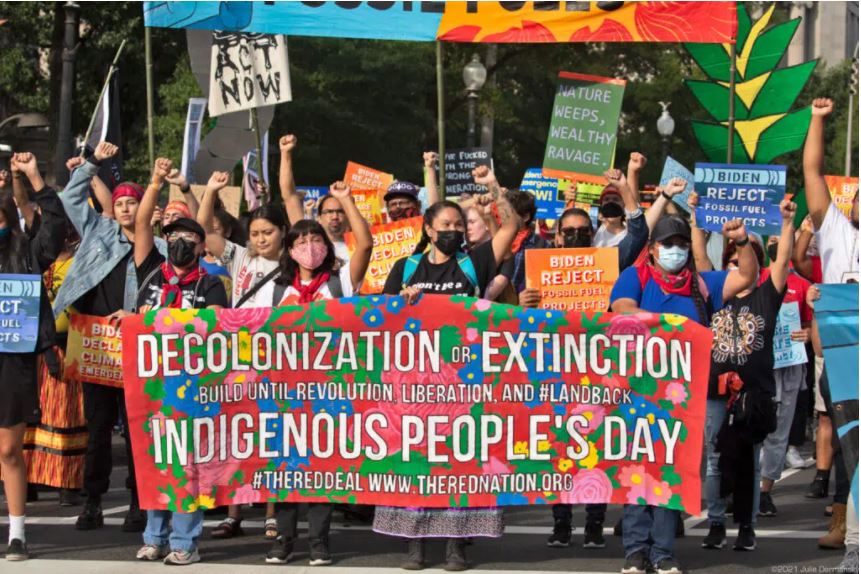
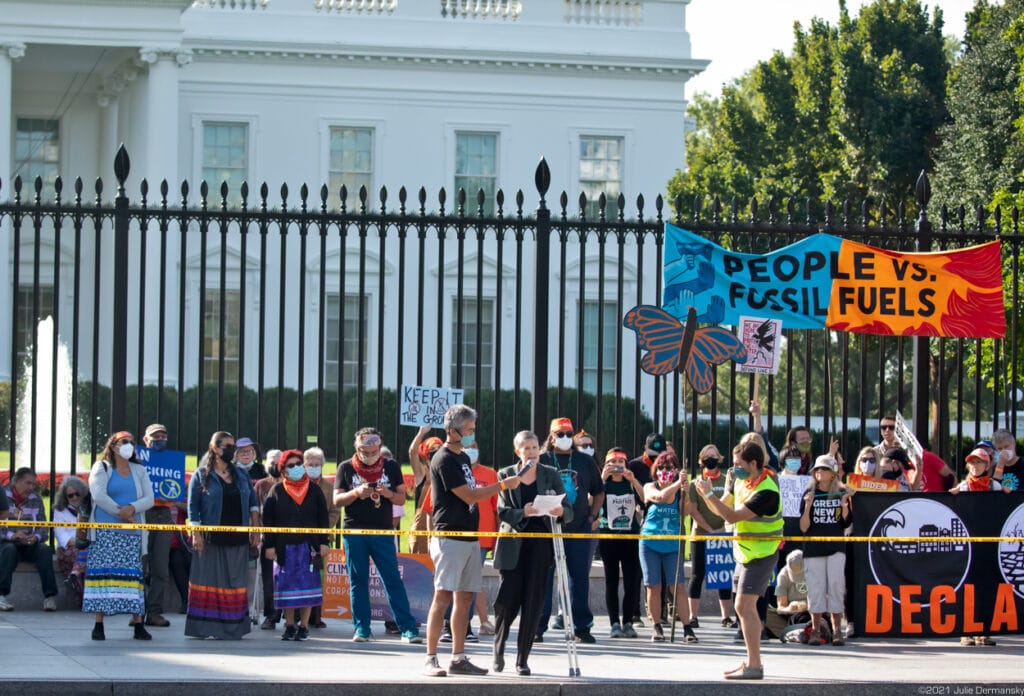
As environmental advocates from across the United States converged in Washington, D.C. last week to take part in the five day “People vs. Fossil Fuels” action, President Biden’s infrastructure package remained stalled, in part, by West Virginia Senator Joe Manchin’s push to cut its largest climate measure.
The series of fossil fuel protests were organized by a coalition of over 25 environmental groups known as Build Back Fossil Free, a poke at Biden’s “Build Back Better” agenda. Indigenous leadership in the fight against fossil fuels was forefront at the rallies.
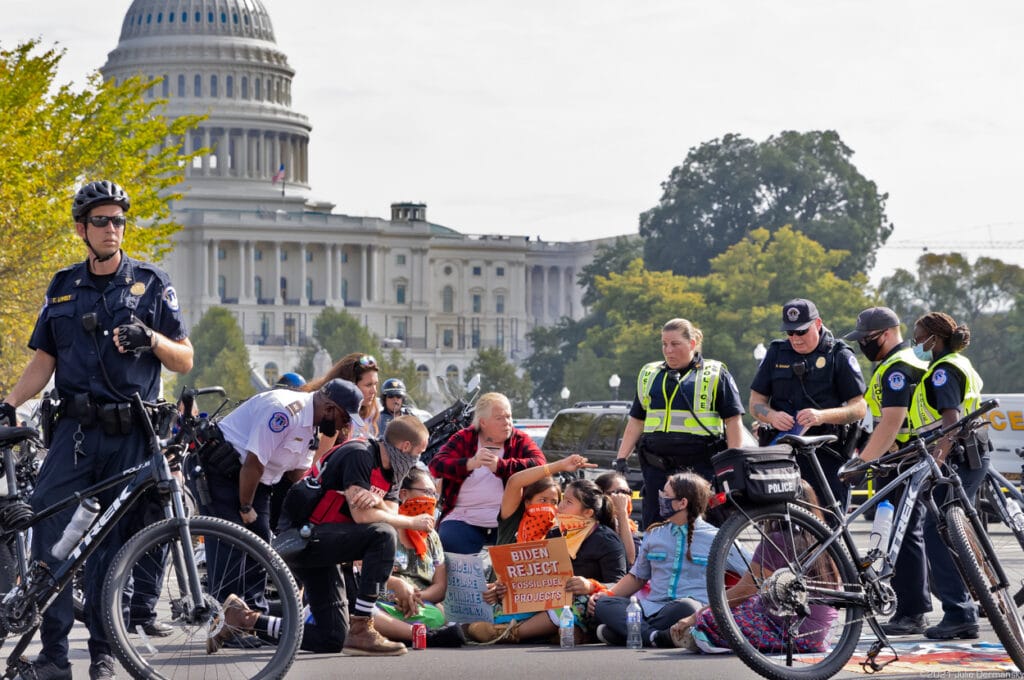
Capitol police in the process of arresting climate activists including Indigenous youth that led the final day of the ‘People vs. Fossil Fuels’ protest in Washington D.C. on October 15, 2021. Credit: Julie Dermansky
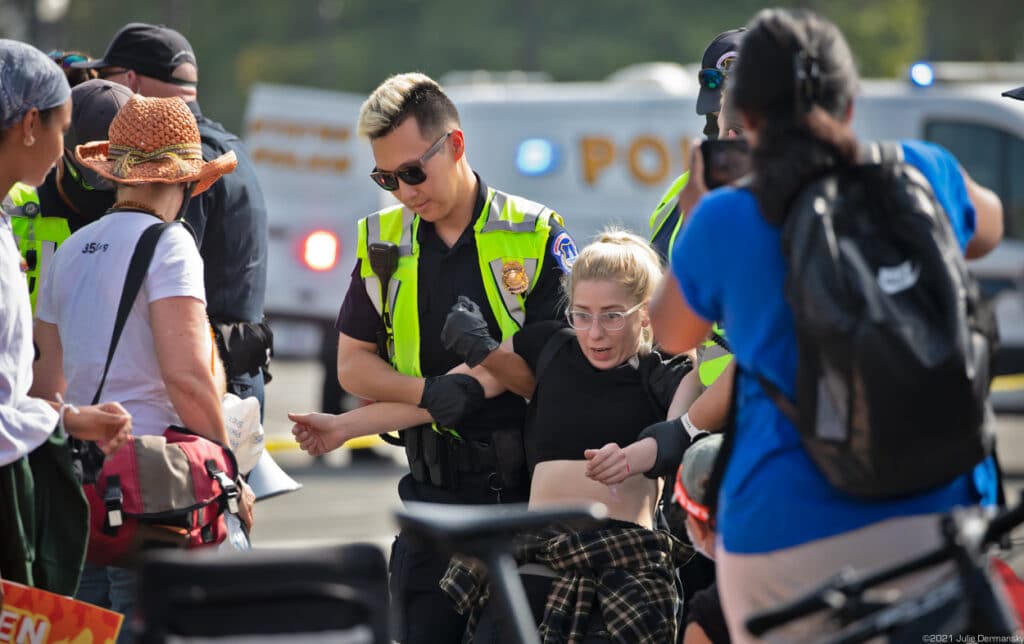
Climate activist being carried away by the Capitol police on October 15, the final day of the ‘People vs. Fossil Fuels’ protest. Credit: Julie Dermansky
The week of protest included acts of civil disobedience leading to over 650 arrests. Most of the arrests took place in front of the White House, where sit-ins were held for four consecutive days. Others were arrested at the Department of Interior building, home to the Bureau of Indian Affairs (BIA), after holding a sit in inside on October 14.
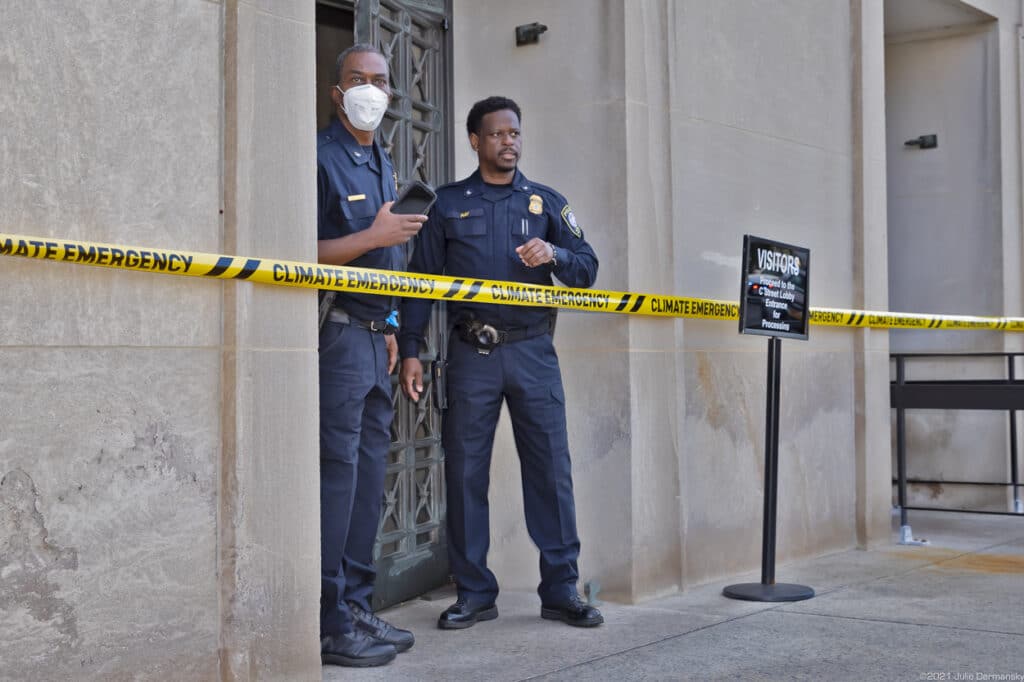
Guards inside the Bureau of Indian Affairs in Washington, D.C. standing behind custom police tape marked “Climate Emergency” that activist put across the entrances of buildings October 14 while dozens of Indigenous activists protested inside. Credit: Julie Dermansky
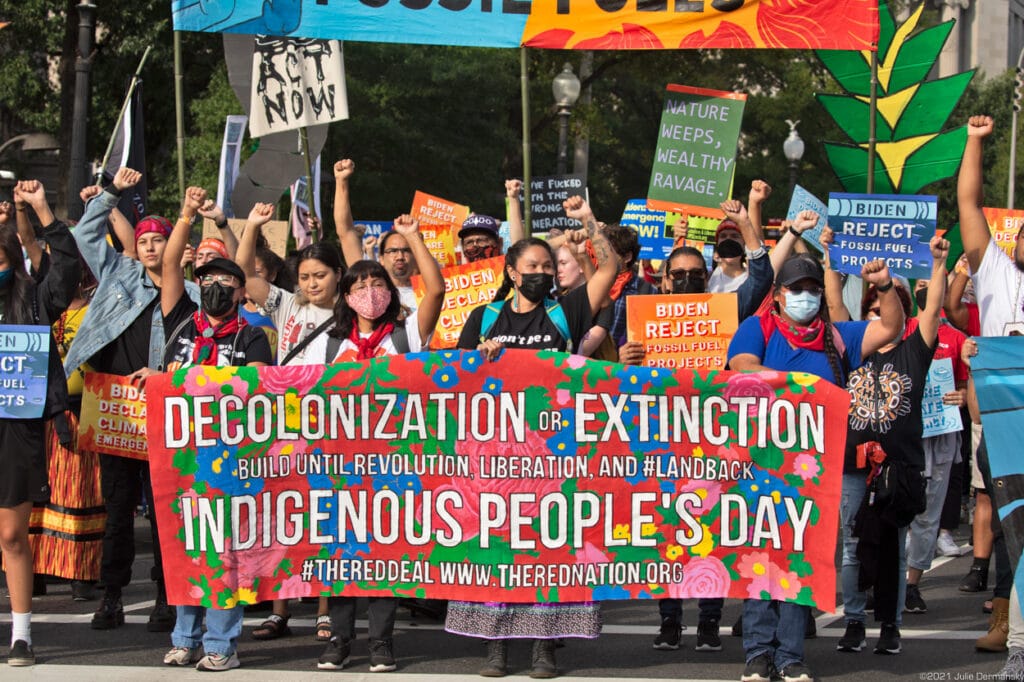
Indigenous youth leading a march from Freedom Plaza to the Capitol on the five day of the ‘People vs. Fossil Fuels’ protest. Credit: Julie Dermansky
And on the last day of the protest, October 15, further arrests were made when a group of Indigenous youth and their supporters participated in a sit-in at an intersection near the Capitol, blocking traffic and refusing to disperse when ordered to do so by the Capitol Police
At all of the actions last week, activists expressed their rage that Biden has not delivered on climate-related campaign promises, adding that the administration’s plans do not go far enough to protect the planet from the rapidly intensifying climate crisis.
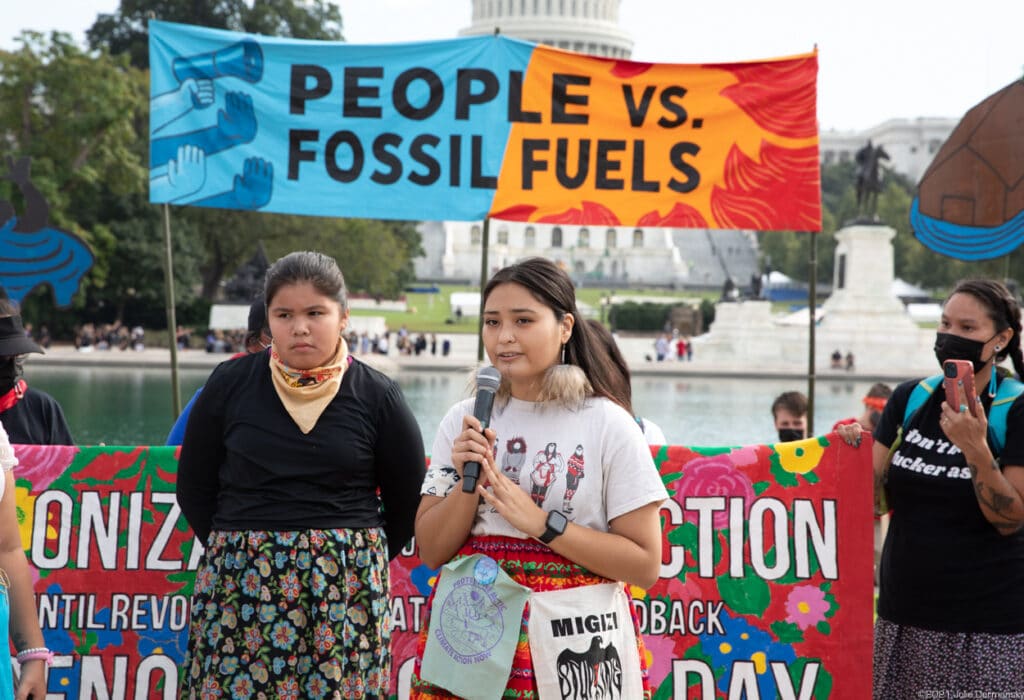
Sonny Urgent speaking about how climate change has affected her community in Northern Alaska in front of the Capitol Reflecting Pool on the last day of the ‘People vs. Fossilfuels’ protest, October 15, 2021. The Arctic, she said, is warming at nearly three times the rate of the rest of the world, and her community in Utqiagvik is on the front lines. Credit: Julie Dermansky
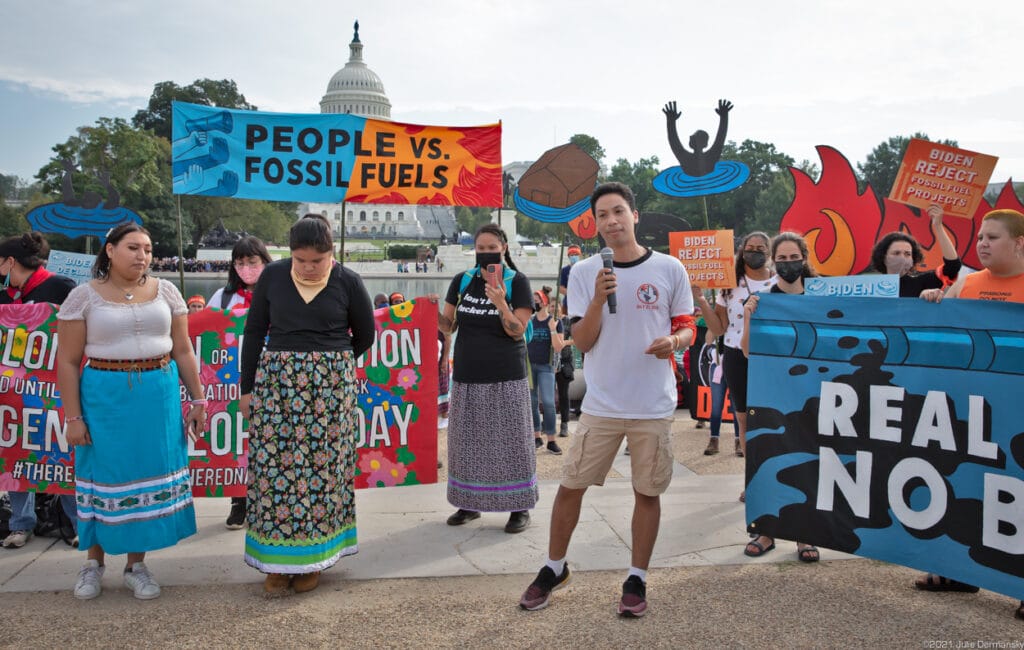
Zanagee Artis, the co-executive director of Zero Hour, speaking by the Capitol Reflecting Pool on the last day of the ‘People vs. Fossil Fuels’ protest. Credit: Julie Dermansky
“We need climate action now. We are out of time to address this issue,” said Zanagee Artis, the co-executive director of Zero Hour, a youth-led climate justice organization, during a rally near the U.S. Capitol on October 15. “I campaigned for Biden. I called voters in Philadelphia. Black and brown people voted in droves, young people voted in record numbers for a president who promised action on climate change. Now he has the power to revoke the permits for Line 3 [pipeline] and he has not. He has the power to stop DAPL and he has not. He has the power to revoke fossil fuel leases and he has not.”
A reporter at a White House briefing on October 14 pointed out that hundreds of climate protesters were in front of the White House demanding Biden stop approving fossil fuel projects and declare a climate emergency. The reporter then asked if the administration is considering or listening to their demands.
White House Press Secretary Jen Psaki confirmed that they are listening.
“I would encourage anyone out there, or not, to look at what the President is proposing, what he’s trying to push across the finish line at this point, which is an enormous investment and commitment to addressing the climate crisis,” she said.
However, the Indigenous Environmental Network, one of the leading groups behind the five-day protest, has come out against both major pieces of legislation, as previously reported by DeSmog. The network contends that each bill includes some form of fossil fuel subsidies — and that there is no time for a middle-of-the-road approach.
As Biden readies himself to leave for the COP26 United Nations climate summit next month, the planet is on track to warm more than 2 degrees Celsius (3.6 degrees Fahrenheit) above pre-industrial levels. If greenhouse gas emissions aren’t rapidly reduced, scientists warn this level of global warming will likely cause irreversible warming of the planet, leading to increased catastrophic disasters including fires, heat and cold waves, flooding, and the intensifying of hurricanes.
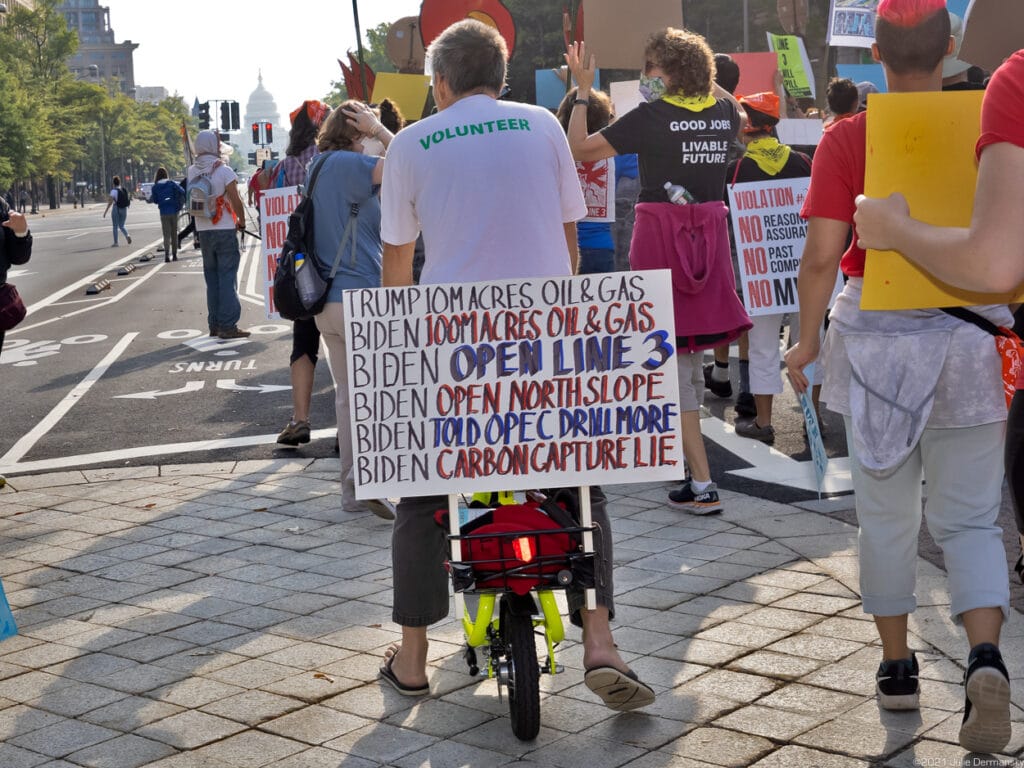
Demonstrators making their way to the Capitol on the last day of the ‘People vs. Fossil Fuels’ protest in October 2021. Credit: Julie Dermansky
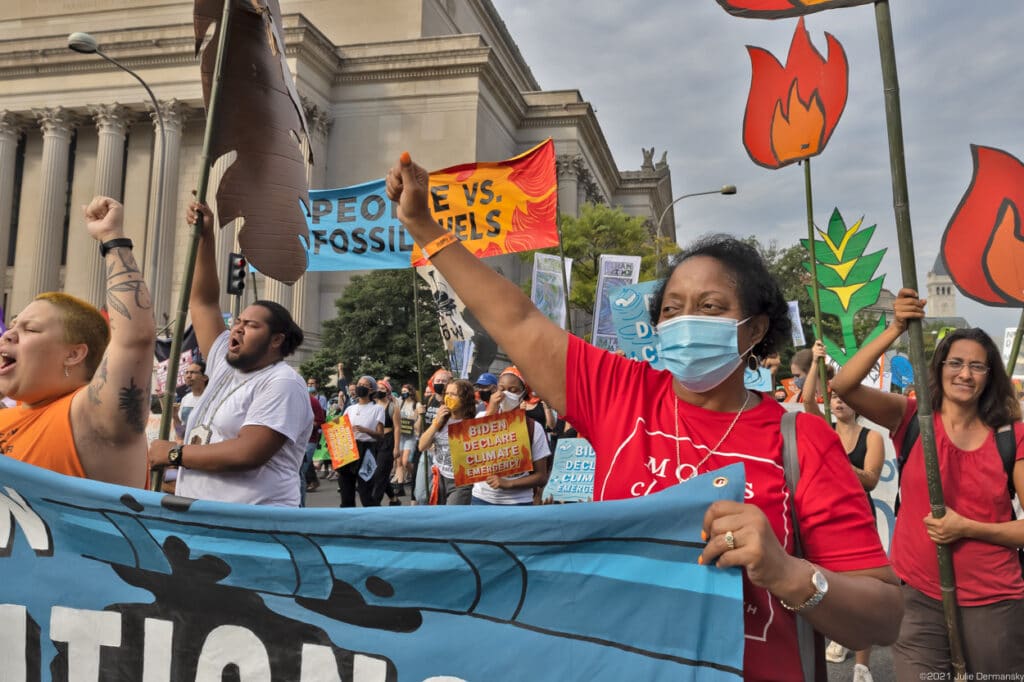
Goldman Prize winner Sharon Lavigne of Louisiana marching from Freedom Plaza to the Capitol on the final day of the ‘People vs. Fossil Fuels’ protest with a couple hundred others. Credit: Julie Dermansky
Climate advocates during the D.C. protests warned that time is almost up to implement meaningful change. Sharon Lavigne, founder of community group RISE St. James from Louisiana, shared her firsthand account of what living with worsening climate impacts is like. Hurricane Ida destroyed her roof, which led to flooding inside her home, leaving it uninhabitable.
Many of the speakers during the five days of action highlighted the Biden administration’s failure to reject projects they say he has the power to stop right now, including the Mountain Valley Pipeline, the Line 3 pipeline, and Formosa’s multi-billion-dollar plastics complex in Louisiana, among others.
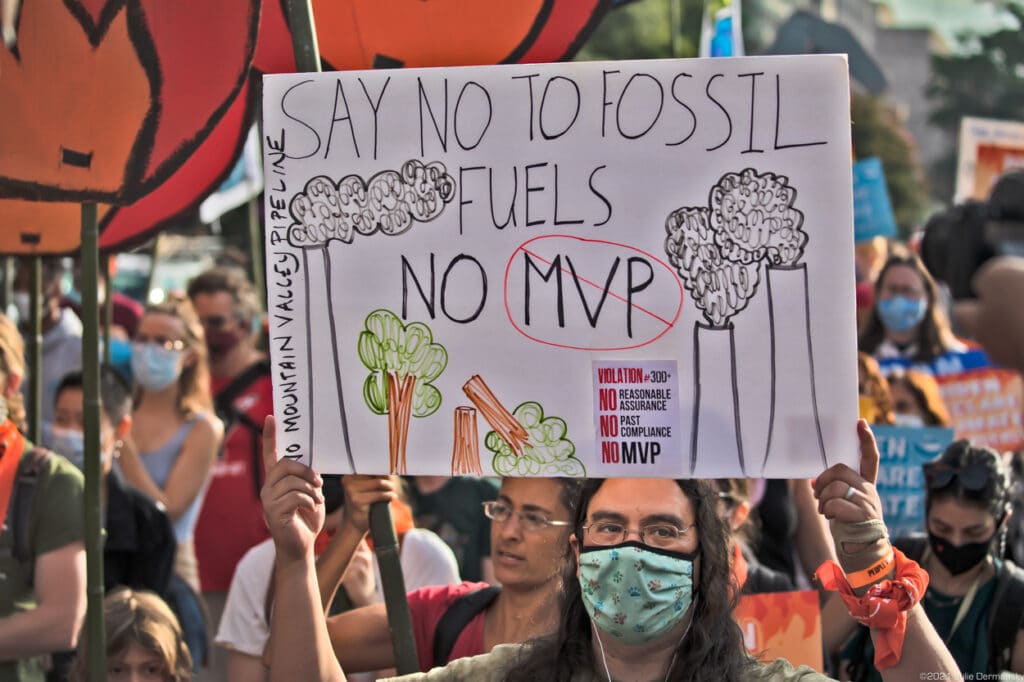
An activist holding an anti Mountain Valley Pipeline sign while marching from Freedom Plaza to the White House on the final day of the ‘People vs. Fossil Fuels’ protest, October 15, 2021. Credit: Julie Dermansky
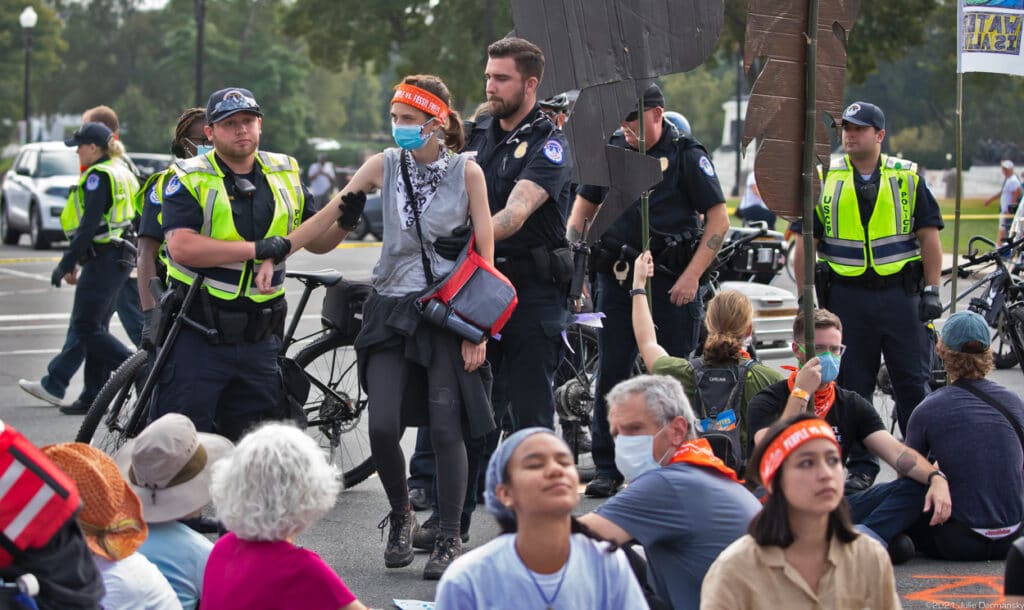
Climate activist being led away by the Capitol police on October 15, the final day of the ‘People vs. Fossil Fuels’ protest. Credit: Julie Dermansky
“By refusing to stop major fossil fuel projects, President Biden has broken his promises to protect Indigenous rights, prioritize environmental justice, and fully address the climate crisis,” said an October 15 release from the organizers of the People vs. Fossil Fuels protests. As the press release states, “new analysis from Oil Change International shows that if the Biden Administration moves ahead with 21 major fossil fuel infrastructure projects that are currently under federal review, it would be the emissions equivalent of adding 316 new coal-fired power plants — more than are currently operating in the United States. The total emissions from just these projects would represent 17% of total US greenhouse gas emissions in 2019.”
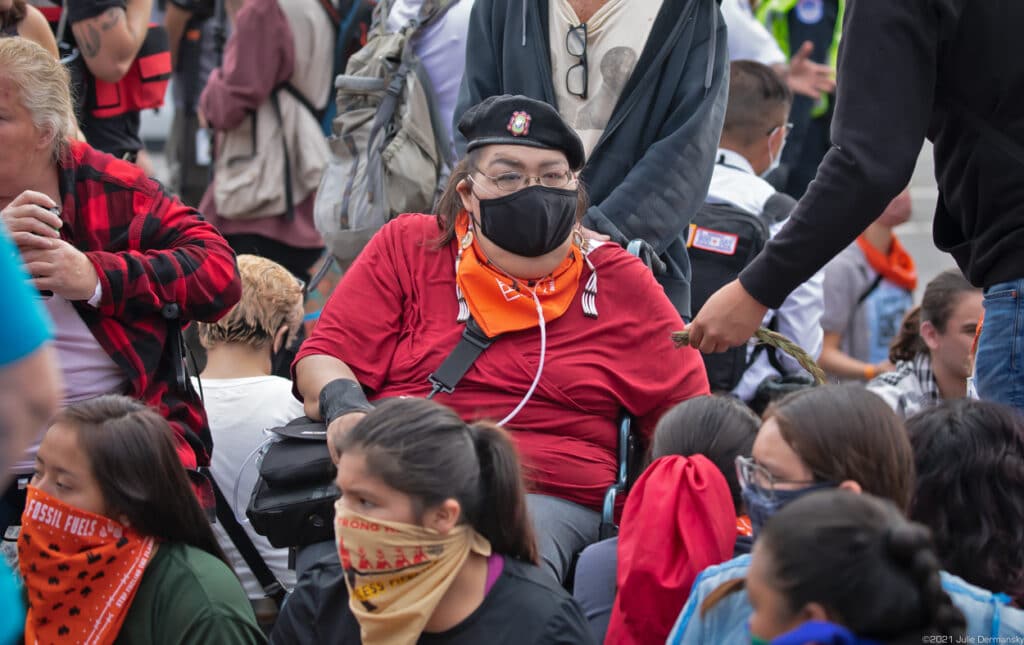
Joye Braun, a member of the Cheyenne River Sioux Tribe and part of the Indigenous Environmental Network, sitting with Indigenous youth risking arrest on the last day of the ‘People vs. Fossil Fuels’ protest. Credit: Julie Dermansky
Biologist and anti-fracking activist Sandra Steingraber urging President Biden to act according to science on day four of the ‘People vs. Fossil Fuels’ protests. Credit: Julie Dermansky
Advocates also warned about false solutions that the Biden administration and other Democratic Party centrists are embracing, such as carbon capture and hydrogen fuel made from natural gas, neither of which are commercially viable technologies. “There is no time for parlor games like blue hydrogen or wolves in sheeps’ clothing like fracking,” Sandra Steingraber, a biologist and author who highlighted the health impacts of living near fracking industry sites, said before she was arrested in front of the White House on October 14. “Or unworkable, fanciful Rube Goldberg–contraptions like carbon capture and storage.”
[slide-anything id=’3472166′]
That same day, on October 14, Louisiana’s Gov. John Bell Edwards welcomed a proposed $4.5 billion blue hydrogen clean energy complex.
The organizers of the D.C. protests have yet to announce their next moves following the five-day action, but the Indigenous activists who were in the streets vowed to do whatever it takes to protect the planet for the next seven generations.
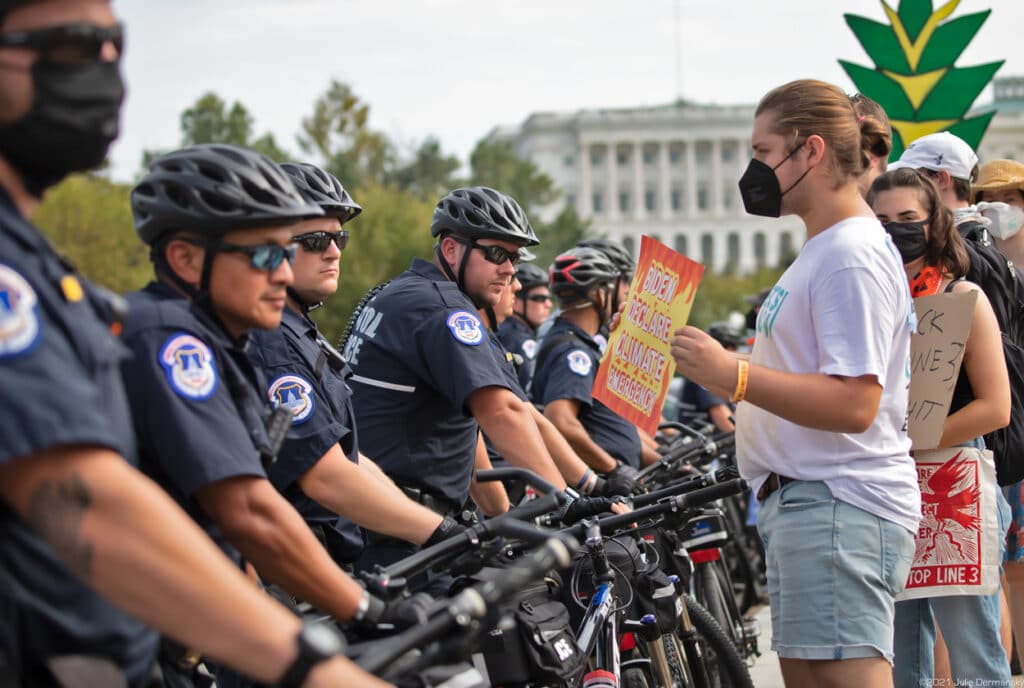
Climate activists taunting the capitol police on October 15, 2021 the final day of the ‘People vs. Fossil fuels’ protest after 90 people were arrested for blocking an intersection near the Capitol. Credit: Julie Dermansky



Comments
We changed commenting systems on September 10, 2026 as part of a site-wide functionality and security upgrade. Your past comments have not disappeared, and you can still log in with your old Disqus account credentials if you wish. Contact us with any questions.
I think, much like rigged election results, denial of whatever someone wants to deny will never go away. It might become discredited enough to not be mentioned in proper company though. As far as peak oil, it isn’t just that it is a chaotic system, but that those studying it kept themselves far too limited in the understanding of the key component parts. For me, the main benefit of the peak oil movement was to teach me empirically that faith based belief is far stronger than intelligence and education. The intelligence and education simply leads you to be more certain in your faith.
I think you’ve got a personal thing about peak oil, or at least some of the people involved.
I happened to mention, back during the Happy McPeakster days, that neither the claim itself, nor the mechanisms and concepts used to declare it, were new. And had anyone figured out why it didn’t work out then, and account for it within their latest grand proclamations. Ran into the conform or be cast our problem. Always struck me as a run of the mill understand your hypothesis problem instead, and those involved in that particular belief system wanted nothing to do with that. So yeah, I’ve got lingering irritation with the acolytes of that particular congregation.
Sorry it happened to you.
Bart, if you are ever out Denver way, and want to have a free lunch, and listen to a killer peak oil story, let me know. In public I will only say that any of us can be motivated to great accomplishments, given the right combination of circumstances.
Looks like an all around good but typically ineffective time was had by all? No capital police were harmed in the picture taking and sign waving, and the committed burnished their future protest cred by snagging a little arrest to establish their bona fides at the next planning meeting?
You would have the signs of a movement in birth. People always do.
Sure. Except the signs of a movement were far stronger this January 6th than the one discussed in the article. And that should make anyone nervous as to the relative strength of the signs, and on which side that advantage falls.
Jan 6 to me was just another chapter of the culture wars. Dramatic but not deeply significant.
The Republican organizing in the background, e.g. to suppress voting is what I’d pay attention to.
Organizing around clinate is going on at the same time, in another dimension. It has legs, because climate change will just be getting more pronounced.
The idea of the Confederate battle flag getting into the capital building carried by a bunch of yahoos when the entire Confederate army couldn’t make it happen was somewhat irritating. And sure, climate change will become more pronounced. Adapt early and avoid the rush, because humans sure aren’t going to do anything about it, except try and talk it to death.
In this era, it’s important to distinguish between kayfabe (phoney drama) and substantive politics.
The real question about January 6 is who in authority allowed it to happen. So far, I’ve seen no satisfactory answers. If there were a serious threat, it would come when sectors of the military and police took sides.
Meanwhile, both parties have a drama that stirs people up and distracts them from real issues.
Climate change is different. The trends that created it were centuries in the making, and they have become interwoven with modern culture. It’s not going to be undone with a march or Jan 6 type drama.
The change in outlook starts at the edges of society – kind of where we are. At first it’s the non-conformists, the eccentrics, who see the changes coming. Gradually the new thinking spreads over society. AKA
“First they ignore you. Then they ridicule you. And then they attack you and want to burn you. And then they build monuments to you,”
So…you use Hitler as your model, and just hope that you get to the monuments part in the end, rather than the other outcome?
What are you talking about? How does Herr Adolph come into the discussion?
First they ignored him. Then they ridiculed him. Then they attacked him and wanted to burn him. But he didn’t get the monuments. Seems like the path to the monuments isn’t as sure fire as some might hope.
True, nothing sure fire.
I’m obsessed with Mittelduropa (Eastern Europe), how quickly and dramatically the regimes changed.
OTOH, there are social changes that are probably irreversable. The revulsion against slavery, for example. Antiseptic procedures in medicine. Scientific thinking.
I agree with you about the first two. After the past 5 years in America, I am seriously questioning whether or not the 3rd can survive, what with the effectiveness of mass production of misinformation, gaslighting, the power and influence of social media to overwhelm the most basic facts and data, etc etc.
This is a quote from an early labor organizer. A similar quote is wrongly attributed to Gandhi.
Signs of a sea change:
Libertarians at Reason getting on board (plugging entrepeurs as usual, of course!)
“Evidence-based policies to slow climate change”
https://reason.org/policy-study/evidence-based-policies-to-slow-climate-change/
And in the Dog that Didn’t Bark Deparment, I haven’t seen much of the climate deniers recently. We don’t get the attacks by climate trolls the way we used to.
Indeed. And in the “how many dooms can we recycle how fast” department, the claimed horrors of peak oil doom from 15 years ago appear to have died down. I’ll bet you that one will come back before the other though.
I think climate denial will quietly fade away, as wildfires, heat waves, etc. become impossible to deny.
Peak oil showed me the folly of making short-term predictions for a chaotic system. It’s still a distinct possibility though – it would just take a war in the Mideast.
For me, the main benefit of the peak oil movement was to focus attention on energy, to learn how critical it is for society – and especially how critical oil is.
After I read through the article, did I receive the correct impression that the discussion is still weirdly focused on ways that might/could/ought to work, without much in the way of overall sacrifice on the part of the fine humans of the world who got us into this mess in the first place?
Hey , what do you expect from the libertarians? 😉
The point is that they are accepting the reality of climate change, rather than saying it’s all a hoax.
It is. I would only ask you keep it to yourself. 🙂 But hey, there is a free lunch involved, so there is that!