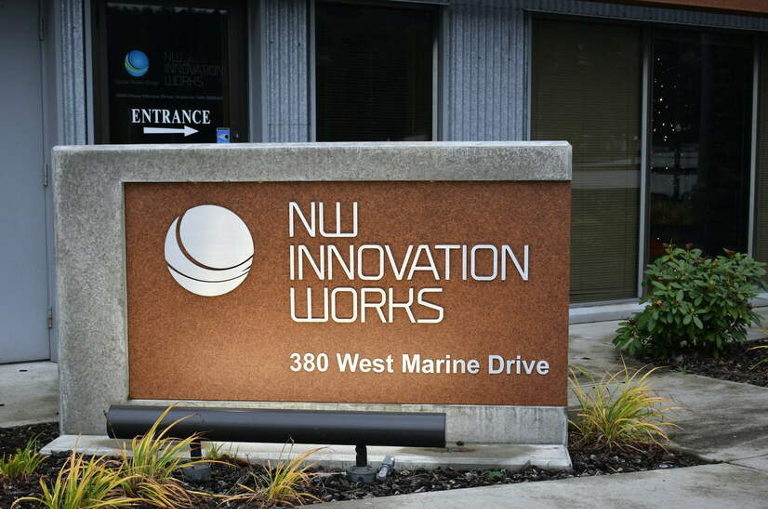
In 2014, a company named Northwest Innovation Works (NWIW) proposed building a multi-billion-dollar petrochemical project in Kalama, Washington, a port town roughly 40 miles north of Portland, Oregon. Now, after years of delays and multiple rounds of evaluation, a critical state permit decision is expected imminently for the fossil fuel project.
The facility would process fracked natural gas into methanol, a liquid chemical that can be used as fuel or for manufacturing plastics, and ship the flammable product down the Columbia River for export to Asia.
The facility is highly controversial and would have an enormous greenhouse gas impact, but NWIW has lined up powerful figures in the State of Washington to help make the company’s case.
 Totem poles carved by now-deceased Chief Lelooska overlook the Columbia River in Kalama, Washington, which occupies the traditional lands of the Cowlitz Indian Tribe and Confederated Tribes of Grand Ronde. Credit: Nick Cunningham
Climate Footprint
One of the key issues facing the State of Washington is the greenhouse gas impact of the project. The Kalama methanol project would be one of the largest gas-to-methanol facilities in the world. If built, it would release as much as 4.8 million metric tons of CO2, roughly equivalent to 5 percent of Washington’s total emissions, according to state regulators.
Viewed another way, the facility would consume more natural gas than all of the Pacific Northwest’s major cities combined, according to an analysis from the Sightline Institute, a Seattle-based sustainability think tank.
Despite this climate footprint, Washington’s Department of Ecology suggests that the gargantuan methanol facility will result in a net climate benefit.
The agency finalized its second supplemental environmental impact statement (SSEIS) in December 2020. It concluded that if NWIW’s methanol project were not built, then China would end up relying on dirtier facilities that produce methanol from coal instead of natural gas, resulting in even more carbon pollution. Without the Kalama plant, Ecology estimates, emissions from methanol production in China could even be twice as high.
In the coming days, that conclusion could be used to approve or deny a Shoreline Conditional Use Permit, a critical permit that would move the project into the next phase of permitting. Ecology has until January 20 to decide.
At the heart of Ecology’s greenhouse gas calculation is a key assumption: that China’s methanol demand will rise inexorably and inflexibly for the next 40 years. Under that scenario, more supply will always be needed, and much of it will come from coal. In that way, Kalama methanol could indeed push out dirtier facilities.
If, however, China works towards slashing emissions, critics say the Kalama methanol project will add fossil fuel infrastructure at a time when the world can ill afford it.
“I think that where their argument really falls apart is this assumption that China will never reduce its fossil fuel energy consumption,” said Paul Thiers, associate professor in the School of Politics, Philosophy and Public Affairs at Washington State University and a China expert.
In September, China’s President Xi Jinping announced that the country would aim to achieve net-zero emissions by 2060. Thiers says that for a variety of domestic reasons, China wants to reduce air pollution and cut carbon emissions.
China says it will cut its carbon dioxide emissions to nearly zero by 2060, in a surprise move announced at the UN General Assembly in New York.
The country is the world’s biggest producer of greenhouse gases https://t.co/FFTuD1Uqpv pic.twitter.com/umKTcP3pK3
— Financial Times (@FinancialTimes) September 22, 2020
In a statement to DeSmog, Ecology spokesperson Jeff Zenk said:
“The economic assumptions in the SSEIS are neither bullish nor bearish. They are the best estimates based on current trends with full acknowledgement of the inherent uncertainties in these type of analyses.”
Instead of basing its calculation on long-term forecasts of market conditions in China, which are riddled with uncertainties, the agency should focus on what it knows, says Eric de Place, director of Thin Green Line at the Sightline Institute.
“And what they know — and what is completely indisputable — is that [the project] is going to create market demand for a whole bunch of fracking, it’s going to need a whole bunch of gas, it’s going to refine that gas into a liquid petrochemical and it’s going to be shipped to Asia. All that stuff is known. The other stuff is speculative,” de Place told DeSmog.
In a September critique of the agency’s environmental impact statement, he wrote that the Department of Ecology “is essentially saying that scientific alarms be damned: we should double-down on climate pollution over the coming decades in the hopes that someone else won’t triple-down on it.”
In an emailed statement to DeSmog, NWIW cited Ecology’s assessment as proof that the project is a win for the climate.
“The Washington State Department of Ecology study has answered the [greenhouse gas] question unequivocally by confirming that building the facility will benefit the planet as much as eliminating the emissions of Seattle, Bellevue, and Tacoma combined,’” the company wrote in a statement. “Opponents of NW Innovation Works are using carbon math that is as deceptive as many of the corporations that DeSmog investigates and debunks.”
‘Influence Peddling’ in Washington State
The proposed methanol facility lost a major political ally when Governor Jay Inslee, citing the urgency needed to tackle global warming, reversed his original support for the project as a much-needed source of economic growth. In 2019, he came out in opposition to the Kalama facility, at a time when he was running for president as the climate candidate.
After signing a bill that bans fracking for oil and natural gas within WA state, I shared how the emerging science emphasizes the urgency of #climatechange and the environmental impacts of natural gas make it clear that our state needs to invest in #cleanenergy infrastructure. pic.twitter.com/1ydPChkLHt
— Governor Jay Inslee (@GovInslee) May 9, 2019
However, other powerful political figures in Washington state, as well as the former Obama administration, have lined up in support. NWIW has enlisted a cadre of heavy-hitters in the Washington political world to make their case in Olympia.
[slide-anything id=’3472166′]
Perhaps most notable is the case of Washington State Representative Richard DeBolt, who did not run for re-election in 2020 and left office in January 2021. For roughly 25 years, he represented a district that includes Kalama, where the project would be constructed. At the same time, since 2016, he has been directly employed by NWIW as the director of external relations, a position that earns him at least $120,000 per year. Such an arrangement is allowed in Washington, so long as Rep. DeBolt did not vote for legislation related to the project and that he didn’t directly lobby state officials.
However, emails obtained by environmental nonprofit Columbia Riverkeeper show that on August 30, 2017 a lawyer for NWIW referred to Rep. DeBolt as their “point guy with Ecology on the Kalama matter,” an apparent reference to the crucial permit process currently under review by Washington’s Department of Ecology. Ethics rules bar him from lobbying state officials while simultaneously working for a company that might be affected by his work as a legislator, but “there is reason to believe that’s exactly what he was doing,” de Place of the Sightline Institute wrote in a December 2020 report detailing multiple political connections to the company. Rep. DeBolt did not respond to questions from DeSmog. Jeff Zenk, a Department of Ecology spokesperson, said in an email: “Richard DeBolt has not lobbied Ecology on NWIW’s shoreline permit.”
Meanwhile, the former head of Washington’s Department of Commerce, Brian Bonlender, has also publicly supported the methanol project. As the agency’s director from 2013 to 2019, he courted NWIW, which involved taking a trip to China as part of a trade delegation, where the company gave him a presentation on the proposed project. NWIW is partially owned by the Chinese Academy of Sciences Holdings, a quasi-government agency of the Chinese government.
In 2019, Bonlender left the state Department of Commerce, and immediately started a lobbying firm. Public disclosure records do not show NWIW as a client, but Bonlender twice appeared at public hearings testifying in favor of the methanol project and talking up the environmental benefits of the huge petrochemical facility. His Twitter account also shows several tweets promoting the project.
Today @EcologyWA analysis: this project will reduce greenhouse gas emissions by 6 mil tons/yr, equiv to Trans Alta coal plant.
Oh, it creates hundreds of jobs in a rural community and helps lead world toward lower carbon synthetics & other materials.
If not this, then what? https://t.co/VQZh7OCSyJ
— Brian Bonlender (@BrianBonlender) September 3, 2020
In an emailed statement, Bonlender confirmed that NWIW has “retained” him for some services related to the project, including helping the company craft a greenhouse gas emissions mitigation plan, as well as analyze trends in China’s plastics industry. State guidelines do not require him to disclose his arrangement with NWIW since his work for the company does not include lobbying.
In his statement to DeSmog, Bonlender wrote at length about the coal-to-methanol pollution footprint in China, and how the Kalama project could help. “NWIW remains the only answer to curbing the growth in China of the climate-catastrophic coal-to-plastics industry,” Bonlender wrote.
Another powerful political connection is Rick Desimone, a lobbyist who is also the former chief of staff to Washington’s U.S. Senator Patty Murray (D). Desimone has worked as a Senior Advisor for NWIW.
The Port of Kalama is seeking tens of millions of dollars in federal grants from the U.S. Department of Transportation to upgrade a dock for loading methanol onto large vessels. And in May 2020, Sen. Murray wrote a letter to the Department of Transportation to support the Port of Kalama’s application. In other words, Sen. Murray has lent her support for a federal grant that would benefit a company where a former staffer of hers now works. Neither Rick Desimone nor Sen. Murray’s office responded to a request for comment.
NWIW also showered the state legislature with political donations. In October 2020, the company put $50,000 into Southwest Priorities PAC, which then divvied up that money to two Democrats representing Kalama in the state legislature: State Senator Dean Takko and Rep. Brian Blake. Both Democrats supported the project, and Sen. Takko even sent Governor Inslee an angry letter in 2019 after the Department of Ecology decided to undertake further environmental review on the shoreline permit. Sen. Takko called the delay “a cowardly swipe at our ambition to bring prosperity back to Southwest Washington.” NWIW’s financial support ended up not being enough, and both Sen. Takko and Rep. Blake were swept out of office in the 2020 election.
In an email exchange, when asked why NWIW might support the two campaigns, Rep. Blake said: “They wanted us to be re-elected.” When asked if NWIW may have funneled that money as a reward for supporting the project, Rep. Blake simply responded: “No.” Sen. Takko did not respond to a request for comment.
Other influential politicians who have been involved with NWIW include former Washington Governor and Commerce Secretary under President Obama, Gary Locke, who served on NWIW’s “Global Advisory Board,” which was created to advise the company on the project. When asked about the nature of his work on the board by DeSmog, Gov. Locke did not answer specifically, but said he did not lobby state officials, adding that he has not worked with the board “since mid-2017.”
Another former board official is David Sandalow, former U.S. Under Secretary of Energy during the Obama administration. Since 2015, NWIW has been attempting to secure a $2 billion loan guarantee from the Department of Energy for the project. When asked about this possible connection, Sandalow, through a spokesperson at Columbia University, where he now works, said that he has not served on the Advisory Board in over two years and did not lobby or influence the U.S. Department of Energy.
The Sightline Institute argued that all of these connections reveal a “pattern of influence peddling.” While NWIW responded at length to questions about its environmental impact, it declined to answer specific questions regarding its political activities. “We are proud of our team, proud of our efforts to bring transparency and accountability to our project,” the company said in a statement.
Kalama Methanol at a Crossroads
 Building front displaying signs and artwork opposing NWIW‘s Kalama methanol refinery. Credit: Nick Cunningham
The Washington Department of Ecology is expected to decide on the shoreline permit in January. The decision could be pivotal either way: approval would give the methanol project renewed momentum while a rejection would severely damage its chances moving forward.
NWIW won’t have a full greenlight even if the project receives its shoreline permit. In November 2020, a federal judge tossed out an environmental permit granted by the Army Corps of Engineers, ruling that the Corps did not adequately assess the greenhouse gas impact. The judge ordered the Corps to prepare a full environmental impact statement that accounts for emissions from upstream gas drilling, shipping, and production of plastics from the methanol in Asia. The decision was a major setback for the project, and could result in further delays.
Opposition from some community and environmental activists remains fierce, and could create new hurdles. But NWIW has lined up a lot of political support. If it receives a thumbs-up from the state’s environmental regulator, its path forward becomes considerably smoother.
“The permit decision is Washington’s one shot to deny the methanol refinery,” said Miles Johnson, an attorney with Columbia Riverkeeper. “It’s Governor Inslee’s chance to show whether his words opposing the project were genuine or politically convenient.”
Main image: Northwest Innovation Works in Kalama, Washington Credit: Nick Cunningham