


“There are plenty of things to worry about, but permaculture helps you to focus on the things that you can do to make a difference” – Andy Goldring
In 2012, I started a small education charity in Southern Africa. In its first five years, it has made remarkable progress, but like many in development, I often worry about navigating my work in a way which feels ethical, innovative, holistic and which makes the most of local resources and wisdom. These challenges combined with the pressure of this kind of work can leave one feeling lost, isolated, or worse, burnt out.
A new course led by respected permaculture teacher Chris Evans seeks to address this. Permaculture for Development Workers invites practitioners working at all levels in development to consider incorporating permaculture into their approach and demonstrates how doing so could increase the suitability and sustainability of their programmes – as well as supporting development workers’ personal resilience.
How permaculture can help
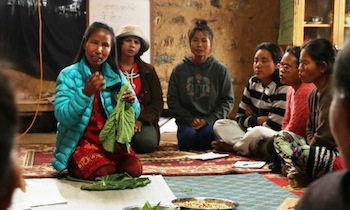 One of my favourite examples of this vision in action is a project called Guba, based in the same community in Swaziland that my own charity operates. Its founders, Emma Granville and Sam Hodgson, were working – one at local and one at national level – to address the HIV pandemic in Swaziland and had become frustrated with the disconnect between interventions, which felt like a barrier to true progress in improving health and reducing poverty. When they discovered permaculture they reformed their approach, starting Guba as a “home-grown” response to HIV.
Working with the local community, they established Guba’s ‘Growing Resilient Communities’ (GRC) programme which teaches community members how to grow healthy, organic food on their homesteads, as well as other skills for sustainable living (eco-building, water harvesting, seed banking, etc).
 Guba’s approach gives families living with HIV access to the nutritious diet necessary for managing the condition, without wasting limited resources on expensive pesticides, as is the norm. Families can also sell their excess harvest, which provides an income source to pay for school fees and healthcare bills, reducing the inequalities they face. From GRC has sprouted the Guba Farm Playschool, which introduces these skills to the young buds of the next generation.
However, at Guba, permaculture influences more than just their programmes. Rather, the principles are used to guide the entire way the organisation is run. Emma describes permaculture as a yard stick against which decisions are made: using the principles to test new ideas and determine their appropriateness and viability. This has had a very positive impact on the sustainability of the organisation, as well as reducing the risk of the team biting off more than they can chew.
Through permaculture, Guba’s founders have created an organisation which is both personally and locally sustainable and effective.
A taste of the opportunity
It is in this spirit that the Permaculture for Development Workers course has been created. Ahead of the main course, there will be a free taster workshop in London on 18 April, 1.30-5.30pm. This will be hosted by the Centre for Agriculture, Water and Resilience (CAWR) at Coventry University’s London Campus (109-117 Middlesex Street, E1 7JF).
All interested individuals are invited to attend, but limited spaces are available so booking is essential. To register to attend, click here (or email [email protected]).
This workshop aims to stimulate discussion about what permaculture can offer international development and humanitarian initiatives. It will also provide space for participants to discuss the current constraints and opportunities they are experiencing in their contexts. In addition, workshop participants will have the opportunity to learn from case studies of development projects where permaculture design principles have been successfully implemented.
Participants will also be able to ask questions about the full ‘Permaculture for Development Workers’ course. All present will be invited to attend (or send organisation representatives to) the five-day course, which will take place at Applewood Permaculture Centre in North Herefordshire 12 – 16 September 2018.
Permaculture for Development Workers course
The Permaculture for Development Workers course is officially supported by the Permaculture Association and has been developed by an experienced planning team. It will be facilitated by Chris Evans with the assistance of some special guests. Chris brings with him significant experience of applying permaculture in challenging development settings, having spent over 30 years living and working in remote Himalayan communities in Nepal.
As well as demonstrating how permaculture can be applied to agriculture projects in development settings, the course will include significant content on social permaculture and, as such, is suitable for development workers from a wide-range of disciplines. These include education, sustainable livelihoods, health, water, sanitation and hygiene, food security, agro-ecology, disaster relief and risk reduction, humanitarian response and peace-building. It is suitable for practitioners working in both fragile ecological and socio-political environments.
Each participant of the five-day course will create a personal portfolio, which they can use to guide their ongoing programme planning and delivery. The portfolio design will also encourage practitioners to consider their personal capacity when designing and implementing projects, in order to increase sustainability and avoid future burnout. Needless to say, I’ll be there!
To reserve a place at the taster workshop, click here.
Details: 18 April, 1.30 – 5.30pm. Room 2.14, Coventry University London Campus, 109-117 Middlesex Street, London, E1 7JF.
The five-day Permaculture for Development Workers course is also now open for bookings. To find out more and to book your place, click here. Prices start from £495 per person.
Teaser photo credit: Guba Facebook page.





Comments
We changed commenting systems on September 10, 2026 as part of a site-wide functionality and security upgrade. Your past comments have not disappeared, and you can still log in with your old Disqus account credentials if you wish. Contact us with any questions.