


1. Oil prices
With OPEC sending mixed signals about the possibility of a production cut at the meeting in Cairo on Saturday, oil prices gyrated between $50 and $55 a barrel last week. Pessimism stemming from a drumbeat of bad economic news alternated with occasional bursts of optimism that one of the many new bailout plans by governments around the world or perhaps an OPEC production cut would do some good. The average gasoline price in the US is now down to $1.82, the lowest since early 2005. US crude stockpiles rose for the 9th straight week, this time by 7.2 million barrels.
2. OPEC
Such is the secrecy surrounding oil production and exports that OPEC, as an organization, cannot rely on its own members’ energy ministries to provide accurate information on the amount of oil being exported. In countries such as Nigeria, beset by insurgency and massive oil theft, and Venezuela, where the government maintains that production is nearly 1 million b/d greater than reality, export figures are notoriously unreliable. To work around this problem, most oil traders, the IEA, and OPEC members themselves turn to information from the three leading “tanker-trackers” — Petro-Logistics, Oil Movements and Lloyd’s Intelligence Marine Unit.
With compliance from the two most recent cuts (total 2 million b/d) still unclear, OPEC decided to delay a decision on further production cuts until the meeting in Oran on December 17th. Although there was little cut in exports during October, preliminary information from November suggests that about 1.1 million b/d have been cut from peak August production.
As the Saudis usually swallow nearly 50 percent of OPEC production cuts, Riyadh obviously wants proof that all members are complying with their agreed upon production levels. Iran for example is thought to have cut its production by only 80,000 b/d during November, far less than its 199,000 share of the recent 1.5 million b/d cut.
Unity among the oil producers may be difficult to achieve for they face a varying set of economic circumstances. While the Saudis and the smaller Gulf producers are hurting, $50 oil is not the catastrophe for them that it is for Venezuela, Iran and Nigeria that already have severe fiscal problems. Iraq, which is exempt from the production quota, is actually planning to increase production by 250,000 b/d by linking new Kurdish oil production to the northern export pipeline into Turkey. Nigeria is threatening to ignore further OPEC mandated cuts.
In the short term, production cuts are certain to reduce an exporter’s revenue as worldwide oil supply currently is running well beyond consumption and stockpiles are growing. While revenues immediately go down with export cuts, there is no guarantee that prices will climb in the short run, thereby adding to the exporters’ fiscal problems. It may take many months to turn prices around if the world’s economic situation continues to deteriorate.
On Saturday, Saudi King Abdullah said in an interview that $75 a barrel would be a fair price for crude oil. This is the first time in years that the Saudis have mentioned a definite number for oil prices. While $75 may be adequate to support the Gulf States budgets and provide some revenue for investment, many new deepwater, tar sands, and heavy oil projects require still higher oil prices to be viable.
The key issue at the next meeting will be just who is going to do the cutting. OPEC continues to call on Russia to join them in lowering production. Statements by various senior Russian officials suggest that Moscow will attend the Oran meeting and “coordinate” its exports with OPEC to keep prices from becoming “too low or speculatively high.” Russia, which is highly dependent on oil revenue, is suffering from the decline in prices as much as any OPEC member.
3. Investment
As US motorists rejoice that the price of gasoline is now approaching an all-time, inflation-adjusted low, many thoughtful observers are bemoaning the effects on future oil production as project after project is delayed or cancelled due to low oil prices and a lack of liquidity. It is starting to dawn on many that, should oil prices and demand remain low for an extended period, new investment in oil production will fall to such an extent that, with worldwide depletion, now thought to be in the range of 5 to 6 percent a year, there simply will not be enough new oil to power an economic recovery.
Cancellations of high-cost oil sands and deep water drilling projects are most prevalent at the minute as are new multi-billion dollar refinery projects intended to process the lower grades of crude. Although the international oil companies are still making money, and seem to be continuing with the next round of projects, the national oil companies, which must turn over bulk of their revenues to support their governments, will soon be in no position to finance new production projects. The resource nationalism that has been rampant in recent years has led to troubled relations between the international oil companies and several major producers including Russia, Venezuela, Iran, and Ecuador. Last week a senior Iranian oil official said his company is going to need $14 billion a year for the next decade in order to maintain oil and gas production.
A few months ago, the major US oil companies were earning so much money that they could afford it all – stock buy-backs, raising dividends, debt buy-down, and expanding investment budgets. With oil at $55 a barrel and sales contracting, they now are forced to make choices.
Of most concern is that expensive clean and renewable energy projects are starting to go on hold as demand for energy drops and investment loans become scarce. So-called “clean coal” with carbon sequestration is extremely expensive. There are increasing calls for new energy taxes in the US, similar to those in Europe, which would bring prices back to a level where investment would be worthwhile and would foster conservation.
4. China
Unlike most of the world’s economies, China is widely believed to need a minimum of 7 percent annual growth to maintain social stability. New jobs are required for the millions of young workers graduating from school each year and the millions more that continue to migrate from rural areas into the industrialized urban economy.
As a major consumer of world energy supplies, the state of China’s economy will play a major role in oil demand for a long time to come. Officially the Chinese government remains optimistic that it has the internal resources to continue to grow even with faltering exports. Last week Beijing cut interest rates by the most in 11 years and unveiled a $586 billion stimulus plan to keep the economy growing in the midst of a global recession.
Over the past two months, however, there has been a rapid deterioration in China’s economic situation. Chinese manufacturing in October contracted by the most on record as demand from the US, Europe, and Japan dropped rapidly. China’s State Information Center, a government think-tank, forecasts that the annual growth would slow to 8 percent this quarter from 9 percent in the third quarter, a rapid cooling from double-digit rates recorded in the past five years. The World Bank just cut its growth forecast for China during 2009 to 7.5 percent.
Over the weekend, the government news agency reported that on Saturday President Hu warned the Politburo that China’s competitiveness and trade are being threatened by the global economic downturn. This announcement suggests that Chinese leadership does not foresee a quick end to the economic downturn and worsening conditions ahead.
5. Detroit
General Motor’s board is currently reviewing the rescue plan that will be released on Tuesday and will be considered by Congress next week. GM said on November 7th that it may not have sufficient cash to operate after December. A 10-12 page summary of the plan will be released to the public and a more detailed 80 page version will be sent to Congress. The plan is rumored to entail closing factories, eliminating half the US brands, delaying health care benefit payments, and converting some of the companies’ $43 billion debt into equity in the company.
November car sales will be released this week and early indications are that sales of US brands may be down again – possibly by as much as 35 percent over last year. Detroit automakers owe banks and bondholders more than $100 billion in debt and considerably more when their parts suppliers and dealers are included.
Where this all comes out is still up in the air. Senior Republicans continue to argue that a $25 billion “bridge loan” to Detroit will only prolong the agony. Congressional Democrats and the Obama team seem predisposed to mitigating the effects on the US economy that would stem from widespread bankruptcy of the automakers, their suppliers and dealers. Events, however, may be spinning out of control.
6. Briefs (clips from recent Peak Oil News dailies are indicated by date and item #)
- Amid the year’s ups and downs, 2008 will mark a record for global oil demand, at 87 million barrels a day. While U.S. oil demand is off 5.5% in the past year to its lowest level since 2002, China’s is up 6.5%. (11/28, #9)
- In July, the IEA estimated that the total number of motor vehicles could increase to as many as 1.2 billion by 2013, from the current 800 million. (11/27, #21) (11/22, #4)
- In October, the active members of OPEC produced about 29m barrels a day out of total output of 86.9m barrels a day, according to the International Energy Agency, the developed countries’ watchdog. That put OPEC significantly above its target of 27.31m b/d . (11/29, #3)
- The world’s top gas exporting nations will set up a formal organization at a December summit in Moscow, a Russian official said on Wednesday, but denied the new body will seek to copy OPEC’s production quotas. (11/27, #6)
- Japan’s industrial production and household spending fell more than expected in October, raising the specter of a prolonged recession. Industrial production declined 3.1 per cent month-on-month in October and 7.1 per cent year-on-year. Official figures reflected a sharp cutback in reaction to declining demand for Japanese exports. (11/29, #7)
- Japan’s third-biggest oil refiner, said on Friday it would cut its October-December crude oil refining volume further amid slowing oil demand. (11/28, #14)
- The severe impact of the credit crunch on US households and business investment was sharply illustrated on Wednesday with the latest wave of data showing collapses in new home sales, consumer spending and orders for durable goods in October. (11/27, #12)
- Despite efforts to diversify their economies, all of the world’s key oil exporters are highly dependent on oil’s proceeds and have always lived in fear of the moment that has now become real — when global demand slackens and prices fall. (11/29, #18)
- The price drop has prompted Canada to ease back on a proposed royalty hike, but left-wing Latin American leaders will maintain high taxes on their vast oil reserves to ensure a steady flow of cash for social programs. (11/26, #10)
- Shell is delaying another Canadian oil sands project, saying it has withdrawn a regulatory application for its 100,000 barrel per day Carmon Creek thermal project as it looks to shave costs by revamping the project. (11/28, #16)
- Nigeria’s crude production has slumped to 2.14 million b/d after pipeline sabotage in recent weeks. (11/29, #6)
- Venezuela is so unsure about how much oil it pumps that from time to time the central bank calls the oil ministry to correct the numbers because there are too few dollars in the vaults to support their inflated oil-production claims, industry insiders say. (11/28, #4)
- Asian refiners cut West African crude oil imports for loading in December by as much as 27 percent after buyers led by China Petroleum & Chemical Corp. lowered purchases because of falling demand for fuels. (11/28, #6)
- Iraq’s oil ministry and the country’s largely autonomous northern Kurdish region have agreed to export oil from Kurdistan to Turkey, an Oil Ministry spokesman said on Thursday. The initial agreement represents a breakthrough in a dispute between the two Iraqi authorities.(11/28, #7)
- Iraqi Kurds say the volume of oil produced from their semi-independent region will hit 250,000 barrels a day by the end of 2009. Most of the crude will come from three main oilfields the Kurds have developed via deals with foreign firms in the past few years. (11/28, #8) Oil contracts signed by the Kurdish regional government with foreign oil companies are not recognized by central government in Baghdad. (11/29, #5)
- With government budgets set for $45 oil, Saudi Arabia will likely end 2008 with a $150 billion surplus. It has $400 billion in foreign assets. That puts it squarely in fat city–at a time when oil-tethered economies in Venezuela, Iran and Russia are in precarious shape. (11/28, #9) The cost of lower oil prices is hitting Venezuela hardest, according to PFC Energy’s calculations, as it requires an oil price above $90 a barrel to maintain financial stability. (11/28, #4)
- Saudi Aramco’s oldest operating well, Ain Dar 1, was drilled in 1948. This single well in the Ghawar complex has produced 152 million barrels from its original casing. The well’s free-flow rate is now 8,000 barrels a day, but Aramco restricts it to 2,500. The Saudis still insist that rumors of Ghawar’s demise are premature. (11/28, #9)
- Thieves tapping into energy pipelines in southern Nigeria have forced Nigeria LNG Limited, supplier of 10 percent of the world’s liquefied natural gas, to warn that it may not be able to meet all of its export obligations. (11/28, #10)
- About $400 billion will be needed to develop Brazil’s pre-salt oil area over a 10-year period, according to a preliminary estimate, Haroldo Lima, the president of Brazil’s National Petroleum Agency, or ANP, said Monday. (11/26, #12)
- Brazil’s Petrobras took an $878 million loan from a state-owned bank due to “temporary” financial problems, according to the country’s energy minister. (11/28, #13)
- Eni Gas & Power’s CEO warned in a keynote address at the European Autumn Gas Conference that the credit crisis could seriously affect the supply and diversity of gas supply projects in Europe. (11/27, #17)
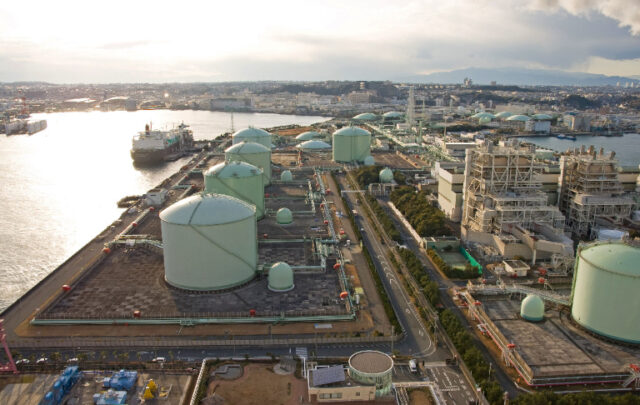
- Companies hope floating LNG systems will be cheaper than building onshore liquefaction facilities, will speed up the time it takes to bring fields on-stream, will reduce projects’ environmental footprints and will make it economic to exploit small and remote offshore deposits. (11/26, #5)
- PetroChina Co., the nation’s largest oil company, doubled the volume of liquefied natural gas it will buy from Royal Dutch Shell Plc in an agreement to supply terminals being built along China’s eastern coast. (11/25, #13)
- Natural gas production from US shale plays such as the Marcellus shale in New York, Pennsylvania, and West Virginia could double in the next 10 years and provide 25% of the nation’s supply, according to a Natural Gas Supply Association official. (11/25, #18)
- A few years ago, Somali pirates menacing Africa’s east coast sometimes demanded tens of thousands of dollars for the safe return of a hijacked vessel and crew. Now they often seek $1 million or more. The reason: Ship owners keep paying. (11/24, #10)
- Cnooc Ltd. and its partners may spend about $29 billion to develop fuel deposits in the South China Sea in the nation’s biggest push to tap reserves off the coast. (11/24, #15)
- TNK-BP may have to freeze new refining and marketing projects next year as Russia faces its biggest financial crisis in a decade. Russian oil companies are already struggling with falling output at mature fields, a drop in crude prices and rising costs for starting projects in harder-to-reach regions. (11/28, #17)
- Russian President Medvedev and Venezuelan President Chavez agreed to form joint ventures to pump crude oil and to increase military and nuclear cooperation last week during the first visit by a Russian president to Venezuela. (11/27, #9)
- Since Finance Minister Alexei Kudrin has said that Russian government spending goes into deficit at $70 per barrel, pressures for spending cuts are starting to mount. Severe reductions have already been announced in housing and education. (11/27, #16)
- Gazprom said Wednesday that if Ukraine did not pay a $2.4 billion debt, the company might more than double the price of natural gas, a move that would deal a harsh blow to Ukraine’s economy. (11/27, #18)
Quote of the Week
- “OPEC might say that they will cut 1 million barrels but in reality the market knows maybe they’ll cut 500,000 to 600,000 barrels. And that’s simply not enough to exorcise the surplus out of the market.”
— Stephen Schork, president Schork Group Inc. (Villanova, PA)




Comments
We changed commenting systems on September 10, 2026 as part of a site-wide functionality and security upgrade. Your past comments have not disappeared, and you can still log in with your old Disqus account credentials if you wish. Contact us with any questions.