Click on the headline (link) for the full text.
Many more articles are available through the Energy Bulletin homepage
The post-abundance era
Michael T Klare, Foreign Policy in Focus via Asia Times
Ever since the collapse of the Soviet Union, foreign-policy analysts have struggled to find a term to characterize the epoch we now inhabit. Although “the post-Cold War era” has been the reigning expression, this label now sounds dated and no longer does justice to the particular characteristics of the current period. Others have spoken of the post-September 11, 2001, era as if the attacks on New York’s World Trade Center and the Pentagon were defining moments for the entire world. But this image no longer possesses the power it once wielded – even in the United States.
I propose instead another term that better captures the defining characteristics of the current period: the post-abundance era.
If there is one thing that most inhabitants of the late 20th century shared in common, it was a perception of rising global abundance in virtually all fields: energy, food, housing, consumer goods, fashion, mass culture, and so on.
…The end of abundance is not the same thing as outright scarcity. Some commodities, such as oil, may become truly scarce in later decades of the 21st century, but they will not disappear altogether. Those with means will still be able to purchase gasoline and air-conditioning and other soon-to-be-luxury items. But the end of abundance will create a new international environment – a new gestalt, [1] if you will – in which expectations are lowered and struggles over what remains become fiercer and more violent.
Ideological, political, and ethnic differences will have their place in this new environment, but increasingly these will be infused with or subordinated to resource pressures.
Michael T Klare is a professor of peace and world-security studies at Hampshire College, a Foreign Policy in Focus columnist and the author of Blood and Oil: The Dangers and Consequences of America’s Growing Dependence on Imported Petroleum (Metropolitan Books, 2004).
(7 Dec 2006)
ASPO Newsletter (Nov) (PDF)
Association for the Study of Peak Oil & Gas – Ireland
Articles in this newsletter:
761. Regional Assessment – LATIN AMERICA
762. Newsweek Covers Oil
763. Peak Oil and World War
764. Oil Company hints
765. A Dip in Oil Price
766. Norway addresses Peak Oil
767. EU Transition to a Sustainable Energy System
768. Russia pressed at G8 Meeting
769. Global Warming and Peak Oil
770. Major Oil Companies seem to pass peak
771. ASPO USA Boston Conference great success
(Nov 2006)
Contributor WT writes:
The chart of Latin America’s past and predicted oil production on page 4 is most interesting… note especially “Brasil DW”
– Brazil’s Deep Water oil.
ASPO Newsletter (Dec) (PDF)
Association for the Study of Peak Oil & Gas – Ireland
Articles in this newsletter:
771. Regional Assessment – NORTH AMERICA
772. The BBC covers gas depletion
773. Climate Change and Oil Depletion
774. The IEA confesses.
775. More assertions from CERA
776. The Meaning of Reserves
777. Impact of the Oil Depletion Protocol
778. National Petroleum Council of the USA
779. Oil Price
780. ASPO 6: 6th Annual International Conference, September 2007 – Ireland
(Dec 2006)
Mystery Cassandra
Andrew Leonard, Salon
…If you’re new to the peak-oil debate, but you’re lazy and want to avoid rehashing the last few years of voluminous discussion on all related topics, this is the speech for you. Quite literally, very little new has been said since. Adm. Rickover was a smart guy.
He is also renowned as the father of the nuclear submarine, and he gave this speech in his capacity as chief of the Naval Reactors Branch of the Division of Reactor Development at the U.S. Atomic Energy Commission and assistant chief of the Navy Department’s Bureau of Ships for Nuclear Propulsion. So it’s little surprise that the ultimate thrust of the speech concludes that renewables hold no chance at providing for the bulk of humanity’s energy needs, but that the outlook for nuclear fuels is “more promising.”
What would Rickover think if he were around today to observe that the last time a new nuclear power plant was ordered by a utility in the United States was 1973? Or if he could read today’s pessimistic Wall Street Journal article on how current shortages of uranium may crimp President Bush’s plans for a nuclear power “renaissance”?
Judging by the quality of his speech 50 years ago, he’d probably have some pretty pithy advice. Like: I warned you idiots this was going to happen, now get off your ass and do something about it. Only expressed more politely.
(5 Dec 2006)
Thanks for the kind mention of Energy Bulletin and Admiral Rickover’s 1957 speech.
Note that Rickover posts a caveat about nuclear: “The disposal of radioactive wastes from nuclear power plants is, however, a problem which must be solved before there can be any widespread use of nuclear power.” More people might be open to the idea of nuclear energy, if the industry were run with the conscientiousness and attention to detail of Admiral Rickover.
-BA
Renewable Resources: An Investment Hedge Against Peak Oil
Bob Wise, Resource Investory
The long-term trend of resource depletion – manifested today in the “peak oil” phenomenon – poses a severe challenge to an investor. Where do you find lasting value in a scenario where rising energy costs impact every industry and business, inflate all currencies, and make location value unpredictable as transport patterns reorganize?
My personal answer has been to invest in renewable resources. Renewables will continue to produce value regardless of fossil fuel prices or disruptions in the financial economy. In a crowded and growing world, demand for that value – food, feed, textiles and lumber- will also continue.
In concrete terms, this strategy means investing in land used for row crops, pasture, orchards or forestry. Unfortunately, there are no publicly traded funds, at least in North America, that invest in such real estate. You will search in vain through the many “natural resources” funds to find one investing in resources that aren’t mined or pumped.
There is at least one institutional fund, Hancock Agricultural Group, which invests in cropland, groves and tree farms. For qualified Canadian investors, the Agricultural Development Corporation (ADC) offers limited partnerships in Saskatchewan farmland. But for most of us, investing in renewables means a major real estate purchase, with the attendant expense and risk.
My wife and I bought cropland in Iowa in 1995; last year we added another parcel. Over the years, we’ve seen net income around 5%, while the market value of the land has more than doubled. Hancock reports similar returns on cropland, while ADC shows a higher rate of income.
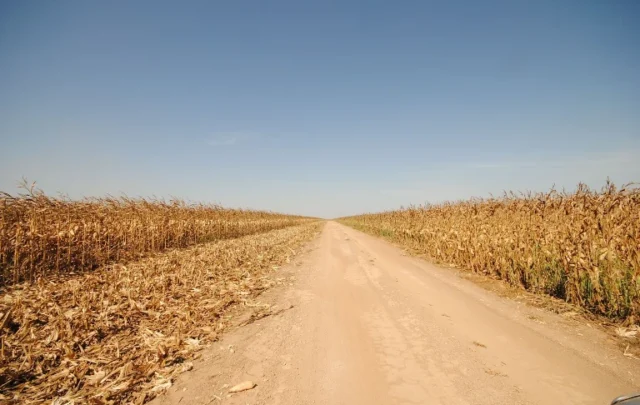
The one big risk on the horizon is climate change. As global warming proceeds, the U.S. corn belt and other mid-latitude agricultural regions are likely to get hotter and dryer. In contrast, some climate models and scenarios show growing conditions in Canada and northern Europe actually improving.
Even if a real estate purchase is out of the question, I suggest keeping the renewables sector in mind for the future; there may be better opportunities. For farm families, here’s another reason to hang on to the land.
(4 Dec 2006)
Courtesy of the author.