

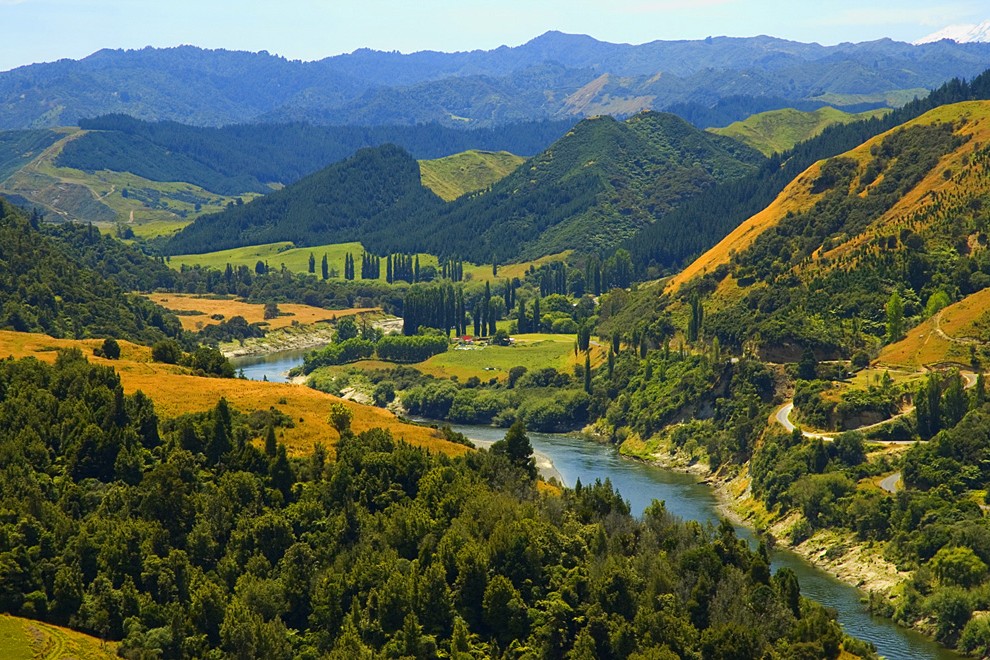
The Whanganui River flowing through New Zealand. 30. January 2005 (James Shook/Wikimedia Commons).
Imagine a river that can sue for its own protection. A forest that legally “owns” itself. Sounds like a fairy tale? In New Zealand, it’s reality. Since 2017, the Whanganui River has held the same rights as a human being, recognised as an ancestor to the Māori people, and Te Urewera forest is governed by a board that represents the forest’s own interests.
This idea – caring for nature as we would for kin or neighbour – is gaining traction globally. Yet it remains radical in a world that mostly treats nature as a resource or a problem to be managed. As a researcher studying relational values of nature, I’ve come to recognise that effective conservation requires more than better policy or more data. It also requires cultivating a culture of care – one that asks not only what nature can do for us, but what we owe to nature.
Conservation today remains largely transactional. We protect forests because they store carbon, wetlands because they filter water, bees because they pollinate crops. These instrumental values aren’t wrong – in fact, they’re essential – but they’re incomplete. They turn nature into a set of services to be consumed, and when a service becomes replaceable, so does its source.
Even as considerations of nature’s “benefits” to people have grown, policy still revolves around measuring contributions and managing trade-offs. The result is a conservation practice that feels procedural rather than relational. Protecting nature is not just about tallying benefits or inviting more voices; it’s about renewing our moral relationship with the natural world of which we are part – a relationship grounded in care, respect, and reciprocity.
Care as a radical act
If our dominant model treats nature as a service provider, then care is the radical alternative.
Over the past decade, international frameworks such as the Intergovernmental Science–Policy Platform on Biodiversity and Ecosystem Services (IPBES) have urged us to broaden how we value nature. This has led to the rise of relational values – the idea that we value nature not only for what it provides or for its own sake, but because it is part of meaningful relationships that shape who we are. These relationships are built on care, belonging, and responsibility.
In theory, this marks a welcome step beyond the narrow, human-centred logic of ecosystem services. In practice, however, relational values often serve mainly to broaden participation, to bring in more voices and worldviews. That is valuable, but it doesn’t answer the deeper question: Why should we protect nature in the first place?
Philosophers have long offered one answer: nature has intrinsic value, worth that does not depend on its usefulness to humans. Yet intrinsic value alone can feel abstract, detached from how people actually live with the natural world. Relational value animates our relationship with nature, giving intrinsic worth a lived expression, joining moral recognition with everyday practices of care and responsibility.
Many cultures have long understood this. In Aotearoa New Zealand, Māori philosophies such as kaitiakitanga (guardianship) and whakapapa (genealogy linking people and nature) express the belief that a good life depends not only on what nature gives us, but on how we care for it in return. The Whanganui River’s legal personhood grew from that worldview: humans as caretakers, not owners. The river’s health and the community’s wellbeing are inseparable: if one suffers, so does the other.
You don’t need a law to practise this. Care can mean a Brussels resident picking up litter in the Sonian Forest because it feels like home, a farmer leaving wildflower strips for bees, or even city planners designing benches to protect the roots of old trees, honouring their silent endurance in urban life. These acts may seem small, but they affirm reciprocity, a moral relationship of mutual flourishing.
Studies show that people who feel emotionally connected to nature are far more likely to act on its behalf. A 2020 study in People and Nature found that simple, sensory engagement – watching wildlife, listening to birdsong, smelling wildflowers, or noticing butterflies and bees – was the strongest predictor of a person’s willingness to protect biodiversity. When we feel psychologically distant from nature, it slips out of our moral circle, making exploitation more likely. Strengthening our sense of connectedness is therefore not just about wellbeing; it is essential for sustaining a caring and ethical relationship with the living world.
Caring for nature, then, is not sentimental. It is transformative. It shifts the question from what nature can do for us to how we can live well with nature. And in a time of mounting ecological pressures, that may be the most radical act of all.
From principle to practice: cultivating care for nature
Our wellbeing, identity, and sense of purpose are inseparable from the wellbeing of the natural world. When conservation policies forget that, they risk becoming exercises in management rather than care. Across the world, decision-making still follows a technocratic logic: biodiversity is weighed against development, impacts are quantified, and trade-offs justified. Even “relational” or “cultural” values are often reduced to another metric. Yet moral relationships cannot be tabulated; they are lived – in how people relate to places, in gestures of respect, and in choices about what must not be lost.
Cultivating care for nature means reorienting conservation within a wider ethical frame. It is not about abandoning economics or inclusion, but about guiding them by moral responsibility toward the natural world. Some losses cannot be offset because they sever relationships that give life meaning.
Many paths can foster this ethic. One is to relearn local ecologies. Care begins with attention – and with wonder. Knowing the names of nearby trees or birds can rekindle curiosity and a sense of belonging. Wonder invites us to see the familiar as alive and worthy of care.
Another is to recognise Indigenous and local knowledge. Communities that have cared for their environment embody reciprocity and show that other ways of living well with nature are possible. A third is to design for care. Residents co-managing green spaces, schools teaching ecological care as a practice of joy, or policy language that replaces “resources” with “the living world.” Words, too, shape how we act.
Critics may call this too soft given the scale of today’s environmental challenges. Yet some of our most pressing challenges – climate change, species extinction, ecosystem degradation – are collective action problems that need not only rules but relationships. Care builds the social fabric for those relationships. When people feel connected to a place, they may be more inclined to defend it – with their votes, their voices, and their daily habits.
A more relational conservation starts from a simple premise: care for nature is not an optional extra, but part of what makes a society good. Instead of asking what nature is worth, we might ask what we owe to the natural world that sustains us. When conservation grows from care, reciprocity, and respect, it becomes more than policy. It becomes a way of living well with the Earth.



Comments