

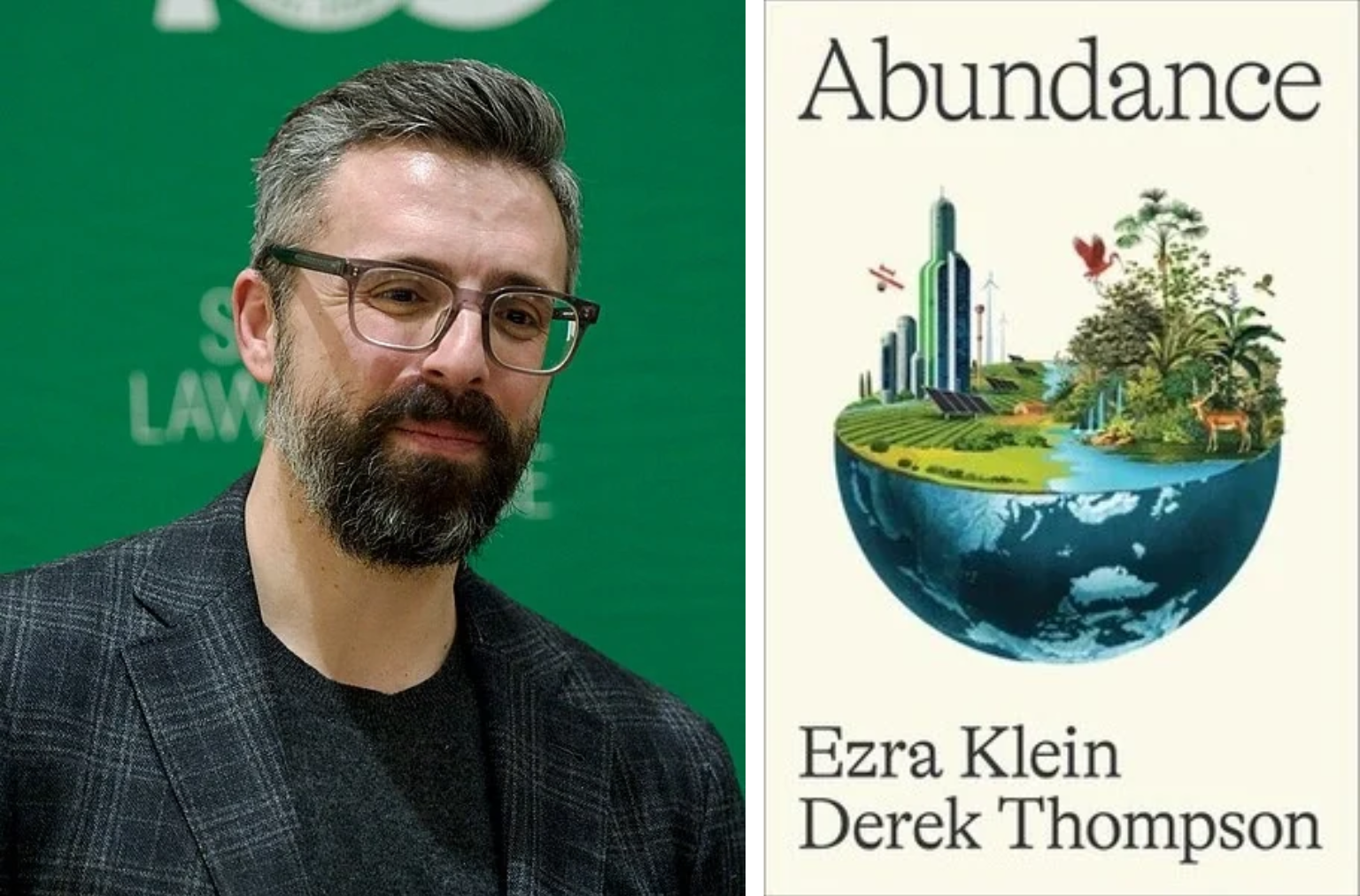
Earlier this year I rode my bike to the library and brought home Abundance by Ezra Klein and Derek Thompson. The book made a big splash when it was published in early 2025, partially because they absolutely nailed the timing. In the United States the Democratic Party had just lost the presidency and both houses of Congress, and people were desperately searching for answers, mainly to questions like: shit, what now? Abundance appeared on bookshelves and sold well, and the core ideas started gaining traction. The thesis was something like: Democrats get in their own way too much, and instead of trying to regulate and litigate harms away, they need to boldly build the future that we all want: prosperous, eco-friendly, and socially just. For me, I had heard the buzz of the book not because I follow politics super closely, but rather because I have a passion for environmentalism, and this was the most attention a book dealing with climate change had gotten in a little while.

So when Abundance came up over dinner with some close friends, I already had some familiarity. And to be honest, it didn’t just “come up.” Our friends, a married couple we’ve known for a long time, were raving about it. They even joked that they were missionaries relentlessly converting more of their friends to the new religion, which was funny in part because of how out of character that would be for them. Our conversations are always a lot of fun, with lots of stories and laughter, but rarely do they turn political. I told them that although not everything I had heard about Abundance in my environmental circles was entirely positive, I would give it a read and let them know what I thought.
Now, I don’t particularly have the motivation or time to do a full review or analysis of all the arguments the authors lay out. I also returned the book to the library a while ago now, so I’m not going to be able to pull quotes and break things down in detail. What I want to offer instead is a general response to one of the key ideas they rest their arguments on. I think I have some context that others might be missing, and I’m hoping that I can add something to the conversation rather than simply being critical.
Here’s the core idea that I want to respond to: economic growth is good, and the limits to ongoing growth are artificially imposed, not naturally occurring.
This is a fairly common belief, albeit not one people always state explicitly or critically examine. If we could just get out of our own way, according to the authors, we could grow our way into a high-energy, high-convenience, high-technology, low-poverty, low-crime, near-utopian society. To make this case they detail the flaws and issues in housing and immigration policy and the crushing burden of environmental regulations on our ability to build stuff. But before they do all that, they spend about two pages dismissing a particular branch of the modern environmental movement called degrowth. In a nutshell, degrowth suggests that actually, the path to more wellbeing for humanity involves less, not more. Self-imposed limits, not endless growth. Naturally this foolish idea had to be swept away swiftly so that Klein and Thompson could carry on with their actual argument.
The dismissal of degrowth is probably the part of the book that bothers me the most, especially because the authors really don’t engage with the ideas at all. They simply brand it as politically infeasible and therefore counterproductive. They even suggest that making the case for degrowth would drive people toward petro-fascism, so it’s an irresponsible political position to take. And this sets the stage for all the analysis that follows on the topic. Given that we have to grow the economy, the authors say, how do we grow in an environmentally friendly and socially enriching way? The degrowth movement, on the other hand, offers us a chance to step back and ask whether growth should be our goal in the first place.
Degrowth has been a rich area of research and activism in the environmental space over the last few years, and it emerged from a fascinating history of environmental thought, which I can only hope to scratch the surface of in a piece like this. But learning even a bit of this history is worthwhile, because it allows us to challenge the strong assumption, widely held but rarely discussed, that growth of the human enterprise is the natural and best path for our species. Challenging assumptions is how we learn, and learning is how we improve and evolve.
Moreover, if we reject outright any idea that is politically infeasible in the present moment, we’ll find it difficult to aim very high for our society. It’s a crudely made point but there was a time when abolition of slavery was politically infeasible. The same goes for women’s suffrage, and marriage equality. Maybe working only within the “Overton Window” (the range of politically acceptable ideas) makes sense if you can only think about one election cycle at a time, but climate change is bigger than that, so we need to think bigger.
All this is to say, I humbly reject their rejection. You can disagree with degrowth, but only once you actually engage with the arguments and ideas, which the authors do not do in any serious way.
If I’ve piqued your interest and you do want to take a serious look at degrowth, a great place to start is in 1972 with The Limits to Growth, a study commissioned by the Club of Rome and conducted by a team of scientists at MIT. The study made use of a novel computer modeling technique called Systems Dynamics, created by Jay Forrester in the 1950’s. A dense technical publication was produced, but one member of the team (Donella Meadows) also wrote up a non-technical summary for general audiences. This non-technical summary, which took the form of a thin paperback book, provides a concise exposition of the modeling results, clearly demonstrating the conclusion that you cannot have endless growth on a finite planet.
How does the report reach that conclusion? Through simulations of a “world model.” Their model establishes a complex set of relationships defined between five primary global metrics: population, food production, industrial output, pollution, and depletion of non-renewable resources. The simulations show how these factors interact and evolve together over time. The business-as-usual model shows exponentially increasing population and industrial output (as exists in real life), but only up to a point. Without fail, a feedback loop kicks in and triggers a “collapse.” What the feedback loop looks like depends on the initial conditions and parameters in the simulation. In some cases rampant pollution causes a spike in the mortality rate. In others food production can’t keep up, or we simply run out of non-renewable resources. Subsequent runs of the simulation test “what would happen if we discovered more resources, or developed new technology, or implemented some policy.” The results show that it actually isn’t easy to set up a simulation to avoid any collapse outcome; the models that are most stable involve significant assumptions of technological, cultural, and political change. These types of changes have not yet occurred in the 54 years since publication, and recent work shows that we continue to be on track with the standard-run business-as-usual trajectories.
I’ve known about The Limits to Growth study for a while, but I had never actually read it until I read Abundance and felt thirsty for an antidote to the “growth is good” mindset. Having now actually absorbed it word by word, chart by chart, I would strongly recommend it to anyone who is curious. It is exceedingly clear and concise given the complexity of what is actually going on in the computational model, and draws the conclusion sharply: the material and energetic throughput of society cannot and will not grow indefinitely. The issues with endless growth are not challenges that human ingenuity can solve. It simply isn’t possible. But, crucially, this does not mean that human wellbeing and fulfillment cannot improve. More on that point in a bit.
One caveat to note, particularly when drawing connections between Abundance and The Limits to Growth, is the scale considered. Abundance is really focused on a national scale, concerning itself with the future of the Democratic Party in the United States. Meanwhile the The Limits to Growth methodology is a global model of the entire world system. Regardless, the implications of The Limits to Growth for the U.S. can be pretty directly inferred. For example: it would be hard to argue that the global economy faces hard natural limits to growth but the United States (already the world’s largest economy) should pursue endless growth.
With the core concepts of The Limits to Growth fresh in our minds, I want to introduce a few additional ideas that are also in the lineage of the degrowth movement. The first is called “Peak Oil,” and there are two key points to know about it. First, oil is central to the modern economy, both for energy (gasoline, jet fuel, diesel, propane, butane, methane, etc.) and materials (plastics, cosmetics, medicines, chemicals, etc.). Literally every economic activity requires energy, and most require materials of some sort. The second important piece is that oil is a nonrenewable resource. It was created and sequestered under the earth by hundreds of millions of years of ancient photosynthesis, and we are extracting and burning through it thousands of times faster, in the span of just a few centuries.
A simple consequence of oil’s centrality to the economy and finite quantity on the planet is that the rate of oil extraction will necessarily follow a path of rapid increase, peak, and eventual decline. Consider that when we humans first started using oil there were many areas around the world with deposits easily accessible, at or just below the surface. Ancient civilizations even collected from these natural “seeps” and used oil for a variety of applications. Now, we drill thousands of feet beneath the ocean and use AI to find the remaining untapped reservoirs. At some point, the economics of extraction will prove profitable in fewer and fewer locations, less and less frequently, and the global rate of extraction will peak and begin to decline. In fact, “peak oil” occurred for “conventional” oil around 2005/2006, and the only reason extraction has continued to expand is because of a technological innovation: hydraulic fracturing (“fracking”). Fracking grants access to harder to reach reserves (“tight oil”) but it doesn’t create anything new, which means it delays but doesn’t change the overall peak oil dynamic. Nate Hagens, the host of a popular podcast on these ideas, refers to this as “widening the straw” when you’re getting to the end of a smoothie. We would be foolish to rely on repeated innovation to perpetually access more oil, as eventually the finite amount that exists will be depleted. And this is to say nothing of the environmental impacts of using the stuff.
The centrality of oil to the global economy and the fact that extraction of any nonrenewable resource will necessarily peak and decline should raise an obvious question: what will the world look like post-oil? This is a question that a lot of people have thought a lot about, and there is a rich literature that I won’t try to summarize here. A good place to start, if you do want a recommendation, is Our Renewable Future by Richard Heinberg and David Fridley. For my purposes, I simply want to encourage a fair bit of skepticism toward the idea that the global economy can continue to grow indefinitely simply by transitioning to alternatives. Solar panels and wind turbines are built with materials that are mined, transported, and assembled using oil. Electric cars are built with a long list of petroleum products. Having built a growing society that is utterly dependent on fossil hydrocarbons (coal, oil, natural gas), their inevitable depletion means that a lot will have to change in ways that may currently seem radical.
A related concept to Peak Oil is the “Carbon Pulse,” which was recently popularized by the aforementioned Nate Hagens. The idea is probably best summarized with reference to the following image. The future part of the graph is conjecture of course, but aspects of it we know to be true. We know that the absolutely massive amount of energy stored in fossil hydrocarbons is being released rapidly and exponentially by humans, and when it’s gone it will be gone forever. This period of earth’s history, during which humans discover, exploit, and eventually run out of (or choose to stop using) fossil energy, is what we can call the “carbon pulse.” It’s an extremely short period in evolutionary and geologic time, but it will prove to be a very consequential one. It has enabled great changes to our society, our species, and to the biosphere itself. But the point here is that it is a temporary, fleeting phenomenon. We are still on the increasing part of this curve and though we cannot predict the future precisely, we know it doesn’t go up forever. And yet we have designed an economy, powered by these finite energy sources, that doesn’t work unless it is growing.

Before returning to degrowth, there is one final piece of context I want to bring to the table: the Planetary Boundaries framework. This framework represents an enormous amount of academic work, kicked off by Jonathan Rockstrom and collaborators at the Stockholm Resilience Centre in 2009. Their goal was to identify a “safe operating space for humanity” by enumerating the most important processes and characteristics of the natural earth system that we humans depend upon and quantifying how close we are to undermining them. Their work resulted in the identification of nine planetary boundaries, and subsequent work has concluded that we have transgressed seven of the nine. Climate change is one of these boundaries, and the others are biosphere integrity, land-system change, freshwater change, biogeochemical flows (aka “nutrient cycles”), ocean acidification, and novel entities (e.g., plastics, forever chemicals, etc.). The two we have not yet transgressed are atmospheric aerosol loading and stratospheric ozone depletion.

That last paragraph felt like a lot of jargon. What does this all mean? For one thing, it means that someone who says they are interested in “sustainability” or “environmentalism” may be referring to much more than climate change. In order to return to a safe operating space for humanity, and therefore to pass a livable word onto future generations, we need to take a U-turn and reverse course, traveling back across all of the boundaries we have transgressed. Relatedly, even if technology could solve climate change by replacing all of our carbon-intensive infrastructure with emissions-free alternatives (which it cannot), we would still be in deep doo-doo. Even if we could build high-speed rail in two years instead of failing to build it in twenty (a fact that the Abundance authors understandably lament), we would still be decimating the biosphere, and would eventually find it difficult to grow food on a dead planet. We would still be disrupting nutrient cycles, causing algal blooms and thereby poisoning our drinking water. We would still be completely overwriting natural land systems with farms, cities, and suburbs, thereby exacerbating issues with climate, freshwater systems, and biodiversity.
The simple solution to all this is that humanity needs to chill out a little bit. Do less. And even if we continue to do more, we will eventually be forced to do less, because our current path is unsustainable and leads to collapse. We can keep trying to plug the holes and whack the moles and keep the wheels on with a wing and prayer and ever more technology, but eventually the truth of the situation will be undeniable. And now finally, this leads me back to degrowth.
Degrowth is about figuring out how we can do less in a reasonable, fair, and inclusive fashion, rather than waiting for one of the possible collapse scenarios to decide for us. A primary insight the movement relies on is that the inequality in the current global distribution of wealth, income, consumption, and environmental impact creates low-hanging fruit for change. Those of us in the high-energy, high-consumption parts of the world (often called the “developed” or “rich” or “first” world) can reduce our planetary impacts significantly, while others who struggle to meet basic needs are not asked to bear the burden. And note that even within “rich” countries there is immense inequality. The billionaires have a lot more room to degrow than most of us.
Another important insight for the degrowth movement, and one that should play a role in the “political feasibility” argument, is that we only need to reduce the most unsustainable aspects of our lives, and these are not often where we find the most meaning and joy. You get more out of a friendship than a new car. You get more out of time with family than time spent on planes. Music, laughter, play, love are simply better than consumption, convenience, and competition. After basic needs are met, the best things in life are free. And if you and those around you have stable, fulfilling lives, will you really care whether the overall economy is growing, shrinking, or staying put?
I’ve heard it said that degrowth is a good idea with terrible branding. It sounds like a reversal of human progress, like advocates of degrowth want to take us “back to the stone age.” But in actuality it is about preserving the progress we’ve made rather than losing it to climate chaos, ecological devastation and social breakdown. By definition we can’t preserve the parts of our society that are inherently unsustainable, but we can preserve much of our cultural, spiritual, intellectual, and artistic evolution. There’s a lot worth keeping even if we can’t have yachts and plastics and data centers.
Still, I’ll happily admit that the political winds do not blow in favor of intentionally shrinking the economy. The logic of “grow the pie and everyone can get a larger slice” is pretty deeply ingrained. But if you’ll allow me a goofy extension of this, I’ll say something metaphorically that I would never, ever say literally: we have too much pie! The pie is overflowing! A few people are hoarding it and most of us are scratching and clawing for a few crumbs, but collectively we are making an enormous mess.
Pie aside, what I mean is that there are stronger forces at play in the global system than the political preferences of the moment. The material and energetic throughput of society cannot and will not grow forever, and personally I’d like to see a political movement that embraces that reality. In Abundance, Klein and Thompson channel Adam Savage in the opening credits of the show MythBusters: “I reject your reality and substitute my own.”
There are a few other key ideas in the book that I have thoughts on, and not all of my thoughts are critical. For example, in one section the authors pull heavily from Jennifer Pahlka’s work, which I am a big fan of. Pahlka wrote a book called Recoding America, which argues that we don’t pay enough attention to the nuts and bolts of how our government institutions implement policy, and as a result they don’t implement it very well, particularly when it comes to technology. There are enormous opportunities to make our government operations more resilient and effective, and having worked in a federal agency, I strongly agree these are well worth pursuing.
I also considered writing a whole additional section of this piece challenging the Abundance authors’ notion that technology is the root of human progress. Frankly, writing is hard and I find myself losing momentum for this particular project, but there is a lot to say about technology and its role in our lives. Maybe I’ll have AI write up a “Part 2” for me sometime soon. (Just kidding.)
Overall, I have to say that I appreciate any work that brings attention to climate change and other environmental issues. But I would caution anyone entering this space to be very wary of anything that seems a little too good to be true. Unfortunately, there are no easy answers here. It certainly won’t be easy to divorce ourselves from an economic system that needs to grow in order to function, but that is ultimately what we will need to do. And while universal energetic abundance is a bit pie-in-the-sky, we should take heart in the fact that it is possible for us to pursue an even greater abundance: an abundance of more-than-human life, of clean air and fresh water, of healthy ecosystems, and of future generations to enjoy it all. An abundance of love, beauty, wonder, and friendship is completely within our reach, if we can reckon with the hard natural limits on our material and energetic economy.



Comments