

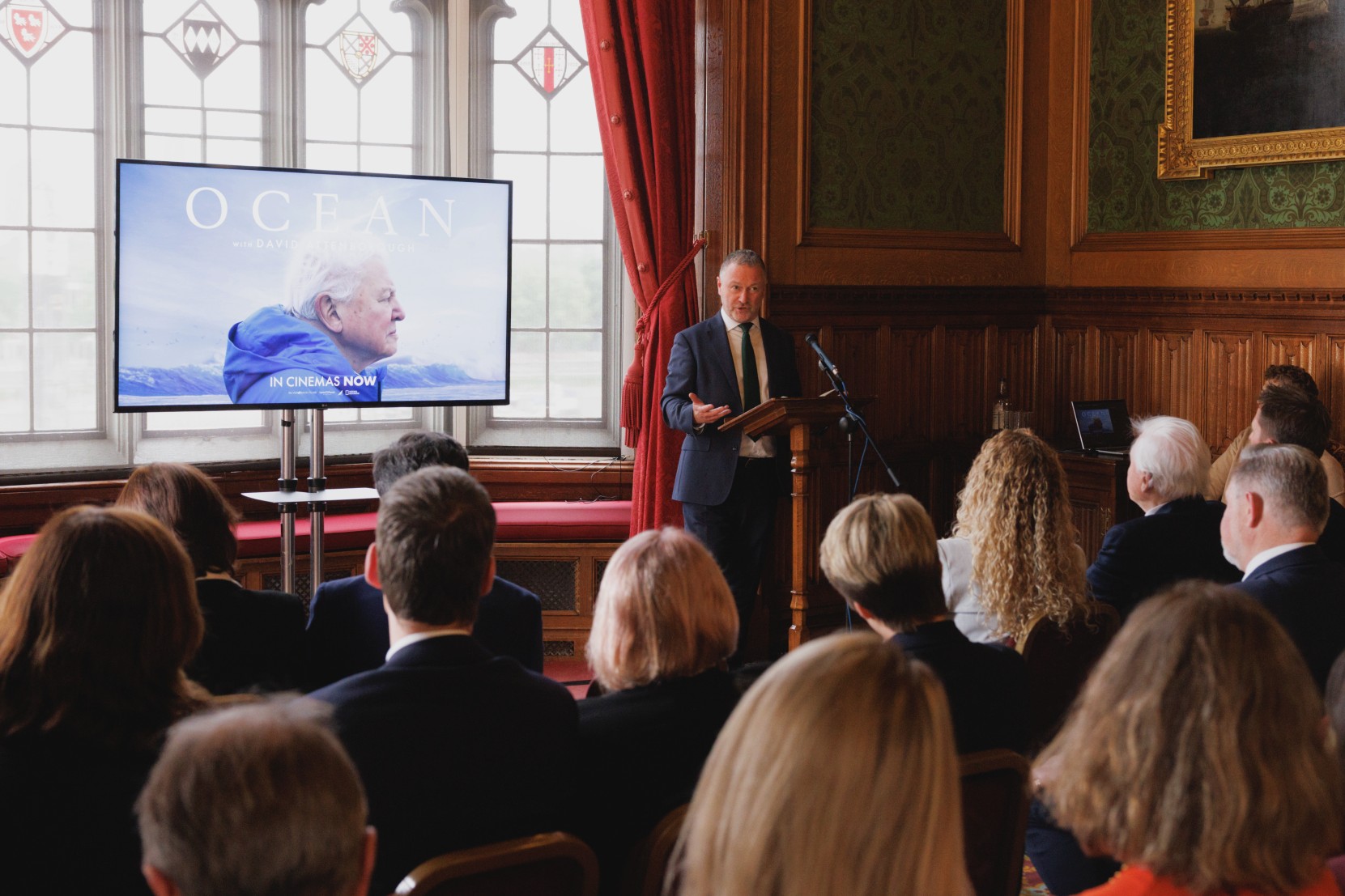
Screening of Biologist David Attenborough’s film ‘Ocean’ in the House of Lords. London, United Kingdom, 2025.
As I write this, the crisis in the Strait of Hormuz remains ongoing, evolving, with the slow yet grinding momentum of a supertanker, from a distant geopolitical flashpoint into a direct driver of dwindling food and fuel supplies and rising prices. A super El Niño is poised to be the biggest ever recorded—and this on the back of, of course, much higher global temperatures than were present during the wicked super El Niños of the Victorian era, which killed untold millions.
And, as reported previously here at Resilience, a brace of suppressed U.K. government reports have revealed that this country is particularly at risk from the coming nature-depletion and climate disasters, especially with respect to food (un)resilience. None of this is mere coincidence.
The times dawning now, not in a generation’s time but right now, are times when ecological dynamics will be determinative. The old politics is utterly incapable of understanding, let alone addressing, this new reality. There is a real risk that hard far-right populism will come to address it soon, in its characteristic exclusionary ways.
As I have argued previously, alongside Caroline Lucas, Liam Kavanagh, Rosie Bell and my other Climate Majority colleagues, addressing this challenge will become the defining issue of our time.
Yet no one is prepared for this, not even us. But we are practicing readiness—or seeking to. And that is the point. This itself is the required turn. To seek safety together, in a way that can bring people together, achieving the genuine critical mass that sectional and culture-war appeals constitutively just cannot sustain. That is the aim of our newly published report on Climate Popularism.
Earlier this year, the UK’s Labour government once again postponed a planned increase in fuel tax, keeping fuel prices artificially low and effectively encouraging continued consumption just as supplies are set to become scarce. This is cowardly, pseudo-populist economic illiteracy, the very kind of politics our report challenges, particularly as the prospect of severe supply shocks becomes increasingly real. In other words, this measure will worsen the crisis without addressing the underlying drivers of the cost-of-living squeeze.
Our report proposes a framework for a wholly different way of running politics: trusting the people, reducing the cost of living in a way that can be sustained through ecologically sane means, and explicitly building (local) resilience against what is coming. In practice, that can include rewarding people for hosting renewables in their area by making locally generated electricity accessible to locals at near-cost rates or establishing zonal price districts.
This past summer, heatwave deaths in the UK reached record levels as wildfires raged across the country. Wars, from Ukraine to Iran, are driving up energy and food prices, pressures intensified by our dependence on fossil fuels. Meanwhile, the potential collapse of ecological systems is putting water and food security at risk and threatening the state’s ability to meet people’s basic needs. Drought is worsening across much of Britain, even in late October. The warnings are clear: these events aren’t anomalies, and a predicted ‘monster’ El Niño year will make them even more severe.
So ours is a report written for the age of consequences. Its message to anyone seeking a popular mandate: protecting people and nature from cascading crises can no longer be treated as a mere policy option. Leave those needs unattended, and the populist right will offer their own kind of security. Environmentally sound, economically fair resilience is the ground on which every other credible policy now must stand.
Climate resilience and adaptation remain largely neglected in UK politics, a glaring omission this report aims to address. The effects of climate change and other crises are already pushing resilience and adaptation up the political agenda. These issues will soon become impossible for policymakers to ignore. But if they become another front in the culture war, meaningful action on climate breakdown will remain out of reach.
But adaptation is not inherently a culture-war issue. Had the radical climate movement placed greater emphasis on adaptation, alongside ‘mitigation’ (decarbonisation), climate politics might have become less polarised. Adaptation is harder to polarise than mitigation, because its results can be seen locally, and relatively quickly, making it easier to judge what works.
So far, Britain has largely been spared the worst of the most serious impacts. That is beginning to change, and the impacts are likely to intensify over the next 12 months. This report is written for the testing period ahead, as Britain enters an age of consequences and climate breakdown becomes a shared national experience.
Here is the good news: strategies for climate-stabilisation, local adaptation and protecting nature can go hand in hand. When adaptation is pursued strategically, often through nature-based solutions, these three goals organically become part of a single approach. Restoring large peatlands, for example, can revive ecosystems, create natural buffers against wildfires and floods, and pull down carbon, all at once.
When lower-income and vulnerable populations are most often disproportionately affected by the effects of climate change, solutions that can help reduce the cost of living while also stabilising the risk of some of the most devastating impacts of the climate crisis through prioritizing resilience-building can finally provide a sustainable and effective climate policy.
That is the promise of climate popularism: climate action that supports a renewed politics of place and challenges right-wing populists.
“…a case for climate popularism: a new framing of serious climate action that works with the social and political currents of our times to defuse right-wing populism and present a genuine alternative. This framing gives a central place to climate and wider crisis resilience: bringing adaptation in from the margins of climate action, and linking it robustly with local economic security and quality of life.” — Climate Popularism (2026), Climate Majority Project
The international establishment—politicians, media, and forums like the UN’s annual climate change conferences, or COP—has failed the public. Elite institutions have worked on the assumption that the population would be counterproductively overwhelmed by the truth about climate chaos. To (try to) manage public emotions, they have resorted to downplaying the scale of the challenge, relying on overly optimistic projections about carbon capture technologies, and minimizing the profound difficulties of achieving net-zero emissions, failing time and again to confront the climate crisis with the honesty and urgency it demands. We propose that a popular intervention from below is the only thing that can save us now!
Climate popularism aims to co-create that intervention, and thus, in due course, to create a politics that responds to our times. My co-author Caroline and I are particularly excited because we truly believe a materially grim future can still be a good future—if we pull together to build community solidarity and resilience. And so we must.
Read the full report by Rupert Read and Caroline Lucas on Climate Popularism here.




Comments