

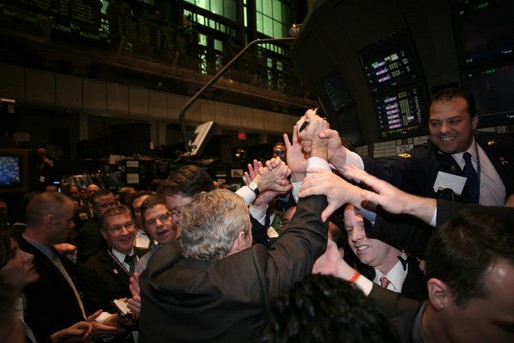
U.S. capital markets—what we often call “Wall Street”—allegedly supply one critical economic function. They provide investment capital to those who need it and are best prepared to use it. A finance veteran might say the bigger and freer Wall Street is, the better. More capital from the nation’s investment banks means bigger ventures, greater marketplace competition, and increased productivity.

But bigger and more productive isn’t always good for people or planet. As Franklin Roosevelt noted when he signed the 1933 Securities Act, “…the merchandising of securities is really traffic in the economic and social welfare of our people.” Knee-deep in the Wall Street of the mythical “roaring twenties,” FDR understood the nexus between investment banking and industrial-age productivity. But he also had a fine sense of Wall Street’s corruption, its role in generating historic levels of inequality, and its need for robust regulatory oversight.
U.S. capital markets are powerful economic forces. Though numbers of publicly listed companies and initial public offerings have declined over the last thirty years, their total value has continued to increase. This reflects intense market concentration and the American affinity for runaway investment bubbles.
An important question hovers above it all: Do U.S. capital markets drive an unending search for growth that Earth cannot sustain?
Asset Valuation Gone Awry
Prior to the 1930s, investors couldn’t count on honest appraisals of company performance. Without good information for long-term investment decisions, many investors simply speculated. They bought and sold assets quickly for capital gains, creating investment bubbles that resulted in the infamous stock-market crash of 1929. Wall Street imperiled the U.S. economy just as often as it underwrote innovation and productivity.

The Securities and Exchange Commission (SEC), launched by FDR in the 1930s, was a response to this immense fraud and dysfunction. Its reporting requirements made it difficult for corporations to fudge their numbers when promoting the sale of their stocks or bonds.
The SEC has remained fairly effective at ferreting out bad asset information. But as Wall Street has evolved—perfecting new, opaque investment instruments and popularizing the efficient market hypothesis—regulation must also evolve.
In the wake of the dot-com and housing bubbles, and with many close observers warning of an AI bubble, it’s time to reinvigorate the SEC. Without significant reform, efficient capital allocation will continue to give way to inequality, fraud, and a planet-killing focus on perpetual capital gains.
Liability and Local Bonds
Mindful that there’s a healthy baby somewhere in this enormous tub of murky bathwater, what should we fix? A good place to start is liability. Prior to 1970, all prominent Wall Street firms were partnerships. This meant that firm owners and managers assumed much of the risk inherent to their investments. Alongside robust SEC regulation, this liability kept investment banks’ worst tendencies in check.
The tides turned in 1970, when the first investment bank sold ownership shares to public investors. Offloading liability onto shareholders has freed investment banks for casino-like behavior. The resumption of a system where owners and managers are liable for investment decisions is long overdue.
Bond markets—a poorly understood segment of U.S. capital markets—also require significant reform and more SEC oversight. They are too costly, inefficient, and unreliable for most passive investors, who are staked to bonds by their pensions, 401K accounts, and mutual funds. One major issue is that private, for-profit agencies conduct the business of bond rating. Conflicts of interest regularly compromise the integrity and efficiency of bond rating, which regulators and institutional investors, such as pension funds, rely on to enforce rules and allocate capital.
Another major bond-market issue is the prevalence of specialized local-government bonds, which are often tied to special taxation zones or economic development projects. Compared with general-obligation bonds, which are tied to the full faith and credit of the issuing government, these specialized bonds carry higher interest rates. This directs taxpayer dollars from other public needs to the bank accounts of usually wealthy bond buyers.
Cutting Wall Street Down to Size
We’ve often heard that Wall Street isn’t the economy. Indeed, the corporate obsession with stock prices and capital gains tends to sacrifice real productivity and shared prosperity. Companies increasingly tie executive pay to stock performance. Startup founders and venture capitalists prioritize cashing out through a big sale or initial public offering. If stock-price gains and “successful exits” are the goals, quarterly growth matters more than building a sustainable business.
Reflecting these backward priorities, the net value of corporate stock issuance in a typical year amounts to zero. Publicly traded companies, eschewing real investment and hoping to goose their stock prices (and corresponding executive pay), quickly buy back more stock than they issue. To grow quickly—with little regard for long-term value—companies stifle competition, squeeze workers, and gouge customers.
Growth for its own sake should have no place in U.S. capital markets. Only real productivity, economies of scale, and actual returns on selective investments remain worthy goals in a steady state economy. And a steady state economy—built on respect for the planet, workers, consumers, and investors—entails optimally scaled capital markets.

Cutting Wall Street down to a sustainable size requires minimizing market dependance on economically and environmentally destructive investment bubbles. Key reforms to achieve this include taxing securities and international-currency trades, eliminating favorable capital-gains tax treatment, and limiting stock-exchange trading hours.
Finally, U.S. capital markets reform wouldn’t be complete without pension reform. Pre-1970s, public pension systems functioned well on a pay-as-you-go basis. Because current beneficiaries’ benefits were funded by current contributors, these systems didn’t rely on outsized stock-market gains.
Today, public and private pensions are treated like a liability to minimize or keep out of the budget, rather than another form of worker compensation. Companies and governments hand the reins to pension funds to invest for the biggest and fastest returns. Much like other investment institutions, these funds speculate, allocate resources poorly, and further inflate investment bubbles. The resulting ecological degradation undermines the very futures these pension funds are meant to secure.
The Act
A new feeder bill for the Steady State Economy Act, the Sustainable Capital Markets Act (SCMA), is a launchpad for capital-markets reform. The SCMA comprises fourteen sections. Sections 1–3 establish the bill’s short title, Congress’s findings and declarations, and definitions. One of the findings is that present U.S. financial sector management encourages speculation and rent-seeking at the expense of the efficient allocation of capital resources. The SCMA discourages or prohibits key elements of this behavior.
Section 4 is designed to reverse the transfer of investment risks from firm owners and managers to public shareholders. It requires partnership agreements that would make investment-bank “partners” personally liable for a large portion of potential firm losses. This would reward and maximize sustainable investment behavior.
Section 5 reverses an amendment to the Dodd-Frank Wall Street Reform and Consumer Protection Act of 2010. The amendment was signed into law in 2018 by President Trump. Dodd-Frank protected shareholders and U.S. taxpayers from bailouts of “too-big-to-fail” investment banks by applying “enhanced prudential standards” for banks with more than $50 billion in assets. The 2018 amendment loosened several of these standards and raised the threshold for their application to $250 billion. In addition to reversing this amendment, the SCMA transfers the performance of annual stress tests—one of the prudential standards—from investment banks to the federal Financial Stability Oversight Council.
Sections 6 and 7 focus on American bond markets. Section 6 phases out for-profit bond rating agencies. Section 7 requires that all municipal and state bonds be general-obligation securities, tied to the full faith and credit of the issuing government. It also eliminates the preferential tax treatment that municipal-bond income currently receives. Though this treatment theoretically makes state and local government borrowing less expensive, its primary benefits flow to wealthy investors, even while the federal debt balloons.
Sections 8 and 9 create two new transaction taxes, one for domestic securities trading and the second for international currency trading. For both, the object is to discourage volatile arbitrage in which insider trading, hot capital flows, and destabilizing transactions favor wasteful speculation over the exchange of essential products and services.
Section 10 introduces two changes to the U.S. tax code, to discourage the chase for capital gains. Current tax code treats capital gains more favorably than simple profits. This bias generates an artificial drive for growth, at the expense of value or need. The SCMA requires that capital gains and corporate dividends be taxed the same as “ordinary income.”
Section 11 is designed to discourage and ultimately eliminate cryptocurrency mining, which needlessly consumes vast amounts of energy. First, banks insured by the Federal Deposit Insurance Corporation are prohibited from dealing in cryptocurrency. Second, all cryptocurrency mining is prohibited. Third, a tax is applied to all cryptocurrency holdings owned by individuals or corporations.
To end the drive for 24/7 securities trading, section 12 mandates a limited (and traditional) six-and-one-half hour trading period based on U.S. Eastern Standard Time trading hours. This is meant to reorient trading to value rather than timing, to real investment rather than manipulation and speculation.
Section 13 requires public pension systems to return to a pay-as-you-go structure. Funded with a progressive tax system, this change would divorce pensions from speculation and antithetical corporate behavior. This section also compels private pension systems to maintain a reserve equal to 75 percent of their estimated thirty-year accrued liability. Section 13 also limits private pension fund investments to U.S. Treasury securities. This would lower returns, forcing companies to fund pensions mostly with current cash flow. This would also transform private pension funds into a significant source of public investment, which has a lighter ecological impact (especially pursuant to a Sustainable Budgets Act) than runaway speculation.

Finally, section 14 defines the penalties and enforcement for any violations of the cryptocurrency and trading-hours prohibitions in sections 11 and 12. As for the bill’s other provisions, each section specifies the entity—primarily the SEC or the IRS—responsible for determining how they will be enforced.
On a finite planet, where overshoot has become all too common, the status quo serves nobody’s interest. Inequality and instability prevail when our wellbeing and planet require the opposite. When our nation’s capital markets actively undermine a sustainable, equitable framework, they surely require change. The Sustainable Capital Markets Act is designed to make these markets do what we need them to do. Broad prosperity, not perpetual growth, is the principal goal.




Comments
We changed commenting systems on September 10, 2026 as part of a site-wide functionality and security upgrade. Your past comments have not disappeared, and you can still log in with your old Disqus account credentials if you wish. Contact us with any questions.