

Discovering the Spiritual Wisdom of Trees by Beth Norcross and Leah Rampy. (Broadleaf Books, 2025)
Along some parts of the coast where there is a steady wind from the sea… it is extremely difficult for trees to grow tall and straight against the sky. Yet they do… It is a very fine art, this bending with the wind and keeping on.
— Howard Thurman, Deep Is the Hunger
We do not need to bear witness to and grieve the loss of our tree kin, or other losses we might suffer, by ourselves. Trees, who have shown extraordinary resilience in the face of extensive injury, are companions well suited to our journey through sorrow to healing.
Mutual Woundedness
A few years ago, on a chilly autumn day, I participated in a grief walk in a beautiful old hardwood forest. Members of the group had experienced a wide range of recent losses, including some that were devastating. As we began our introductions, I noticed one man standing off to the side by himself. His face was drawn. He was stooped, as if carrying a heavy sack on his shoulders. It seemed like an effort to hold his head up. I had learned earlier that this man’s sixteen-year-old daughter had recently died by suicide. I could not imagine the depth of his loss.
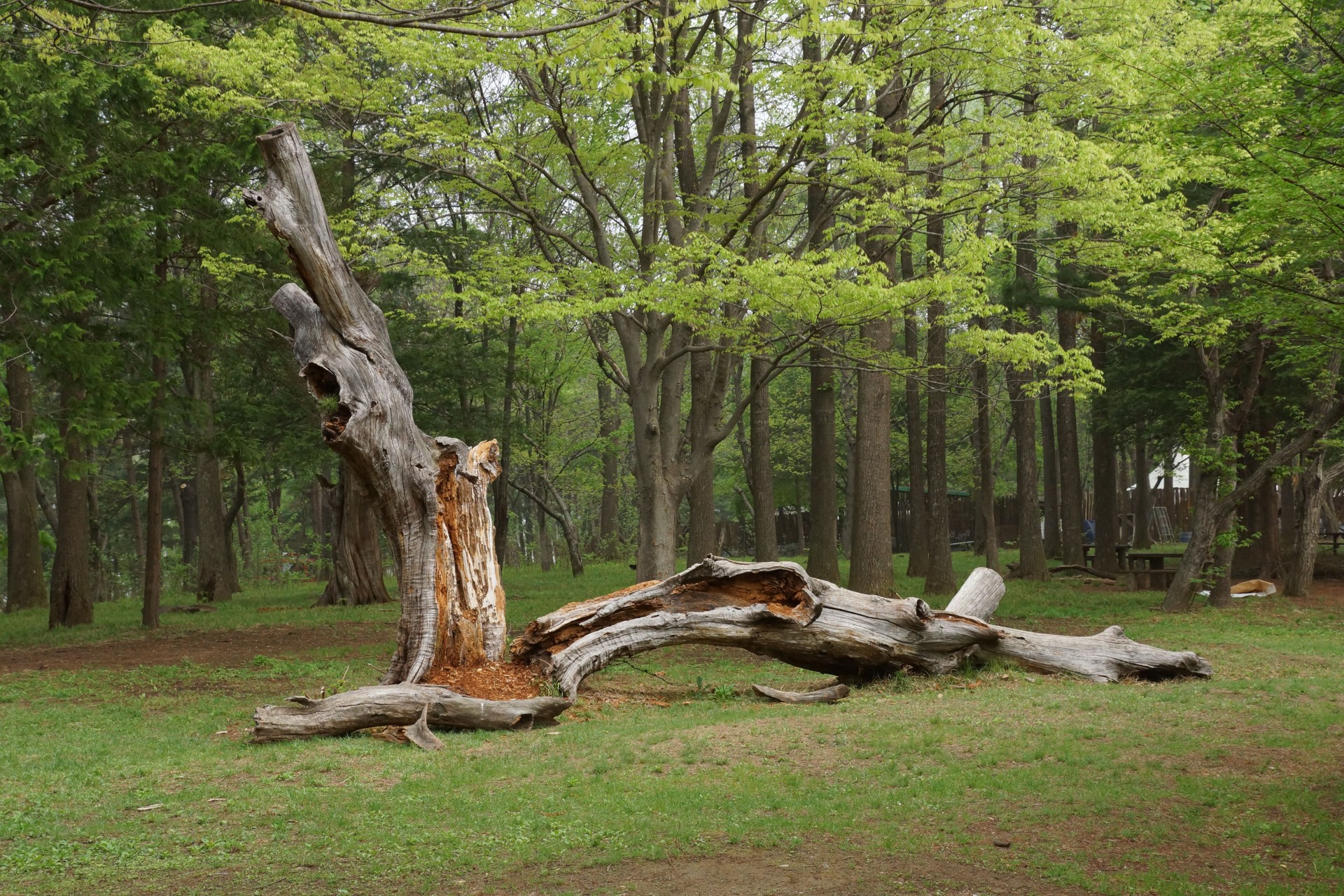
Protected and enveloped by towering ramrod-straight tulip trees and huge shaggy white oaks, we walked slowly down the wooded path in silent single file until we reached the bottom of the valley, the belly of the forest. Some in the group gasped as they saw the huge sixty-feet-high, fourfeet-wide tulip tree. About ten feet of the huge trunk had been culled out, and the enormous jagged wound stood open and exposed. It looked as if a giant ice-cream scooper had taken out the entire bottom of the tree. The heartwood was almost completely gone, and the tree was being held up on only three sides. Certainly, she was no longer living. Who could survive that kind of loss?
But when we looked up, we saw those telltale green tulip-shaped leaves scattered on her branches as far as we could see. Squirrels were skittering up and down her bark, and blue jays were pecking at her seeds. Her heart(wood) was gone, yet she survived. She would never be the same tree. She would always bear the scars of her loss. Yet she lived. And she was still giving back to others within the forest community.
I watched our group take in this noble, wounded survivor. Tentatively, the grieving father approached the tree. He reached inside the remaining tree bark and touched her ragged interior. He then spoke softly to her and walked away.
I will never know what this heartbroken father said to the tulip tree, nor the impact that visit had on him. I would like to think that, if only for a moment or two, he found some comfort. Perhaps the visible deep cuts within the tulip tree gave him a place to put his own horrific loss. Perhaps the tree reassured him that he, too, would learn to live again in his wounded state, despite the hole that would always remain in his heart.
I must confess that I, too, in moments of overwhelming loss, have spent time curled up inside that big old tree and have felt held and supported in my own grief. What was it about this wounded giant that touched this grieving father, that made me want to crawl inside of her and be comforted? In his description of how he fell in love with Grandfather Tree, Belden C. Lane talks about how he was drawn to the tree because the extensive storm damage Grandfather had endured spoke to him as he was grieving the loss of his mother. “Suffering,” Lane says, is “the door, joining us by a mutual woundedness.”
Quite possibly, it was mutual woundedness that drew the injured father, and me, to the injured tulip tree. As we connect intimately with a broken tree that still lives, still grows, and still gives back, we draw sustenance and hope that we, too, will somehow go on despite carrying seemingly unbearable pain. The tree does not offer us a superficial hope that life will be as it was before. Rather, she reminds us that we will somehow learn to live with our brokenness and, in time, live a full, if altered, life.
Trees for Life, a group that is dedicated to rewilding the Scottish Highlands, routinely brings refugees, the homeless, and those struggling with mental health issues to the Highlands for the arduous work of tree planting in a rugged and remote area. Through its Rewild and Recover program, people actively participate in the healing of the forest and are in turn healed in the process. Said one participant: “For me, it wasn’t a holiday. It was emergency first aid on a completely crushed and flattened brain. I arrived virtually dysfunctional and at a dead stop… I have managed to get home in a functional state and standing upright again… At least I’m back in a position where I can try and do something about it.”
When we broken and lost individuals connect intimately with a forest that is undergoing decay, disease, infestation, or complete devastation at the hand of aggressive logging, we experience a visceral soul-to-soul empathy with the trees. The health of all species within the forest is bound together in an inextricable web of belonging. Since we are now one, we cannot separate our human needs from those of our other-than-human kin. Our wounds do not cut quite as deeply, as they are now shared with other family members who have also known injury. By helping to heal the trees, then, we, too, are healed. As Buddhist ecoactivist Joanna Macy says, “As we work to heal the earth, the earth heals us.”





Comments
We changed commenting systems on September 10, 2026 as part of a site-wide functionality and security upgrade. Your past comments have not disappeared, and you can still log in with your old Disqus account credentials if you wish. Contact us with any questions.