

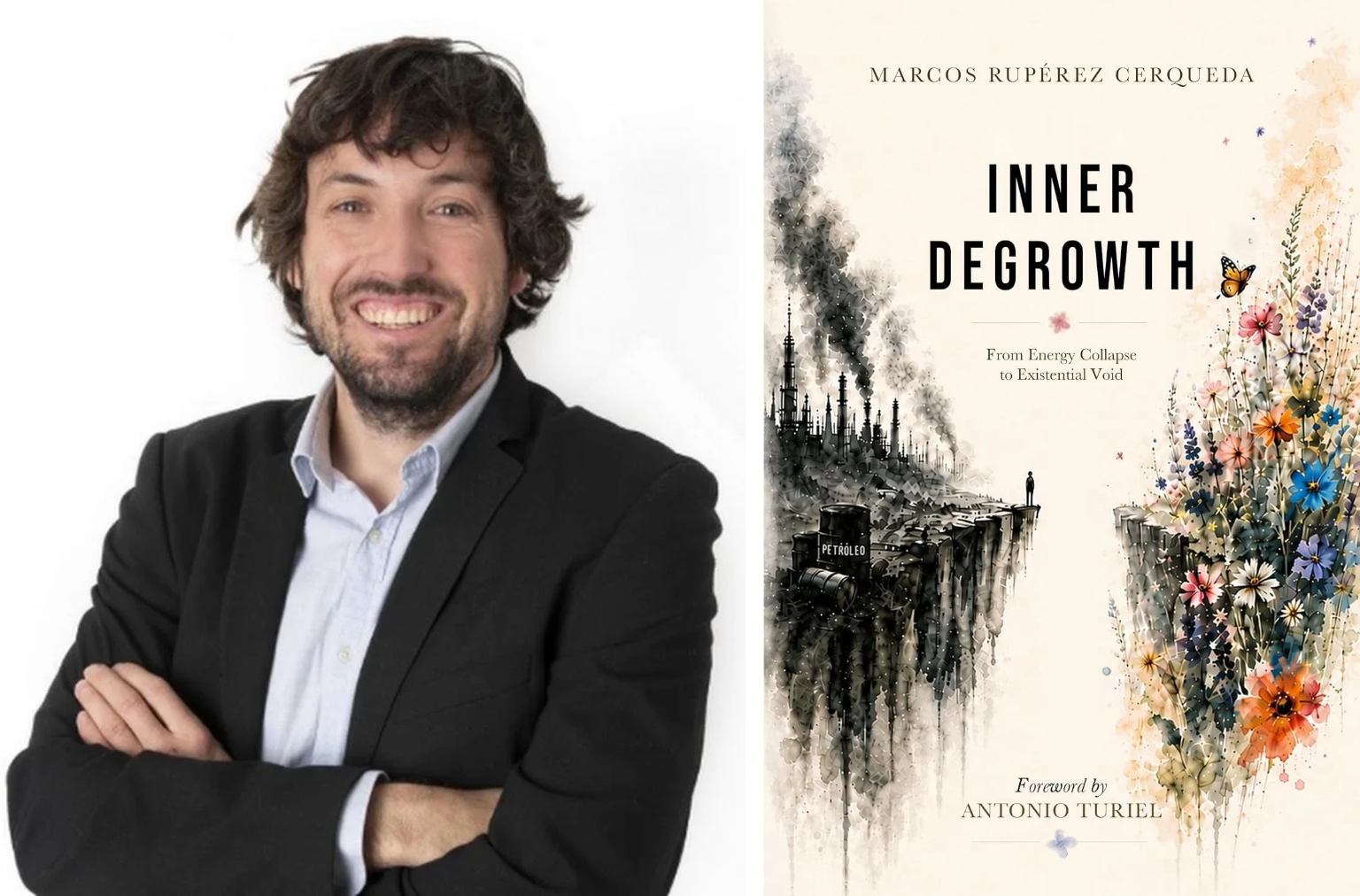
Marcos Rupérez Cerqueda spent years as an engineer on green hydrogen projects in Spain, installing electrolysers and fuel cells, before the numbers made him stop believing in a technical fix. His new book, Inner Degrowth: From Energy Collapse to Existential Void, with a foreword by the Spanish physicist Antonio Turiel, follows that path from the energy data to a much more personal question. In this Q&A, he traces this journey and discusses his upcoming book.
Starting as a believer in green hydrogen. What changed?
I grew up inside the solution. My father is an engineer who chaired an environmental foundation, and we lived in one of the first bioclimatic houses in my region of Spain. So when I chose what to study, it felt obvious: industrial engineering, then a master’s in hydrogen in Denmark. If most of the energy that moves our civilization isn’t electricity, hydrogen looked like the perfect bridge: make it with renewables, store it, move it, use it.
Then one afternoon, in front of a spreadsheet with my business partner, I did the full count for one common chain. Around 40% of the energy is lost in the electrolyser, roughly another 10% compressing the hydrogen, and another 40 to 50% turning it back into electricity in a fuel cell. Of every 100 units of renewable electricity you put in, only 20 to 25 come out at the end. That isn’t a problem better engineering can fix. It’s thermodynamics. Hydrogen has real uses in a few narrow niches, but as a universal energy carrier, no.
Many people reach that conclusion and stay in the technical debate. Why the change?
Because once hydrogen fell, I started seeing the same hole everywhere. Electricity is still only around a fifth of the energy the world uses. The rest is fuel, heat and raw materials: diesel for tractors and trucks, fuel for ships and planes, heat for steel and cement, gas for fertiliser. And where you can’t electrify directly, turning electricity into something dense loses half the energy or more.
Then there is the pattern economists call the Jevons paradox: every time we make something more efficient, we end up using more of it in total. Our computers are vastly more efficient than forty years ago, and computing uses far more energy than it did then. So I stopped asking which technology saves us, and started asking why we keep needing more.
And where did this question lead?
Somewhere I didn’t expect: inside my own head. In 2017 I went on a ten-day Vipassana retreat. I went in as an engineer, looking for a technique to make my mind run better. I came out not knowing who I was. What followed was the hardest year of my life. I closed my company, went back to my parents’ house and spent months coming apart.
I’m not going to romanticise it. But on the other side I saw something I couldn’t unsee: the same dynamic I had found in the energy numbers was running in my own mind. I use the image of an ideal gas. Leave it free and it fills whatever space you give it, a bottle or a whole room. The mind does the same with any capacity it gets: more time, more money, more energy. It doesn’t save them. It uses them all, and then it wants more. That is the core of the book. The energy crisis and the emptiness so many of us feel are the same phenomenon: asking material things for a fulfilment they cannot give.
On the provocative chapter on degrowth titled “The Degrowth No One Wants to Do”
It’s meant to be honest, and it includes me. Most people who follow the energy analysis to the end go through the same steps. First, technology will solve it. Then, if not technology, changing our habits. And finally, degrowth: shrinking the material economy in an organised way before collapse does it for us. That is the position most consistent with physics.
But almost none of us actually does it. Many degrowth advocates, myself included, live at the pace of the civilization we want to slow down: flights to conferences, careers that demand more output, a constant rush to tell everyone we need to slow down. It isn’t hypocrisy in a moral sense. It’s a sign that the problem isn’t mainly one of information or policy. We know where we’re heading. What fails is something more inner: the part of us that keeps reaching for the next thing.
Is “inner degrowth” a call to personal virtue instead of systemic change?
No, and I’m wary of anything that sounds like that. In the book I’m quite hard on the personal development industry, because it often sells the opposite of what it claims: more drive, more goals, more acceleration, using the language of inner transformation. It’s the Jevons paradox applied to the soul.
Inner degrowth isn’t another technique to optimise yourself. It’s closer to letting go: less mind, less speed, less need for the next step. It won’t change the system on its own, and I don’t pretend it will. But I don’t believe any system will be willing to do with less while the people inside it are still convinced that more is the answer. The outer change and the inner one have the same root.
It’s easy to be pessimistic about avoiding collapse. On finding ‘hope’
I’m not sure hope is the right word. Hope often works as a way of postponing: someone else, some future technology, some summit will fix it. What I’ve found more useful is accepting what the numbers say and then asking what is still truly ours.
I end the book with a parable about a father and a son walking a path. The son keeps leaving it to chase a flower among the thorns, and the father keeps pulling him back with a rope. The further the son strays, the harder the pull has to be. I think that’s where we are as a civilization: two centuries running through the thorns, and the physical limits of the planet pulling harder each time. The pull isn’t a punishment. It’s the way back to the path.
Who is this book for?
For people who already sense that something doesn’t add up, whether they come from the energy numbers, from climate, or from a personal crisis of meaning. It starts with data and ends with something much more intimate. I hope engineers find the first half honest and the second half unsettling, and that people who come for the inner part find in the first half the reasons why it matters.




Comments
We changed commenting systems on September 10, 2026 as part of a site-wide functionality and security upgrade. Your past comments have not disappeared, and you can still log in with your old Disqus account credentials if you wish. Contact us with any questions.