

Few among us question actions done “in the name of science” when said actions are carried out by credible groups or individuals. It goes without saying that the acquisition and expansion of knowledge is highly valued. As long as the pursuit is not directly harmful to people, it generally gets a pass. But one level deeper, what is science itself done in the name of?
Not surprisingly, much of science is in the service of modernity: producing remarkable short-term advantages for humans—generally at the expense of the rest of the Community of Life on both short- and long-term scales. A great deal of the scientific enterprise concentrates on technology. Market systems assure funding for efforts that will facilitate continued growth: accessing more energy, more materials (and novel ones, to boot), more indispensable gadgets, and longer lives for affluent humans whose ecological footprints are already monstrous (let’s keep those ones going the longest, yeah?).
But you know me, I can find fault even with “good” science whose focus is on the more-than-human world. I am reminded of a statement a grad student once started to make: “The problem with trees…” Another student, seizing on the humor of the moment, adopted an official tone as if a debate moderator: “The Problem with Trees: GO!” Yeah, so the problem with conservation biologists…
Let’s see how much I step in it, here.
A Recent Trigger
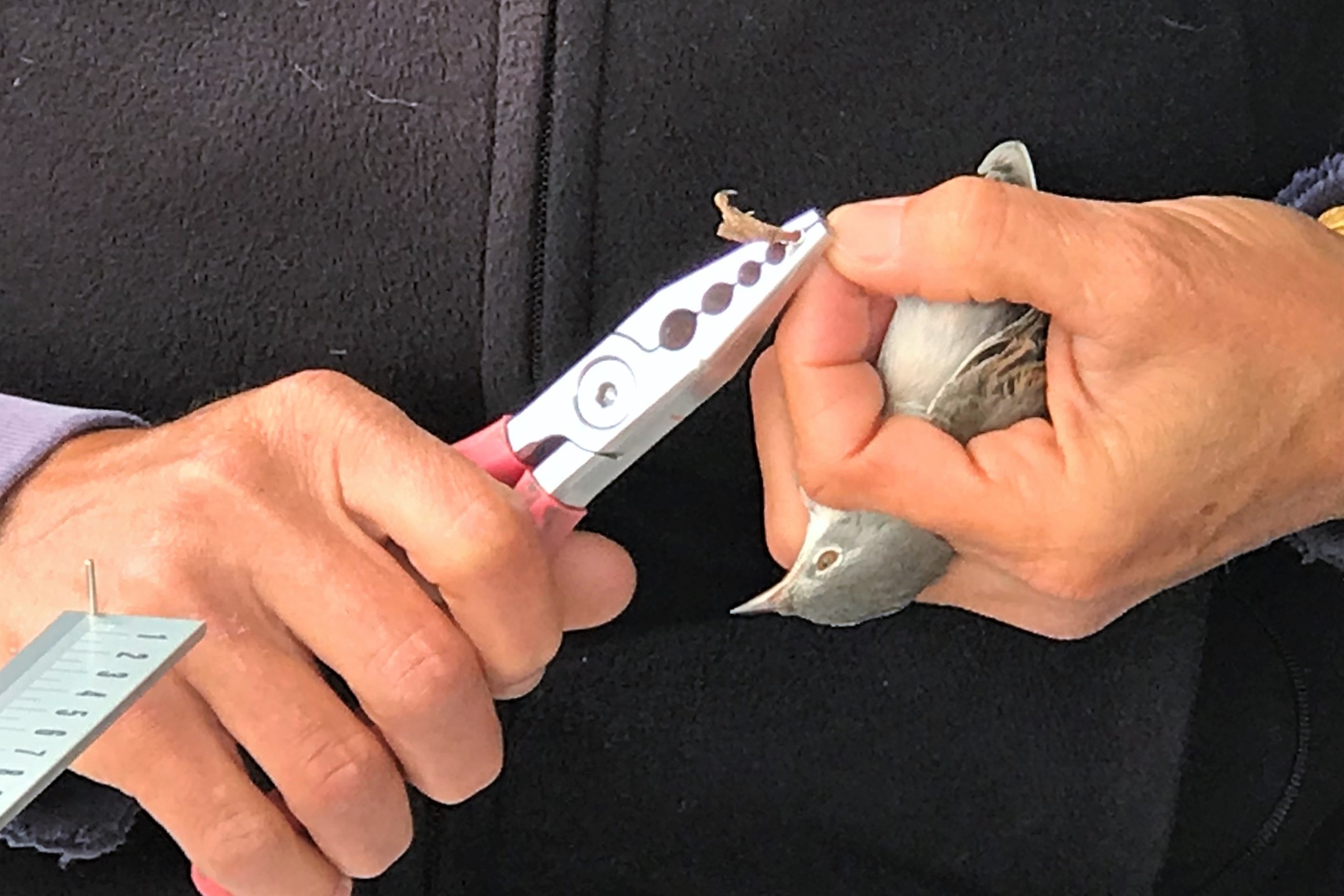
Let’s first ground this discussion in something I recently encountered. A friend loaned me a book, called Seabirds as Sentinels, by Eric Wagner. I enjoyed learning about rhinoceros auklets and tufted puffins, and connected to the many familiar places on the Olympic Peninsula referenced in the book. I’ve sailed quietly around and past Protection Island and Destruction Island, often watching from the bow of the boat as countless rhinoceros auklets dive to get out of the way—almost always in pairs. I try in vain to catch glimpses of them deep in the clear water as the boat passes over the spot where they disappeared, but all I ever manage to see is their bubble trails disappearing into the depths.
The characters described in the book—assisted by the author—perform science on the auklets to learn more of their secrets and challenges. It doesn’t always turn out so well for the auklets. A passage from the book captures some of the author’s conflict over this, in the context of intercepting adults returning at dusk with beaks full of small fish—confiscating the booty for bagging and data collection [square brackets are my additions]:
To know I have stolen food from a chick in the name of Science is not the best feeling, but I take comfort in the fact [hope?] that I am depriving it of only half a meal. It’s other parent will [presumably?] bring it something soon, and both of them will [presumably?] be back tomorrow. Having conveniently absolved myself, I stuff the baggie in my pocket and wait for the next auklet [victim].
At least he struggles with it, sensing deep down that what he’s doing to the auklets is wrong—before embracing his left-brain rationalization built on a number of comfortable presumptions. It’s in the name of science, after all. That’s gotta be holy work, right?
I could give the scientists the benefit of the doubt that they already tested to their satisfaction that such invasive actions do not cause the chicks to be abandoned, or that the other parent is basically guaranteed to provide at least half-a-meal. But as an ignorant reader, I could easily believe all sorts of ill fates stemming from this invasive but superficially innocuous activity. It’s an action out of context for the auklets, and that’s always a red flag. Not thinking it to be a problem is not at all the same as the universe agreeing that it’s not a problem. We miss a helluva lotta stuff in these brains of ours.
More Generally
But what I really want to explore is what benefit actually derives from many of our scientific pursuits in conservation biology. Who does it help? What’s the underlying assumption at play?
The standard argument is as predictable as it is comforting. By knowing more about a certain species and the challenges they face, we might improve their lives in the hope that we—meaning modernity, of course—may coexist. One of the relatively few success stories—like the banning of DDT saving the bald eagles—can’t be held back from the lips of proponents. Without scientific work, the link between DDT and rapid population decline might never have been identified.
Sometimes, when convenient substitutes are available, fixes are easy. Those are the ones we hear about, repeatedly. The ozone hole (which is still there and basically holding steady, by the way) prompted a shift from one nasty chemical cocktail to another, having all-new unknown side effects. Abandoning refrigeration was never on the table: a wholly preposterous proposal to the human-supremacist modernity-booster. Beware the non-negotiable! Likewise, DDT gave way to new pesticides that have no negative environmental side effects. Of course I’m being sarcastic. Again, the response was not to recognize pesticides as dangerous contributors to ecocide, and therefore to stop using them.
When the problems stem from non-negotiable practices of modernity, wildlife will lose every single time. Domestic cats and windows—neither of which are part of a longstanding ecological context—kill billions of birds per year. Humans of modernity have no interest in giving up pristine views from our shelters or going without cuddly feline monsters. Roadkill is eliminated in an instant by ceasing to drive cars and trucks. How is that absurd suggestion likely to fly?
The Goal?
Back to the main thread: what outcome of the scientific pursuit is considered to be the goal? If it’s just the well-being of the Community of Life, we don’t actually need to know the masses of fish in the beaks of auklets. Declining populations across the board are obviously caused by various aspects of modernity, dammit! If able to wave a magic wand that eliminated agriculture, deforestation, mining, manufacturing, pollution, shipping, overpopulation of humans, etc. is there any doubt that the boot would come off the throat, giving wildlife a chance to rebound? Even then, the damage may already be too large in some cases for a proper rebound. And we might expect millions of years for the myriad perturbations (e.g., invasive introductions) to mostly settle out.
So, without explicitly saying so, conservation science seeks ways that ecological health might obtain in the shadow of modernity, if we can tweak modernity’s practices. That’s a dangerous prior. It’s practical…I’ll give it that. Modernity isn’t going to respond to a sharply-worded journal article by saying “Well, you’ve got me there. Guess I’ll just fold up shop.” This is one wing of the prison I described in a recent post. The inmates (practicing conservation biologists) are likely themselves fond of the comforts of prison, and not ready themselves to call for its dissolution. It’s scary, for sure.
The dream is that by studying the deep mysteries—no matter how invasive—it will pay off in the end by allowing us to have our cake and eat it, too.
Why not face up to the monster and stop pretending that a modality initiating a sixth mass extinction can be reconciled with ecological health? Would the conclusion of any scientific paper be wrong to suggest that without modernity the ecological Community of Life (which includes humans, of course) would fare much better? Such statements are not tolerated. Of course, throughout natural history every species has faced stresses and challenges now and again. The question is whether modernity—and its countless tentacles—represents a primary, originating threat to virtually all endangered species. We don’t need sophisticated measurements to know the answer to that one.
The complicity of scientists in support of modernity likely stems from either lack of courage or lack of acceptance regarding the incompatibility. I’m betting it’s more the latter. Scientists are products of modernity, and tend to cheer for the home team. Inside our brains, it is easy enough to tell reassuring stories of separability and compatibility: that we can have computers and low infant mortality and somehow still manage to pull off a healthy ecology. Good science ought to be based on evidence, and there is exactly zero evidence for this common conviction. Meanwhile, evidence abounds for drastic signs of profound incompatibilities.
In the name of all that’s sacred—which need not include science or modernity—let’s stop protecting modernity by “sciencing the shit” out of the innocent victims. We actually know what we have to do, right? It’s not that hard a mental puzzle. It’s just that too few want to give up short-term comforts and baubles even if it means ecocide. As a form of placation, we can busy ourselves in measuring the many ill effects as we circle the drain.


Comments
We changed commenting systems on September 10, 2026 as part of a site-wide functionality and security upgrade. Your past comments have not disappeared, and you can still log in with your old Disqus account credentials if you wish. Contact us with any questions.
“It’s just that too few want to give up short-term comforts and baubles even if it means ecocide.” Therefore: Chekhov’s famous theatrical gun rule: “If you show a gun in the first act, it must go off in the third”