

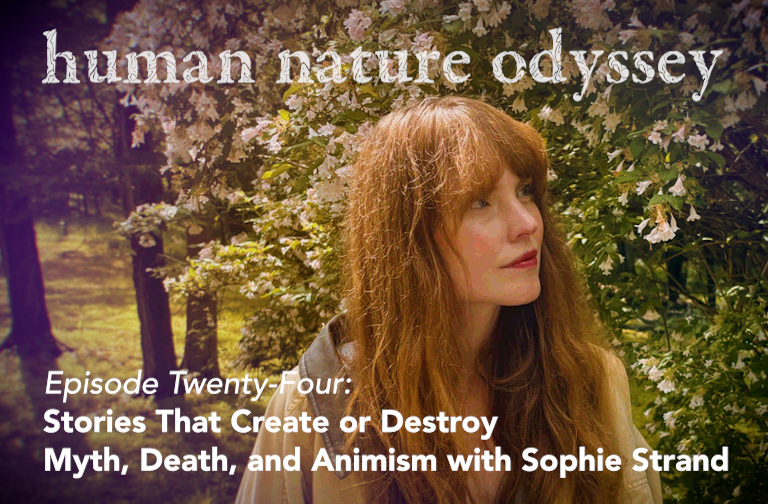
Show Notes
What if the crises of our time are not just ecological or political, but also mythological?
Poet and author Sophie Strand joins Human Nature Odyssey for a wide-ranging conversation about stories, illness, ecology, and transformation. Drawing from mythology, religion, folklore, and her own experience living with chronic illness, Sophie explores how the stories we inherit shape our relationship to the living world—and what happens when those stories no longer serve us.
Together, we discuss death and rebirth, animism, the power of storytelling, and the art of composting old narratives so that something new can grow. From Jesus of Nazareth to One
Thousand and One Arabian Nights to the ancient Greek epic of Odysseus, we explore stories not as relics of the past, but as living companions for navigating an uncertain future.
This conversation asks what it would mean to truly live in an animate world—to encounter plants, animals, rivers, and landscapes not as resources or scenery, but as relatives. At a time when many of our cultural myths are unraveling, Sophie offers a vision of belonging rooted in reciprocity, relationship, and participation in the wider community of life.
If you’d like to support Human Nature Odyssey, please subscribe wherever you enjoy your podcasts and leave us a review.
Sources & Links
- Sophie Strand’s Substack: Make Me Good Soil
- Sophie Strand’s Instagram: @cosmogyny
Extras
Join us on Substack and get exclusive access to audio extras, writings, and notes.
For full episode transcripts and additional context, visit: resilience.org/human-nature-odyssey-podcast
Credits
Thank you to Blindspot for sharing their original music. Check out Blindspot on Bandcamp and Spotify.
Theme Music is “Celestial Soda Pop” (Amazon, iTunes, Spotify) by Ray Lynch, from the album “Deep Breakfast.” Courtesy Ray Lynch Productions © Ⓟ 1984/BMI. All rights reserved.
Transcript
Sophie Strand (00:02.274)
We are always hijacked and puppeteered by cultural myths. They're invisible as air. We don't think of them as being fictional or as being stories, but they are. And we become their characters and we play out narratives that we didn't individually author. And I think that that one of the most liberatory things you can do is you can realize that you're in a story you didn't write and you can choose to exit it. And you can choose to tell a new story. And to stop letting yourself be a character in someone else's ecocidal narrative of domination and separation.


Alex Leff (00:47.95)
Welcome to Human Nature Odyssey, a podcast exploring how to come home to the world. I'm Alex Leff.


Alex Leff (01:19.96)
There's always that moment on a long hike when you've got to rest for a bit, take a swig of water, and gaze out over the landscape you've been traversing. In the last episode of Human Nature Odyssey, we looked out on our Odyssey thus far. These past few years we've been exploring the consequences of a global civilization that sees itself on a linear march towards endless growth, progress, and control.

But if we're gonna leave behind a world for future generations that we'd be proud of, we need to tell a different story. Not a quest to conquer the world, but an odyssey where we learn to come home. Sophie Strand is an excellent person to help us do exactly that. Sophie is a poet and author based in upstate New York's Hudson River Valley. She writes beautifully about ecology.

Mythology, and animism. Sophie is the author of books like The Flowering Wand, The Madonna Secret, and most recently, The Body is a Doorway, her memoir about living with chronic illness, and how that reshaped her understanding of the ecological unraveling all around us. In this conversation, we explore death and rebirth.

The power of stories to heal or harm, and what it means to compost old narratives from 1001 Arabian Knights to the ancient Greek epic of Odysseus's Odyssey, so something new can grow from them. And without any further ado, here is my conversation with writer Sophie Strand.


Sophie Strand (02:56.92)
Alright.


Alex Leff (03:14.094)
So for our conversation today, essentially I have a sense of the river that I'd love to navigate together, but there will be unexpected banks we can stop at and Eddies to explore. And thank you again for taking the time to talk today and excited to get to explore with you.


Sophie Strand (03:30.07)
Yeah, the only way I ever think anything new is by talking to someone else, so


Alex Leff (03:34.328)
So this is the Human Nature Odyssey podcast. Thinking about humans and nature, I think our culture tells this story that humans are the main character and we even have this word, the environment. We think of as like this background, it's just the setting, and we're raised to ignore it. It's almost as if our culture is just a nose, and this nose thinks it's the only intelligent part

And the the hands, the feet, the head, just a bunch of stupid stuff. It's all about the nose and then there's all the not nose. It's almost like the nose doesn't have a word for the body. And I see you as someone exploring this interconnected body as something to have a relationship with. And I was curious, is that an understanding you were raised with, or is that something you came to? How has that evolved for you?


Sophie Strand (04:34.348)
Well, first that's a great metaphor, a great way of explaining that disconnect that we are part of an extended cognition, extended embodiment, of which we are one small part, yet we think we are on top of that, or separate from it, separate from the dynamic dance of the biosphere, when it is the very thing that bodies our bodies. I was lucky enough to be raised by pretty I would say feral academic spiritual writers.

on a kind of unofficial animal rehabilitation farm up in the Catskills. And they were studying interfaith groups. My dad's an ex-Buddhist monk. My mom is kind of a ex-Catholic pagan. At the dinner table, there were often, you know, rabbis, environmentalists, writers, nuns. So there were a lot of different paradigms on the compost heap and a pretty generous understanding that each of them

was worthy of attention, but not necessarily the sole possessor of truth. And for me, an understanding that we are part of this larger ecology was, I think the key takeaway from all of these different traditions, this kind of animism that we see crop up in most traditions across the earth. We see a kind of a biodiversity of different types of animism, an understanding that the earth is alive, different beings are alive, albeit differently than us.

And so yeah, I think my parents definitely gave me, they oriented me towards that and then I developed it for myself. I do think though that there was a key moment of flowering into an a deeper understanding of that through my own embodiment post-college. I'd been very, very sick and then I went to Bard College and became pretty infected by philosophy and academia. And after that I had to deprogram.

From this sense that human beings are rational, that we are in any way separate from the world itself. And so I think post-college I had to unlearn a lot of things I had learned and come in to reclaim a new version of of animism.


Alex Leff (06:51.31)
'Cause I imagine, you know, animism is something that just like all of these philosophies we can study and think about. But I imagine animism itself has to be embodied to truly understand. I'm curious what steps you found yourself taking to feel the more embodied side of it.


Sophie Strand (07:13.144)
I don't think there was a heuristics to it. I think that it was something that I didn't order off the menu and came on my plate anyway, which is very serious illness with no cure. And just the desire to survive and keep making meaning. And, you know, I fell very ill at sixteen and then didn't receive a diagnosis until I was twenty two. And by that point I was very, very sick. And the diagnosis came with no cure.

Just kind of a list of the ways my body was going to break down. So pretty demoralizing. And so for me it was about trying to understand that even if there wasn't a cure for my body, my body leaked well past my skin silhouette into my extended web of ecological relationships. And if I couldn't find healing or wholeness inside my own story or my own body, I could find it in that extended relationality.

And so for me it was very much about trying to come into a wider sense of aliveness, wholeness, health, well-being when I couldn't perform it or complete it within a human body. I think for me it was a moment where I was walking a lot. I actually guess a practical answer to you is that I quit smoking cigarettes. I had been smoking in college. It was very much the culture of Bard.

And and I was also pretty pretty depressed as someone very, very sick and unable to find a cure, find any relief. And so I would have these moments of being like, well, it doesn't even matter. But then there was a moment where I kind of recommitted to the aliveness of the world, quit smoking, and I started walking like ten to fifteen miles a day. And that walking I always say like I traveled hundreds of miles within like two miles. I walked

these loops through these farm fields near the Hudson River so many times. I like wove myself into the hawks and forsythia bushes and gankos, the deer, the stone, so deeply that I felt like I had an intimacy with with this place that was deeper than I'd had with any human being. And it was the mundanity of those walks, the accumulation of intimacy that you can't do with just like one heroic dose experience. Yeah.

Sophie Strand (09:36.738)
You know, it's so antithetical to how our culture operates, which is take this pill, do this psychedelic trip, do this one thing and you'll be better. For me, I had to literally walk back into an understanding of the aliveness of the world over many, many days. Days that were much the same, not very exciting, and beginning to come back into an extended awareness.

So I always say that any kind of intimacy you can weave with where you are actually rooted is pretty powerful. And if you start to put your attention on the web of kin that show up right outside your door, they'll show up even more. I think there's a reciprocity to that. And it's really beautiful if you start to yeah, what what you're paying attention to, I believe, is paying attention to you.


Alex Leff (10:25.046)
I love that. And I've talked about it before on the podcast, but growing up in the suburbs just outside of Philadelphia, for me there was this abandoned country club down the street. And as far as I know, I was one of the only people I ever saw in there. And it was closed down for a decade, so all throughout high school, and then I would come back in college and it was still abandoned. And it was the most amazing place

For me to explore because I got to watch this process of, you know, the golf course becoming a a a prairie and the yeah, the private pool ended up having these cattails and lily pads and croaking frogs. I watched as the dirt and acorns just accumulated on the roofs of the abandoned buildings and by the time I left for college there was these little sapling trees like growing on the roofs and yeah, it really was that repetition going there.


Sophie Strand (11:00.334)
That's amazing.


Alex Leff (11:21.942)
every day I could and becoming familiar with a place, it was just such a profound sense of belonging to a place that was so juxtaposed with how I was relating to the suburban landscape I was, you know, raised to navigate in.


Sophie Strand (11:38.59)
What kind of frameworks were you raised with? How did you come to this more animistic sensibility?


Alex Leff (11:46.266)
I I was raised going camping a lot and really loving being outside. I was raised with Judaism but Reconstructionist Judaism. So the the philosophy is that the stories from the Torah are not to be taken literally, but something to be wrestled with and challenged and the whole point of these stories are to kind of be playful with them. Our rabbi talked about God being the breath of life.

and kind of more integrated into the landscape. So that helped give me a certain, you know, prejudice towards wanting to view the world that way. But I still feel like my own, you know, relationship with other species is surface level. It's something that moving back to Massachusetts last year, I wanted to be in a place where I could be surrounded by other people who were kind of into herbalism and permaculture and thinking about that. I'm curious

How you view relationships with other species going beyond just because I think there's a certain kind of like projection. It's easy for us as humans to tell ourselves we're in relation with these species, but you know, just to exist in our culture means most of our food is not coming from the local landscape. We're not drinking the water that's flowing down the creek right by us. It's coming from a pipe. What does real relationship mean to you?

Alongside the system we're in that keeps us so separate from


Sophie Strand (13:16.322)
Hmm, it's a really good question. I mean, I have many different ways into this. One I will say that I think the injunction, the kind of dominant injunction against projection and anthropocentrism is actually a covert psyop by the mechanistic paradigm.


Alex Leff (13:33.742)
Whoa, explain that.


Sophie Strand (13:35.488)
It's much easier to extract and destroy things that you don't care about. And the best way of caring about something is by imagining it's like you. And then if you look at most folktales across the world, they involve a certain kind of personification of elementals, plants, animals, you know, and many different indigenous traditions you call different species peoples. So people has nothing to do with being a human, it has to do with being a community of species that has importance and agency.

And isn't in any way underneath you on a chain, a hierarchy of being. I study fairy tales, and one dominant motif you see in fairy tales is you never ever want to disrespect or be egotistical when you're approaching a being that you don't understand or don't know, however small or ugly or inconsequential it may seem, because in a fairy tale it's very often the fairy king or the witch or someone who has immense power.

And that in a fairy tales, the best way to survive is to navigate through the terrain with extreme humility, understanding that anything that you run into could be more powerful or wiser than you. Maybe we don't understand what it's like to be a tree, but that means we should operate from extreme humility, that it may be much wiser and much more powerful than us. But to go back to your question about relationship, you know, just saying that, you know, a hawk is your totem.

Is not a relationship. Are you actually protecting hawks? Are you paying attention to them? Are you listening to them more than you're speaking at them? Can you have a dialogue? Are you helping to preserve the environment that helps them live? So I think a real relationship is both being responsive to each other, actually being able to hear each other, and to be invested in each other's mutual flourishing. I think the truth is that most of nature is already invested in our flourishing.

And that's the most upsetting part about our ecosidal paradigm is that no matter how hard we work to destroy our ecologies of relationship, they continue to offer us oxygen and food and sunlight and beauty. And so the person in that equation that needs to correct its its addition is the human being. We need to learn how to cultivate the flourishing and the spiritual evolution and the well-being.


Sophie Strand (16:00.606)
of the other species that we consider ourselves to be in relationship with.


Alex Leff (16:05.002)
I'm curious if you'd feel comfortable sharing a little about the story of when you first got sick and what did health mean to you before you got sick? What was your relationship to being healthy in your body before you got sick and how did that how did that initially change?


Sophie Strand (16:25.346)
Well, I write about this in The Body as a Doorway, but I was quite healthy and I was very athletic and didn't experience my bodies ever slowing me down. But I also was quite disembodied. And weirdly enough, within this f fairly sick culture, burnout culture as Bjung Ho Chan would call it, that disassociation actually made me quite optimized, quite successful. I could run long distance races, I could stay up all night, I could do all the drugs.

I could write papers, I could produce and produce and produce and never take my body into account. And then one day my body failed. Overnight, my whole body shut down. I went from being a track cross-country runner, very, very healthy, to not being able to eat anything, kidneys, gastrointestinal tract, heart, brain, everything shutting down. No explanation. And I never went back. So the a very simple explanation is that the first couple of years were very, very hard.

Because in our culture that it has inherited Christian ideas of sin and rearticulated them within a mechanistic framework that doesn't acknowledge them, we somehow believe that health r it represents our own personal effort. That if we're sick, we haven't tried hard enough, we haven't eaten good food, we're somehow in sin, that we failed or we haven't paid enough money, that health is something that belongs to an individual and is earned by an individual. And it's a very punishing framework.

If you get sick as a young person, you're supposed to have a heroic narrative and get better and then write a book about it. And I didn't get better. And there were I got sicker and sicker. And so I felt exiled from youth and also from classical illness narratives of getting a diagnosis and getting better. And I felt very alienated by that. But in another way, I had been very disembodied. Becoming ill dropped me back into my body. I couldn't escape it anymore.

That I had to be deeply aware of how fragile it was, how much care it needed, how tied into its environment and dependent on its environment it was. And so in some ways, I'm deeply grateful for that because I think that had I not been forced to drop back down into messy, sick, glitchy embodiment, I might have totally outrun my body.


Alex Leff (18:47.254)
Something I'm so interested in in what you write about is kind of this micro and macro relationship we as individuals have with our civilization. It almost feels like our culture's relationship to nature that's always trying to control it and view it as this opponent to overcome plays out individually for us as well. The way that

We may view like an unwieldy river that's just for some reason like rudely flooding our towns every once in a while that we have to dam. We kind of play personally with illness. When someone has a serious disease, people talk about like, well, you know, you have to fight it. And we talk about people losing their battles to cancer and kind of putting it in that framework. Our

civilizational mastery of nature also relates to how we're supposed to master our bodies. And I I think on some level, I wonder if it's coming from this place of really feeling like this deep betrayal almost, as if like here we are coming into the world, part of nature, these forces that are supposed to feed us and nurture us. And now that those same forces are also

bringing us illness and and one day inevitably bringing us death. And I think thinking sympathetically to our culture, there is this sense of confusion and betrayal we have towards that that turns many of us against nature. And I'm curious how did you receive those kinds of messages as someone with illness in terms of that sort of viewing it as something to overcome and how did that relate to your relationship to to nature?


Sophie Strand (20:40.12)
do think when we get sick we we're we're looking for an explanation and a reason. Why did we get sick? But the truth is it's not why did we get sick, it's how can I have a wider framework whereby me being sick or getting better isn't the end all be all. That there's no story that is moving along some linear continuum whereby eventually I get better and then eventually I die. We need much bigger, more ambiguous paradigms than

simple human value dualisms of of good and bad, because things happen on scales that dwarf the meteor streak of a human lifetime, that we are born into stories that with our limited sensory apparatus and short lives, we will never understand. And that deep ecological perspective as someone who has a body that's breaking down may not live as long as my peers, may not accomplish the things that I want to

Can be terrifying and also extremely comforting to realize that I am woven into and a key thread in a story that well outlasts not only me, but my entire species. When we look at many different mythological paradigms or esoteric and religious inheritances, there's this idea that one life is not the only life. And that

you are woven into many different generations. You're you are the continuation of your ancestors preparing the way for ancestors to come. You might be reincarnated as another animal, so you better treat those animals in accordance. You may experience injustice and unf in unfairness in one life, but then there will be other lives. And that on a very material level, your matter will be recycled into soil and feed and become other matter.

Nature is inherently creative, but its creativity is so much bigger and stranger than my human narratives can possibly explain. Nature is always trying something new. In a lot of ways, illness is that edge of a species where it's experimenting with new forms of embodiment. Most of them fail, but some of them actually turn us into an ever-shifting, evolving, adapting species.


Sophie Strand (23:00.034)
We forget that our hands were mistakes that then turned out to be exactly adapted to a shifting ecosystem. That everything that we think of as being purposive today was in some ways initially an illness, a genetic malfunction, a defect that then proved useful. And then in fact to glitch, to defect, to be wrong, is to always be experimenting with new ways of surviving.


Alex Leff (23:29.012)
In your book The Body Is a Doorway, you relay this great tale between the wizard Merlin and the young King Arthur I want to ask you what is Merlin's advice to how to deal with tragedy beyond our control?


Sophie Strand (23:46.934)
Hmm. Anytime you are wallowing in your despair and you feel like all hope has been lost, learn something. Turn your attention outwards towards another being, another idea, another story, and learn something. That whenever you book feel like you're being trapped within yourself and your circumstances and how unfulfilling or horrible they are, learn something. Or like try and imagine yourself as another species, as another being. Extend that.

Kaleidoscopic empathy, that imaginative empathy. If you feel bad, imagine how another species is dealing with pollution and forest fire smoke in the air and anthropogenic sound disruption. Like imagine otherwise. Extend your empathy and your attention outwards. And so for me, it's been that has been the lifeline, which is when I become so mired in my own physical breakdown and suffering.

I get really tired of my brain, and instead of becoming paralyzed with depression and defeat, I try and learn something new. And it's been, I have to say, it is like saved my life. It's like right now I'm I'm dealing with fairly weird and difficult autoimmunity and that my doctors can't explain and can't cure. It's very, very unpleasant and and hard hard to hold because it doesn't have an answer or a cure. And

Instead of being defeated, I was like, okay, I want to learn a lot of new things and be thinking about really delicious, juicy things all the time that are not this. That I want to turn my attention towards joy and beauty and romantic stories and narratives and flowers and weird science so that my brain isn't as defeated as my body is.


Alex Leff (25:39.798)
It's interesting in the book you talk about how stories save you. Yeah. And I'm so curious about this relationship between the body and the mind because one way, you know, our stories and the mind can dissociate us from our bodies, but in another way they can also help us access them as well too.


Sophie Strand (26:01.048)
I mean, one thing I think about a lot as both a patient in inside of a medical paradigm and also as a storyteller is about placebos and nocebos. Placebos as being stories that we tell that activate our immune systems and help us to manifest the best possible physical outcome, even when it would seem that we were headed towards defeat or failure or death. That, you know, placebo effects have been shown experimentally to outperform many drugs.

many antidepressants. They're extraordinarily powerful. They're really theater. It's good medical theater, good storytelling, telling someone a good story about what is possible in their body. But equally powerful are no SIBOs, and in fact they're more dominant within a for-profit medical system, which is when we don't make eye contact with people, don't remember a patient's names, make them rearticulate constantly their patient histories, when we tell them a list of side effects, a bad prognosis,

They are much more likely to manifest the worst possible outcome. So bad story enmeshes itself in our our somas predictive processing. We predict a dystopic future for our culture and for ourselves. I oftentimes say, like, we should be very careful when we write dystopias, because we've seen, we've seen that we've created the worst technologies in dystopias that were were written decades before. So we should be careful about what we're dreaming into being, because we may predict it into being. And so storytelling is.

powerful and it can be a powerful good and a powerful bad. Bad story, good story. Placebo nocebo. And so for me, as both someone dealing with illness and someone making story, I always want to be creating the most powerful placebo possible to activate a cultural immune system that can bring us back into resilience and responsiveness with our environment. And also that placebo that helps me see the doors locked and see an open window out.

To wider versions of embodiment and health that my doctors might think I would never achieve.


Alex Leff (28:06.166)
And I really loved the what you write about this prompt you kind of give yourself facing your own mortality and not knowing how much time you have. What is the story that you have to tell? And I really could relate to that. It's actually partly how this project, Human Nature Odyssey, was born, contemplating the unknown of the limited time I have. And there's always this sense that.

the stories that I most care about, I feel like, I'm I'm not ready to tell them, you know, I need I need more time to to prepare. But I came to a point where I even wrote down this prompt of like, okay, if I was told I had twenty four hours left to live, what would I do? And I was thinking like, well, I I have these stories that I would just need to tell.


Sophie Strand (28:58.058)
It's a good prompt. I mean, I I I th I always bring up Shaherazad, of the Arabian Tales and just


Alex Leff (29:04.184)
That's where I was going with this. I wanted to steer us exactly to this. So the Arabian Knights is something we hear and we don't know exactly what that is. Could you tell us the framework of those stories and the way you talk about it in the the book that I think is so powerful is your work talking to the girls about storytelling as survival and then relating that to Shaherazad. I'm I love how you tie that together.


Sophie Strand (29:32.768)
Yeah, I was mentoring these young female writers at high school and just noticing how they were dealing with a lot of the same sexism and cultural limitations that I had been through when I had been in high school and kind of feeling sad that, you know, nothing had changed and things had in fact gotten worse. And then I was thinking about the famous Arabian Knights, which are these marvelous tales we know,


Alex Leff (30:01.57)
Aladdin is one of


Sophie Strand (30:03.244)
What's the one with open sesame? I'm trying to remember Alibaba and the Thieves. Yeah. But the frame narrative, the frame narrative whereby all of the stories live inside, is that there's a king, King Sharyar, and he marries a new woman every day, and then he kills her the next day. And finally his his vizier, her daughter, is one of the only ones left. She's very canny, very smart though. You know, her father is


Alex Leff (30:08.184)
Forty thieves.


Sophie Strand (30:31.574)
incredibly inconsolable because he knows she's going to be killed. She says, Don't worry about it. I've got this. She goes in and that night she says, Before we sleep together, before you kill me tomorrow, I'd love to tell you a story. And she devises, I would say, one of the first cliffhangers, which is she tells a story that's so compelling and she doesn't quite finish it. She refuses closure, such that he is compelled to keep her alive for one more night to tell another story to finish it.


Alex Leff (31:00.268)
Right, and she keeps this up for one thousand and one nights.


Sophie Strand (31:03.574)
And that is the composite body of the Arabian Tales. However, for me, Shaherazad is this really interesting figure to think of as being storytelling as adrenaline. Storytelling not as just being this hobby or this pastime, but being this way of staying alive, convincing someone else to let you stay alive, this survival adaption. And how can we access storytelling as being this really key tool, evolutionary tool?

And convincing other beings to keep us alive, ourselves to stay alive. In my book, The Body is a doorway, I even cast the biosphere, the earth itself, a Shaherazad, telling these urgent stories with a syntax of glaciers and shifting climatological pressures and rising sea levels and temperatures, that climate change itself is a kind of ecological material storytelling that's trying to convince us to stop our extractive processes that are driving.

The earth out of its stable realm of homeostasis.


Sophie Strand (32:07.618)
The times are urgent. We are well past the cliff whereby we are falling into escalating extinctions, rising sea levels, rising temperatures, and off-ramp, unpredictable consequences. Like these things are going to happen at this point. We can't stop them. But we're going to need to start getting really clear about the stories we want to survive and the stories that might help us live in a more communal, resilient way.

So yeah, it feels like a time where we can't take any kind of communication, be it artistic practices or storytelling, as being non-important. It has to be our most urgent story. Yeah. Because as a human being, we can do this practice, which is like, what are the last stories you'd want to tell with our limited time? What if we had limited time as a species? Mm-hmm. What are the last songs you want to sing as a species?


Alex Leff (33:03.34)
And you give this prompt to the high schoolers that you were working with, you know, what is the story that will save your life? I know. You also put it, how do you stop a narrative that will destroy you? And it's by telling other stories. And so you put out this idea that I found so fascinating and compelling. You know, there's the 1000 and one Arabian nights. What are the 1000 and one nights of climate change?


Sophie Strand (33:31.438)
Yeah.


Alex Leff (33:32.546)
What are the stories we would retell?


Sophie Strand (33:35.502)
question. I mean that's an anthology of of many different people. Like I maybe someday I'll have an opportunity whereby I can anthologize other people's stories.


Alex Leff (33:45.102)
Well, you you kind of explore a few examples of this and I wanted to ask you about them. One being composting Jesus' story, you talk about the Odyssey. I wanted to touch on some of that with you because I think that for, you know, a segment of people, there's this idea that something like Christianity, which has been used by Empire to persecute people and

feels very limited and it's like very much part of the expansive extraction culture that we live in. I think there's this desire to want to kind of throw out those old stories and just tell new ones from scratch. And as I was sharing with you, I was raised in reconstructionist Judaism, which is not about discarding these old stories, even the ones that are about like

Pretty morally questionable things. I'm not holding these stories up as like the ultimate divine blueprint of great morality, but these stories are rich and worthy of our wrestling. And the metaphor you talk about is composting these stories. And specifically with the story of Jesus and Mary Magdalene, I'm curious what you found in that process of.

resurrecting a story, composting it, what aspects of that story would you include in the one thousand and one nights of climate change if we're trying to survive as a species a little


Sophie Strand (35:18.794)
Yeah, I when I when I study myth, the history of myth and civilization, I always say re-root, rewild and retell, which is many of the stories that come down to us have been uprooted from their original ecological, socio-political context, and so they no longer make sense and they easily can be co-opted by empire and other cultures. Jesus is a classical example of this. He's an anti-imperial, anti-agricultural, very marginal, probably illiterate storytelling healer.

in northern Galilee trying to reform Judaism, who's killed when he's just beginning to kind of concretize his message, and then it's co-opted by the very empire that killed him.


Alex Leff (35:59.564)
It's the craziest historical irony of all time.


Sophie Strand (36:02.028)
I always say it's like a very bad game of telephone. Like the Christianity that comes down to us is so many levels of mistranslation that it bears very little to do with what may have actually been said by the Galilean storytelling healer.


Alex Leff (36:16.216)
That would be a fun version and a maniacal version of telephone to have the goal be how can you try to manipulate the story you just heard and use it to then yeah pass along a more, you know, manipulative story.


Sophie Strand (36:30.732)
It would be called like empire telephone, because that's what it does. The best way to dominate a culture if you're an empire is not to try and erase its myth, but to co-opt it. Then in a lot of ways, you can see Greek mythology as co-opting earlier partnership cultures in in the Mediterranean base basin. And then Rome comes in and co-opts Greek mythology and updates it. So when you go in to colonize a people, the best way to bring them into the fold.

is not to get rid of their gods and goddesses, but to take over their gods and goddesses. So


Alex Leff (37:04.118)
it seems like it goes both ways too. Like if you're going to try to compost a imperial mindset, how do you use those mythologies to


Sophie Strand (37:12.246)
Turn it all aback itself. Yeah. So for for Jesus, I what I did is I thought I don't want to write a nonfiction book that makes any claims to expertise. There's no way to pin down the historical Jesus. We can look around him, we can kind of feel his photo negative, but we'll never be able to actually locate the a the person and what he may have actually said. But, you know, that was a time period where there was a lot of primary documentation by many different people. We have

Tons of information about that time period, both ecological, historical, competing narratives.


Alex Leff (37:47.362)
Right. And people don't realize that, you know, we have the four gospels that became canonized, but there was, you know, dozens and dozens, I don't know, hundreds of Gnostic gospels.


Sophie Strand (37:58.936)
There were hundreds of gospels before that. The Gospel of Thomas, written in Coptic, is probably the earliest collection of apothegyms attributed to Jesus. What we think of as being the primary documents of the Gospels are actually probably several generations down the line of telephone. But for me, the thing to plant back into the Jesus story to compost was the fact that if we look at his parables, the stories that probably are attributed to him, their ecological

He was telling stories about the plants, the lands, the agricultural practices of a very specific place. And he was informed by a kind of folkloric animism that is Judaism before Judaism also is concretized post the destruction of the temple. So we're also looking at a strain of Judaism that's much more based in storytelling and animism.

And it's much more a type of monolatry than it is monotheism. People don't understand that difference. Monolatry is understanding that there are tutelary land deities in any place, but yours is the one you believe in. You have a covenant with a specific place in a specific god, but that doesn't mean that other gods don't exist. And so people don't understand that Judaism actually was a kind of monolatry.


Alex Leff (38:59.254)
Ooh, what's the distinction?


Sophie Strand (39:20.82)
It was a very ecological place-based covenant with a specific god born of a place. In Galilee and Northern Judea, you have psalm lines. Just like in Australia, you have song lines, you had psalm lines. You would be passing places that were mnemonic devices to an ancestral ecological inheritance. Like stories were stored in the brain of the land. I always say that the real Torah was the land itself.

And most people were illiterate at that time period, but you were walking past where Moses received that information, where David fought that battle. You were living inside these stories, and the land itself was that which gave you life and was your God. And so for me, it was, you know, Jesus comes out of this illiterate storytelling, improvisational, adaptive kind of folkloric tradition, and we've lost that.

So as I retold the story, it was important to compost it with my newer version of imagining what that could be like: a kind of ecological interruptive pedagogy. And when I say interruptive pedagogy, like he told stories that provoked people to interrupt him, that made people angry. And the content of them was less important than the fact that it provoked conversation, that it was about community and debate and argument and participation.


Alex Leff (40:47.394)
Then you also compost the story of the Odyssey as well, too. This podcast is called Human Nature Odyssey.


Sophie Strand (40:56.43)
I wonder what you think of the new Matt Damon version.


Alex Leff (41:00.174)
I yeah, we'll we'll see. Yeah. I mean, I for me the the concept of human nature odyssey was less about the Greek mythology and more just this idea of coming home, I think is such a powerful mythology. I think like as a culture, we tend to use the language of like a linear quest in advancement and progress, and it's just it just goes in this one direction. Whereas I see the

journey our culture and species and planet needs to go on is one of coming back home, recognizing like, oof, that's so embarrassing. We weren't separate from the earth at all. But boy have we altered and changed an extraordinary amount by telling ourselves that we have and acting as if we were separate and and how do we come home after that. So for me that's that's the aspect of the Odyssey that I really love. But yeah, you talk about the story itself and you focus on Odysseus's wife

Penelope. And so for people who are not familiar with that story, haven't gotten to see the Matt Damon version yet, how does Penelope help Odysseus come home? And what can that teach us about coming home?


Sophie Strand (42:10.72)
It's beautiful that you were framing that wider question about yeah, homecoming and how hard it is to come home. I always think it's funny when you look at a math at Odysseus's journey and it's like such a short trip between Troy and Ithaca and yet it takes him so many years. And so that's a great thing to remember, which is that, you know, when you've really when you've gone to war, when you've killed people, when you've changed, when you've lost yourself, lost your relationships with the land, the journey can look short.

But it takes a long time and it's really hard. I think Penelope, I love, is such a figure. So she's the wife who waits at home in Ithaca. And she waits and waits, and Odysseus does not come back. And her father-in-law dies, and she's supposed to weave a shroud, and she promises all of her suitors, so all of these men who want to marry her to take over Ithaca. She's also very beautiful and powerful, and they want to take her land and their position beside her.

And she says, when I finish the shroud, I will acknowledge that Odysseus is dead and never coming back from Troy. But every night she unweaves the shroud. And so for me as a person who's very interested in the Homeric tradition as being one of rhapsodos, which were rhapsodes, it's a word that means to stitch together. And that the Homeric tradition was essentially oral and there was no Homer. You stepped into the Homeric role as a storyteller. And there wasn't a memorized text.


Alex Leff (43:40.076)
Yeah, I wanted to ask you about that. What you bring up about that Homer wasn't actually one storyteller, but maybe originated as a collection of bards whose stories got went together as one person. I thought that was fascinating.


Sophie Strand (43:53.09)
This is true of a lot of like Taliesin. There are lot of bardic figures that actually they're like umbrella terms for a bardic tradition, a story tradition. that authorship and individual identity was much less important. You stepped into a storytelling tradition and kept the story alive. So, in a lot of ways, the Odyssey is built to be broken down and then restitched back together. Just as Penelope weaves the shroud and unweaves it.

To keep open the possibility of Odysseus making at home, so does the Odyssey itself come from a tradition that is built to be unwoven and woven back together again. And in that way, we think of storytelling as being static words on a page that are unresponsive to our questions, that don't evolve or adapt. The truth is for most of human history, knowledge and story transmission has been oral. It's been a verb more than it has been an object, something that is relational and adapts.

Each time it's retold, and you keep it alive by keeping it changing. If you tell a story the same way in a different place, you could get your head cut off by an angry king. So it's important to let your story have an organismic, ever-evolving quality. And so for me, Penelope teaches us to weave and unweave our stories such that they don't get stale and don't cause us to go extinct. And that to come home, we need to be Odysseus, but we also need to be Penelope.

That Penelope keeps open the possibility of Odysseus coming home by unweaving the shroud, never completing the tragic narrative, never completing the story each night. So I think if we find ourselves in some limiting narrative where we feel defeated or hopeless, we can ask ourselves, how do we unweave that shroud? How do we write a new story? Or unweave the story such that it's messy enough that something new can come in and interrupt us.


Alex Leff (45:46.646)
And such an interesting balance to have to strike, to leave an openness for new narratives, to not just be sure of our our doom and demise. And at the same time, at the end of your book, you kind of explore this expectation of the storyteller to tell us about how things get better. And you resist that, I think, really beautifully. Thank you. You have this.


Sophie Strand (46:09.752)
Yeah.


Alex Leff (46:15.84)
sentence that is almost like a a prayer I took a note of that I'd love to r share here. You write, I am not feeling better and I may feel worse, but I am feeling with every part of me. Can you feel with me? And I'm curious how you came to that acceptance of where you were at and the lack of like a neat

Ending of things getting better, but then also like Penelope, how do you leave open the space for things to get better? How do we navigate?


Sophie Strand (46:54.11)
When I was writing The Body as a Doorway in particular, I was very aware that I was writing into a tradition of illness memoirs that really trend towards trying to tie a bow. Like many of them, I would, if not most of them, end with someone having some kind of resolution, meeting a partner. Even if they don't get better, something good happens. Like there's some way of offering the reader closure.

And I did not want to offer as someone who had been sick and looking for books that helped me understand my experience, I wanted to write the book I wish I could have given to myself, which is one that says that life is worth living even if it doesn't have completion or closure or wellness or meaning, that you keep making new stories, you keep dancing. And so for me it was very important to not write either a bad ending or a good ending.

To keep it as wide open as possible, to keep the door open. I think in my own life, I am always trying to question my stories and notice when I'm becoming too fatalistic or too optimistic or too dedicated to one outcome. Always, always trying to hold myself open to changing my mind and risk changing my mind in conversation with other beings and other people.

To let myself be able to change tact and change course and be interrupted, interrupted by the world. And I think that that's not a comfortable position to take. And I think that our culture prizes comfort to a problematic degree or safety. And I think that we need to get better at staying in uncomfortable shapes because sometimes the most interesting information occurs when we are staying with that discomfort of not getting an answer, of not

Accelerating into certainty. I would rather be unclear about something than accelerate into the wrong answer. And I know this because I've done it before, which is accelerate into the wrong diagnosis or the wrong relationship or the wrong business contract. That I think that staying with uncertainty and humility and curiosity is a much more interesting creative place to be, even if it can be profoundly uncomfortable.


Alex Leff (49:17.102)
And that's such a powerful way to kind of frame the journey that our civilization is on. I guess one of the stories that I would want to compost is the story of Adam and Eve in the Garden of Eden. Just this idea of coming home. You know, we know how Adam and Eve are banished and there's this fiery sword and they they can't ever come back. But what would it look like for Adam and Eve to come home after all that? And

Even if our culture manages or when our culture is forced to cut it out with all this stuff and live more humbly, we're not gonna be returning to a world of abundance and vitality necessarily. You know, I think as we we were talking about earlier, we culturally maybe have like some resentment to nature.

Why isn't it just like taking care of us all the time? How could it possibly make us sick? How could it possibly let us die? And that resentment we've had has caused so much conflict in our relationship to the natural world. And I worry that as things continue to collapse and unravel and our climate is even more chaotic than ever before, it's gonna be tempting for us to be even more resentful to the gods for not taking care of us.

But how do we actually form a loving relationship to the land even as things continue to deteriorate and decay? Like how do we find ourselves back home in an Eden that is not at all like the one we left?


Sophie Strand (50:59.63)
Was watching Chernobyl, the TV show about the nuclear meltdown. That was my way of unwinding after doing a lot of work. I was like, I've never seen Chernobyl. I think I'll watch that. I think a lot about the nuclear waste we've created and the ways in which it will offload and change the environment for thousands of years to come. And think about how there's no purity that


Alex Leff (51:10.286)
Just give yourself a nice relaxing tree then.

Sophie Strand (51:26.572)
Whatever comes next, we are gonna have to learn to digest and collaborate with a lot of toxicity that we have created. And like the oyster mushrooms in Chernobyl growing towards that radiation, learning how to digest it, we're going to need to learn how to take responsibility for the toxicity we have offloaded onto our web of kin. And so that's really important for me to understand. To speak to that resentment though, something I think about a lot is sobriety and like AA.

And about how human beings are all addicted to a culture of separation and to the ease of late stage capitalism. That honestly we probably won't change anything 'cause we just wanna still be able to drive to the grocery store to buy our food. Wouldn't that be No matter how how woke we are, how educated we are, we're still each and every one of us is addicted to some kind of consumerist paradigm whereby we're hurting other beings and contributing. Yeah.

And it's very hard to interrupt this, but none of us are sober. And even if we're more sober, it's like how you're always an alcoholic. You know, even if you've been sober 20 years, you introduce yourself at a meet as a meeting as an alcoholic. I am an addict of this culture. I'm a critic of it. I recognize I'm addicted to it. I'm still addicted to it.

And I think resentment is a key aspect of addiction. Resentment is a way of not changing your behavior, and it's a way of saying I'm a victim of circumstances and I'm not responsible for my actions. I honestly think we should be twelve stepping as a species. Who can we apologize to? What is my higher power? What is gonna help me make meaning in this process? How can I take accountability for myself? How can I make meaning when I've hit rock bottom and it feels like there's no meaning?

That's the moment when something really powerful happens. You make a conscious decision, this moment of sheer willpower to say, no, I'm gonna make meaning. I'm gonna take responsibility and accountability, and I'm also going to apologize and mend my relationships. So I think there's some kind of communal sobriety that it will take people from every walk of life. It will take real sober people.


Sophie Strand (53:44.538)
who've done twelve step work. It will take artists, it will take politicians, it'll take engineers, it'll take therapists, but there's some kind of communal project in civilizational sobriety that I want to be a part of.


Alex Leff (54:00.344)
Yeah. The twelve steps of civilization I feel like will have to be a whole other episode. That idea. I think that maybe what's what's keeping us from that sobriety, from keeping us from relation to nature and not as oppositional is is our fear of death. Yeah. You have this wonderful


Sophie Strand (54:06.35)
Yeah, that'd be great.


Alex Leff (54:24.852)
line that also kind of I feel like functions as a prayer. You write, If I die, let it not be seen as a failure. And if I live, let it not be mistaken for success. And

I'm curious how you view death at this point in your life. You question whether something that has died really becomes inanimate. And I'm curious, yeah, what what your views on death are at this point.


Sophie Strand (54:59.854)
I think death is the moment when life overflows its cup. The story I always bring to explicate this is that this deer was hit by a car on a very hot summer day when I was living with my parents till I think it was like in the end of high school, and I was very, very sick by that point. So pretty incapacitated doing school from home in and out of the hospital, struggling and struggling with questions of mortality and decay. And very upset by this deer's death.

And I went and sat with it over the next couple of days in intense heat as it stank and decayed and was churned into otherness, into microbes and maggots and beetles and flies and slugs and was digested from the inside out. And it was gruesome and it was one of the most powerful spiritual experiences of my life of watching this deer that had been a single life become an ecosystem for many lives.


Sophie Strand (55:59.968)
It was this profound reminder that death is the womb of new life. That decay is the womb, the soil womb that grows the root systems of new vegetation and new possibility. And that if you interrupt this process of decay and death, you don't have new life. Things constantly have to be recycling, breaking down, changing form.

As a person who has come up close to mortality, especially in the past three years, I'm very scared of it. I I mean, I will not lie and say I'm not scared of it, but I'm also really grateful of how it has polished my life to potency and to sparkling cherished importance. Like I don't want to squander anything that I'm experiencing now.

knowing that life can end any day. There's no given. And what I am experiencing now is what I have. And I want to be h very present and very grateful for it. I think we live as a culture and we're taught to live as human beings in an imaginary future that is always rendering us deviant. We haven't gotten that promotion, that job, that relationship yet. And it means that we're always living in a kind of state of disassociation.

non-presence. And I think for me, mortality is this very helpful, intense way of coming back into presence, of realizing, no, this is the moment I'm in. This is the day. It could be my last day. I would have no way of knowing. And I want to be extremely present for it.


Alex Leff (57:43.982)
Thanks for listening. Until next time, I hope you'll consider what old stories would you like to compost and find new meaning in? And how might you try to better know the land you live in and the fellow beings that make that place home? Well, year four of Human Nature Odyssey is off and running. And along with being a monthly podcast, it also now exists on Substack, where I share bonus episodes.

essays, unfinished thoughts, and behind the scenes reflections. This is the place to connect with other fellow travelers. It's only been a month on Substack so far and it's been so exciting to see folks share their ideas and reflections with each other. Thank you to everyone supporting the podcast on Substack and Patreon. Over the course of the summer I'll be transitioning the community side of HO fully to Substack. If you've been supporting the project on Patreon,

Thank you and I'd love for you to come join us over at Substack, check your messages, I send you a message on exactly how to do this. There's gonna be a lot of new stuff happening this year, and you are invited to be a part of it. If you enjoy human nature odyssey, please share it with a friend and leave a friendly review. And thank you to Sophie Strand for joining us today.

You can follow her work on Substack as well as Instagram. I'll link to it in the description. And thank you to the band Blind Spot for sharing the music we used in the episode today. You can listen to Blindspot on Spotify and Bandcamp, a link to that as well. This series was made in association with the Post Carbon Institute. You can learn more at resilience.org. And as always, our theme music is Celestial Soda Pop by Ray Lynch. You can find a link in our show notes.

Talk with you soon.



Comments
We changed commenting systems on September 10, 2026 as part of a site-wide functionality and security upgrade. Your past comments have not disappeared, and you can still log in with your old Disqus account credentials if you wish. Contact us with any questions.