

Humanity is on a collision course with Planet Earth, and so far, we have not been able to address it.
The causes are more diverse than CO2 emissions and their effects upon the climate. Examples abound. Soybean production has doubled over the past 20 years – not to feed people but to feed livestock in China and Europe while destroying the immense Brazilian Cerrado savannah and the Amazon rainforest.
The oceans are full of plastic food and drink containers, causing physical injury, starvation, and toxic chemical contamination across the entire marine food web. The massive global food trade is permanently altering Earth’s soil chemistry. Exported crops retain vital soil nutrients such as nitrogen, phosphorus, and potassium, forcing exporters to use energy-intensive, synthetic chemical fertilizers to replenish their soil – while the importers release a toxic surplus of these nutrients into their wastewater systems.
The European Commission has reported that global food-miles account for 19% of total food-system emissions. These food-miles are highly complicit in climate tragedies: Each summer, the Ganges River runs dry because of retreating glaciers, as 28-30 Indian farmers take their lives each day. The snows of Mount Kilimanjaro are gone, removing this massive “water tower” from East African farmers.
How did the global food trade begin?
At the end of World War II, a decision was made in the United States to transfer the massive industrial war-fighting machine to farming. According to agrarian Wendell Berry in a presentation at Yale University’s Chubb Fellowship Lecture held in 2013:
“At the end of World War II, industry geared up to adapt the mechanical and chemical technologies of war to agriculture and other ways of using land. At the same time, certain corporate and academic leaders, known collectively as the Committee for Economic Development, decided that there were too many farmers. The relatively self-sufficient producers on small farms needed to become members of the industrial labor force and consumers of industrial commodities… The first problem of a drastic reduction of the land-using population is to keep the land producing in the absence of the people.
The Committee for Economic Development and their allies were fully aware of this problem, and they had a ready solution. The absent people would be replaced by the mechanical and chemical technologies developed for military use and subsisting upon a seemingly limitless bounty of natural resources, mainly ores and fuels. Agriculture would become an industry, farms would become factories, like other factories, evermore automated and remotely controlled. Industrial land use became a front in a war against the living world… Finally, nearly all of the land-using population have left their family farms and … moved or commuted into the cities to be industrially or professionally employed — or unemployed. And to be entirely dependent on the ways and the products of industrialism.”
By the 1970’s, the government had incentivized farmers to “get big or get out.” Direct financial subsidies had shifted from stabilizing the price of small crops to rewarding the volume of their yields – thereby displacing millions of self-sufficient farm families, who became a primary labor force for the growing post-war urban and industrial sectors.
The impact on other countries
Initiated by Western agencies and heavily funded by the Rockefeller and Ford Foundations, the shift to mass production and high-volume crop yields in other countries occurred during the 1960s and 1970s.
The years following have been a mixed blessing. Apart from its carbon footprint, the international system is vulnerable to shocks. Interconnected supply chains are fragile: Border closures, geopolitical conflicts, and climate anomalies in one part of the world can create sudden price spikes and shortages everywhere else.
Furthermore, high-volume monoculture foods can lead to a shift away from traditional, nutrient-rich, localized diets. Over-reliance on processed imports is closely linked to the global rise of diseases such as obesity and diabetes, now recognized as international health crises.
Although the West led the world towards food globalization in the 1970’s, times have changed since widespread international food insufficiency prompted that initiative.
Nations of the world are ranked according to food self-sufficiency
The UN Food and Agriculture Organization defines food self-sufficiency as “the extent to which a country can satisfy its food needs from its own domestic production.”
Recent research has identified Guyana as the only nation among 186 studied that achieves 100% self-sufficiency across all seven major food groups, including fruits, vegetables, legumes, dairy, meat, fish, and starchy staples.
A July, 2025 infographic, “Which Countries Produce Their Own Food?” ranked the world’s most self-sufficient countries in terms of the seven food groups. Remarkably, neither the US, Canada, US, Mexico, Great Britain, or any European countries (except Spain and Greece) made the list.
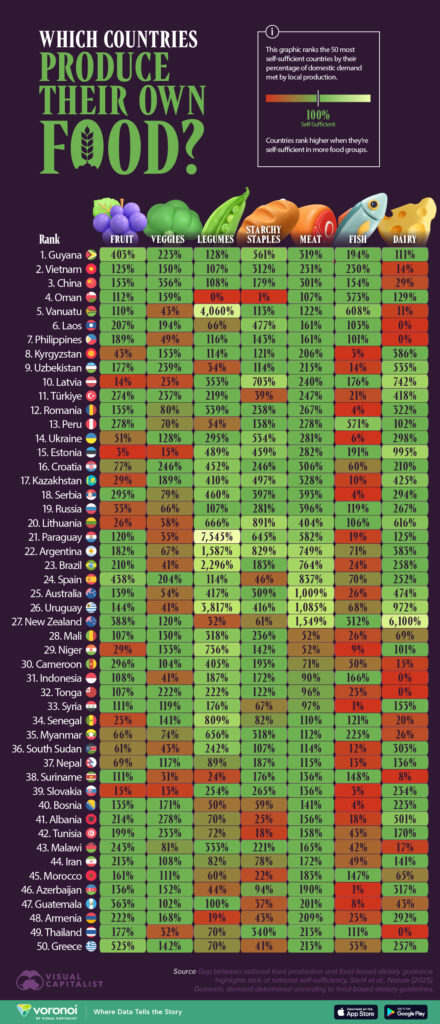
The top ten countries were Guyana, Vietnam, China, Oman, Vanuatu, Laos, Philippines, Kyrgyzstan, Uzbekistan, and Latvia. Ukraine was 14th; Russia, 19th; Australia, 25th; and New Zealand, 27th; while Syria, Nepal, and Iran were also included.
Why are these countries food-sufficient, when the top industrialized countries are not? There is evidence for the reasons behind this phenomenon in the chapters of Garden Earth: Grounding Ourselves in Nature on Small Farms, which explores changes in our Western consciousness and values since the 17th-century rise of science.
This is an edited excerpt from author Elizabeth Woodworth’s new book, Garden Earth: Grounding Ourselves in Nature on Small Farms.



Comments
We changed commenting systems on September 10, 2026 as part of a site-wide functionality and security upgrade. Your past comments have not disappeared, and you can still log in with your old Disqus account credentials if you wish. Contact us with any questions.
A subsequent question:
Which of those countries could keep their production going, ex fossil-energy?