

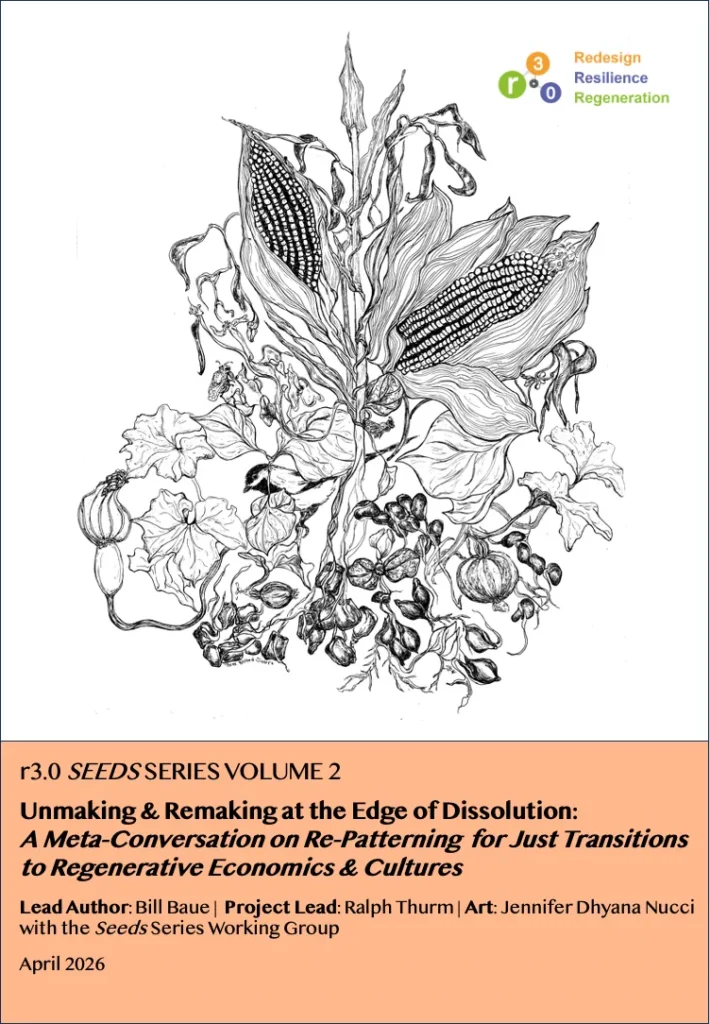
 The miraculous thing about seeds is that they germinate unseen beneath the soil until Spring, when they burst forth in their green glory! Likewise, Seeds Series Volume 2 is now springing forth.
The latest volume, entitled Unmaking & Remaking at the Edge of Dissolution: A Meta-Conversation on Re-Patterning for Just Transitions to Regenerative Economics & Cultures, features perspectives from 19 prominent thinkers and doers on regenerative economies and cultures.
With permission from the organization behind the Seeds series, r3.0 (Redesign for Resilience & Regeneration), a nonprofit organization that helps rethink and redesign how our global economy works so that people and the planet can thrive, we’re sharing chapters from Seeds Volume 2 here, starting with the Executive Summary, which you can find below (and as a PDF here).
The predicament humanity has made for ourselves cannot be solved. It can only (possibly) be unmade, to create space for our collapsing social systems to be remade in ways that revitalize ecological systems. Seeds Volume 1 focused on defining the core dimensions of our collapse predicament; Seeds Volume 2 focuses on Collapse Resilience, necessary to de-pattern away from the entrenched template of civilizational collapse cycles, and re-pattern through a just transition toward regenerative economies, cultures, societies, and ecologies.
This volume includes interviews with a range of contributors, among them members of the Post Carbon Institute community, Board Member Gaya Herrington, and Advisor Nate Hagens.

In the first volume of Seeds, interviewees answered the question, “What are the fundamental flaws of current economic systems & cultures?” Seeds 2 has asked interviewees to share their thoughts on the fundamental imperatives of regenerative economies & cultures and the necessary elements of just transitions to them. As with Seeds 1, we present the resulting findings in thematic clusters in the Aligned Findings section, and additional unique Idiosyncratic Analyses in their own section, based on a coding process informed by a comprehensive review of the interview notes (taken by members of the Seeds Series Working Group) and transcripts.
We identified eight Aligned Finding themes:
- Systemic;
- Relationality;
- Mindsets/Paradigms/Worldviews;
- Regeneration;
- Story & Narrative Framing;
- Solidarity;
- Indigeneity; and
- Community- and Place-Based.
And we identified three Idiosyncratic Analyses:
- Transcend Justice;
- Sovereignty & Autonomy; and
- Empowering Women.
For each of these themes, we provide a brief introduction followed by an interweaving of Interviewee quotations, to create what we call a meta-conversation: although the interviewees did not speak to each other directly (as we conducted separate interviews), the perspectives they shared very much spoke to each other in a conversation that we braided together. We believe this structural design leads to the emergence of a rich tapestry of voices that become more than a sum of their parts.
These conversations underscores a fundamental strategic objective of this Seeds Series: our goal is not to assert a new regenerative & distributive economy/society framework, theory, regime, etc… (as Nate Hagens says, “there’s so many people who are opining on a regenerative, sustainable future that are an expert in X without having a group of people working on a more of a systemic approach”), but rather to offer a synthesis of leading frameworks, theories, regimes etcetera that already exist. Our hypothesis — that there is significant overlap amongst these interviewees, as well as idiosyncratic ideas amongst them — proved itself out.
We label this synthesis approach Affinity of Inquiry, borrowing the term from interviewee Vanessa Andreotti, who contrasts it with an insistence on “shared identity or ideology.” Instead, Affinity of Inquiry is:
“The creation of experimental and experiential spaces where we can hold questions differently and support each other in a continuous learning and unlearning collaborative inquiry process. This perspective supports our prioritization of a pluriversalist approach over a universalist approach.”
We draw the title of Seeds Volume 2 – Unmaking & Remaking at the Edge of Dissolution – from the Introduction epigraph quotes from Sylvia Wynter (“…that which we have made, we can unmake, then, consciously now, remake”) and from Arturo Escobar, Michal Osterweil & Kriti Sharma.
“Remembering that our dominant stories are myths that can be unmade and remembering our capacity to choose – from among all our potentials – stories and practices that will serve us, we finally come more squarely to the question of what we will choose, practice, and make. What will we call forth, here at the edge of dissolution?” — Arturo Escobar, Michal Osterweil & Kriti Sharma
Our predicament is dissolution – more specifically, ecological and social systems collapse. In this volume’s introduction, we also assert that civilization is our predicament. More specifically, the class (and race and sex) hierarchies that define civilization also drive us toward collapse (per Peter Turchin’s elite overproduction research, which conclusively demonstrates that competition for limited power is the single most consistent cause of civilizational collapse across the evidence compiled in the Seshat Global History Databank).
So, if humanity is to persist, we must unmake (or de-pattern) our trajectory toward civilizational collapse — potentially by developing an alternative to the current model of our societal structure — and remake (or re-pattern) a sustainable, regenerative form of society in which life can flourish on Earth indefinitely (to riff on our concluding epigraph quote from John Ehrenfeld).
Stated slightly differently, humanity needs to adopt Collapse Resilience, where we first insulate ourselves from the worst impacts of already unfolding collapse, second, we adapt to post-collapse scenarios, but most importantly, we pursue this de-patterning by abandoning our collective suicidal tendencies, and we re-pattern into a more mature form of collective self-nurturance.
Seeds Volume 1 explored the patterns we need to unmake; Seeds Volume 2 explores the patterns we need to remake. The forthcoming Seeds Volume 3 will map out this necessary re-patterning in the bioregional context, which we believe is the most promising path for post-collapse survival.
You can access the complete Seeds Series Volume 2 here.
This post has been edited for clarity. An earlier version of this piece was published here.




Comments
Welcome to the new Resillience commenting system!
We have moved from the former Disqus commenting system to a new system as of September 10, 2026.
We made this change because of privacy concerns regarding Disqus. It's also part of a set of changes to bring more services to the Resilience community under a single login: commenting, (coming September 2026), and online courses (coming 2027). Unfortunately, your old Disqus comments may not reliably link to your account in this new system. Please contact us if you have any questions or concerns.