

This is the final article in a three-part series featuring an interview with Richard Heinberg by Manuel Casal Lodeiro of Instituto Resiliencia, originally published in the Spanish magazine 15/15\15 and reproduced here with permission. It builds on themes introduced in the first and second parts of the series.
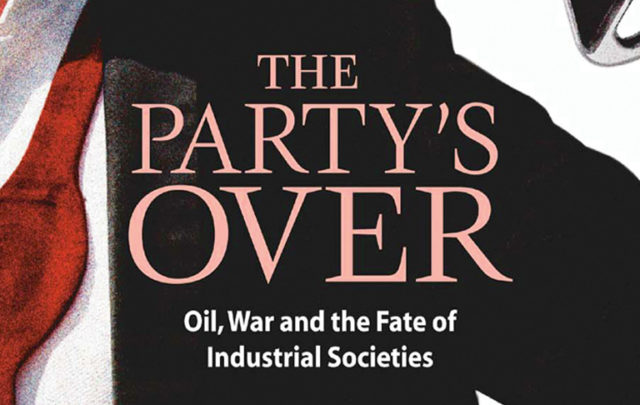
This year marks the 20th anniversary of the publication of Richard Heinberg’s The Oil Depletion Protocol: A Plan to Avert Wars, Terrorism and Economic Collapse (2006). This book was based on the protocol designed by geologist Colin Campbell and later improved by Kjell Aleklett, also known as the Uppsala or Rimini Protocol. The protocol aimed to design a system to reduce oil extraction rates in oil-producing nations to match the global oil depletion rate, which was roughly 3 percent per year at that time. 15/15\15 spoke with Heinberg about the current state of oil geopolitics from a protocol point of view and the protocol’s present-day validity.
15/15\15: Some people are glad to see that the great energy descent is being postponed, thanks mainly to shale/fracking, and they even use that fact to mock the energy descent concept and people who are struggling to make their communities aware and prepared in the face of what that will mean. But the more the extractive plateau is extended, the more abrupt will be the descent, as the scientific data show. So, does this fact turn planning into something even more urgent and necessary, and the international conflicts into something more dangerous?
R.H.: Sadly, I think the failure of the peak oil movement almost 20 years ago is having a terrible after-effect. Some of our forecasts for declining oil production and economic collapse were premature. That doesn’t mean they were wrong in principle. But most policymakers and pundits drew the conclusion that it is stupid to think that oil production will ever decline—at least until we have viable substitutes in place. That means we are flying blind. As US tight oil production starts to diminish, and as Middle Eastern oil infrastructure is destroyed by war, the world is about to learn a hard lesson.
15/15\15: A lesson that could have been avoided if the Peak Oil warnings (let’s say the official ones like the Hirsch Report) had been listened to, even though they were a little too ahead in their timing of the global energy descent. But that was a feature, not a failure of those warnings: even if the timing is not correct, taking action would have advantages anyway, for example, to prepare the world for war-related disruptions of oil, gas, fertilizers, etc. Do you agree with that?
R.H.: Yes, it’s much better to be too early than too late, in the final analysis. However, being too early is punished by the market. Those who pre-adapt use their capital for that purpose, while those who don’t pre-adapt continue growing production for immediate consumption and out-compete the pre-adapters. That’s just one example of the perversity of capitalism.
15/15\15: The protocol was already an improbable thing in the first years of the century, when the international legal system seemed quite solid (we had the ozone depletion agreements, climate change agreements were still a credible possibility, etc.). But after 20 years of COP failures, with Trumpism and the far-right on the rise, with ethics in such a bad shape that we witness televised genocides without rebelling, and with international law shattering and losing advocates even in Old Europe… is it more difficult today than then to promote such a deeply moral proposal?
R.H.: Yes, it is. Trump is not entirely to blame, but he has shredded the world order that was based on norms, agreements, and rules. He has ushered in a period of brutal “might makes right” politics. It’s a very inauspicious political environment for anything like the Oil Depletion Protocol.
15/15\15: Regarding your president, you have pointed out “a stark reality: one man is causing an acceleration of civilizational collapse.” Maybe he is also accelerating the general recognition that we are entering a time of total disruption, that nothing will ever stay the same, and that unprecedented chances are opening, generally seen as worse, but maybe also something better can sneak in through the cracks of a collapsing world?
R.H.: Yes, I agree.
15/15\15: And that being so, how could we (degrowth/resilience activists) take advantage of this new recognition among people?
R.H.: We can continue making our case, using current events to buttress our arguments. Degrowth advocates already stress a higher quality of life as an alternative goal versus perpetual economic expansion. That does appeal to a lot of people, especially as they’re getting more stressed out, looking over their shoulders to see if AI is coming for their job.
15/15\15: And with the worsening of climate chaos and the likelihood of reaching some climate tipping points, how is the protocol’s validity affected?
R.H.: It is more valid than ever, more needed than ever, but I don’t see its political prospects as being good at all. As of now, we are past the time of warnings and preparations and have arrived at the age of consequences. That doesn’t mean there’s nothing more that we can do, just that most of our efforts will necessarily be focused more on response to disaster rather than prevention.
15/15\15: Your book was a message to the world leaders in a post-Iraq-war world. Which would be your message for them now, in a context of multiple wars, but with the energy focus on the Iran situation?
R.H.: My message now would be similar. Fighting over access to depleting resources will lead civilization to utter ruin, from which there can be no recovery. Our only hope is to cooperate on reducing the scale of our energy and resource usage and to share what’s left.
15/15\15: In 2006, you noted that even though immediate causes of terrorism are not usually related to resources or specifically oil, if the protocol was not adopted, the other factors which do favour terrorism would be worsened. Do you think something like that is possible in the short term? Maybe the war on Iran could trigger that effect, as their theocratic regime has been repeatedly accused of “promoting international terrorism”?
R.H.: It’s hard to imagine the Iranian leaders not wanting to engage in asymmetrical warfare at this point, given that their supreme leader was recently assassinated by the United States. We can only hope they have limited means.
15/15\15: Now, in this “Great Unraveling” moment, in which direction related to the spirit of the protocol would you advise the environmental, peace, degrowth, anticapitalist movements to work? Maybe you could point out some lessons from your last book, Power: Limits and Prospects for Human Survival? Is “local action to build community resilience” still the only way to go, as the Post-Carbon Institute has always argued?
R.H.: I wouldn’t say that building community resilience is our only possible strategy, but it should be at the top of the list. We must relocalize economics and politics voluntarily as much as we can, before circumstances do that for us. Voluntary efforts give us choice and agency; the impact of necessity is likely to be more unfair and unkind.
15/15\15: And finally, in that sense of community resilience building, what are the lessons that you think can be taken from the recent events in Minneapolis, I mean, the occupation of the city by that paramilitary force commanded by Trump? There seems to be a real risk of sparking a civil conflict, but can something positive also be learned from what has been happening there and, to a lesser extent, in other places in the USA? Is resistance akin to resilience?
R.H.: When governments become repressive, then resistance and resilience go hand in hand. I recently interviewed a participant in the Minneapolis resistance and was impressed with the degree of selflessness, organization, and kindness of their efforts. As the world gets greedier and grimmer, we need to nurture humor, empathy, creativity, and tenderness.
This interview has been edited and condensed for length.


Comments
We changed commenting systems on September 10, 2026 as part of a site-wide functionality and security upgrade. Your past comments have not disappeared, and you can still log in with your old Disqus account credentials if you wish. Contact us with any questions.
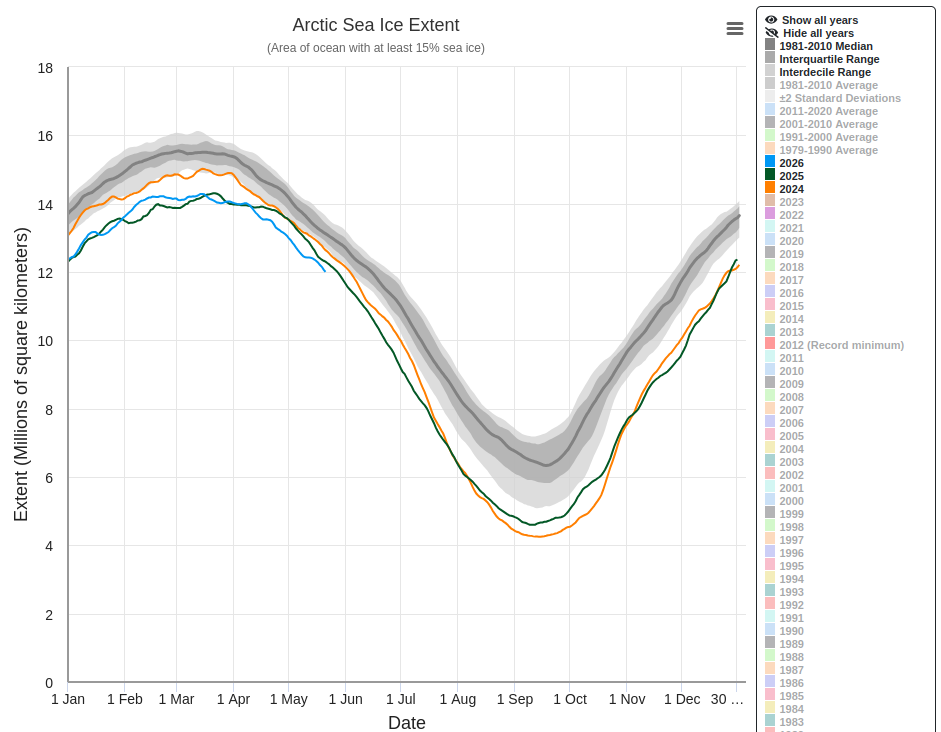
I'm wondering this morning about the physical observables, such as the Arctic leaving its temperature orbit, which began in June 2024 (see figure). This is a new state of affairs, El Nino notwithstanding. Accordingly, now it's the second year here in Arizona with no discernible winter. I know hummingbirds migrate across the Sonoran desert relying on seasonal timing of their food supply (but I know nothing about their recent prospects in their overwintering grounds). Now, in May 2026, there are significantly less than half the number of hummingbirds at my feeders than in years gone by. I suspect the Arctic changes are really having persistent effect after this second year of change.
 _____________________
_____________________
Perhaps there is better-tasting food elsewhere this year. But I rule that out b/c normally it's the availability of food that drives populations, all else being equal, not the availability of "better tasting" food.
Reading Richard's answers I think he has come to similar conclusions as me. We are currently in collapse. It isn't coming later. It's already here. So my suggestion to everyone is to prepare for the emergency now. Think of this like a hurricane is coming and you have a few days to prepare. What will you need to survive the storm?
One of the best books I read was "Reinventing Collapse" by Dmitry Orlov. He described the unfolding of the collapse of the Soviet Union. He compares and contrasts it with what could happen if/when the US undergoes collapse. I think the US is already in collapse but we are being lied to by the media, Fox News, and our current Federal government under the control of Trump. I think we have a limited amount of time until the store shelves are empty or the prices are exorbitant when we still have an opportunity to stock up. Put your money into real goods that will help feed and protect your family.
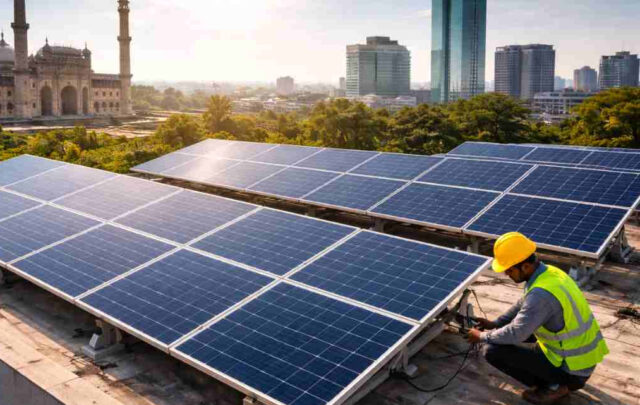
And do other things, like start a garden, plant fruit trees or berry bushes, set up a rainwater collection system, get a few solar panels.
(This message is to everyone in this thread, not just mwildfire)
Yes, collapse really is happening now, and has been for a long time. We're witnessing social, cultural, economic, ecological and environmental forms of collapse, each unfolding in its own entangled way with the others. The only part we cannot say with assurance is when the economic dimension of collapse will result in full on social chaos. Let us hope that never happens to the worst extent which is possible. Meanwhile, keep in mind that how we respond to this ongoing crisis (crises) will shape how it unfolds. It's not a spectator event but a participatory one.