

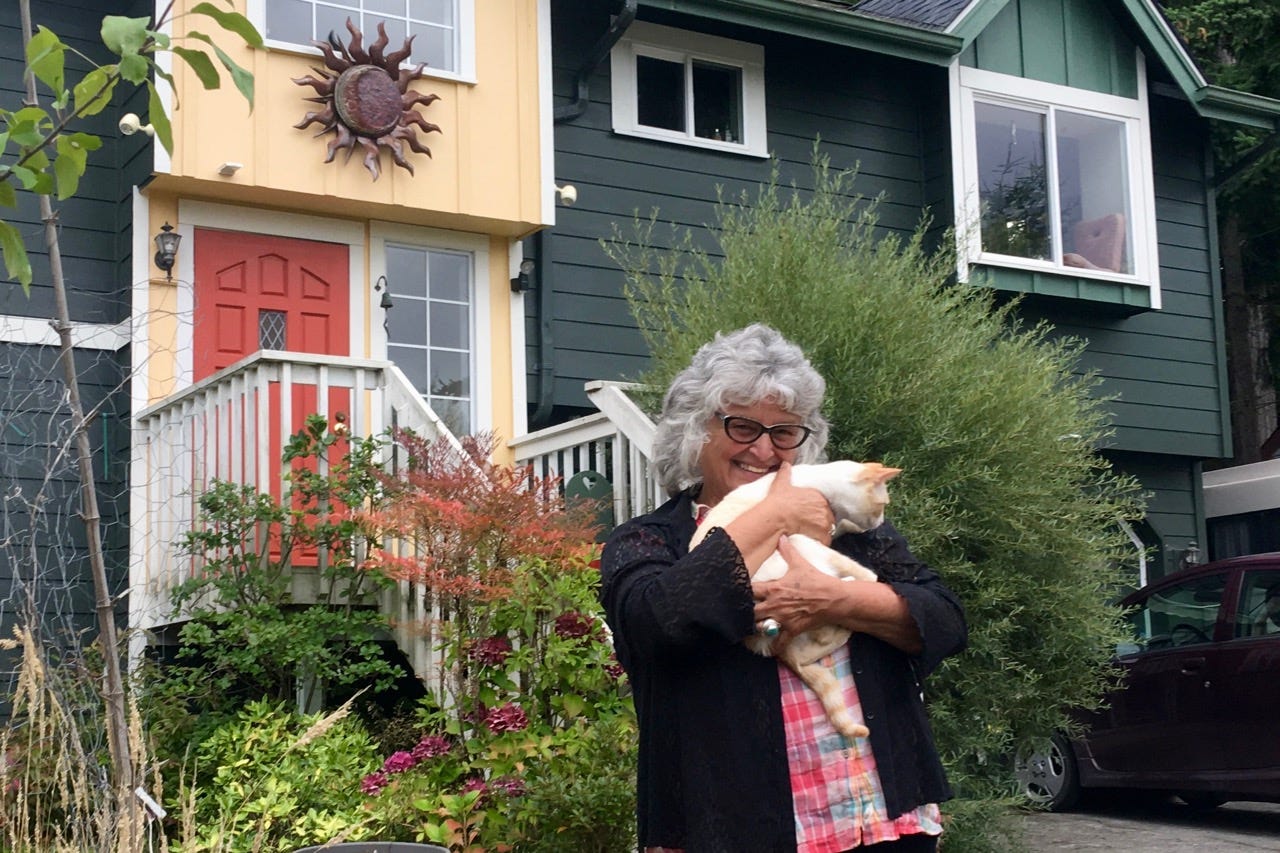
Imagine you have a year’s stash of food, a huge garden and chickens for eggs, a rainwater collection system, a solar system … and on and on and on. Welcome to my suburban yard.
Yesterday a group of volunteer earthquake preparedness neighbors met to test out our walkie talkies. I slipped a question into the conversation: “Do you have enough food and water stored for a week? There are only two roads in to our subdivision and if both are blocked, we’ll be home alone.” I tried to sound nonchalant. I don’t want to scare people with talk of crossing 7 of the 9 planetary boundaries and the Atlantic meridional overturning circulation (AMOC) – such party stoppers. So I sidled in questions about water storage (a gallon a person a day for a week) and survival food (tuna, peanut butter, dried milk, instant oatmeal, almonds.. nothing fancy.) It did start a conversation about rainwater collection, so that’s a plus.
Prepared for what?
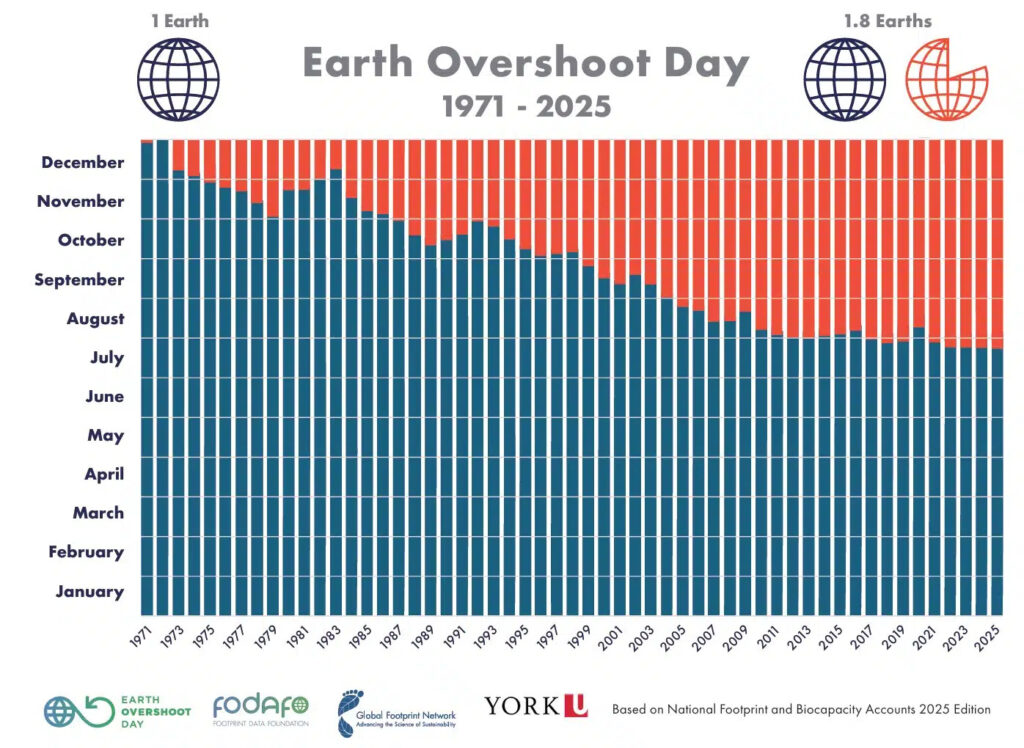
I first heard the data about “overshoot and collapse” 37 years ago and it changed my life. “Holy shit,” I said, when I saw the graph of how much planet we have and how much we’re overspending. The line of have and the line of spend crossed in the 1980s! The Footprint Network developed the idea of Earth Overshoot Day to express our dilemma. It’s the day of the year we exceed the planet’s capacity to support us. We were flush in 1970. Now, Overshoot day is August 2. As I said, this is not a polite conversation among friends. Reality sucks when you’re having fun.
Quartermaster
My response to data has always been to do something. I don’t demand 100% right. Over 50% is enough to get me started ambling towards solutions.
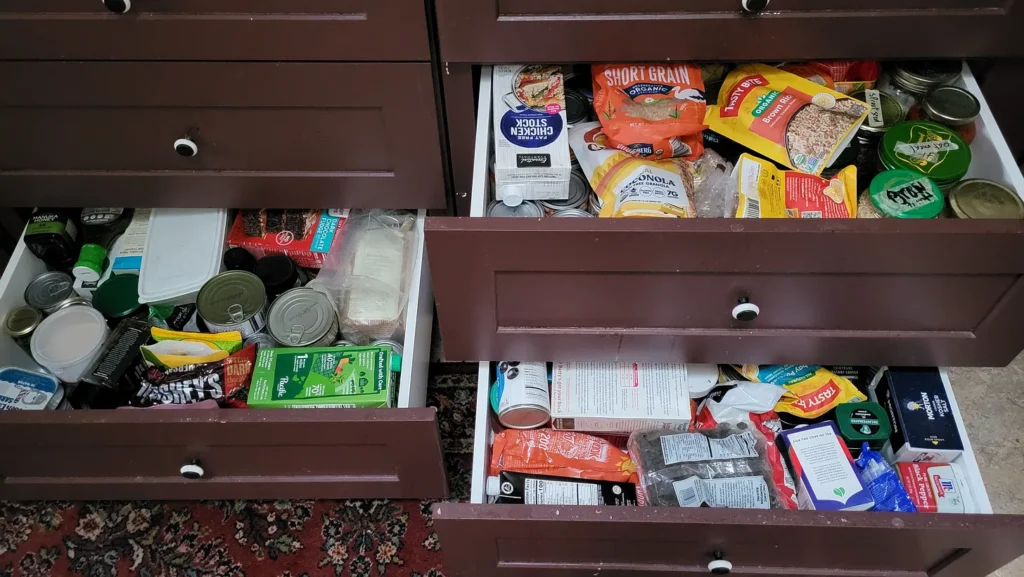
I must have been a quartermaster in the army in a prior life. I think in terms of provisioning (ergo my survival compound). How many mouths, how much food, what tools, supplies, etc? Here’s just half the stash in three deep kitchen drawers. Double it to include cupboards for a better estimate.
How many mouths to feed?
Ever since seeing that “Holy Shit” graph, I’ve watched population like some people weigh themselves. When I was born, there were 2.5 billion people on the planet. When I learned about overshoot, there were 5 billion of us, and that seemed a good place to plateau. To me. I’d hoped Your Money or Your Life would be a lever long enough to reduce human impact on Mother Earth. Nope. Not with passing 6 billion in 2000 and adding another 2 billion since then.
Well, if I can’t hit the big solution to overshoot jackpot, maybe I can go regional. The island I live on, and about 100 in all directions, is the US part of the Salish Sea – and my local home. I wrote a book about local food, asking a farmer if the 60,000 people on my island could survive from what we grow on the island. Yes, she said, for two weeks in August. Called Blessing the Hands that Feed Us, the book documents my effort to eat for a month within 10 miles of my home. Here’s the TEDx version. Maybe the book will have a resurgence now that more people are trying to be quartermasters of their own lives – but I’m not counting on it.
Enoughness is the through line of my work. First book: enoughness at the level of stuff. Second book: enoughness at the level of food.
Now – and we’ve finally arrived at the essence of this post – what is enoughness at the level of housing, more specifically, affordable rentals? At the moment, we have nowhere near enough affordable rentals in my 100-mile region, and it’s squeezing the life out of our communities and economy.
I always start with a personal experiment
Before writing Your Money or Your Life, I’d lived on next to nothing for 2 decades. Before writing Blessing the Hands that Feed Us, I’d lived for a month only on what grows within a ten-mile circle of my home.
A rental-enoughness idea – that’s now called In-Home Suites – started for me when I bought my first house, at 65. Until then, I’d lived with others in vans, a school bus, a communal household and a tiny first apartment.
My communitarian habit
I was part of a tight community in my 20s and 30s, and a looser one in my 40s. Some of our group’s economy came from sharing bedrooms, rice and beans meals and the dining table we ate at, a living room, cars, closets, chores, and a general philosophy of life. We were high-minded, dedicated to the common good. Sharing seemed like manna, not deprivation.
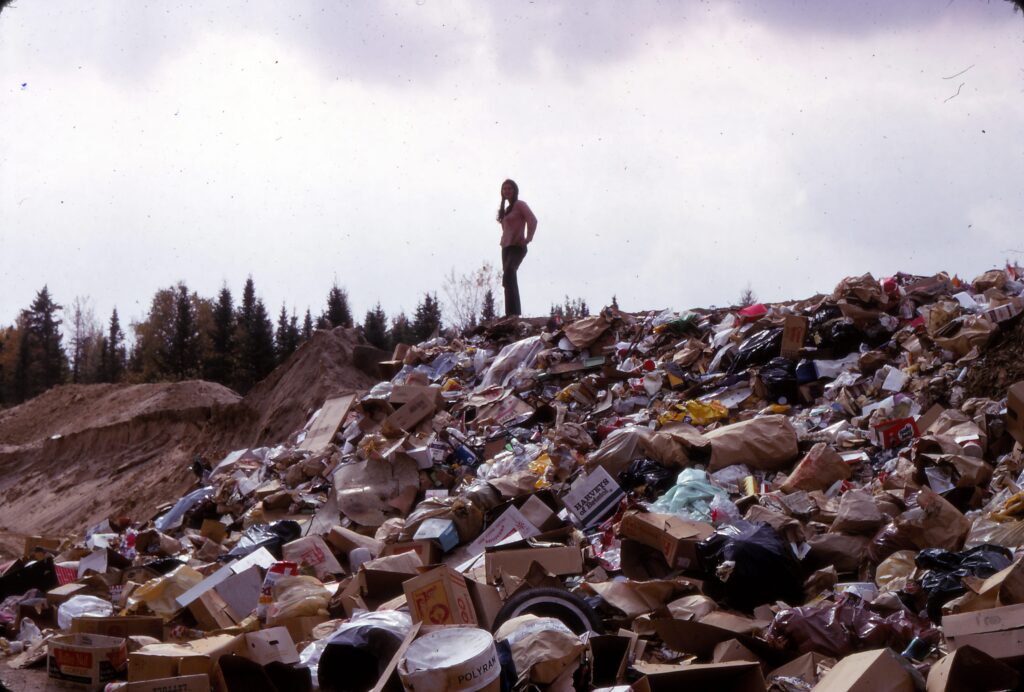
This communitarian habit pairs well with my survivalist tendencies that come from when our group lived on 14 acres in Northern Wisconsin, where locals joked that there are two seasons: winter and the 4th of July. Growing a half-acre garden took skill and intention. We lived in said school bus for part of that time, then built a general-purpose building and a dome, raised a pig and rabbits and ate them, hunted and butchered deer, and pounded in a well point for water. Our supplies came from town or…the town dump. We called it the source of all goodness because we’d find doors, windows, building materials, some supplies, washed-and-folded clothes left over from the Saturday church bazaar, and even a tool shed (OK, it was an old outhouse, but it worked).
Sharing the wealth
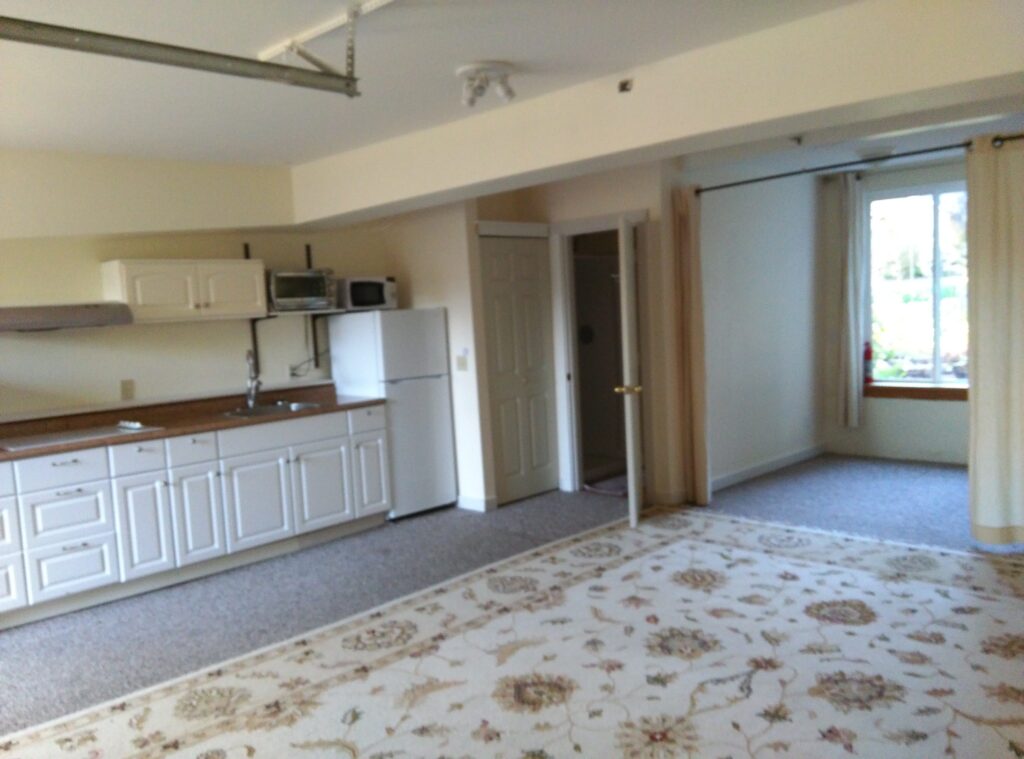
Fast forward 50 years, and here I was, padding around the bargain-priced big house I’d bought with more rooms and room than I needed. Of course, I asked, “How can I share this”? A friend moved into the family room on the ground floor and converted it into what we now call an In-Home Suite. It has a bathroom, exterior door and an efficiency kitchen. She also built in a sweet desk and closet, and lots of pantry space. After she left, I paid her for her investment and rented it out. I’m now on my 10th renter of that space.
Then I eyed the garage. I’d converted it into a bonus room and used it as a rehearsal and performance space for my improv troupe as well as for neighborhood gatherings, trainings and whatever interested me at the time. Of course, it graduated to a second In-Home Suite. Between the two, I’ve made back 80% what I paid for the house!
This is an idea whose time has come!
It’s not a roommate situation where someone has a room, shares a bathroom and has kitchen privileges. It’s not a housemate where all corners of the house are shared (except bedrooms). Both of those would now cramp my style.
Neither are these studios attached ADUs (Accessory Dwelling Units). The difference from an In-Home Suite is in the meter. Not rhythm, but whether electric, water and sewer hookups are shared or separate. Nor are they co-ownership; I am the landlord, and they are tenants, and we navigate the power gradient with as much grace as possible.
Each suite (whether in my house or elsewhere) has:
- a separate entrance
- a bathroom
- a kitchenette
- ideally an off-street parking space
Each suite shares the envelope of the house, including washer/dryer and all utilities, including high-speed internet. We share the benefits of the house (beauty, safety, utilities, yard) while having completely separate lives.
Sharing space can be enoughness at the level of housing
Sharing is mainstream. Go Shareable to learn more about how the sharing economy operates now. Here’s how they say it:
“A better world isn’t a dream, it’s a movement.
Shareable collaborates with organizers and allies to imagine, resource, network, and scale cooperative projects. We envision a just, connected, and joyful world where sharing is a daily practice and communities flourish.”
What if our society was rooted in a sharing culture?
Imagine neighborhoods where food, tools, housing, care, and power are shared (not extracted, exploited, and hoarded!). Where co-ops replace corporations, mutual aid replaces individualism, and collective resilience outlasts crisis. This is the solidarity economy in action.”
The essential spirit and toolkit of a sharing economy is called “Mutual Aid,” where, whenever the dominant economy becomes too expensive, too heartless, too insecure, too insufficient, or too boring, you start to realize that there’s a wide, wide world beyond solving problems privately. There are Libraries of Things. I use platforms like Buy Nothing and Next Door for meeting some of my needs – and often you can do an ISO (in search of) request, and someone has the very thing gathering dust in their garage.
Shareable Housing
In this hyper-individualistic, competitive society, sharing sounds dangerous and/or ditzy. Maybe not.
Castle consciousness is a rigid mindset that deserves to be disrupted. Sharing is safe, economical, socially acceptable, generationally fair, and did I say economical? Safe sharing, like safe everything else, involves boundaries, agreements, and exit doors. Many times, out of fear, habit or pride, we’ll pay extra to have everything we might ever need and never share it. Our social standing seems to stand on the number of square feet of house we call our own. Is sharing a low-life strategy? “I worked for it, own it and let others work for what they want just like I did.” Is sharing un-American? Let’s look at whether these fears, habits, entitlements or pride hold water.
Sharing isn’t as un-American as it may sound
We already have a myriad of collective solutions to personal needs, though we take them for granted.
- Infrastructure: sidewalks, bridges, ports, airports, telephone lines, cell towers, electric lines and on and on. We have roads and ways to share them: speed limits, traffic lights, and lanes. Self-made men are delusional – without the common resources, their supplies would never arrive, their trucks would go nowhere.
- We have shared services like post office, libraries, local law enforcement, and public schools.
- Then we have laws, government, social programs… still.
- What am I missing in these lists? How else is the sharing economy right in front of our noses?
Sharing our Castles Rn’t US – yet
Sharing ends at property lines, though. Who has the right to cut “their own” trees? Graze animals right by “their own’ stream. Burn old tires? Or brush? Burn wood in their fireplace in fire season? Have someone living in a motorhome or tiny home on their property? Build a septic system? Drill a well? Build a barn, a second or third home on their land?
Do you know that “life, liberty and pursuit of happiness” was borrowed from Englishman John Locke’s “life, liberty and property”? Property rights are king. No, I’m not heading for your fence with community shears. I’m talking about contractual sharing for the benefit of the property owner and those they choose to let on their land, or in their home.
Putting our houses where our mouths are?
Seniors stay put for many social and financial reasons, unintentionally limiting opportunities for younger people. To us seniors, this makes perfect sense. Where would we go? How would we afford a higher mortgage rate? What about the webs of community?
Perfectly healthy octogenarians like me don’t want to move from our homes with our treasured collections of art and such, and good neighbors and meaningful clubs and belonging – into a room in “a facility.” Some don’t want to relocate to a room in their children’s homes either. Nor do we want to spend down our savings to a nub and let Medicaid house us
Good, wise, loving people with large houses may not realize that our reasoned choices may make life harder for younger people. We don’t mean to. Those with a social justice bent might consider an In-Home Suite as a way to provide for themselves – and for a nurse, teacher, librarian, or barista. In this country, we are encouraged to consider our own interests first and foremost, not asking questions about how our boon might be someone else’s bust. In-Home Suites that offer privacy and safety can be a personal as well as a social good.





Comments
We changed commenting systems on September 10, 2026 as part of a site-wide functionality and security upgrade. Your past comments have not disappeared, and you can still log in with your old Disqus account credentials if you wish. Contact us with any questions.
All we can reliably do is prepare for repeated "shocks," as Heinberg has said in the past. How we live is too complex to become independent. A massive, 3,000 gallon rainwater tank won't support drinking/cooking water and modern bathrooms and farms for even a year unless you live in a high-rainfall region – rare in CONUS.
Wonderful idea! I've been hunting for roommates for the 10 years I've been here, and am wondering what to do next. That could be a possibility. 16 acres with creeks and woods is hard to give up, and at my age (same as yours) I need to think sensibly. Of course zoning won't allow me to build a separate space.
Sharing my property is my worst nightmare.