

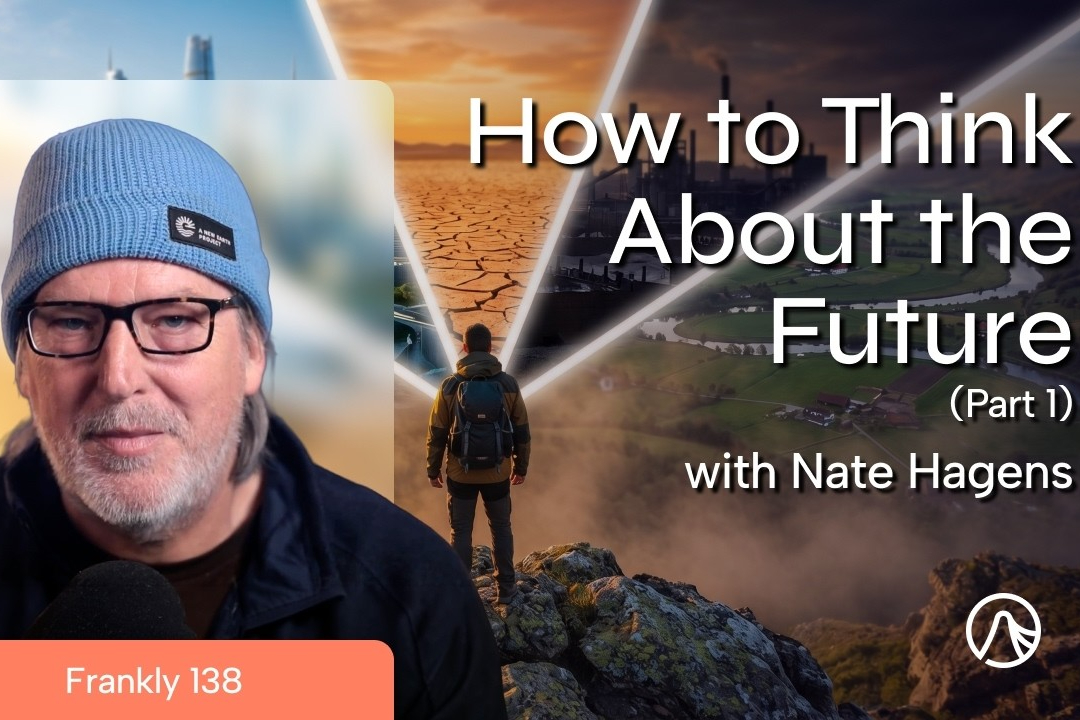
Recorded on Apr 11, 2026 | In this week’s Frankly, Nate opens a new series called How to Think About the Future. He begins with some comments he’s heard repeatedly on this platform: why cover nuclear, plastics, renewables, or climate when something else is the real issue? Nate observes that these questions come from people who have already settled on a single storyline about what’s coming, and are filtering everything else through it. Our actual reality is much more complex and unknowable, and even the most well-informed perspectives may only be able to capture pieces of the bigger picture. Nate emphasizes that even his own base scenario – that the global economy is likely to hit a wall in the relatively-near future – should be held with humility.
Nate introduces the idea of “scenario thinking” as a practical strategy to reflect on and prepare for several versions of the future, keeping one engaged and grounded in what matters. He also names why this line of thinking is hard in practice – 1. our nervous systems want resolution, 2. our careers and identities are attached to particular futures, and 3. cultural incentives reward confident stories over honest uncertainty. The episode closes by introducing shortfall risk, which is the danger that something essential, like topsoil, social trust, grid stability, or the nuclear taboo drops below a threshold from which it cannot easily recover. This concept will act as connective tissue across the rest of the series, which is an attempt to expand perception instead of picking the right future, and to identify what is coupled, what is irreversible, and what kinds of responses stay robust across many possible worlds.
Where in your life have you quietly settled on a single story about the future? Which of the essentials you rely on would be hardest to rebuild if they fell below a threshold? And how might the decisions you make this week change if you held more than one plausible future in mind at the same time?
The TGS team puts together these brief references and show notes for the learning and convenience of our listeners. However, most of the points made in episodes hold more nuance than one link can address, and we encourage you to dig deeper into any of these topics and come to your own informed conclusions.
00:30 – The Great Simplification
00:55 – More-than-human predicament
01:30 – Renewables are better termed “Rebuildables”
01:35 – Climate is* in the top 10 risks that people are worried about
03:03 – Narrative as active inference, Narrative as reducing cognitive effort
04:00 – The likelihood of an upcoming global recession, Recession vs. Depression
05:45 – Scenario planning, How to do scenario analysis, Scenario Thinking: A Historical Evolution of Strategic Foresight
06:00 – Frankly #129: A Guide to Staying Human (Part 1): Desperately Seeking Agency
06:50 – The predicament is much bigger than one person can see alone
07:00 – Overconfidence effect
08:12 – Frankly #132: What to Do as the World Falls Apart: A Framework for Action
09:00 – Shortfall risk
09:35 – Iran War 2026
09:40 – Complex systems thinking, Complexity and Postmodernism by Paul Cilliers
10:57 – Hormuz situation (In-video map, In-video graph): Fertilizer issue (In-video graph), Food security threat, Political legitimacy threat, Financial reset
11:50 – The Oil Drum blog
12:30 – Complex systems move in fits and starts
13:20 – Ecological phase shifts and path dependency
14:30 – Global Tipping Points Report 2025, Tipping points: Ice sheets, Soil systems
15:05 – Non-linear causality, Feedback loops
19:30 – The Danger of Single Story Thinking
19:45 – The metabolic cost of thinking and cognition, ATP, How the brain burns calories
20:20 – Questioning one’s beliefs feels threatening, Ego development and how to manage such threats
22:00 – Role of religion, Terror Management Theory (More info) (TGS episode on such)
22:25 – Iain McGilchrist, TGS Episodes: #165, #85
26:00 – What would happen if we lost our top soil or fully depleted an aquifer?
26:20 – Nuclear use taboo decreasing and nuclear proliferation (Iran situation),
The Inherent Unpredictability of Nuclear Deterrence
28:10 – Portfolio management in finance
28:42 – Oil 101-301 Frankly Series
Join us online on May 6, 2026, for a live panel discussion with Nate Hagens: “Chokepoint: The New Urgency of Ending Our Fossil Fuel Addiction.” Reserve your spot by registering today.




Comments
We changed commenting systems on September 10, 2026 as part of a site-wide functionality and security upgrade. Your past comments have not disappeared, and you can still log in with your old Disqus account credentials if you wish. Contact us with any questions.