

Show Notes
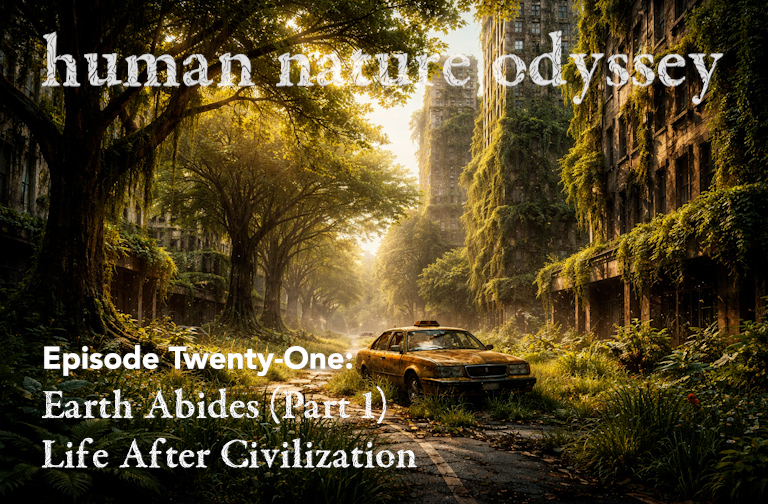
You ever go on a little trip, to just get away from it all — only to come home and find all of civilization collapsed while you were gone and you might be the last person left on earth?
Well then you could totally relate to George R. Stewart’s 1949 science-fiction novel, Earth Abides.
Earth Abides is not your typical post-apocalyptic tale. It challenges some of our core notions on progress, human happiness, and civilization itself.
It’s a study of how our built infrastructure crumbles in our absence and becomes home to nonhuman life. It’s about how human communities organize without the enforcement of the state, and how culture changes over time—taking us from the immediate aftermath of civilization’s sudden collapse to a distant future when the last generation, known only as the Americans, leaves behind a people who barely remember what the United States once was.
In this two-part series, Alex is joined by astrophysicist, writer, and friend of the show Tom Murphy to retell and explore this science fiction classic, unpacking its radical ideas about collapse, resilience, and what it means to live a meaningful life.
This episode is for listeners interested in societal collapse, critiques of progress, and the big questions about the future of humanity on planet earth.
Citations
- Earth Abides [book] by George R. Stewart (1949)
If you’d like to support Human Nature Odyssey, please subscribe wherever you enjoy your podcasts, leave us a review, and visit humannatureodyssey.com.
Join us on Patreon and get exclusive access to audio extras, writings, and notes.
Theme Music is “Celestial Soda Pop” (Amazon, iTunes, Spotify) by Ray Lynch, from the album: Deep Breakfast. Courtesy Ray Lynch Productions © Ⓟ 1984/BMI. All rights reserved.
Transcript
You ever go on a little trip to just get away from it all? You know, break free of the hustle and bustle and go somewhere where you can relax, maybe be in nature, a camping trip for the weekend? And you ever come back from a nice time alone in the great outdoors just to find out wait a second–where the heck did everyone go?

Oh, they all died in a massive global plague and now I might be one of the last – if not the last person alive on planet Earth? Uh oh.

And you ever then spend the next days and weeks, wandering the empty streets, until eventually, you meet up with some scraggly survivors, over time form a collective, and obsess over trying to teach the next generation how to rebuild civilization, only to find, you know, they’re just not that interested? And then over the course of decades you watch as your small, intimate tribe adopt a more animist worldview and begin to live as hunter gatherers again? Classic, am I right?

This is the story of Earth Abides - a science fiction novel by George R. Stewart. It’s not your typical post-apocalyptic tale. It challenges some of our core notions about progress, human happiness, and civilization itself. It's a study of how our infrastructure would crumble in our absence and the ecological adaptation that follows, how lands once covered with concrete are reclaimed by weeds, and brief, successive surges of ants, rats, and even mountain lions. It’s about how human groups organize without the enforcement of the state, and how culture changes over time, taking us from the immediate aftermath of the sudden collapse of civilization to a future when the last generation, known only as the Americans, leaves behind a people who barely know what the United States once was.

Written all the way back in 1949, this was a story ahead of its time. In fact, it’s probably still ahead of its time.

In this two-part series, astrophysicist, writer, and friend of the show, Tom Murphy rejoins the podcast to unpack and discuss the fascinating thought experiment of Earth Abides.


Alex Leff
Well, yeah, you and I talked like a month ago or so and you mentioned having read this book, Earth Abides, and you were recommending that I check it out. And I read it first when I was in eighth grade. I think this was the last book that my dad was reading to me for bedtime. In my memory, he like stopped reading it halfway. And then I ended up finishing the second half on my own. And it kind of corresponds with like an interesting point in the book where I was like, Whoa, like

Tom Murphy
I see.

Alex Leff
to be reading this on my own now felt like the old world had gone away.

Tom Murphy
Because they relied a lot on the trappings of civilization for a time and then you know throughout the course of the book they Depended less and less on that as you are depending less and less on your your father reading the bedtime book. So yeah

Alex Leff
Yes, yes, exactly. So very thematically appropriate. I'm curious how you heard about it and how it was pitched to you.

Tom Murphy
So I remember, who recommended to me, and I remember where we were standing when he did, you know, it's one of those things. There was an astronomer, Frank Xu, who was quite well known and a theorist and very capable. And we had a lot of conversations because he was somewhat interested in energy issues as I was and sort of fate of modernity and that kind of thing. He was a broad thinker. So at one point, just in the hallway, said, he looked at me very earnestly. You should read Earth abides.

You know, and that's all it took is this guy. I trust his recommendations. And if he says I should read this book and he had this sort of very intense expression about it, I thought, okay, I will read this book. And I'm glad that I did. I've read it a few times over the years and each time I see it through new eyes. Hmm.

Alex Leff
Yeah, I'm curious what you feel is the best way to go about this because we're ultimately going to spoil the crap out of this whole thing for anyone that hasn't read this book before. I it's hard to not. I think we should just view this as we're essentially telling the story. Yeah. And for people who've read the book before, hopefully our thoughts are interesting companion. And for people who haven't read the book, now you don't have to because you're about to ruin the whole thing.

Tom Murphy
I think so.

Tom Murphy
And I do think it would be really hard not to because the change that happens is profound and I'm not sure how we could talk about it without.

Alex Leff
Exactly. Yeah. Yeah, this is a book where the points that the book's making are completely tied to the plot. And maybe we tell the story of it together to see what we remember piece the chronology and then as we're doing that, we could talk about the themes that emerge and then maybe reflect on all the things that came up for us as well. But I'm curious how you would suggest going about it.

Tom Murphy
I'm game.

Alex Leff
Cool. Awesome. So what do we know about this book? It's written by George R. Stewart. It came out, what, like 1948? Yeah.

Tom Murphy
Yeah, it's Older than me. Yeah. Yeah. Yeah. It's 21 years older than I am. Crazy. And the book also has some pretty hokey elements to it. mean, it's not. it's. It's not great literature that I agree with that. Some parts make me cringe, right? And some of that's just. 1949 mentalities and some of it's he's not really a talented author at.

Alex Leff
Yeah, it's not this is not a work of great literature.

Tom Murphy
interrelationships, personalities. He's a little weak on that point, but I think he's very strong in the rest of it. And so I think there's great value.

Alex Leff
So maybe just to give people like a sense of what the scope of this book is, it's this sci-fi novel about this deadly virus that wipes out the vast majority of people on earth. And we see it all from the perspective of this one young man named Isherwood Williams, nicknamed Ish. And we're experiencing, you know, the immediate aftermath, but the book takes us all the way through to generations beyond. The immediate aftermath when Ish is an old man and his perspective on all this changes drastically.

Tom Murphy
And what is it about us and books with the main character named Ish or Ishmael?

Alex Leff
I know, I know, I know, was thinking about that.

Tom Murphy
Moby Dick has to be next, right? That's going to be our next step. Our next hit.

Alex Leff
Exactly. Do you think Daniel Quinn read this book? I was wondering that a few

Tom Murphy
I wondered that too and there were definitely times when I thought, he must've, but of course it's just a gut sense.

Alex Leff
So yeah, so I was also thinking about you with this character of Ish because he's a man of science. I'm guessing early 20s.

Tom Murphy
He's a graduate student in geography and he's out doing field work when this happens with his hammer. The hammer becomes basically a student of ecology and civilization, kind of multidisciplinary.

Alex Leff
important. Yes.

Alex Leff
Okay, so how does it happen? It starts with him in a cabin. He is sick from this rattlesnake bite, and people are knocking on the cabin door, and he doesn't know why, and then when they see him, they run away and tear-

Tom Murphy
Right, they see that he's sick and they just run for their lives.

Alex Leff
Right. And as he heals and he's going back to town where he lives in the Bay Area.

Tom Murphy
sort of the Eastern Bay over Berkeley. Basically the campus is meant to be Berkeley.

Alex Leff
And so as he's returning home, he's seeing that there's not many people about it. he slowly comes to realization with like, something must have happened. picks up like newspapers, right? And he's like learning about this deadly virus. And he avoided it by going on this camping trip, which is a good promotion for camping.

Tom Murphy
And possibly the snake bite helped him live when hardly anybody else in the world had as he's going back out into the world and seeing abandoned places and piecing things together and getting newspapers. He's piecing this together and it's a real shock, but he has this kind of detached perspective. I'm a scientist. I'm an observer. This is fascinating. I'm just going to take it in and see what all this is about.

try to find people. And so when he gets back to the Oakland Berkeley area, he's looking for people and he finds a few, but they're really damaged goods. You know, they've gone, he was protected from all the one week rapid die-off or something on that time scale of all of humanity and everybody, you know, and everybody you love. And so he was somewhat isolated from that trauma, but the people who lived through it tended.

to be in pretty bad shape. Yeah, not worth teaming up with. You would think that you would want to band together, but the people he ran across were really in bad shape. And so he just decided to be solitary and observe what happens when civilization gets a big shock like this.

Alex Leff
still in sh-

Alex Leff
I think this is key. The narrator is not Ish, but the narrator is very sympathetic to Ish's perspective. So we're hearing his judgments. The narrator is not critical of him. And as the book evolves and as Ish's perspective changes, the narration's perspective changes, which I found really interesting. So he says his personal temperament is somewhat antisocial. He doesn't need to be around people and all of the social anxieties he had that had been weaknesses now are maybe a strength.

and he finds himself maybe like uniquely capable in this kind of situation with some camping skills and staying alive and sane through being fascinated on seeing what would happen to the world. There's so many great descriptions in the book. It reminds me of the book, if we talked about this, The World Without Us.

Tom Murphy
know if we've talked about it, but I did read that many years ago. I haven't returned to it. But yeah, there are parallels for sure.

Alex Leff
Alan Weissman is this nonfiction author who did a lot of research on how manmade structures, cities, any sort of infrastructure would erode and return to nature if we were to suddenly vanish. And that book was written 50 years later. So George R.R. Stewart in Earth Abides seems to have done a lot of research and thought on what would happen. And it's written very poetically. Like he talks about on page 36, there's these great little like italicized sections.

that are stepping outside of the narrative and more like commentary on the overall world. And so this is just an example of like one of these little italicized sections. Soon after he's realizing that all humans are gone. In that day, as in some ancient time when a great king was overthrown and the remnants of the conquered peoples were jubilant against him. In that day will the fir trees rejoice and the cedars crying out, since thou art laid down, no feller has come up against us.

Will the deer and the foxes and the quail exult? Are thou also become weak as we? Are thou become like unto us? Is this the man that made the earth to tremble? It's like so mythic. And I love the idea of imagining nature, seeing this conqueror that had kept them all at bay for so long now like falling to their knees and nature coming about being like, whoa.

Tom Murphy
Is it our turn now?

Alex Leff
Yes, exactly. What were some of the things you loved hearing about most about how nature was reclaiming and how things were eroding?

Tom Murphy
I do have a fondness for such things. And if I were ever a photo journalist or a photo essayist, I would probably pick that as a theme to see, you know, weeds surrounding a tractor or mushrooms pushing up through asphalt or those kinds of things. Yeah, I think he has several examples of when the first storm comes and the drain gets blocked and.

Alex Leff
totally.

Tom Murphy
Water runs down the front yard of this house and seeps under the door. And so surely this carpet is going to get moldy and eventually collapse. And so all the defenses that we normally maintain slowly erode. And a big theme in the book is about the electricity when the electricity is going to fail. It's hydroelectric and it's portrayed to be pretty automatic. I'm not personally so sure that it would last as long as it did for that.

case, but also water systems and gas delivery systems. there are these infrastructures that he talks about eventually going by the wayside one by one streets that are now blocked by trees growing up in the cracks. The cracks started small and grasses, but those plants pushed the cracks wider and made an anchor point for dirt to collect. The grocery stores are a big deal because

stocked with all kinds of food and anything in cans and jars do pretty well, but any other packaged materials the rats get to and things spoil anything without refrigeration spoils. so the dietary choices change dramatically and pretty soon they're kind of no chickens because these domestic chickens are wiped out by coyotes and raccoons and whatever else and, and aren't really made for this world. And we've got all these

products of animal husbandry where we've made poodles instead of wolves. And a lot of them just aren't up to the task of living in some sort of ecological relationship because they've been fenced in and sheltered and fed and protected to the point where they're no longer really viable.

Alex Leff
Yeah, he talks about like different animals boom and bust as nature's struggling to like create a new equilibrium after all humans disappear. The rats. There's just this period of time where there's just rats everywhere. And he watches almost this like horror few days he's living in of just like rats on top of rats on top of rats. And then there's this just die off and he can see the way like rats cannibalize themselves because rats are only so

prevalent because humans were around to create the perfect conditions for them and can imagine that, yeah, really like without a city, a rat's just a minor character in a forest and kind of hiding in the shadows there.

Tom Murphy
And they'd surge on the temporary surplus left behind by civilization, but it's not a long-term solution. And yeah, there are various waves of different animals that kind of prosper. And you go up in sequence from ants to rats to mountain lions. And they sort of, you know, as you get to longer time scales and larger animals, you can get these boom and bust cycles. But that's just all part of the ripple effects of some calamitous.

discontinuity in the way the world is organized.

Alex Leff
Okay, so then he goes to his parents' house who live on this street. What's the name of this street? Yeah, San Lupo Drive, which becomes an ultimately very important, but not quite yet. He like goes to his childhood home, realizes his parents must've died. The book's not super emotional, but he talks about maybe he's still in shock from it, but he leaves and he goes on this great American road trip trying to cross the continent.

Tom Murphy
San Lupo Drive.

Alex Leff
and gets all the way to New York City and he realizes once he gets there that he wanted to just kind of like see it to see like if something like New York City was silent, then that would be a confirmation of just how like, this had to have been everywhere. Right. He meets this hilarious couple, these two stragglers who are traumatized but are kind of going about their lives, maybe drinking themselves to death. They didn't know each other beforehand, but they're like referring to each other's husband and wife.

They're middle-aged, they're playing games of bridge at night with him or something like that. They temporarily take him in and he recognizes the kinds of people that were just on autopilot going about their day, not thinking about big picture concerns because of that tendency. They're doing pretty well in this situation, all things considered, but ultimately it's just like, can't, I can't stay with these people.

Tom Murphy
Yeah, they're very pleasant people. He enjoyed his time with them. They were sort of in denial and sort of outraged that there's not a block of ice anywhere in New York City, you know, for my martinis. And he didn't give them high odds of doing well through the winter. And he said there would be plenty of ice then. But, you know, for your martinis. But otherwise, they're not going to fare so well. They weren't in great physical shape. And, you know, they weren't they weren't cut out for making do on their own.

Whereas he ran across some farmers in Arkansas, a trio, no family members tended to survive. was extraordinarily rare that any two survivors would be related. And so people would band together and there was a trio, a man, a woman, and a younger boy who seemed to be getting on with things, growing crops and keeping pigs and had some of those skills.

So he thought these folks are probably going to be okay. They're more connected to the land already.

Alex Leff
Yeah, they were already a little more self-sufficient in how they were living their lives. And so he ultimately he goes back to the Bay Area to... I keep forgetting it. San what? San Lupo Drive to his childhood home. Oh, he gets a dog along the way, names her Princess. Right, little eagle type. As his companion.

Tom Murphy
and Lupo drive.

Tom Murphy
Yeah, useless dog never caught a rabbit just always going off barking and baying and you know very inconvenient, but but a companion and that was important to him

Alex Leff
And then so he meets this woman in San Francisco or maybe down in Oakland. Her name is and the characters aren't too fleshed out, but we know that she's very strong and confident and has like a certain sort of like intuition that he, you know, he's very intellectual. Like he never quite really understands it. Maybe that's why we never get a good description of it. She had children that died during what is soon called in Isha's mind, the great disaster.

They embrace each other, they become partners, and he brings her back to San Lupo Drive. There's one thing that I thought was really interesting. It's like on page 111, the book is like really subtle about it. It doesn't go too deep into it, but she talks about, it sounds like she was mixed race. maybe her mother was black. She references it at one point. And again, you know, this is still 1949 in this book. And she's like confessing that to him as if it would be like something he'd be worried about. And he tells her like, hey, listen, like,

the racists are dead. Right. We don't have to.

Tom Murphy
We get to make the rules.

Alex Leff
Yeah. And then they have a child together.

Tom Murphy
There's one element about that. When she finds out that she's pregnant, is kind of panicked for several reasons. He's very conflicted. Should we bring a kid into this, you know, post-disaster world? And lots of things can go wrong in the childbirth. And so I'd better go look at all the books and study obstetrics because he had access to basically the Berkeley campus library. And that was his cathedral of everything that all the knowledge that would be necessary to rebuild civilization. And that's where this theme

starts to emerge in the book, this awe over the library. And so he goes to get some books on obstetrics, but gets distracted and finds books on other things and, you know, says, we've got plenty of time. And in the end, basically, the child is born without any books necessary to have that happen. And so that's one of his early lessons in problems just kind of work themselves out and.

didn't really see the need to study up. She'd had kids before and said, it's not so bad. Like it's just gonna, it's gonna work out. So he's a warrior. It's just a warrior. And, and that, that's a real theme to the book. And is very not a warrior and keeps telling him to just go to sleep. It'll be fine. And so she really kind of helped calm him in a lot of ways and, and indicate that

Alex Leff
Yes.

Tom Murphy
The problems weren't as big as he was making them out to be in his head.

Alex Leff
Yeah, totally. Which I think, yeah, you're right. That's like a central theme of the book. And I had the quote from 121 of when he really begins worrying. says like, now that he knew himself soon to be a father, he had suddenly a new attitude, a feeling for the future. The child should not grow up to be a parasite scavenging forever. And it would not need to. Everything was here. All the knowledge. Tom out like you're saying I get the the university ish starting

Now he has like what I would call like this civilization mania. Like he just really wants to rebuild back to civilization. And he is a warrior. He's a very anxious person. And I thought the book kind of is showing how like civilization itself is a response to an anxiety disorder to some extent. And I, personally relate to this a lot. mean, I'm a

I've been working on this a lot. I've changed my mindset significantly, but I'm a naturally a big worrier, a big planner. know, planning is obviously what you do when you're worrying all the time. And there's these two different personalities of Isshin of her just like saying it's all going to work out. And I can totally relate to Isshin's perspective where it's like, it's all going to work out. Like that's so irresponsible. And ultimately he has to figure out like, what can I

I want to restore civilization, which is just what he takes for granted, it's like what we need. But in order to do that, it's just this constant uphill battle that he struggles with the whole book.

Tom Murphy
Yeah, that's right. that really is the fascinating element of the book. I will point out that I highlighted, see that little margin bracket, that's how I note significant parts. That's the part that you just read. we're highlighting the same parts. That's good.

Alex Leff
I also highlighted to the next page, like he's taking on a lot of responsibility. Like he's, he must see to it that the more important domestic plants did not vanish from the earth. It's like, it's a big responsibility.

Tom Murphy
Yeah, he's putting a lot on his shoulders. He himself is going to try to salvage or at least make easier the salvaging of civilization. And that's why he starts when kids start coming along. He and have their own kids, but some others find them who, by this time, if you've kind of made do for several years, you're not the damaged goods people.

who self-destructed what he called secondary kill after the great disaster. it's not hard to, you've got a little smoke column coming up from your fire or whatever and people find you. so they found some quality people. They had seven survivors and those survivors started having children and they really got along well. And so Ish started trying to educate them and teaching them to read.

Alex Leff
teaching the kids,

Tom Murphy
It's because that this was you can't this library is useless if the kids don't know how to read. And so this is step one. And, you know, early on, it was kind of interesting that the he was having trouble getting the the kids to pay attention to school because they wanted to go fishing and the kids had initiated this fad of fishing. And this happens a lot throughout the book where the kids get really revved up about something and they go gangbusters on it.

And fishing was one of those earliest ones, which had a lot of practical application. Right. Here's some tasty food that's not out of a can that we get ourselves. You know, this was to ish a bit of a distraction, but to the kids, it was not only fun, but served a really great function. Yeah.

Alex Leff
have this other quote of Ish's Civilization Mania. It seems like he's the only person of the seven survivors that really has this obsession with returning to things how they are. mean, George and Maureen are another couple of the survivors. George, he's just a hardworking, hands-on handyman. He keeps his painted white picket fence. Something that I thought was kind of funny is that they all move on to San Lupo Drive and they live in separate houses.

Ish talks about how they all go home for dinner in the evening. was like, I think given the situation, they would be much more communal than that. But maybe that's like this idea of the nuclear family kind of sticks with them at first. he goes to George and Marine's house and they have all these items that no longer work, like a television set or radio, a phonograph.

Ish realizes, they're holding on to these things like these were symbols of prosperity. And so now they're just like holding on to the symbols, even though they have no function anymore. Right. And so like, that's how Georgia Marine are holding onto the past. So I wrote this quote. So Ish is like obsessing with himself. He's like, we got to get civilization back into some kind of running order. Civilization wasn't just only gadgets and how to make them and run them. It was all sorts of social organization to all sorts of rules and laws.

And he's like trying to figure out how can we have a form of government? Like how can we have punishment? How can we have the state? And I was just like, ish, let it go, man. But there'll be these big social gatherings, which he is lamenting that they're not parliament procedures. They're just kind of more like these hangouts where people are like casually discussing things. He wants there to be some order. I have this one quote where he dreams.

about encountering the governor of California with the sign on his truck that says US government. He's just like, like those were the days. And I think from a psychological viewpoint, I was thinking about how some people really crave authority because that's how kids feel safe. kids feel safe. Totally. And then the people that really crave like authority from like a state are the ones that I think don't realize, no, we must grow up to become adults.

Tom Murphy
how they grew up.

Alex Leff
Authority of the state is for adults who just don't have the emotional or mental capacity to like take responsibility of their own lives is something I was thinking.

Tom Murphy
Government as kind of the parental unit for adults. This is sort of what happens when you move out of your home where you had an authoritarian regime at home, parents who ruled the roost, and now you go out into the world and you want that similar safety paternalistic protector. So yeah, I think a lot of people do see government that way.

Alex Leff
Totally.

Alex Leff
issues struggling with the loss of the government more than he's struggling with the loss of his own parents.

Tom Murphy
Right. And at these social gatherings, he will get on a soapbox and he'll be very moved and just passionately talking about what they need to be doing and that they're slacking and the years go by and they don't make any progress. And and then somebody will inevitably start clapping. And he always he always takes the bait thinking, I really got across this time. But they're just making fun of him because he always does this. good old same old speech, dad, you know.

And it keeps happening and he doesn't learn the lesson that he's the oddball and he's not representative of how that human tribe, they come to call themselves the tribe, how they operate.

Alex Leff
And just for context too, so this is 22 years past after the great disaster. So it's what? 1971. that that, not that that means anything, right? The context of things, but I wrote how I get issues, really obsessive, like all these shoulds, these shoulds. This is one of his speeches that he apparently repeats. says, we ought to be teaching the children to read and write. We ought to send an expedition to find out what's happening in other places.

We should have more domestic animals. We ought to be growing food. There's part of me as someone who's critical of civilization that's frustrated with him, but also I found something interesting. Like he's, he doesn't want them to just live as scavengers. And he's using that word scavenging as opposed to foraging. And I was thinking of maybe there's a really interesting distinction between scavenging and foraging. He's recognizing that like they're living their lives just living off of the

remains of civilization, but they're not actually learning how to live off of themselves. And at first I was like, okay, he's disturbed that they've kind of become like hunter gatherers and he wants them to do what civilization did, which is like grow our own food, take control over our natural environment, have a say of when we eat, don't let it just up to nature and the gods. But then I was realizing, well, maybe also what he's disturbed by is that they're scavenging off of non-renewable resources.

And that's, that's so different from foraging. He knows that they're taking these things that one day are not going to exist anymore. I'm like, so then what are they going to do? found Isch's concern is somewhat similar to like our concern of how we're using energy. We are scavenging in the ways that we're getting our fossil fuels and our energy and coal and fracking. We're scavenging from these things where I feel the Isch worry of guys.

What do you think is going to happen in a couple of generations from now? This isn't sustainable. like on one hand, he's advocating for a return to civilization, but on the other hand, he's like advocating for trying to have them be self-reliant and sustainable in the long run.

Tom Murphy
Yeah, I think by this point, know, 22 years in, he's recognized that things aren't moving really fast. Civilization is not roaring back. And so we've got to have at least an intermediate term game here where he hasn't really let go of the idea of civilization coming back yet, but he realized it's going to take a long time. in the meantime, those cans are getting pretty janky of food. They're doing more hunting, but they're using rifles.

And there are plenty of bullets around, but he's recognizing that A, the bullets run out and they probably stop working as well if they get moisture or whatever, you know, they're not going to hold up. And so he does worry about the just complete reliance on all of these old materials and recognizes that they need to be smarter about things.

Alex Leff
I thought something I wanted to ask you about that I was reflecting on as well. He's arguing with as he often does before bed about how like they need to do all these things and he's saying, but in the old times, people thought about the future. Look at the way they built up civilization. And it's such an irony of civilization because on one hand, yes, is civilizations like really obsessed about the future, trying to stockpile and create surplus so we can have more. It's not really trusting that like, well, we'll figure it out. We'll get what we need.

But also at the same time, civilization is the form of social organization that also seems to be like the least practically concerned with the future in that it's not looking towards future generations being like, I think this is actually going to destroy everything if we keep going on this path. I'm curious what you think about that seemingly inherent contradiction to civilization.

Tom Murphy
Yeah, that's a really interesting point. And I think that's correct in that the horizon becomes very short. And part of that is due to the fact that the traditions of 50 years ago are no longer really valid. mean, life changes so quickly and the context changes so quickly that I believe that makes people suspicious of any proclamations about the future so that I often hear

that if I'm projecting something like an into modernity or a return to something closer to hunter gatherer lifestyles, the counter argument is, well, people 200 years ago couldn't possibly have predicted what we're doing today. We can't possibly predict what's going to happen in 200 years. And I think there's a lot to that. That's true. But it cuts both ways. Many people today couldn't imagine that we would not have a lot of these

modern conveniences, but that very well may be true. think it's likely to be true. So there is a kind of throw your hands up. We can't know about the future and there's a lot to that for sure. And there's kind of a so far, so good attitude. Look at what's happened in the last 50 years. We must be doing something right. Let's not really even question the premise because so far it's really going great.

Alex Leff
Totally. Well, it's just so funny. It's like this inversion. You and me are the kind of people that are like, guys, I don't think this is going so well. I think we need to like dramatically change things. Most people are kind of like, nah, think it's going to be okay. Like, you know, someone's going to invent something. Like we always forget that. And we're advocating for abandoning modernity, whatever that means. But now in Earth abides after the great disaster, is kind of in our position.

He's like, guys, I don't think this is going so well. We got to do something. But they're all like, we're going to figure it out. But ironically, he's advocating for a return to civilization. their mentality is what is allowing them to slowly transition into becoming hunter gatherers again. That personality of warriors and the Cassandras that are trying to rally the troops and the personality of it's all going to be OK. It's just interesting how those personalities can work.

in favor of either situation and like we can see how that mentality of like, we'll figure it out, it'll be okay is what allowed us to live as hunter-gatherers for hundreds of thousands of years perhaps. But it's also what's so dangerous right now is we're like so complacent in a obviously catastrophic situation.

Tom Murphy
Right.

Tom Murphy
Well, yeah, and I think that, you know, it's understandable that for most of human history and even before tomorrow is going to be a lot like today and a lot like yesterday. Things don't change that fast. Modernity is a big anomaly and an exception to that. But, you know, it's not strange that humans would evolve to basically have this conservative element of just accepting things as they are and not projecting any

Radical change, but you do want a few people there are going to be a few people in in a tribe who are weird and Worry about things that others aren't and you want some some mix but yeah I was very much taken by at one point the the water fails and this took a long time and this was a big turning point for them they started to dig wells, but the kids and other folks would

work for a few hours on digging the wells and then they go off to hunt and play. And there wasn't a big distinction between work and play.

Alex Leff
Yes, I took a note of that. Yeah.

Tom Murphy
And it kind of felt like Ish was lamenting kind of their work ethic, that they were kind of lazy and only cared about their immediate needs, you know, so that on that day that the water failed, well, some kids went to the spring and got buckets full of water. And so they were kind of okay for that day. So what's the big deal about all these wells? Like we can, we can do that. And they're not wrong. You know, that's the thing is they were fine for that day. And I kind of feel like they,

took everything in stride, they were kind of happy-go-lucky, and I feel like the author was really kind of ahead of his time in recognizing that mentality among hunter-gatherers. What we would call a poor work ethic, but work and play were no different, and they just did what they wanted each day with some eye toward what do we need, but what do we need right now? And can we get that right now? And if the answer is yes, then we're good.

You know, so I think there's a confidence there in, you know, our ability to make do. Yeah, that's right.

Alex Leff
Yes. Faith.

Even though the author is kind of subtly making this point about how people are starting to border the distinction between work and play and he's not endorsing that because Ish is not endorsing that. Like Ish is very disturbed by that. Ish thinks they're lazy and this is a huge problem. And the narrator is not subverting Ish's worrying. He's reinforcing it. If Ish is taking it seriously, the narrator is taking it seriously. You're seeing this like one man up against the like current of how society is going.

I really love this middle section where he's trying his hardest to do something. He's asking on page 167, what made a society change? He saw society reduced in size until it had attained the simplicity of a laboratory experiment. So he's just trying to figure out what can I do to keep this continuity with the old world? But he realizes there's no reason to teach them property or economics. So here's a quote that I love on page 218.

But nobody built any fences now, and he found himself having to start by explaining why people once had built them, a much more complicated matter to explain than you would think, until you tried it. He thought of emulating the progressive school again by setting up a shop where the pupils could buy and sell and keep accounts. But this was not practical, for there was no more storekeepers now. He would have to start with a whole explosion. Did I mistype that? There's no way he said explosion.

Tom Murphy
Exposition.

Alex Leff
Exposition that makes way more sense of ancient economics. You know, he realizes another thing that he says on 168 is he could probably wield more influence in shaping of its future than an emperor or a chancellor or a president in the old times. And I thought that was really interesting how in a small community, individuals have more influence over their community than a dictator has over a nation state.

Tom Murphy
And he toys sometimes with this notion of he could set himself up as kind of a, not only a demagogue, but a demagogue that there's this sort of superstition that the kids have built up around him and his hammer. So he could exploit that. And he realizes several times I could be that guy and make this all about me and get, you know, my wishes satisfied, but he always pulls back from that and doesn't want to become that guy.

Alex Leff
And I don't hear him being tempted. I hear him like being really afraid of that happening. There's a few pages where he's obsessed with how superstitious they've become. They've come to all these conclusions the kids have about certain things that it's just like, no, no. He's had this hammer with him ever since his first camping trip. And he realizes that the kids revere this with some awe. And he's like, okay, maybe I should just take this down to the bay and throw it into the water.

then he's realizing like, no, that'll have huge metaphysical significance for them too. And here's a quote from 2 23, no matter what he said, it might easily be twisted and made into some kind of religion. Cause he has all the kids come over, they're very polite and want to be good to him. He has these daily classes with them. And he realizes that him and the seven survivors are referred to as the Americans. An American is almost taken on like a mythological sense.

Tom Murphy
They built this incredible city things that these kids had no idea how to do so it did look magical Anything that didn't connect to their local geography was difficult and at one point he realized that He understood how to get around that area by street names and the kids But might not know where the streams are but the kids knew that extremely well because they had explored and

Alex Leff
yeah.

Tom Murphy
But they had trouble communicating to each other about directions because he was all about the abstraction layered on top of this reality. And they were much more embedded in the reality of the geography that was more permanent, more relevant than a bunch of street names.

Alex Leff
I think that's a really interesting thing that the book brings up. I think about this too, you know, we always talk about people being educated, who's educated and who's uneducated. But I kind of feel like it's impossible to not be educated. You can be uneducated about certain things, but if you live, you're going to be educated. People that have never gone to college are very educated just about different things, maybe things that we don't value, but

issues carrying this assumption like he has to educate these kids because education is a thing that we do to people. And if we don't do it, they're just going to be these primitive uneducated, you know, savages. Yeah, the book does a good job at showing how subtly like, no, the kids are learning what they want to learn. And that's important to them. that's and so we got to talk about Joey. OK, one of his youngest sons, because that's a key part of the book.

And Joey kind of stands out from the other kids. Joey seems to be more of like a, have the natural inclination of being a bookworm and being interested in some of the lessons. Like when all the other kids eyes glaze over, Joey is still really listening to his father and ish, even though he views himself as very like non-emotional and like intellectual, we can see like he's starting to like put so much psychological pressure.

on Joey as he even starts jokingly at first but then somewhat seriously refer to Joey in his head as like the chosen one.

Tom Murphy
Right. All his hopes really kind of start to coalesce around Joey that he realizes he's getting old and none of these kids are really interested in this stuff and none of them want to learn how to read. But Joey kind of picks it up just like that and starts reading books.

Joey is not afraid of the hammer. Also this symbol that so other kids don't want to touch it because it's, powerful, but Joey sees through that. And so there are all these indications that they, they see each other. they get each other. They have these, they exchange looks, you know, during community meetings and ish realizes that, okay, this is, this is the guy. This is, this is where all the hopes are. So yeah, a lot of, you know, no pressure, but all civilization.

relies on this kid Joey.

Alex Leff
And it also just made me feel so sad realizing how profoundly lonely-ish is. This is someone who was probably going to become a professor at a university and wanted to be around other people who were interested in that kind of stuff. And there's no other human beings left in the world, as far as he knows, that share his interests with him. And of course he views his interests as the most important possible things. He's very righteous about it. even if we...

put aside like whether it's the most important or not. just found myself like empathizing with Ish and he's like sees Joey. It's like finally another person that wants to learn about this stuff and just like, what a powerful feeling that must have been.

Tom Murphy
Yeah, but Joey was also a lonely kid. He didn't fit in with the other kids. It's not that he was ostracized. They were really awed by his capability. The kids really respected and saw that, but he was still somewhat apart. And so they were lonely together in a way. They had each other.

Alex Leff
I also just think like, again, just from a writing perspective, like, I really love how we're seeing everything from Ish's view. We're seeing life and community evolve how one person aging is experiencing it. So we really feel Ish is a young man and very vibrant and like a leader in the community. And we can then kind of see his authority like slipping away from him as he's getting older and older. These things that we're learning about the kids and their superstition and how they feel about Joey.

We're always just seeing it from Ish's perspective and it felt like very accurate description of like how a dad might, you know, wonder like, what's going on with my kids? How are they treating him? But you're always not appearing in, you're never, there's no scenes that Ish is not there for in book, which I thought kept us in a really interesting perspective throughout it.

Tom Murphy
This is kind of like the GoPros attached to Isha's head, you know, and that's the story that you're getting is Isha's experience the whole way through, for sure.

Alex Leff
I would watch that movie. That would be an incredible way to tell this story. Just have GoPro to a main character's head the whole time.

Tom Murphy
Do you know that they made a TV show out of this? Earth abides. Yeah, yeah, yeah. No, I was shocked to see that. Well, I I might, but I don't have that streaming service. I can't remember what it is and I can't.

Alex Leff
Watch the crap out of this.

Alex Leff
MGM plus, okay. Whoa, whoa, whoa, whoa, whoa, Tom. They made this the last year.

Tom Murphy
Yeah. And I'll bet it sucks. I'll bet. I'll bet you and I would hate it.

Alex Leff
I'm sure it's terrible.

Tom Murphy
I maybe I should watch it because I'm such a, know, I think the book has such great themes, but would a TV production actually be bold enough and ostracize its its viewership enough to to tell the story that we got out of it? I don't know. Yeah, so there's that.

Alex Leff
Yeah!

Alright, and that is Part of 1 of our two-part series on Earth Abides. And just so you know, since the initial recording of this episode, Tom and I both went back and watched the Earth Abides tv show. And if you even found this podcast, because of that show, that’s awesome, I’m glad you found us. And obviously, everyone will come to their own conclusions about the show. But I will say, like Tom and I predicted, they changed how the story ends in a pretty crucial way.

And next time, in part two, we’ll explore where this book goes next, and the really radical message it ultimately explores. And maybe then it’ll make more sense why a TV show would struggle with a story that challenges our dominant culture’s narrative about civilization.

Thanks for listening.

Until next time, I hope you'll consider how the heck you would react to a global catastrophe that led to you being one of the survivors. How would you pick up the pieces, try to survive and create community? And more importantly... why I think this is an interesting thought experiment: how would you structure a small-scale society if civilization went away? What from the old world would you try to continue and what would you try and create entirely new?





Comments
We changed commenting systems on September 10, 2026 as part of a site-wide functionality and security upgrade. Your past comments have not disappeared, and you can still log in with your old Disqus account credentials if you wish. Contact us with any questions.
Thanks for this great analysis of the book, you added more depth than I had found reading it. I also particularly appreciated the narrator's depiction of the new generation's unambivalence about work vs play, and how they learn to navigate rivers and landmarks the way Ish navigated street names, as well as Ish's realization that it would be pointless to reinstate a market economy. What struck me was the quite glaring lack of acknowledgment of indigenous peoples, culture or knowledge in this world rebuilding. Maybe this was because it was written in the 40s and the colonial identity was such an ingrained world view for most Americans including the author. The "old world" you reference in your outro is ironically the end of the new world — and its end is an opportunity to undo the massive harms done to the land and community by these past centuries of imperialism, and instead foster a sense of mutual care and obligation (which the novel does touch on by the end). I'm curious to see if the TV show will give a nod to the civilizations that existed in America for millennia, long before colonial modernization. Perhaps you talk about this in Part 2? I'd love to find some fiction that centers first nations teachings as the guide to surviving a post-apocalypse, if anyone has recommendations!
This is a most profound and thought-provoking episode. Thank you. One thing you didn't point out was the contrast of this story with the better known story of that era by George Orwell.
I will be reading this, but not immediately (it's late and I'm tired). I did want to post here though because: "Earth Abides" is one of those rare books that bored right into my brain and being when I read it and never left. I look forward to Tom Murphy's take on it. Another two tales with similar feelings for me are "The City Not Long After" (Pat Murphy) and "Always Coming Home" (Ursula Le Guin [who else?!].