


In the escalating drama of climate breakdown — especially as we navigate the apparent crossing of the 1.5C warming threshold — a binary is emerging that wastes a huge amount of time, energy and passion, needlessly limiting our vision to confront and adapt to our situation at all levels of society: Are we (optimist) solutionists or (realist) doomers?
As “optimists” we’re committed to the idea that it’s not too late to fix things (think ever steeper net zero pathways dependant on direct air capture). As “realists,” we’re committed to telling “the truth” of just how bad things are already (think cascading tipping points and trajectories towards Hothouse Earth).
Both well-intentioned positions are easier to define through their fierce critique of the other. To optimists, the realists are doomers; peddling de-motivating despair and self-fulfilling prophecies, often with unwarranted certainty. If it’s already too late to solve our problems, why try? On this account, “accepting” the likelihood of permanently breaching the 1.5C red line is a betrayal of those who will feel the impacts most harshly. To realists, optimists are naive solutionists; trapping the public in a dangerous fantasy-land where incremental change will be enough; leaving consumerist ways of life largely intact. Trusting that smart people are out there fixing it all (and will do so just in the nick of time) we remain passive bystanders as our crises escalate beyond intervention. On this account, optimism is itself the betrayal, preventing publics from accepting that deep change is necessary to protect those most vulnerable.
There’s validity in both critiques. Optimists point to convincing psychological evidence around the demotivating effect of bad news. Realists invoke common sense: How can we expect people to support sufficiently radical climate action, with the sacrifices and trade-offs it entails, if they don’t know the true scale of the problem? In fact, almost all of the experts involved value both hope and realism, and consider themselves to appropriately balance the two (and, rest assured, nobody’s opinions are as simple as we’re painting them here). However, these respective strategies, and communication frames, emerge as antagonistic; tending towards paralysis. Citizens seeking a channel for their awakening climate anxiety are caught between two directives — distrust optimism, for fear of complacency; or ignore how bad things already are, for fear of despair.
Certainly, neither despair nor complacency is any use to us. Conversely however, both acceptance and optimism are functionally necessary. Acceptance of our current circumstances is a precondition of effective action in the reality we actually inhabit, whilst hope that liveable futures are possible remains a precondition of necessary effort to bring them about. Rather than play strategies based on one value off against the other, what’s needed is a middle way, where hope remains paramount – but what we hope for is allowed to evolve in-line with current realities and the many possible ways things could unfold.
Adaptive Challenges and Opportunities for Change
Between total, miraculous solutions and total, eco-induced societal collapse lie a wide spectrum of possible middle paths. None is better than addressing the climate crisis 30 years ago at a cost of only two percent of GDP. All are deeply tragic in contrast to a techno-solutionist dream. Without a sudden global epiphany, we won’t avoid loss and disruption at a scale difficult to comprehend from our current position. Many millions, perhaps billions, will experience loss of livelihood, loss of home or worse. Meanwhile, current precipitous declines in biodiversity and wild biomass will increasingly tip over into localised ecological collapse, even mass extinction. Nonetheless, the brighter of these pathways still hold promise of a future worth having for a great many across the world — even a much brighter future, long-term. And crucially, to realise those possibilities, every fraction of a degree of warming that can be avoided is going to matter. The scope of our optimistic imagination must therefore remain wide, and we should practise humility about what we can know for sure.
It’s our collective duty never to discount the suffering in humanity’s future — especially for those on the frontline of climate impacts. But we are likewise duty-bound to consider whether even catastrophic scenarios contain seeds of needful renewal, both in the medium term, and at civilisational scales.
Our ecological crisis is not an accident; at its very root lies a mindset — a way of thinking and perceiving the world that will continue to manifest destructive patterns for humanity and all earthly life, until we are forced to confront it. A modern illusion of separateness underpins global institutions and industries: Economic “externalities” allow for the unseen costs of pollution and exploitation to vanish from our balance sheets and moral considerations. Yet in reality, there are no externalities within our interconnected global ecosystem. As such, the climate crisis can be viewed as a “crisis of disconnection” — or more particularly, a failure among dominant cultures to perceive their connection with the rest of the world, and act accordingly. The same mindset of separateness that has underpinned centuries of colonialism and extraction is at the root of global inequality, social alienation and out-of-control ecological destruction today. What we face, then, are not just technical or material but adaptive challenges, requiring many of us to rethink our approaches to solving problems and develop entirely new mindsets. A desirable future depends on changing not just our actions but our perceptions and values; our widespread way of seeing the world. And collective mindsets can and do change: particularly in the face of crises.
Humans are poorly evolved to recognise abstract, diffuse and long-term threats like global warming as a call to deep change. As climate impacts become more tangible and immediate however, dominant cultures will be forced to transform in ways previously unimagined. The acute crises and failure of brittle global systems — that many experts think are now likely in just a decade or two without major course correction — may well serve to catalyse a widespread mindset shift.
We would not wish this upon ourselves: acute crisis will mean large-scale loss of life, toppling critical infrastructure and fraying social cohesion, with a greatly increased risk of cascading collapse and authoritarian capture. As such we must do everything in our power to improve societal resilience. However, such scenarios may also contain opportunities to develop a collective worldview more attuned to reality, and accepting of our intimate interdependence, fostering a culture of repair, regeneration and renewal. Such a collective mindset shift, whenever it becomes possible, stands to transform not only attitudes towards ecology but a raft of co-occurring crises — alienation, inequality, materialism, nihilism — reining in harm in the shorter term and laying a foundation for a radically better future. This is hope of a kind that goes far beyond our lifetimes. A tall order in the age of individualism — and yet conversely, the sooner we’re able to envisage such a shift, the sooner we’ll escape the solutionist-doomer binary — and the better chance we’ll have to keep the curve of collapse as shallow as possible.
Three Fields of Action
In hopefully contemplating this broad field of yet-to-be determined futures, we might imagine three interrelated ‘fields of action’ that call for our energy and commitment.
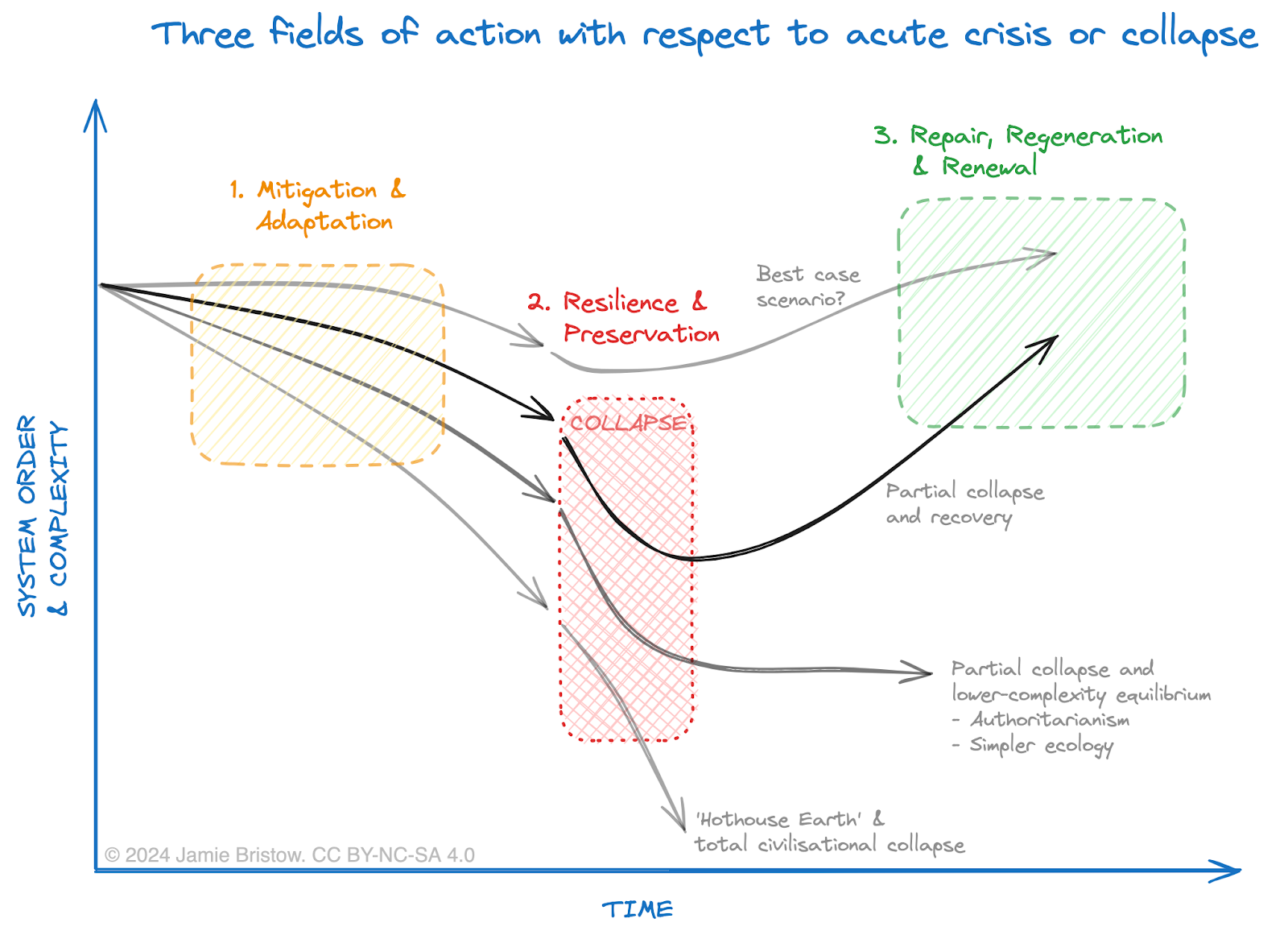
1. Immediate Mitigation and Adaptation
We must avoid the worst impacts of climate change through ambitious collective action to reduce emissions and rein in ecological destruction. Every tonne of carbon dioxide, every fraction of a degree of warming counts, and the hotter things get, the more true this becomes. We must also adapt to environmental changes in the short term, with countries at the sharp end of climate impacts receiving support. The vast majority of climate change discourse to date has been concerned with this first field.
2. Resilience to Future Shocks
Action can be taken now to prepare for acute crises or even partial collapse of systems in the medium term, preserving (some of) what’s precious and ensuring that critical infrastructure, communities and social order are sufficiently resilient to withstand significant shocks.
3. Foundations for Future Renewal
Philosophies and practices that can be foundational to a regenerative society may find more fertile ground among post-crisis mindset-shifts. We have an opportunity now to nurture existing wisdom and develop new ideas and approaches, building “islands of coherence” that could seed later civilisational renewal.
A Call to Action in All Three Fields
Action in each of these three fields supports the others, and focus on one need not draw energy away from another – rather, many virtuous cycles persist between all three. For example, increased attention to preparation for future shocks is likely to build public awareness and appetite for climate mitigation measures, and vice versa. Investing in community resilience can reduce unsustainable behaviour and foster a mindset shift towards greater appreciation of interconnectedness. Advocacy for paradigmatic transformation can energise the case for deep mitigation and adaptation. Shared efforts to reduce emissions, protect local ecology and build adaptive infrastructure can strengthen bonds of community; in turn supporting social order and preserving life amid crisis. The greater the effort invested now in all three fields, the shallower the decline we are likely to experience and the better likelihood of renewal.
The complex crises we face demand that we move beyond totalising attitudes to optimism and realism. We must embrace a more nuanced understanding that incorporates a range of adaptive strategies and actions. This model is intended not as a new, fixed framework for the way things are, but a device with which to loosen up our thinking around the challenges ahead. Reality will be infinitely messier, less clearly defined than this picture suggests – but within this mess, while we can’t avoid some degree of loss and suffering, we can direct our energies towards minimising impacts and preparing for a more resilient and beautiful future.


Comments
Welcome to the new Resillience commenting system!
We have moved from the former Disqus commenting system to a new system as of September 10, 2026.
We made this change because of privacy concerns regarding Disqus. It's also part of a set of changes to bring more services to the Resilience community under a single login: commenting, (coming September 2026), and online courses (coming 2027). Unfortunately, your old Disqus comments may not reliably link to your account in this new system. Please contact us if you have any questions or concerns.
Omg….here we go again. Having to explain. Exactly what a Doomer is. A Doomer is NOT someone who wants to do " nothing" about climate change. A DOOMER IS ..someone who wants to do something about …PLANETARY OVER SHOOT ….which means…let's NOT make more technology.. lets DO LESS..of that. .which .is only trying to PROP UP industrial civilization ….which ..is THE CAUSE of our predicament…there…I said it…
Exactly!
But sometimes it's better to preface "doomer" with "prepper" (in the larger sense), so as to indicate that doom is something that should be prepared for. The key to ethical preparation is to "do something" that facilitates life during and after doom but also makes the ecosphere a little healthier while doing it.
My list of top things to do (all should be done simultaneously by whoever can help):
1. Build soil fertility wherever it has been diminished by human activity.
2. Plant trees or protect existing forests.
3. Clean up the stuff that will damage ecosystems, especially if that stuff is abandoned.
4. Get rid of nuclear weapons and sequester nuclear waste.
5. Help people move out of cities to places where they can live with much less exogenous energy when the time comes that they must.
6. Promote rapid depopulation (fewer children) everywhere but especially in rich countries. No children at all would be best, but hard to achieve.
7. Rapidly reduce CO2 and other GHG emissions.
8. Prepare for draconian rationing systems that fairly distribute diminishing necessities.
There are more, but only reducing CO2 emissions gets much traction and even that gets far too little.
Climate will indeed become a major factor in global food production, but energy shortages will also greatly impact food supply, likely sooner than the climate will. Modern civilization has built urbanized living conditions for over half the world's population. Every aspect of growing, harvesting, processing, preserving and transporting food into cities requires huge amounts of energy (the "we are eating fossil fuels" meme). If that energy supply fails, which it certainly will at some point, possibly very soon, cities will die.
Human population overshoot is so extreme, economic complexity is so great, and so many critical resources are subject to effectively complete depletion that the "total civilizational collapse" path is a certainty, with or without hothouse earth. Of course, the sooner collapse happens the lower the chance of hothouse earth happening. This is why I cross my fingers in the hope that it comes soon.
We will not collapse into a stone age economy because abundant metal will be available for centuries in the ruins of modernity, but we will rapidly end up with localized wood and muscle fueled agrarian or pastoral economies all over the world. Getting as many people as possible ready for participation in these kinds of economic activities should be the highest priority of government at all levels. But the necessity of planning and managing those preparations is something that seems to be beyond the imagination of government officials everywhere. (Even Jamie Bristow is not quite there yet.)
I suspect that this same lack of imagination and foresight will reduce the chance of maintaining social order, too, both within and between nations. It's going to get very ugly and many more people will die than is absolutely necessary. The scariest part of this prospect for social disorder is that there are still over 12,000 nuclear warheads in the world. What are the chances that none of them are ever used?
Yep, there's a lot going on. I tend to focus on things out of human control, like the weather, and I think that's why Lester Brown felt food was the weak link. Energy: Lots of new teslas around here and in the Beach Cities around LA, so I'm guessing significant grid problems are on the horizon. (A tesla ramps-up household electricity use by a factor of 2 – 5, depending on pre-tesla profligacy.) This also shows how cliodynamics' demonstration that overproduction of elites (think musk:teslas) is such a problem. The Affluent will suck up energy that way, or at least try to.
Of course billions will die; that's already begun, in 2012 Brown pointed out foodless days were becoming the norm. In 2012! Deaths will ramp up rapidly, paralleling the ramp-up in summertime temperatures. That's the most staggering thing one can say, basically; I think. When someone asks for any facts about our future, I say, "Billions dead." (In physics, we think of boundary conditions and limiting cases…)
______________
https://youtu.be/KPfUqEj5mok
I watched the Lester Brown video and agree with him that food will be the breaking point for civilization (absent nuclear war), but in 2012 he was still hopeful that a "wartime-like" mobilization could ramp up renewables and cut carbon emissions enough to save the climate. We know how that went.
Yes, billions dead. One would think that this prospect would concentrate minds, but it's rarely thought about and never discussed by politicians. I can understand why, but I can only hope that somewhere in the bowels of government there is a Plan B that can be revealed when the Overton Window finally expands to the point where "billions dead" can be discussed publicly. It might be able to save a few million who would otherwise die.