

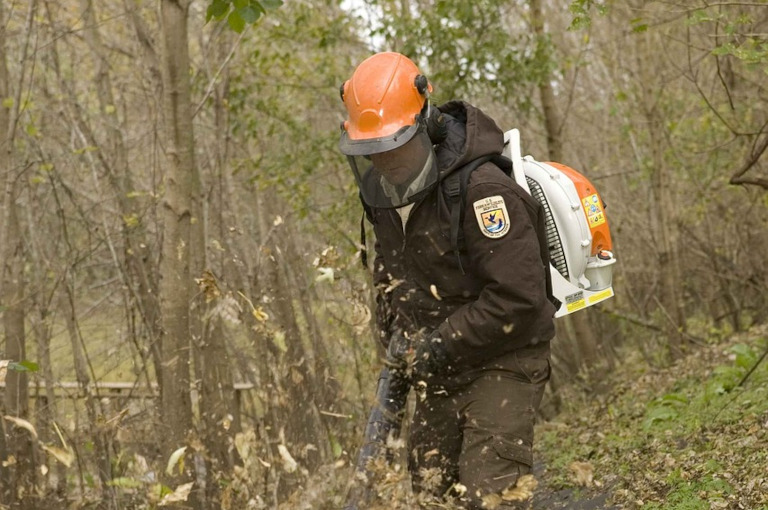
Every Thursday our next-door neighbor hires a worker to use a leaf blower. This infernal machine drives me nuts. Rather than letting a pet peeve render me literally insane, I’ve decided to explore the leaf blower’s deeper significance. A psychologist might call this writing therapy. Maybe the result can also provide a little relief for you, the reader, if you share my irritation.
The most obvious critique of the leaf blower is that it’s an obnoxious, destructive piece of machinery. As everyone within earshot of one knows, gasoline-powered leaf blowers are noisy. Deafening, in fact. The device blasts 95 to 115 decibels of sound at its operator. According to the website Dangerous Decibels, this is roughly equivalent to a chainsaw or a passenger jet taking off, and it can cause permanent hearing loss. Further, research into the specific characteristics of sound from gas-powered leaf blowers, published in the Journal of Environmental and Toxicological Studies, showed that, unlike most other loud machines, leaf blowers produce low-frequency noise that travels long distances and penetrates building walls. That’s why a single leaf blower can annoy an entire neighborhood.
Leaf blowers contribute significantly to worsening noise pollution in cities. Wildlife experience chronic stress as a result, with birds having to sing louder to find mates or define breeding territory. Everyone—human or non-human—feels on edge when that ugly noise starts up.
At the same time, leaf blowers emit toxic pollution. The blower’s two-stroke engine drinks a combustible mix of oil and gas, but a typical leaf blower burns just two-thirds of its fuel, spewing the rest into the air. That’s why two-stroke gas engines have been phased out in nearly all applications—except landscape maintenance. The noxious stew of gases released by leaf blowers—including cancer-causing benzene, volatile organic compounds, ozone, and nitrogen oxides—is a health hazards for workers and bystanders alike.
Regarding nitrogen oxide, the California Air Resources Board figures that using a gas-powered leaf blower for an hour emits as much as driving a Toyota Camry from Los Angeles to Denver. Of course, gas-powered leaf blowers also spew climate-wrecking CO2, but their nitrogen oxide emissions have an outsized climate impact: the EPA estimates that one pound of nitrous oxide has almost 300 times as much global warming effect as a pound of carbon dioxide.
All of these drawbacks have led over 100 cities and towns across the country to ban or restrict the use of gas-powered leaf blowers. California is phasing out gas-powered leaf blowers, but doing so will take many years. My neighbor obviously hasn’t gotten the memo, nor have millions like him.
It Goes Deeper
People use leaf blowers, blasting air at up to 280 miles an hour, to remove tree leaves, with the ultimate goal of keeping their lawns looking neat. But leaf litter is habitat for worms and insect larvae. Leaf blowers are just one reason the total biomass of insects on the planet is declining by about 2 percent per year. Leaf litter also protects and builds topsoil, of which we’re losing tens of billions of tons per year globally. So, we’re using noisy, polluting machines to do things that, in many cases, we really shouldn’t be doing in the first place.
The leaf blower replaces muscle-powered work, thereby increasing what economists call labor productivity. In this respect it’s just like a wide range of other industrial machines. From the powered loom, which displaced workers in early industrial Britain, to artificial intelligence (AI), which now threatens the livelihoods of millions of information workers worldwide, new machines disrupt economic routines. They make life easier in certain respects, but in doing so they impose environmental and social costs that often eventually overshadow the immediate benefits.
Physical work can be hazardous, particularly if it involves powered machinery or chemicals. But it provides needed exercise, along with the psychological benefit of seeing a process through from start to finish. Do we really want a future in which all we do is push buttons and stare at screens (the button-pushing eventually to be replaced with a brain-computer interface)? Techno-optimists may say that, with ever more machines in our lives, we will be freed to get our exercise by doing yoga or playing pickleball rather than from back-breaking toil. But survival that’s no longer tied to physical effort can leave us feeling unmotivated and useless. Perhaps our rush to increase labor productivity by replacing muscle power with machine power has passed the point of diminishing returns.
Then there’s the problem of economic inequality. Who actually uses leaf-blowers? In most cases, it’s low-income landscape workers, who are exposed to the air pollution and noise from leaf blowers at close range over sustained periods of time. Gas-powered lawn care has been linked to debilitating health issues like cancer, asthma, heart disease, and hearing loss; so, unsurprisingly, it’s the less-well-off who face the brunt of those health insults.
Stepping back, we see this general pattern reflected in the rest of industrial society: just as leaf-blower noise and air pollution gets shunted mostly toward low-paid landscape workers, resource extraction and polluting industries tend to be located near marginalized communities, nationally and globally. Therefore, the leaf blower just binds us more strongly to already unfair and dangerous social trends.
Finally, this technology’s reliance on gasoline and oil ties it to a historical development that I’ve come to think of as history’s greatest catastrophe disguised as humanity’s biggest triumph—the fossil-fueled Industrial Revolution. Depleting and climate-changing coal, oil, and natural gas have brought about dramatic human population growth, along with immense profits and unprecedented wealth (for the few). But all of these presumed and probably transitory benefits have been based on depleting natural resources, and on processes that are perilously changing the climate and degrading ecosystems across the planet. Every time we pick up a gasoline-powered machine we are viscerally linked to that chain of ersatz benefits and spiraling impacts.
What’s the Solution?
For years, my wife Janet and I just used an ordinary garden rake when we needed to move leaves around. But we live on a quarter-acre lot, with a garden and orchard that require constant upkeep. And we’re getting older. Last year we bought an electric leaf blower, mostly just to remove leaves from the rain gutters on our house—which it does very effectively. It’s much quieter than our neighbor’s gasoline-powered leaf demon (According to the American Green Zone Alliance, the average electric blower produces 65 decibels of noise at the point of use). It doesn’t emit health-harming or climate-changing gases (again, at the point of use). And we have solar panels on our roof to charge the battery that powers it. So: problem solved?
Well, not so fast. Manufacturing the machine, and particularly the battery, required minerals that had to be mined, transported, and processed; along with energy—most of which probably came from coal, since the device was made in China. The resource extraction, energy production, and manufacturing that brought us our electric leaf blower entailed pollution, which probably ended up impacting relatively poor communities. And if everyone used electric leaf blowers, we’d be causing more soil loss and insect habitat destruction.
In some ways, the gasoline-versus-electric leaf blower choice mirrors the conundrums and trade-offs of our larger societal energy transition from fossil fuels to solar and wind power. Climate change and fossil fuel depletion require humanity at large to shift away from its current dependence on coal, oil, and natural gas. But replacing our currently vast fossil fuel energy usage with equivalent amounts of energy from renewable sources will require building enormous numbers of solar panels, wind turbines, batteries, and power lines, along with a bewildering array of machines and manufacturing facilities that use electricity rather than fossil fuels. Producing all this new infrastructure will take oodles of minerals and metals, contributing to resource depletion. The manufacturing processes will generate pollution. Factories will likely be located in relatively poor communities. And new solar farms and transmission lines will entail more land use, and therefore more disruption of ecological cycles.
The only way to avoid those ill effects would be simply to use less energy—which means doing less with machines, and more with human hands and feet. This is why electric cars are not as much of a solution to climate change as the simple overall reduction of powered transport.
If we started down that path, beneficial results would ripple throughout society; however, during the transition, the medicine of degrowth would have side effects, not all of which might be desirable to everybody. Eventually, corporations, megacities, and economic growth would be replaced by cooperative communities working within local environmental limits. We could preserve scientific knowledge, which might gradually come to resemble traditional wisdom.
But, back to the leaf blower. Why make such a big deal over so small a problem? Compared to the existential predicaments we humans face (including climate change, hyper-partisan politics fueled by spiraling economic inequality and social media algorithms, nuclear weapons, and “forever chemicals” disrupting human and animal reproduction), the gasoline-powered leaf blower is just an annoyance. Why not just use the electric blower and leave it at that? After all, it’s better than the gas version.
Sorry, I can’t stop there. Call it the curse of knowing too much. Yes, Janet and I will keep using our electric blower where raking is impractical. But every time I pick up the machine, I’m reminded that our society’s overall socio-economic model is unsustainable and anti-life. We need far, far more than a green energy retrofit. We need an entirely different way of existing on this unique, imperiled planet—a way that many Indigenous people are still familiar with.
Buying an electric leaf blower was an interesting experiment that we may not repeat. I’m glad we kept our rake. It gets a lot more use.





Comments
Welcome to the new Resillience commenting system!
We have moved from the former Disqus commenting system to a new system as of September 10, 2026.
We made this change because of privacy concerns regarding Disqus. It's also part of a set of changes to bring more services to the Resilience community under a single login: commenting, (coming September 2026), and online courses (coming 2027). Unfortunately, your old Disqus comments may not reliably link to your account in this new system. Please contact us if you have any questions or concerns.
Regarding the big, existential picture: besides changing lifestyles significantly to reduce energy use, why doesn't anyone want to touch the subject of overpopulation? Think what a reduction of, say 20%, of the human population would do for the earth! If people would just stop having more than 2 kids per couple, the population could start to decline rather quickly since many people don't have any kids or only have one. But I know the mere suggestion of any kind of population control brings out the worst in religious zealots and other selfish, ignorant types everywhere. So humans will just continue on the road to the inevitable total breakdown of the environment. Then there will be a major decrease in population by the worst possible means!
I’m not enthusiastic about population as an issue for several reasons:
– In the developed countries, our job is to tackle consumption. We consume many times the resources per capita than those in the global South. We have high consumption lifestyles, plus our countries spend our budgetrs on the military and wars — more waste of resources.
– Reproduction rates are falling in the developed countries already. The media is full of articles bemoanng this trend, pointng out (correctly) that it’s going to be a shock to our economies. The best thing we can do is to spread the word that declining populations have many positive effects.
– I don’t believe that government policies can do much to affect population trends. Population is driven by other factors, like high cost of raising a family. The only exception is China’s One-Child Policy, which was successful, but draconian.
– There has often been a confluence of racism and classism with population issues, starting with Malthus. Serious population activiest are careful to separate themselves from the racism, but it’s hard to avoid.
– Most of the people who want to talk about population haven’t done much research on the issues. There is good work being done, but it takes work to educate oneself.
Best wishes, Bart
–
Electric leaf blowers are no where as powerful, they last about 30 mins on one battery and need a $3000 converter or a backpack full of battery’s to make last longer. My work day is 10 hours long. Electric will never ever make it in landscaping, not until you people stop paying $20 a cut. Some people need to get the stick out there ass and grow up to what is realistic and what is fantasy.
Right. But this applies to almost all modern tools that I pick up. We have lost so many skills and so feel lost without all the toys of the modern world. I’m slowly accumulating hand tools but even these seem like modern conveniences compared to almost the whole history of humans.
Thanks for this calm rant. I totally agree. Leaf blowers deserve a special award for stupidity and annoyance. The same award should be given to the (white) homeowners who have obsessive compulsive disorder about leaves in their yards, and the (mostly immigrant, where I live) workers who cash in on this.
I curse landscapers who blow their dusty debris into the street. They could at least blow their dust and leaves into a pile and then bag it. Even some homeowners blow their yard waste into the street. Increased particulate air pollution must be due to increased blower use. All of them should be outlawed.
So glad you wrote this Richard. These things are the bane of my existence, and it’s so good to read a kindred spirit on these issues. Most of the people I see who own these things to use in their own yards seem to be men. I wonder if there’s some role that patriarchy is playing in all this too, where men find it more compelling to blow stuff around and consider it implicitly effeminate to use a rake?
Posting a comment from Guus Dekker:
“I follow “Post Carbon Institude” with great dedication because I believe the World Needs this organization!
But….I would like to express my Utter outrage at Richard Heinberg’s use of a leaf blower……
I am particularly disappointed that you … yes, you, despite your age,
indulge in such a horror device! I can’t reach this… sorry, REALLY a
bridge too far.
I will consider whether I would like to continue receiving your newsletter.”
EXCELLENT points here!!… Omg… LAWN MOWERS, are also a truly disruptive machine. I really cannot stand them… So, we have almost 2 acres… my husband, is addicted to machines. If we had more money, it would probably be a bigger problem… Anyway… the front of our land, is for the two gardens we do in the spring/summer. Our actually yard, around the house, is also, fairly large, especially in the back. But, there are also neighbors… We live in a rural neighborhood, but, good grief… One year the people next door actually had the balls to mow their lawn at 8:00 on Sunday mornings… I was even in the garden by 9:00 some times… and it was still going… because that expanse, next door is massive… omg… I want to scream every time I hear all the noise from these ridiculous machines… it is soooo disruptive. I go to the garden and try to have PEACE and quiet… but good grief… So, also, my husband has run over so many of the flowers I have planted… STAKES AND ALL… yes.. 1ft stakes and he chopped it up like candy… Also, it really gets to me when some people…ESPEICIALLY WOMEN… think they are soooo tough… because they mow their lawn with their riding lawn mower. REALLY?… These women will ask me (yes, I am a woman)… “Oh, don’t YOU ever mow the lawn, instead of your husband?”… As if… because I don’t, I am weak, or not “tough”… I want to ask them, have you ever walked a stallion between a few paddocks of brood mares covering about 1/3 of a mile… with a twitch on his nose and the chain in his mouth?… …I mean, I worked 8 years with race horses … getting kicked and bit and … shoveling… and taking care of legs… riding my bike to work 3/4 of the year… through traffic on Hempstead Turnpike in Nassau County.. N.Y. … I think I will next time someone asks… Yeah, I think it would be right to make it mandatory everyone buy a MOTORLESS lawn mower… and MOW LESS.. I am going to try to put a few nice flower beds in our front yard… and have nice, cute little walking paths between them…( I have to talk him into it though)..so there would be alot less lawn to mow… The fruit trees in the back… help… but, hope they bare fruit this next year… we had nothing this past summer…..