

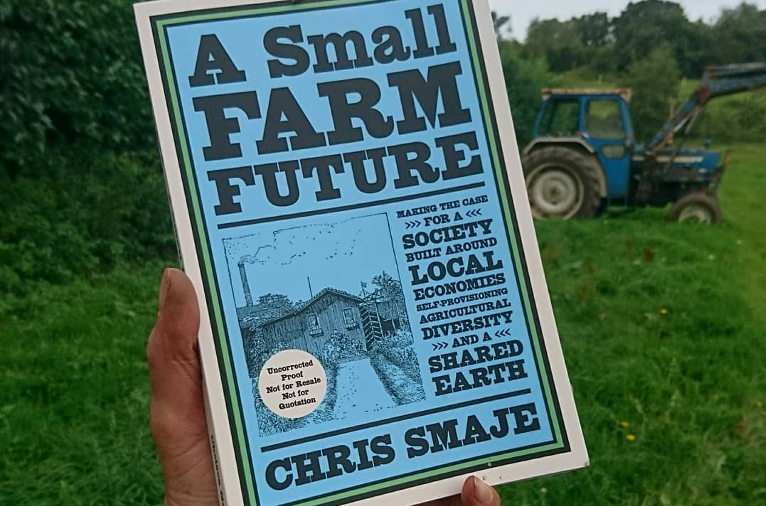
Continuing the final descent of this blog cycle to finishing its discussion of A Small Farm Future, Chapter 18 of my bookis called ‘From nations to republics’. I hope to say more on this theme in the future, but for now just a few words here on this chapter.
Nationalism has been much the most successful of political projects worldwide over the last couple of centuries, and a major employer of politicians, writers, historians, cartographers, soldiers, bureaucrats, priests, academics, architects, policy wonks and others whose work has helped build the story that the modern political power emanating territorially to the boundaries of the world’s existing nation-states from hallowed ground at the heart of their capital cities is justifiable, natural and uncontestable.
I think that story will come to an end, and we’ve now entered the beginning of it. In my book, and probably in the tenor of my comments so far in this post, I convey a view that its end is overdue, and welcome. And that pretty much is how I see it, although perhaps I should concede there’s a more positive case that can be made about nationalism – something along the lines of bringing people together around a shared project to use centralized politics to move positively into the future to the benefit of all. Maybe one indicator of how seriously to take that is the shape of the hallowed ground I mentioned at the centre of the nation’s capital – more seriously, perhaps, if it’s a public square, less seriously if it’s a walled fortress. Though some pretty nasty things can happen in public squares. Anyway, I believe that positive shared project has had its day. It’s hard to see nationalist rejuvenation of existing centralized states as a viable project for the future.
The terrain of the nation is now pretty much entirely the ground of the self-consciously ‘reactionary’ right, along with a few ‘progressive’ politicians riding on its coat tails in the hope of getting more votes. These right-wing nationalists like to insist that their version of the national story is the only authentic one, with others dismissed as the bad faith product of wokeism or other enemies from within. But, as I argue in Chapter 18, for every nationalist narrative that tries to create some singularity around national history and destiny there are always several counter-narratives that bring a different account of history to the fore. Attempts to forge singular nationalisms are doomed to fail, often bloodily.
Attempts to re-enchant local landscapes with social meaning are a different kettle of fish, as – for example – with environmentalist movements like bioregionalism that I broadly endorse. But I think it’s important not to connect these movements with statist nationalism, an approach long favoured by the far right that seems to be gaining force again. Love and soil over blood and soil. In my chapter, I criticized a somewhat notorious essay by Paul Kingsnorth for making such connections – a criticism I stand by, though I’ve recently come to re-appreciate much of Paul’s project.
In the context of supersedure state situations, I believe the more promising political form of the local state is republican (but not, I’d stress, Republican), and I talk about this a bit in Chapter 18, pretty much along the lines of earlier essays I’ve written here (eg. this one). I won’t go over that ground again just now. A key aspect of republics is that they usually emerge out of some political crisis in which citizens break decisively with a preceding polity and define a new common basis for collective political life. Typically, this requires a founder or a law giver to reset the basis of the political community.
As with all political forms, republics are beset with problems and tend to degenerate over time into oligopolies or other more problematic forms. The problem with the founder or the law giver is that they’re just some guy. The problem with forms of political authority that base themselves around some more naturalized or divine source of sovereignty is that ultimately the interpreters and custodians of these forms are ultimately just some guys. I’m basically a believer in the self-sovereignty of small farm proprietors as the foundation of the republic, because a small farm proprietor is just some guy too, which makes it easier to tolerate the ministrations of the larger republican state – you have your own domain of sovereignty, and the larger state becomes tolerable in that context, especially in view of the alternatives. Its very artificiality underlines its importance.
I don’t think a political vision of that sort need be wholly incompatible with ones grounded in a more organic sense of tradition, but that’s something I hope to write more about in the future. One thing I stressed in my book chapter and that I do want to stress here is the danger of what I called ‘front parlour’ republicanism. What I had in mind with this metaphor is the kind of domestic culture where people keep one room in the house clean and tidy with all their best possessions on display specifically to host distinguished visitors with whom they behave with utmost decorum, while the dirt, hard work, power games and dispute is kept hidden in the other rooms round the back. I wanted to highlight by analogy the dangers of creating little bubbles of self-congratulatory civic republicanism that deliberately or unwittingly keep hidden the toil of other people in maintaining the façade of republican freedom and autonomy.
An obvious modern example of that would be the Southern Agrarians in the US, who I believe had genuinely interesting things to say about small-scale farming societies, but in keeping slavery largely out of their front parlour vision fatally undermined their analysis. I consider a lot of small town or small farm republicanism today likewise as front parlour efforts overly concerned with who doesn’t qualify for membership in ways that limit its potential for building plausible post-global and post-capitalist societies.
When I wrote about ‘front parlour’ republicanism I hadn’t come across the Front Porch Republic initiative in the US, as laid out here by Notre Dame political scientist Patrick Deneen. From parlour to porch, another architectural metaphor. I like the idea of the front porch as an outward-looking liminal space between private and public, between local households and local community.
Deneen’s book Why Liberalism Failed is also worth a read. It’s grounded in a more conservative worldview than my own, but aside from the odd passage of gammon I found myself largely in accord with its criticisms of why both left/progressive and conservative forms of liberal politics have delivered us into the present parlous state of politics. After liberalism, then, I believe the task is to steer our societies towards a small farm civic republicanism of the front porch and not the front parlour variety. I don’t think that’s going to be easy.




Comments
Welcome to the new Resillience commenting system!
We have moved from the former Disqus commenting system to a new system as of September 10, 2026.
We made this change because of privacy concerns regarding Disqus. It's also part of a set of changes to bring more services to the Resilience community under a single login: commenting, (coming September 2026), and online courses (coming 2027). Unfortunately, your old Disqus comments may not reliably link to your account in this new system. Please contact us if you have any questions or concerns.
His articles about how UK can feed itself were well researched. He determined that it can not with the current population.
My sources say that Smaje’s book actually says quite the opposite. It argues that, in fact, the UK could feed itself without relying upon food imports, though it would be challenging and would require a particular set of specific changes to food production.
Here’s a quote from the book, A Small Farm Future, offered by Chat GPT (which is not always accurate).
“While it’s certainly possible in theory to feed a large population like Britain’s using agroecological methods, this would require significant changes in the way that food is produced and consumed in the country. We’d need to focus more on crop diversity, reduce our reliance on synthetic inputs, and move towards more decentralized systems of production and distribution that prioritize local needs over global markets” (Smaje, 2020, p. 16).
James R. Martin on April 7, 2023
[Small Farm Future blog]
A commentor at Resilience.org (see below link) said about you,
“His articles about how UK can feed itself were well researched. He determined that it can not with the current population.”
My knowledge of your work is quite limited, as yet, due to my inability to read ten books at once. So I’m here to ask… is this so? I had been told quite the opposite.
https://www.resilience.org/stories/2023-03-29/from-nations-to-republics-front-parlour-or-front-porch/
Chris Smaje
on April 9, 2023 said:
Yes you’re correct, and the commenter is incorrect. My modelling suggests Britain can feed itself adequately with its current population (or even a higher one) with low impact methods – though it would involve many changes from present dietary and employment patterns.
People will flee cities because there will soon be far less access to basic livelihood in them. There will be far fewer jobs, and no means of living a subsistence lifeway in crowded cities. So it’s not like re-ruralization is optional. It’s necessary.
Re-ruralization is necessary and should be the primary policy of governments everywhere, but the last couple of hundred years of industrialization have locked modern nations into economies that make reruralization difficult to impossible. This is due to the way that agriculture has evolved during the industrial era.
There has been a synergy between the mechanization of farming and urban industrialism. As more fossil energy replaced muscle energy on the farm, the more people moved to cities and the bigger farms could be. This is old history and well known, but what is less well known is that reversing the process is extremely difficult and something that can’t be done quickly.
The difficulty is that it will always be easier and cheaper to prioritize industrial agriculture to keep people who live in cities fed. Even with far fewer jobs in cities, it will be easier to just feed the unemployed by diverting an increasing share of energy to industrial agriculture than using a great deal more energy to move them to the country.
Just imagine the difficulty in taking an apartment dwelling family in a city and getting them situated in what is now a vast expanse of industrial farmland, land that can only produce food by using synthetic fertilizers and other farm chemicals. Housing, water systems, woodlots, roads, outbuildings and building soil fertility would all take far more energy than just dumping a bag of wheat on their apartment doorstep every month (something that was common in the Great Depression).
There is an energy trap context to making a transition from fossil energy to renewable energy systems (partly mitigating the Heinberg Pulse), but there is also the energy trap which comes from waiting until energy supplies decline before attempting to reverse centuries of urbanization. I doubt that it can now be done. Perhaps if we started fifty years ago …
That opening paragraph is a wild ride, Joe.
It begins with “Re-ruralization is necessary and should be the primary policy of governments everywhere” then goes on to say that the challenge is next to impossible.
I think the main reason it is presently next-to-impossible is that a major social problem has to be acknowledged prior to it being addressed. And it has to be understood in order to be acknowledged. And we’re presently living in a society so deluded about reality and facts that the overwhelming majority of us neither acknowledge nor understand what’s happening — which is the gradual disappearance of the basis for an urban industrial consumer economy.
But it is only momentarily gradual, as you and I both acknowledge and understand. The mismatch between the biophysical reality of our situation and the pervasive public (mainstream) narrative of energy/economy/ecology will result in ever increasing Ill preparedness for ever-worsening economic and social crises and dilemmas (within a polycrisis). As these crises inevitably reach a breaking point, without a re-ruralization of much of the population, the situation will become fully desperate, with millions of “first world” people suffering the worst, as these are the ones most dependent upon the dying industrial consumer economy for livelihood — which isn’t just food, but also shelter and other basic needs.
The only way to stave off utter calamity in this regard is to begin re-ruralization before the current system snaps — for the reasons you listed, such as frequently poor soil conditions in lands stripped by industrial scaled chemical farming.
It’s clear to me there will not be an “energy transition” which comes anywhere near to full replacement of current fossil energy with ‘renewables’. But the public is perpetually told otherwise. But there will not even be 1/4 replacement of such energy with ‘renewables’. And so industrial civilization as we know it will end in the near future. There are also not enough materials of every sort to sustain it — and every day the very ecological basis of life grows weaker and thinner. And the general public neither acknowledges or understands any of this. So what is our polycrisis / metacrisis / megacrisis? It is a crisis of education. It’s really that simple! And I’m not talking here about a crisis of schooling. Education is ever so much more than mere schooling.
The present world runs on pure bullshit, but, unfortunately, it isn’t the kind we need to spread on our depleted soils.
What you say is correct, the education of the general public about the polycrisis hasn’t even begun. But that’s the least of our problems. Even if everyone was totally on board with winding down industrial civilization and marching in the streets for rapid degrowth, what could actually be done? The problem is so big and the hour is now so late that the real “solutions” are almost identical with an uncontrolled collapse of industrial civilization.
We need to get to negative carbon emissions right now. We need to stop all deforestation right now. We need to abandon industrial agriculture right now. And the list goes on and on. I hope those things happen, for the benefit of future generations, but if they do it will mean a big dieoff of the existing urban population without the immendiate re-ruralization we both prescribe. As much as it pains me to say it, I just think it is too late to make the transition to a “small farm future” on a collective basis.
It’s long past time for families with enough resources and foresight to flee, yet we don’t even see that happening, even among those that know they should be doing it. I mostly hear excuses from families that could make the move, but don’t, and even though those excuses are mostly valid, the result is the same as with families that are oblivious. I just keep sounding the alarm, and wait.
“Even if everyone was totally on board with winding down industrial civilization and marching in the streets for rapid degrowth, what could actually be done? The problem is so big and the hour is now so late that the real “solutions” are almost identical with an uncontrolled collapse of industrial civilization.”
While it is true that the situation is rather desperate, in that there is precious little time to “build a bridge” (to the inevitable near term future), I’m utterly convinced that we could build a bridge for at least a significant portion of the total population if we could manage to coordinate folks. Coordination would amount to those with knowledge and skills offering their support to those in need of those — which will be most everyone, of course. Lots of folks who have never built their own homes of locally available materials will have to learn how to do this. Same with growing food. And folks will require land access. These problems are not impossible to address. What seems to be standing in the way of these things happening at the necessary scale is the ignorance of the general public, who believe Market Forces (a god-like thing with invisible hands) will drive a Miraculous Energy Transition Just in Time (like just in time inventory).
People believe in this story not because it is grounded in evidence, fact, or reason (it’s not), but because of the massive public relations campaign which sold this story to pretty much everyone. Most people actually believe that “renewable energy technology” will replace fossil energy while reducing emissions and solving the climate crisis. While doing so, the economy will continue to grow and prosperity will be had for all. So there’s no need for a small farm future of the kind Chris Smaje advocates for. Problem solved. Don’t worry; be happy.
Those of us who understand that this “energy transition” narrative is false somehow need to coordinate our own public relations efforts in order to wake people up from this dangerous delusion and ruse.
I always cheer when a new Chris Smaje article comes out. One of the most fascinating writers on here, and in general in this sphere of writing for me!