

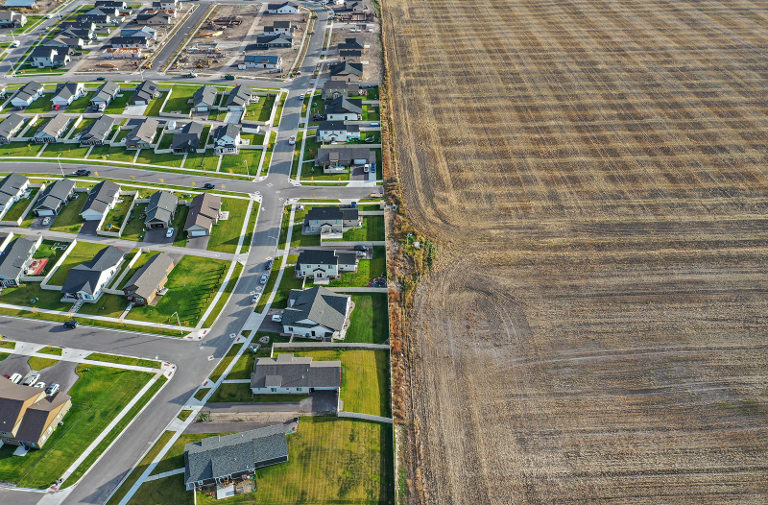
Land change is a scientific term you’re not likely to hear in mainstream climate conversation, which is a shame, because what it refers to, the climatic effects of human damage to living landscapes, is a big part of the climate crisis. I talk in greater detail about land change and how it got left out of the climate narrative in an earlier Resilience piece, called Putting the Land Back in Climate. Here, I want to consider the effects of this omission, not only in the practical terms of climate policy, but in terms less definitive. What does it mean to our treatment of the land that it’s gotten left out of our picture of climate? Or another way of putting it: how does not knowing that our local landscapes hydrate, cool and stabilize our climates affect our relationship with those landscapes, or lack thereof?
But first I want to be clear that nothing here questions or counters the danger of carbon emissions, the greenhouse effect, or subsequent global warming. Land change should be seen as being in addition to these things, or more to the point, intimately entwined with them. The climate, when fully comprehended, emerges as a constellation of actors and effects, physical and biological, with an unimaginable complexity of feedbacks and signals. To reduce it all to quantities of carbon, and speak only of that, is to miss the thing itself.
So let’s quickly review what land change is and how it got left out the climate picture.
One way to think of land change is as original climate change. We began changing climates as soon as we started draining marshes and plowing soil, as observed in the time-worn adage: desert follows the plow, and seen now in deserts like those of the Middle East, which were once lush with marshlands and cypress-draped hills. The reason has to do with water cycles, which are largely invisible to us. We don’t see the roots underground, interlinking with extravagant webbings of soil fungi, soaking up spongelike massive quantities of water, around 600 liters per day for the average tree. Nor we do we see the water evaporating from microscopic pores under the surfaces of leaves and needles, which like all evaporation, is profoundly cooling. And we don’t see the columns of vapor rising from trees and fields, feeding the clouds overhead to rain somewhere else and continue the cycle. Lastly, we don’t see the soil absorbing and holding that moisture, banking the landscape against drought and flood. Life not only sequesters carbon, it sequesters water as well. The two, it turns out, go hand in hand.
Scientists refer to this with the term evapotranspiration and know it to be fundamental to the hydration, cooling and moderation of local and regional climates. It follows then, that when we damage, or “change” land it dries out, heats up, and becomes prone to hydrological extremes like drought, floods and heatwaves. Sound familiar?
When coal and oil was discovered, a new cause of climate change entered the picture: emissions of greenhouse gasses. And early climate science treated it that way, as an additional cause, not the cause. Mediterranean-climate expert Millan Millan remembers that time, referring to it as a “two-legged” climate understanding—one leg for land change and hydrological effects and a second leg for carbon emissions and the greenhouse effect. So how then did we arrive at an official narrative which describes only carbon emissions as the cause of climate change? What happened to the land leg?
A clue can be found in the titles of the IPCC’s periodical Assessment Reports, such as the most recent assessment Global Climate Change 2021: The Physical Science Basis. What is meant by those last four words? The easiest answer is to think of the physical science basis is as the mathematic, or quantitative basis, the basis necessary for the computer modelling of climate. When CO2 emissions emerged as a climate threat, science immediately turned to computer modelling to ascertain and predict the effects. Carbon emissions, well dispersed in the atmosphere, proved highly amenable to such modeling, while the biological/hydrological processes of land change were the opposite. Though we can feel the effects of land-change, and are surrounded by it in the form of wastelands and vanished species, it is almost impossible to render in quantitative terms. The process are too detailed, complex, varied and changing.
[slide-anything id=’3472166′]
A good many scientists are currently working to resolve the matter, quantifying land change effects and bringing them into global computer models, and we can expect the next round of IPCC assessments to include some of this work. But that’s still five to six years off, and by then trillions will have been spent on industrial infrastructure causing how much land change?
This must be the first and most tragic effect of leaving land change and water cycles out of the analysis. Nature disappears, reduced to quantities of carbon, buried under tech jargon, sacrificed all over again for a new era of human device and progress. To the plow, the ax and cattle drive, we now add the solar farm, transmission corridor and a new generation of mines.
Environmentalism has suffered mightily from this formulation, and now confronts a kind of ecological Sophie’s Choice: either sacrifice the land or sacrifice the climate. It can be that stark. Consider the US state of Virginia, who’s recently passed climate legislation is resulting in thousands of acres of forest being cut for solar farms and transmission corridors, much of it to support data centers for tech corporations like Google and Microsoft. Meanwhile, those citizens who elect to protect their forests rather than sacrifice them for energy generation are labeled NIMBYs.
But there’s more. With this big industrial push comes a parallel push for what is being called “permit reform.” The Inflation Reduction Act, recently passed in the US, contains 1.2 billion dollars to staff up permitting agencies in an attempt to rush this infrastructure. And I noticed, when Senator Joe Manchin tried to attach a “permit reform” bill to the IRA, the official environmental opposition was carefully directed at only the permitting reform around fossil fuels. Presumably, they are for it when it comes to industrial infrastructure deemed “green” or “clean.” Thus, another dichotomy: big green working to take away permitting power from little green, the locals defending their own land bases. Ask yourself how long you think such contradictions can last.
There’s a personal dimension here as well. I know for myself, once I began learning about the biological, water-based aspects of climate, my view of climate and the natural world transformed. Muir’s oft-quoted observation, “when we try to pick out anything by itself, we find it hitched to everything else in the universe” suddenly came alive. I discovered, over and over, that when I grabbed the thread called “climate” it was hitched to everything on Earth, part of something very much alive and capable of recovery. And with that my doom, not my worry and concern and grief, but that powerless sense of doom vanished. I stood on different ground, having come to know its power.
Now I see my surroundings, my climate-shed if you will, not as climatically helpless against rising CO2 emissions, but the very basis for climate healing and recovery. This is what happens when you bring the living land back into the climate equation, it comes alive. The land turns ally, and a new clarity emerges, with a very different set of priorities.
First, protect all remaining wild and semi-wild places. They are the last living links to the once cool, wet Holocene climate, which we can still save. Understand that where land is at its healthiest, so it’s climate function.
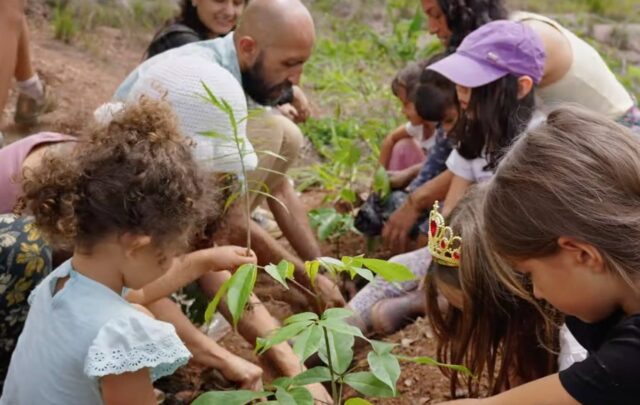
Second, restore the lands we’ve already damaged. Here is where hope literally grows. For buried within the sad fact that half of Earth’s land has been converted to human use, is the stunning comprehension of just how much land is available and waiting for restoration, bringing new carbon sequestration and water cycling to the climate system at game-changing scale.
Third, stop “changing” land. Housing developments, logging, road building, solar farming, all continue with no public awareness of the climate damage being done. Integrate land change into the environmental review process.
Fourth, slow down, cool down—the only thing that ever has reduced emissions. The land is telling it needs rest and recovery, not to be subjected to a new industrial revolution.
Do we really need decades of climate modelling to figure these things out? Might there be other ways of approaching this crisis?
We are not alone in this. For the land, though degraded, still retains its potential for regeneration. Given a little protection, ecosystems recover. Even the poorest soils contain ancient seeds of bygone life, awaiting only water. And in the field, the land’s enthusiasm for reemergence continually exceeds the expectations of those working to restore it. It turns out that regeneration, and the passion for regeneration, is in the very grain and fiber of all that surrounds us.
Those seeds are in us too. That’s the invitation. But only the land, and the processes of life, can bring the water.
Teaser photo credit: Author supplied


Comments
Welcome to the new Resillience commenting system!
We have moved from the former Disqus commenting system to a new system as of September 10, 2026.
We made this change because of privacy concerns regarding Disqus. It's also part of a set of changes to bring more services to the Resilience community under a single login: commenting, (coming September 2026), and online courses (coming 2027). Unfortunately, your old Disqus comments may not reliably link to your account in this new system. Please contact us if you have any questions or concerns.
I really like the term hyperthreat (i.e., by a hyperobject) wherein Climate Breakdown is the hyperthreat. We simply can’t perceive it (hence: hyper-), and if we claim we understand, then we’re unaware of how much we’re missing. But, hey, some folks are paid not to admit their ignorance (scientists, university professors, surgeons, dentists…) so it’s not an unusual state.
https://www.researchgate.net/profile/Elizabeth-Boulton-3/publication/323635414_Climate_Change_as_a_Hyperthreat/links/5da79ff74585159bc3d442e2/Climate-Change-as-a-Hyperthreat.pdf
What’s really interesting in this is the delineations of human engagement – fear being the stimulus for courage and heroism – affective states, which bind people’s hearts instinctively, not the cerebral states and discourses that we scientists cherish so much.
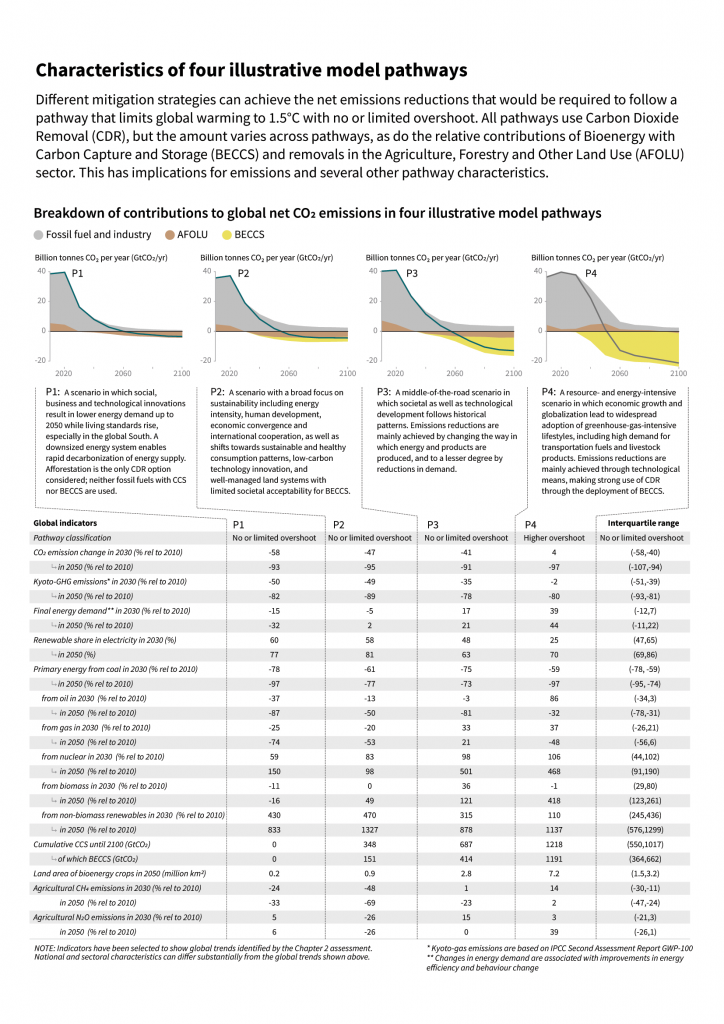
If you want to know about the future quickly – just read the IPCC SP15 Summary For Policymakers. You need to look no further than figure SPM3.b – scenario P1 (the only “real world” scenario of the four) to see what must by done and by when.
It’s easy to say we need to stop all land change and heal the land that has already been damaged, and that this will stop climate change. But this means that the rich world must accept wrenching change in our systems, including getting by on say a tenth of the energy we’re used to expending–and the poor world must never upgrade. It’s a hard sell. Arguably it’s a better choice than inflicting Planet Hell on our children. The number of politicians and Big Greens willing to say this–if they even know it–is, I think, zero. A couple of climate scientists do. But most find it a lot easier to pretend we can have our cake and eat it too, as James Martin puts it, Unplug/Replug. I hear people saying we must stop burning fossil fuel and instead put up a huge amount of new solar and wind, thus creating millions of jobs…I guess the jobs are in magic wand generation, since otherwise creating all those solar panels, batteries and windmill parts would require burning a lot of fossil fuel
One solution to land regeneration is to live in mother Earth and stop land-destroying development, which would all but eliminate heating/cooling needs. Yes, de-growth is a solution, but so is regenerative development of renewable energy, which a recent Oxford study argues would save trillions supplanting fossil fuels and their pollution by 2050. Land is being raped and people are being exploited by wealth creation, social justice and class struggle ensure that labor, which creates all value, brings eco-justice by suppressing wealth creation and inequality. An integrated planetary renewable electrical grid solves the energy crisis without a lot of polluting battery and other storage, as mother Earth turns she is bathed in sunlight 24 hrs a day. The end of fossil fuel burning cannot some to soon.