

There is nothing like a sudden decline in available oil supplies to bring out forgiveness in what is dubbed in and around Washington, D.C. as “The Blob.” This term refers to an amorphous, but powerful group of think-alike U.S. foreign policy actors both inside and outside of government who have influenced every U.S. administration since the end of World War II. The main tenet of The Blob is that America knows best how to lead the world and it must do so.
The Blob seriously penalizes those whom it regards as a threat to American power and security. The Blob likes to use words such as “rogue” and “pariah” to describe those countries which get on its wrong side. (Many are admittedly run by truly odious regimes.) To get a sense of who has violated The Blob’s sensibilities, one needs only to glance at the U.S. Department of Treasury website page entitled “Sanctions Programs and Country Information.” On it you will find The Blob’s who’s who of rogue and pariah states.
With the abrupt drop in oil supplies from Russia in the wake of the Ukraine/Russia conflict, the list of rogue and pariah states is about to get shorter as the necessity of obtaining ready oil supplies trumps any concern about previous challenges to The Blob’s narrative.
Venezuela and Iran, two large oil producers, are suddenly being courted by the current U.S. administration with an eye toward increasing world supplies of oil. To be fair, the United States was trying to revive a deal to prevent nuclear weapons development in Iran before the Ukraine/Russia conflict began. But a deal has become a more urgent priority since world oil supplies dropped abruptly at the beginning of the conflict.
Will all be forgiven or at least overlooked in exchange for ramping up oil exports? We do not yet know.
The facts about oil suggest an affirmative answer to the question above. World oil production peaked in November 2018 and has been in decline since then with a huge drop related to the outbreak of the COVID pandemic. (This applies to crude oil including lease condensate which is the definition of oil in world markets.) Production recovered, but was still several million barrels per day below the 2018 peak when the Ukraine/Russia conflict began. Russian oil production has almost surely fallen since the war started as the Russians find fewer and fewer places to sell their crude and not enough space to store it all.
One very important truth about America’s power is rarely mentioned by The Blob in public: That power depends in large part on access to resources found in other countries. The U.S. Geological Survey (USGS) lists 17 minerals for which America is 100 percent dependent on imports. (See page 7 of this report.) The USGS lists another 32 for which the United States imports more than 50 percent of its needs. And, contrary to the popular impression, the United States still imports a considerable amount of oil (though it exports some of it again as refined products). More important, American prices for oil are tied to the world market. Those prices would be affected by the current shortage whether the country imported oil or not.
All this explains, in part, why getting countries around the world to accept American leadership is central to The Blob’s strategy. The United States needs those imported minerals and other commodities to remain a world power. It’s true that if the United States can somehow provide stability to the rest of the world, that’s good for those who have such resources to sell (whether they came to control them legitimately or not). But it is becoming increasingly difficult for the United States to do that—especially as it is more and more challenged by China and Russia and even some smaller countries such as oil-rich Venezuela that believe American power has limits and that try to expose those limits through their economic, political and military actions.
Look for The Blob (that is, the American foreign policy establishment) to make more compromises in order to secure U.S. access to imported commodities critical to maintaining the country’s power. Without those commodities in sufficient quantities, it will be difficult for the United States to project power into the world in the way that The Blob wants it to.
P.S. One of the critical chokepoints for the commodities the United States needs for its electronics industry is China which has an overwhelming share of worldwide production of rare earth elements critical to that industry.
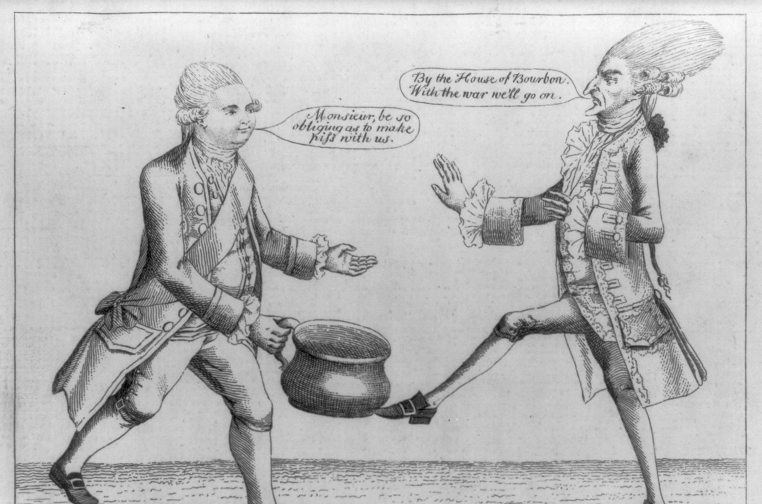
Image: Print shows Lord Shelburne holding a chamber pot up to a Frenchman, saying “Monsieur, be so obliging as to make piss with us.” The Frenchman is kicking the pot, saying, “By the House of Bourbon, with the war we’ll go on.” (1783) via Wikimedia Commons https://commons.wikimedia.org/wiki/File:L-d_Shel-,_begging_Monsieur_to_make_piss_or_p-e_LCCN2004673513.jpg




Comments
Welcome to the new Resillience commenting system!
We have moved from the former Disqus commenting system to a new system as of September 10, 2026.
We made this change because of privacy concerns regarding Disqus. It's also part of a set of changes to bring more services to the Resilience community under a single login: commenting, (coming September 2026), and online courses (coming 2027). Unfortunately, your old Disqus comments may not reliably link to your account in this new system. Please contact us if you have any questions or concerns.
The policies to acquire and maintain direct lines of communication contain a contradiction. The pursuit of control of energy supplies creates the instability which jeopardizes their security. That contradiction is very evident with the reversal of enemy status of nations coveted for their oil. Russia is also targeted by the American war machine, and in the same ways Iran and Venezuela have been provoked. Oil is a
crusecurse to those that have it and the Americans who have been subjectivized to its power.“Oil is a cruse”: you mean a curse?
So do you consider America cursed as well, with its oil wealth, in the same way that other countries have been? The “resource curse” has been a topic in economic circles in the past, but a distinction has generally been made that a more diversified economy which balances resource extraction off against consumers with opposing interests in an economy where extractive resources like oil are balanced by manufacturing and services and whatnot. It is a curse to one hit economic wonders like Iran and Venezuela and Russia.
Since domestic oil was the energy source creating the US empire, yes, oil has been a curse for the American people. A people who are subjects to the power exercised by their rulers.
Well, I’ll give you that the US was hell on wheels when it came to free market development of its vast oil resources, but it wasn’t an empire along the way any more than any other generally democratic country. As far as that oil being a curse, you would need to elaborate, because it has been quite geopolitically advantageous, as any comparison to other resource endowed countries might indicate…like Venezuela perhaps?
Most Americans know about the Alamo and how that led to Texas independence/statehood and was followed with a war which resulted in the expansion of the US to California after occupying Mexico City. Manifest Destiny was the ideological tool to enable the US to become a continental power. Fewer know about the occupation of Vera Cruz in 1914 or the ‘invasion’ of Mexico by Gen. Pershing in 1916. These last two ‘military actions’ were imperial, just like the US occupations of Nicaragua.
If Venezuela had no oil reserves, the US might still oppose its Bolivarian government but not as overtly. Oil is the reason the US makes the peoples of Venezuela and Iran suffer for their yearning to be free of America’s imperialist yoke.
It’s also a curse to those who live uncomfortably close to where oil, coal or gas are extracted, refined or transported. Or burnt. It’s only NOT a curse if you are privileged to live where none of that goes on, but the finished gasoline and electricity is delivered for your use. I live in West Virginia, which has been under the coal curse for over a century and the gas curse more recently.
Well, grandma had 3 gas wells on her property, all drilled and fracked back in the late 1970’s. The coal being mined under her property was more of an issue, to her water supply, than anything the gas wells were doing.
Invasions are not by themselves proof of a form of government of empire. And sure, Manifest Destiny was a tool involved in the overall colonial period of expansion for many countries, once upon a time. Doesn’t make them empires either. If Venezuela had no oil reserves, I agree it would be another banana republic, and the world would have less interest, the world having less interest in bananas than oil. But what does this have to do with one living out the resource curse at its most basic, and the other, not? As far as who is imposing suffering on Iran or Venezuela, might I refer you to religious nutjobs in general and socialist leaders who are ignorant of how the industry works? Or even basic economics if you’d prefer. There is an old saying in drag racing that applies exactly to the oil industry, and ex-paratroopers (and perhaps the current leader of Mexico) unfamiliar with such basic American entertainment miss at their peril. Here it is. “It costs money to go fast. How fast would you like to go?” Oil production works the same way. Give all the money away rather than investing it in your oil future, and pretty soon, you have no oil future. This is also a key point to why the resource curse exists, some countries figured out how to continue to invest, and produce, and the others just assumed that the golden goose would never get old and die. Oops.