

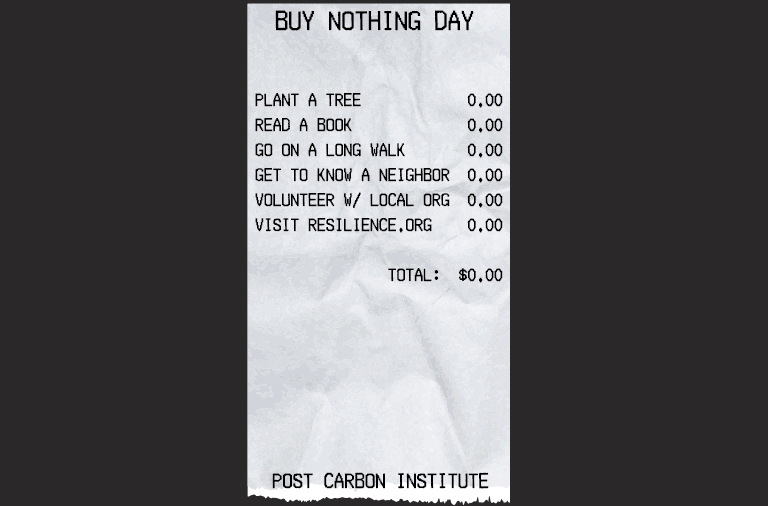
Last year, Americans spent an estimated $5,000,000,000 shopping during the 24 hours that made up “Black Friday.” That’s over $208 million an hour or about $3.5 million a minute. I don’t have hard evidence for this claim, but my educated guess is that a good portion of this spending is on stuff that’s made by people in far corners of the planet who couldn’t afford to buy it themselves, for people who don’t really need it. And I also think it’s safe to say that much of this stuff is made from depleting, nonrenewable resources through processes that cause pollution, help warm the planet, and will wind up in a landfill someday soon if not already. Aside from the warm-and-fuzzies generated by holiday gift giving, this “Black Friday” tradition leaves a lot to be desired.
The good news is that we can all have those warm-and-fuzzy experiences without spending a dime.
This Black Friday we’re inviting everyone to join us and our friends at Adbusters in celebrating “Buy Nothing Day.” We’re not asking you to become a Grinch, or completely abstain from Christmas or Hanukkah or whatever form of gift giving ritual you and yours celebrate. But maybe take a pass on this most egregious day of consumeristic binging.



Comments
Welcome to the new Resillience commenting system!
We have moved from the former Disqus commenting system to a new system as of September 10, 2026.
We made this change because of privacy concerns regarding Disqus. It's also part of a set of changes to bring more services to the Resilience community under a single login: commenting, (coming September 2026), and online courses (coming 2027). Unfortunately, your old Disqus comments may not reliably link to your account in this new system. Please contact us if you have any questions or concerns.