There’s a lot more to know about weeds than most people expect. In fact, there are quite a few surprises there if you become familiar with the plant life growing in an uncultivated field—especially on a vacant city lot.
The Detroit Urban Garden Education Series provides hands-on workshops twice a month at various locations all over the city. I came to a workshop on edible ecology for the purpose of capturing the spirit of the people involved in the community gardens.
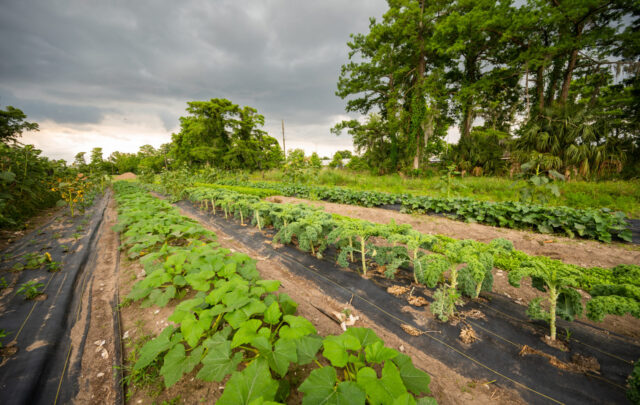
The Hope Takes Root Garden was the scene of the workshop. It is located in North Corktown on Wabash and Temple Streets, not far from Downtown and just a few blocks away from the majestic and still used Masonic Temple. A large swath of vacant land surrounds the garden, which is enclosed by a white bar fence reminiscent of the urban renewal fences that dotted the city in the early 1970s. The only buildings around are a few houses—some lived in and some vacant—and a liquor store on the corner.
About a dozen women came to the workshop that started around 6 p.m. but only after they took a look at the garden and visited with each other. It was unclear to me whether the participants knew each other, but it was an instantly lively group that exchanged information and pleasantries before then got down to the serious business of learning about edible plants. They brought pens and paper with them for notes.
The workshop convener eventually asked everyone to gather around in a space that had a makeshift table located on the outer edge of the garden near the apple trees. Large tree logs that had been sheared of their bark and smoothed on their tops served as chairs.
Ashley Atkinson, director of the Greening of Detroit, was there, too. She brought some bright orange five-gallon buckets which, when turned over, provided additional seating.
The workshop leaders were Patrick Crouch, manager of Earthworks, who introduced himself and Julie Cotton. Julie is a graduate student at the University of Michigan’s School of Natural Resources and Environment. She is writing a thesis on Detroit’s community gardens and how disinvestments in the city have led to food scarcity, real estate speculation that threatens to displace residents and an increase in vacant lots where Nature has taken over.
The first objective of the workshop was for participants to recognize edible urban vegetation and the role they play for the soil. Secondly, they would learn how human beings influence the presence of this vegetation and what effect the “weeds” have on other plants in a garden. Thirdly, in order to foster biodiversity, gardeners need to know what happens to the plants that are intentionally cultivated.
After the participants briefly introduced themselves and stated their motivations for coming to the workshop, Patrick and Julie asked us to take a walk around the garden and in the open field across the street to notice the types of weeds growing in the area and their patterns of growth. Flowers on the plants were a good clue, but participants were also advised to notice the types, size, leaves and where they found each plant.
After 15 minutes of collecting plants in the field across the street, two boys returned with their plants and layed them on the makeshift table. One of them excitedly showed Julie a plant with teeny tiny bugs crawling all over the stem.
“These are aphids,” she said. “The ladybugs love them.”
Aphids are one the most destructive insect pests on Earth, explained Julie. They can migrate great distances by riding on winds or by tagging along on humans. Their saliva is toxic to plants and affect their growth rates and yields, leave mottled leaves, cause yellowing, browning or wilting, and even kill them.
Another participant wandering among the tomato plants discovered a caterpillar with parasitized white wasp eggs on it.
“What a find!” said Julie congratulating her. “These wasp eggs are taking care of your caterpillar problem.” “They’re doing your work for you.” Caterpillars strip the leaves off the tomatoes and can ruin the plant.
Once everyone returned from collecting plants, we all took our seats. Patrick held up a Queen Anne Lace plant and began asking questions about people’s observations and experience with it. Then he explained that the plant is a biennial, which means it has a life cycle of two years. The first year the plant is a vegetative and it stores sugars in its roots. The second year it develops a flower and becomes woody.
One participant had noted that near the Queen Anne’s lace was another plant with leaves that resembled a carrot’s. Patrick passed around the plant and had the people smell the root. It smelled like a carrot. In fact, it was a wild carrot with a small, edible knob to it.
Patrick pointed out that as a taproot, Queen Anne’s Lace is a “healing plant.” A healing plant not only holds the soil in place to prevent erosion but it puts nitrogen in the soil, the essential element for growing plants.
“Plants add nutrients to the soil to make way for their progeny,” said Julie.
Some common nitrogen producing plants used to revitalize soil are alfalfa, clover and timothy.
Patrick and Julie identified and discussed a few more plants the participants had collected in the same way and later they provided a three-page handout of the plants found in the area. For example, evening primrose is good for inflammation of the joints as well as women’s hot flashes.
Chicory is good for honeybees and serves as a caffeine substitute. It’s bitter, but highly nutritious, especially when it’s wild.
Burdock may attach themselves to your pets in the fall but the taproot is tasty when it’s pickled. The Japanese use it for sushi.
Lambs quarters are great for salads, especially in the spring and can be substituted for spinach. They’re super nutritious and a great source of beta-carotene, calcium, potassium and iron.
The milky sap from wild lettuce can treat skin irritations and St. John’s Wort can treat mild depression.
Chickweed adds much flavor to salads and has a ton of vitamins that can substitute all the supplemental pills people take. It’s also good for skin conditions and is used in Earthworks’ hand balm.
Pokeweed is poisonous and needs to be cooked in at least two change of water. Its young shoots are best in the spring.
“We used to eat pokeweed as kids down South,” said one of the participants astounded by her memory of the plant.
Purslane is a common weed that used to be cultivated. It is a good source of vitamins and it’s extremely high in Omega-3 fatty acids, the kind associated with healthy hearts and good brain function.
“Oh my goodness,” said another. “We’ve been throwing away tons of purslane in our garden.”
It was soon becoming clear that these weeds were once part of the regular diet for people who recognized their edible qualities. Likewise, medicines came from plants before they came from pharmaceutical companies that put them in little sanitized bottles and sold on the market.
I was beginning to acquire a new appreciation for our ancestral hunter-gatherers who first discovered these plants and their qualities. What a change we have made to this long practice when we turned to cultivating monoculture crops and the huge industrial agriculture scene!
“Don’t try to learn everything all at once,” advised Patrick. “Pick a few plants at a time. Get a reference book to help you identify and learn about them.”
“And be sensitive to ecological systems so that you can learn to cooperate with Nature,” said Patrick. “If you can recognize the benefits of these plants, then it’s no longer about ‘those darn weeds.’”
Participants observed that some of the plants grew around trees. Some had flowers. Some had long taproots. Some grew in the cracks of the streets. But the question was: how did all these plants get there considering that these fields were once neighborhoods with houses and lawns.
After the participants took a stab at these questions, Patrick guided them to a discussion about biennials, which have a better seeding process. Perennials were mowed down first from grazing animals and then by mechanized grass cutters, he said. Besides, these plants provide the nutrients our bodies need and they have coevolved with us.
(Coevolution is an important concept for gardeners to understand because it implies that one species is dependent on another for survival. Bumblebees, for example, rely on the flowers for their nectar and the flowers are dependent on the bees to spread their pollen. Each species exerts selective pressures on each other that are adaptive so that they can reproduce successfully and pass on vital traits to their progeny that affect their own evolution.)
“People in Detroit don’t think we have a lot of wildflowers, but we do,” said Patrick.
In fact, 90 percent of what grows in this area was brought here by the Europeans when they first settled these lands, said Julie. The broadleaf, dandelion and chicory were all imported plants. So were the bees, which coevolve with these plants. Because they had no predators, they’ve been able to endure.
Sunflowers, however, were native plants and one of the first to be cultivated. Peppers, tomatoes, beans and squash were all native plants that are self-pollinating. Corn is pollinated by the wind. Magnolia trees are pollinated by beetles and they developed before bees were around.
“In growing gardens, the plants do best in polycultures rather than monocultures and we can see that across the street where there are apple trees, grapes, grasses, currents, gooseberries, trees and vines. This is a permaculture design,” he said.
Permaculture, a word coined by Australians Bill Mollison and David Holmgren during the 1970s (permanent + agriculture), is an approach to designing human settlements and perennial agricultural systems that mimic the structures and interrelationships found in the natural ecologies of an area. Consequently, permaculture is a definite move away from industrial systems of production and distribution that are systematically destroying the Earth’s ecosystems.
“Nature always wants to plant something in order to hold the soils,” said Patrick, “so the best way you can improve your soil is to grow stuff in it.”
So, what I gathered from this short workshop is that we need all living things around us in order to live. That includes the plants, the trees, the animals, the insects and the “weeds.” As an ignorant, non-science person, I had not studied these things beyond my ninth grade biology class. I had denied myself of all of these wonders of Nature!
However, on this warm summer evening together with some of Detroit’s best community gardeners, I came to understand our earth’s environment in a new way and was inspired to know more. However, dusk would soon turn into night and I had a 2.5 hour drive back to Kalamazoo ahead of me. Curiously, I felt satisfied, happy and speechlessly stunned by the past two hours.
In reflecting on my experience I soon realized that just being in the garden, among growing and living things—especially among people who love and care about plants and are hungry to learn more about them—had made a difference in my day. I recognized this same endorphin rush a couple times before as I rode my bike among the wildflowers in a nearby preserve.
Can it be that disconnecting ourselves from Nature affects us negatively? Especially for those of us who live in a city? Are we cutting ourselves off from healthy living by insisting on speed, convenience, cleanliness and packaged foods? My experience tonight taught me that spending some time in a garden—even in a devastated city like Detroit—does make a difference. What would happen if I actually dug in the dirt? That will be my next experiment.