Cultural historian Thomas Berry doesn’t remember his birthday party in 2007 or being named honorary chairman of the 2008 Greensboro Bicentennial’s Heritage Festival. Two strokes stripped away his ability to read and freedom to travel from the Greensboro retirement center where he lives.
But the 94-year-old easily recalls the transformative experiences of his youth in a Greensboro meadow. And unchanged are his lifelong discomfort with the Industrial Age and his prescription for how people should live:
“It would be living more integrally with the natural world, with the dawn and the sunset and the rivers and the lakes,” Berry said during a January interview, sitting in a blue recliner and wrapped in blankets.
Berry worked for decades to develop and promote his vision of an Ecozoic Era, a future historical period defined by humanity’s move away from exploitation of the natural world to a harmonious relationship with other living beings. His radical ideas have influenced people all over the world — from corporate globalization critic David Korten to Nobel laureate Wangari Maathai of Kenya.
But Berry also has disciples who are working locally to translate his abstract synthesis of modern science and religion into new ways of living in a post-Industrial Age.
“What’s going on in this part of the 21st century is a cultural change. Big time,” said Nelson Stover, a Greensboro resident and Berry follower. “My picture of Thomas is that (he) got through the wall of cultural change and got on to the other side.”
A man of great curiosity
Thomas Berry, a Passionist Catholic priest, is a leading ecological thinker in America who has been called a global prophet, a visionary and a spokesman for the Earth. He holds eight honorary degrees and numerous awards and honors.
But he never carries himself with an air of self-importance, say those who know him well. Carolyn Toben, who met Berry in 1978 and visits him weekly, described him as a man who would give his clothes to strangers. She recalled an occasion where he wore a secondhand jacket to an award ceremony.
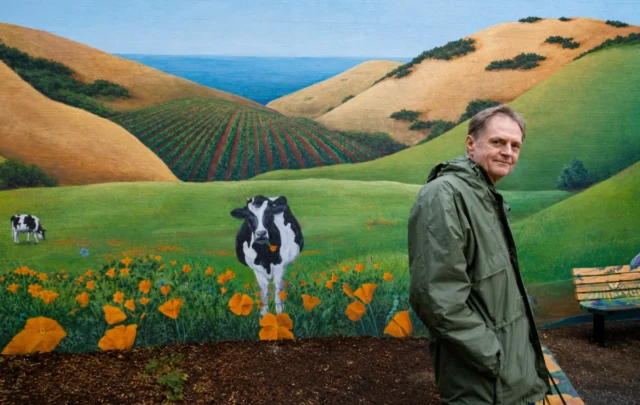
Thomas Berry at the Wellspring Retirement Center on April 9. – Joseph Rodriguez
“He’s never made me feel like a student,” Toben said. “He’s always asking questions like we’re on some equal ground.”
Berry was born in 1914 in Greensboro, one of 13 children, five of whom are still alive and reside in Greensboro and Charlotte. In 1970, he founded the Riverdale Center for Religious Research in Riverdale, N.Y., where he developed his thinking on the relationship of humans to the natural world.
His ideas are heavily influenced by childhood nature experiences, Asian and indigenous religious traditions, French philosopher Pierre Teilhard de Chardin , and modern evolutionary theory. He moved back to Greensboro in 1995.
Berry’s most recognized works include “The Dream of the Earth” and “The Universe Story: From the Primordial Flaring Forth to the Ecozoic Era,” co-written with mathematical cosmologist Brian Swimme . He wrote his latest two books in Greensboro: “The Great Work: Our Way Into the Future” and “Evening Thoughts: Reflecting on Earth as Sacred Community.”
Due out this fall are two collections of essays: “The Sacred Universe: Earth, Spirituality, and Religion in the 21st Century” and “Christian Future and the Fate of Earth.”
Margaret Berry, who manages her brother’s affairs, said she has a list of 500 of his friends, associates and inspired organizations all over the world.
Learn more about Berry at www.thomasberry.org or www.earth-community.org.
MORE ONLINE
Video: Thomas Berry and Timberlake Farm
Related audio for this article
Gallery: Center for Education, Imagination and the Natural World
The relevance of Berry
Imagine an America where the trees in your backyard have legal rights, urban dwellers travel mostly by foot or bicycle, and people meet for religious worship outdoors as often as indoors.
Imagine a world with no landfills, a world with “living” buildings and food gardens on every neighborhood block.
That, in a small way, helps illustrate Berry’s “Ecozoic Era.”
Berry wrote in his seminal 1999 book “The Great Work” that humans must conceive new politics, economics, religious teachings and ways of educating:
“Our own special role, which we will hand on to our children, is that of managing the arduous transition from the terminal Cenozoic to the emerging Ecozoic Era, the period when humans will be present to the planet as participating members of the comprehensive Earth community.”
Berry’s vision has special relevance today. Concerns about climate change, species loss, and depletion of natural resources have propelled the nearly 30-year-old sustainability movement into mainstream consciousness. Local cities — including Greensboro and Winston-Salem — as well as universities and corporations have hired sustainability managers to oversee initiatives such as implementing green building standards and encouraging people to drive less. And citizen groups, including the new Sustainable Greensboro and the established Piedmont Environmental Alliance, are working to reduce waste, promote sustainable agriculture and protect habitats.
Still, some fear these initiatives don’t go far enough.
“I think one of the most critical questions we can ask ourselves is, where are we?” said Herman Greene, president of the Center for Ecozoic Studies in Chapel Hill. “We are destroying the Earth and life systems but we’re not at the point where we’re making any significant changes.”
It starts with the children
Before the Earth Walk begins, Sandy Bisdee gathers a cluster of Sedalia Elementary fourth-graders in a circle to bless the journey. She instructs them to walk quietly on the trails of Timberlake Farm in Whitsett and listen to the natural world speak.
“We’re going to do something that children often don’t get to do,” Bisdee tells the children.
“Get exercise?” one student asks.
“Well, we’ll get exercise, but we’re going to practice silence today.”
Of course, being quiet is not something elementary students do well. But they master the most important parts of the hour-long trek, engaging all five senses as they collect rocks, track deer prints, marvel at baby ferns and tadpoles, and sniff lemon balm.
They taste wild onions, listen to the wind whistle through the trees and sympathize with a lightning-scarred hickory tree. Then the students stop at a special rock where they close their eyes and make a wish. One student asks for a million dollars; another, the return of her dead father; another, the health of the wounded tree.
“Our aim here is to offer this place where we have a deep understanding and love for the earth, in all its forms,” said Carolyn Toben, co-founder of the Center for Education, Imagination and the Natural World. “We want them to understand they are part of helping to create the future, to take care of things and love them.”
Long-term educators Toben and Peggy Whalen-Levitt, who began reading Berry’s writings in the late 1970s and ’80s, started the center in 2000 to help children establish an intimate connection with the natural world that they would carry with them through life. The two are also raising money to relocate the house Berry grew up in from the path of the Greensboro Urban Loop to Timberlake Farm, where the center is located.
Berry, Toben and Whalen-Levitt are not alone in their concern about children’s separation from nature.
Renowned children’s and nature advocate Richard Louv spoke to a crowd of about 300 people at Greensboro Montessori School last year about the need for children to experience regular, and unplanned, outdoor play. Louv called for a family-initiated nature movement not vulnerable to burned-out community volunteers or budget cuts.
“What if an idea like that could catch on like neighborhood watches and block parties did in past decades?” he asked.
Berry, who served with Louv as an adviser to the national Children and Nature Network, recalled how learning the names of trees during a Boy Scout trip shaped his thinking as a child:
“That was a great event in my life,” he said. “I learned what names mean and what the capacity to name something means. It’s the human dimension of life that establishes a world of experience. … So that’s how I came to have this tendency toward the natural world.”
One school in the Triad that benefits from work at Timberlake Farm is the Montessori School in Clemmons, which plans to build a nature preserve on its six-acre campus, in partnership with the Natural Learning Initiative at N.C. State.
Elizabeth Meadows, the school’s business manager, said the preserve will help make amends for the clear-cutting of cedar trees during the school’s construction, and it will better integrate the school into the surrounding neighborhood.
“It’s amazing to me that we have to teach our children to become comfortable outside or that we need to teach our staff to be comfortable,” Meadows said. “Hopefully this will become a safe area, not only for our adults but also for our children.”
A new way of life
For Greensboro residents Nelson and Elaine Stover, Berry’s work helps them understand the nature of social change, a subject the couple has studied since meeting in 1964. The couple read one of Berry’s books before moving to Greensboro and later became acquainted with two of Berry’s brothers before Thomas moved to the city in 1995.
The Stovers, members of the Unitarian Universalist Church in Jamestown, espouse a world view that sees each individual as co-creator of an emergent universe, rather than actors in a God-scripted global play.
“What I’m passionate about is figuring out how to market a new set of cultural understandings so that we can undergird new behaviors,” Nelson said. “What Elaine is good at is … how to organize communities. The problem is that stuff falls flat when people go back to a hierarchical universe, or consumer mentality or they start to treat the trees like potential chairs. Or they end up looking for some other authority other than what their heart tells them about how to relate to the universe.”
Nelson compares Berry with Copernicus, a 16th-century astronomer who bucked conventional knowledge and proclaimed that the sun was the center of the universe. Only, Berry proclaims that the Earth and the universe are the primary referents for meaning, not the human.
The Stovers worked previously with the Institute of Cultural Affairs and lived overseas for 20 years. They lived at times without indoor plumbing or telephone, bathing with a water bucket in an Indian village and sleeping on a mat on a dirt floor.
The couple moved to Greensboro from Belgium in the early 1990s with 26 boxes and no debts, children or property. They later settled into a two-bedroom home and created a Berry-inspired outdoor trail that teaches visitors about the unfolding of the universe.
Elaine Stover, a human ecologist, formerly served as chairwoman of Greensboro Beautiful. Nelson, a computer consultant, joined Environmental Stewardship Greensboro, a 2-year-old interfaith organization. Several churches have participated in six-week studies of “The Great Work” that Nelson created.
A new spirituality
Elon University professor Andrew Angyal believes the advent of a sustainable age won’t happen without mainstream religious leadership. Angyal met Berry at Timberlake Farm several years ago and incorporates his ideas in his environmental studies courses at the university.
“If it doesn’t enter the church and doesn’t become part of our Christian awareness, then I think it’s not going to happen,” said Angyal, a liberal-progressive Catholic. “People have got to embrace earth stewardship as part of their Judeo-Christian obligation, their religious obligation. Otherwise it’s just going to be a fringe movement.”
But Berry sees the social transformation as inevitable. “It will go forth anyway,” he said. “There’s no doubt about the future except there will undoubtedly be a Christian aspect to it as well as other aspects.”
In the meantime, Angyal and others do their part to usher in a new era. Angyal operates an organic garden, vineyard and orchard at his house in Gibsonville and heats water with solar energy.
Herman Greene, an ordained minister and former Wall Street attorney who met Berry in 1982, started an earth ministry at Binkley Memorial Baptist Church in Chapel Hill. He consults for the Center for Earth Jurisprudence in Florida and advises environmentally progressive companies.
“My purpose is to enable new enterprises to go forward that will make a big difference,” he said.
And Carolyn Toben’s son Tim, also inspired by Berry, is a developer of a mixed-use housing project in Chapel Hill that bears the design of renowned “Cradle to Cradle” architect William McDonough. The project will feature roofs that grow plants, solar hot water and rainwater collection systems.
Cultural change occurs, Nelson Stover said, when enough people can translate vision and theory into lifestyle. That has now happened, he said, and an increasing number of people live a new reality.
A fortunate few still talk about that new reality during visits with Berry. They soak in his words of wisdom, even though his memory loss and physical frailty keep those conversations short.
“I’m not able to read, I’m not able to walk,” Berry said, apologizing for his limitations during a recent visit with Carolyn Toben. “I’m not able to do things that humans generally are able to do.”
To which Toben replied: “You just sit there and inspire. That’s what you do.”
Contact journalist Morgan Josey Glover at [email protected]
Want to help?
The Center for Education, Imagination and the Natural World is raising funds to preserve Thomas Berry’s Greensboro house and relocate it to Timberlake Farm in Whitsett. Find out how to donate by calling (336) 449-0612 or visiting https://beholdnature.org.
Nelson and Elaine Stover host Berry-inspired workshops and presentations throughout the year, with the next event on May 9. Call 605-0143 or visit www.greenschemesnc.com/education.html for more information.