Click on the headline (link) for the full text.
Many more articles are available through the Energy Bulletin homepage
The End Is Near! (Yay!) (NY TImes on the Transition Movement)
Jon Mooallem, New York Times Magazine
… The Sandpoint Transition Initiative, a new chapter of a growing, worldwide environmental movement, was officially coming to life.
The Transition movement was started four years ago by Rob Hopkins, a young British instructor of ecological design. Transition shares certain principles with environmentalism, but its vision is deeper — and more radical — than mere greenness or sustainability. “Sustainability,” Hopkins recently told me, “is about reducing the impacts of what comes out of the tailpipe of industrial society.” But that assumes our industrial society will keep running. By contrast, Hopkins said, Transition is about “building resiliency” — putting new systems in place to make a given community as self-sufficient as possible, bracing it to withstand the shocks that will come as oil grows astronomically expensive, climate change intensifies and, maybe sooner than we think, industrial society frays or collapses entirely. For a generation, the environmental movement has told us to change our lifestyles to avoid catastrophic consequences. Transition tells us those consequences are now irreversibly switching on; we need to revolutionize our lives if we want to survive.
(16 April 2009)
Long article about the Transition Movement with on-the-spot reporting from Sandpoint Idaho Transition. One of the best pieces written about it in the mainstream press. -BA
Why we forgot how to grow food
John-Paul Flintoff, Sunday Times (UK)
As a food shortage looms, people are digging for Britain — and their dinner table. John-Paul Flintoff gets back to our roots
—
… About 40% of the food we eat is imported. That includes an astounding 95% of our fruit and most of the wheat in our bread. This reliance on goods from abroad is perilous. During the 2000 fuel strike, Sainsbury’s chief executive wrote to the prime minister to warn that food supplies would run out “in days rather than weeks”. Supermarkets rationed bread, sugar and milk. The situation is now arguably worse: world food reserves are at historically low levels, and last year several countries stopped exporting staples because their own populations were going hungry.
If the problems were only temporary, it would be bad enough. But they’re not. We have become dependent on fossil fuels that are starting to run out. Taking account of all the oil- and gas-derived fertilisers, pesticides, distribution and retail practices, our modern farming uses an incredibly wasteful 10 calories of energy to put a single calorie of food on your plate.
Reverting to old-fashioned farming will be hard because our soil is in poor shape. Fertility has come to rely on annual, chemical top-ups instead of the traditional long-term build-up using animal manure and crop rotation. Suddenly taking away all the artificial fertilisers will result in drastically lower yields. And if we’re to feed ourselves, we can’t afford lower yields — because the UK is more densely populated than China, Pakistan or any African country except Rwanda.
Meanwhile, levels of minerals such as phosphate, which plants need for healthy growth, are falling fast. Global supplies have peaked, and last year phosphate prices rose by 700%. Britain imports 80% of its phosphates. The only alter-native is to return all food waste and animal and human manure to the land, instead of flushing it to sea.
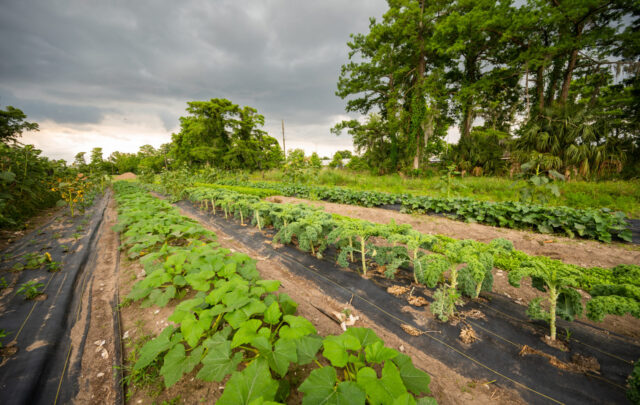
… Back home, inspired by the Guerrilla Gardening movement to grow beans on a patch of scrubby land beyond the end of my garden, I stare across at the vast gardens of the neighbouring care home, and notice — not for the first time — just how big and bare they are. Then I look down the road and notice that one of my neighbours, five doors down, has likewise been cultivating the wasteland. I knock on his door, we get chatting, and in no time he’s touring the gardens of the care home with me. A few days later, I ask a family with girls about the same age as my own daughter. They visit the site too.
I set up a neighbourhood project on an online food-growing network and soon my neighbours sign up. I decide to ask them over for drinks. We’ll watch the first episode of The Good Life, then The Power of Community. In a few weeks time we will have achieved nearly as much here as Belsize, down the road, achieved all last year. After that, who knows, we might set up our own veg-box scheme…
But I shouldn’t get carried away. In The Transition Handbook, published last year and already reprinted several times, Rob Hopkins offers what he calls a “cheerful disclaimer”: “Just in case you were under the impression that Transition is a process defined by people who have all the answers, you need to be aware of a key fact. We truly don’t know if this will work.
(19 April 2009)
Homer-Dixon: A doomsayer, and a father, with a heart of faint hope
Cathal Kelly, The Star (Canada)
… The marquee hire of the University of Waterloo’s Balsillie School of International Affairs last year, Homer-Dixon has built a career by warning us about the worst parts of our own natures. Our violence, our capacity for self-delusion, our destructive greed. All of it adds up to a planet spinning toward environmental and energy crises of Hollywood blockbuster proportions. Few writers tie the dispiriting facts together as compellingly as Homer-Dixon.
It has earned him a reputation for gloominess, one that friends are at pains to dispel.
“The bearers of bad news aren’t often welcome at parties,” says David Welch, his colleague at the Trudeau Centre for Peace and Conflict Studies at the University of Toronto.
Nonetheless, Homer-Dixon sticks steadfastly to a grim optimism that, as yet, has little concreteness about it. His newly published third book aimed at a general audience – a collection of essays called Carbon Shift, edited by him with Nick Garrison – is yet another designed to scare us sensible. But Homer Dixon says he can’t bring himself to consider worst-case scenarios.
Today, the angular 52-year-old academic just looks beat. He’s wearing the leisure suit of the creative class – work shirt, khakis, Birkenstocks over thick woollen socks. He leans back in his chair and stares glassy-eyed out over his backyard in Fergus, Ont., a short drive north of Guelph.
“The people who know about this stuff – the real experts – the more they know, the less optimistic they are,” Homer-Dixon says. “What should we do? Most of us can’t face it. We divide our brains up into compartments. That may be what I do.”
… His latest book, which consists of six essays by other writers sandwiched between an introduction and conclusion by Homer-Dixon and Garrison, highlights the two freight trains headed toward our species. The first is climate change. The other is fossil-fuel depletion. The conclusions are more downbeat than anything Homer Dixon has written before, ending with a vision of future generations looking back at us with scorn.
(19 April 2009)
Are There Demand Limits to Growth?
Nate Hagens, The Oil Drum: Campfire
On this site we typically discuss the extent and timing of our energy supply limits, (as well as planetary sink capacities and non-energy input limits). Less common are discussions on our ends, and whether our current trajectory is mentally sustainable irrespective of resource shortages on the horizon. Tonights Campfire questions will relate to demand limits to growth in the hypothetical situation of unlimited resources. Perhaps from a perspective of infinite abundance we might gain insight on how best to address resource shortages.
The genesis for this post was news this week that Twitter and Facebook could affect peoples morality due to the speed at which our brains process events that historically required time to reflect on and absorb. Also this week, a friend had sent me the article Is Google Making Us Stupid? I have written previously how our brains are increasingly being hijacked by a larger and larger smorgasbord of stimuli in our modern worlds. We quickly habituate to a certain stimulation level and then need higher or different stimuli to obtain the same neurotransmitter ‘feeling’. Eventually, addicts reach a point where they require said ‘drug’ just to feel normal. The step beyond this is when even the drug doesn’t get them back to baseline, and they experience ‘anhedonia’, or the inability to feel pleasure.
(19 April 2009)
Why Isn’t the Brain Green?
Jon Gertner, New York Times Magazine
… Over the past few decades a great deal of research has addressed how we make decisions in financial settings or when confronted with choices having to do with health care and consumer products. A few years ago, a Columbia psychology professor named David H. Krantz teamed up with Elke Weber — who holds a chair at Columbia’s business school as well as an appointment in the school’s psychology department — to assemble an interdisciplinary group of economists, psychologists and anthropologists from around the world who would examine decision-making related to environmental issues. Aided by a $6 million grant from the National Science Foundation, CRED has the primary objective of studying how perceptions of risk and uncertainty shape our responses to climate change and other weather phenomena like hurricanes and droughts. The goal, in other words, isn’t so much to explore theories about how people relate to nature, which has been a longtime pursuit of some environmental psychologists and even academics like the Harvard biologist E. O. Wilson. Rather, it is to finance laboratory and field experiments in North America, South America, Europe and Africa and then place the findings within an environmental context.
(16 April 2009)
Long article