


Click on the headline (link) for the full text.
Many more articles are available through the Energy Bulletin homepage
World May Be Facing Highest Grain Prices in History
Lester Brown, ENN
Investment in fuel ethanol distilleries has soared since the late-2005 oil price hikes, but data collection in this fast-changing sector has fallen behind. Because of inadequate data collection on the number of new plants under construction, the quantity of grain that will be needed for fuel ethanol distilleries has been vastly understated. Farmers, feeders, food processors, ethanol investors, and grain-importing countries are basing decisions on incomplete data.
The U.S. Department of Agriculture (USDA) projects that distilleries will require only 60 million tons of corn from the 2008 harvest. But here at the Earth Policy Institute (EPI), we estimate that distilleries will need 139 million tons—more than twice as much. If the EPI estimate is at all close to the mark, the emerging competition between cars and people for grain will likely drive world grain prices to levels never seen before. The key questions are: How high will grain prices rise? When will the crunch come? And what will be the worldwide effect of rising food prices?
One reason for the low USDA projection is that it was released in February 2006, well before the effect of surging oil prices on investment in fuel ethanol distilleries was fully apparent. Beyond this, USDA relies heavily on the Renewable Fuels Association (RFA), a trade group, for data on ethanol distilleries under construction, but the RFA data have lagged behind movement in the industry.
(5 Jan 2007)
Staggering figures. -AF
Era Of Cheap World Food Ending
Lisa Kallal, Dow Jones via Cattle Network
The era of cheap global food supplies is drawing to an close, according to Peter Kendall, president of the National Farmers Union for England and Wales.
Addressing the Oxford Farming Conference Wednesday, Kendall said agriculture will be more greatly valued due to world population growth, biofuel demand driven by energy security concerns and climate change.
“We will need to double our world agricultural production by 2050,“ Kendall said.
He said the world’s population is expected to increase about 3 billion people by 2050. In addition, expanding economies of Asia will meaning changing dietary habits.
David Miliband, U.K. Secretary of State for Environmental, Food and Rural Affairs also told the conference that demand for global meat and milk production will more than double to 465 million tons and 1,043 million tons, respectively.
Kendall added that because of awareness of energy security, more of the world’s agricultural giants such as the U.S. and Brazil are using foodstuffs to produce biofuel.
(5 Jan 2007)
Hard to swallow
Jonathon Porritt, The Guardian
New research indicates that gas-guzzling cars are a much less important factor in climate change than the huge amounts of food devoured by carnivorous ‘burger man’. Jonathon Porritt on the geopolitics of food
~~
Of all the seasonal homilies about “green” Christmases and “sustainable” new year pledges – an oxymoron if ever I’ve heard one – only one stuck in my mind: each of us could make a bigger contribution to reducing emissions of greenhouse gases by becoming a vegan than by converting to an eco-friendly car.
Researchers at the University of Chicago have calculated the relative carbon intensity of a standard vegan diet in comparison to a US-style carnivorous diet, all the way through from production to processing to distribution to cooking and consumption. An average burger man (that is, not the outsize variety) emits the equivalent of 1.5 tonnes more CO2 every year than the standard vegan. By comparison, were you to trade in your conventional gas-guzzler for a state of the art Prius hybrid, your CO2 savings would amount to little more than one tonne per year.
This may come as a bit of a shock to climate change campaigners. “Stop eating meat” is unlikely to be the favourite slogan of the new Stop Climate Chaos coalition. Even “eat less meat” might not go down too well, even though Compassion in World Farming has produced an utterly compelling explanation – in their report, Global Benefits of Eating Less Meat – of why this really is the way forward.
(5 Jan 2007)
Excellent to see the connection between food and climate change talked about. As a simple rule eating less meat is a good one, but ultimately we need to do much more. (While in some uncommon circumstances eating hunted or fodder fed meat would actually be preferable to industrially produced or imported grain. See for instance The Oil We Eat by Richard Manning.) Ultimately a return to low energy home and other local production, with minimum processing offers the most robust strategy. -AF
An Inconvenient Truth: We Are Eating Our Planet to Death
Choosing a Plant-food Based Diet Is a Moral Issue
John McDougall, MD; The McDougall Newsletter
Have you felt helpless as the earth warms? As followers of the McDougall Diet, we have the power to cause hard-fought changes that will slow global warming. And it is not too late. Our success hangs upon whether or not we can convince very large numbers of people to make the morally responsible decision to follow a plant-food based diet. You and I, who already live on oatmeal, pasta salads, and bean burritos, have had eating experiences which allow us to see the world differently. Our friends, family, and co-workers haven’t a clue-they cannot imagine life without beefsteak, fried chicken, and cheese. So, the opportunity is ours to take.
According to the 2006 UN report, global production of meat and milk will more than double by 2050. We cannot let this happen. Our planet is already being devastated. Long-overdue changes based on the truth could halve livestock usage by 2015
Buying a hybrid car and switching to energy efficient light bulbs are important, but these actions pale in consequence compared to the effects we can get by causing planet-wide, dietary changes. Present levels of meat- and dairy-eating may become synonymous with death to our civilization. We stand on a precipice-the planet is ours to save.
(Dec 2006)
Dr. McDougall is right about the problem with rising levels of meat consumption — even if one isn’t a vegetarian, one can agree with that. -BA
PAY DIRT: Fighting global warming with a ‘dirty’ strategy
Sylvia Wright, UC Davis
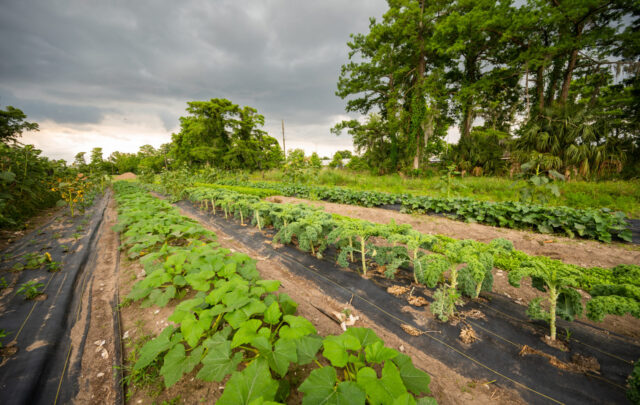
In the endless fields of California’s Central Valley, the sun rises and sets on tractors moving dirt. The rumbling diesel machines crumble the soil to make it penetrable by fertilizers, pesticides and plant roots. They pile up seedbeds and dig irrigation furrows. They weed out unwanted competitors, harvest finished crops, and rake up leftover stalks, stems, leaves and straw.
On some farms, however, growers are giving their tractors, and their soil, a rest. Slowly adopting a new regimen of farming operations called conservation tillage, they are learning that making fewer tractor passes can increase profits, keep the land productive and help them meet new environmental regulations. What’s more, say UC Davis agricultural and environmental scientists, it may help slow climate change.
Conservation tillage reduces the amount of greenhouse gases in the Earth’s atmosphere two ways — by burning less fossil fuel and by sequestering carbon in soil. Carbon, nitrous oxide and methane form an unholy trinity: They are the three major greenhouse gases in Earth’s atmosphere. Climate scientists have talked for decades about reducing warming by socking away carbon atoms in soil or other long-term storage banks, such as trees, oceans, aquifers and even (ironically) depleted underground oil and gas fields. They focus on carbon because, although carbon dioxide traps the least heat of the three gases, it is the only one with great potential for being collected from the air and held benignly in some sort of sink.
Johan Six, a UC Davis assistant professor of plant sciences, cites the work of Ohio State University Professor Rattan Lal, who says that 80–200 million metric tons of carbon per year could be hoovered out of the sky through a variety of changes in the way American farmers work their land. (Lal estimates total U.S. carbon emissions total about 1,900 million metric tons per year.)
(20 Jan 2006)
So the food system is both one of the primary contributors to climate change, but could potentially help to remediate it. See also Allan Yeoman’s Priority One: Together we can beat global warming for a take on how intelligent farm design and ‘keyline’ plowing techniques can build the soil’s carbon holding capacity. -AF



Comments
Welcome to the new Resillience commenting system!
We have moved from the former Disqus commenting system to a new system as of September 10, 2026.
We made this change because of privacy concerns regarding Disqus. It's also part of a set of changes to bring more services to the Resilience community under a single login: commenting, (coming September 2026), and online courses (coming 2027). Unfortunately, your old Disqus comments may not reliably link to your account in this new system. Please contact us if you have any questions or concerns.