In this post, I want to compare the amount of global cereal production going to biofuels, with the amount going to animal feed (the animals in turn are mainly eaten by humans as meat, dairy products, etc). I found the data through 2007 at the FAO here. The restriction to 2007 is a bit unfortunate, as that was only part way through the recent big expansion of biofuels. Here’s the data on that through 2009:
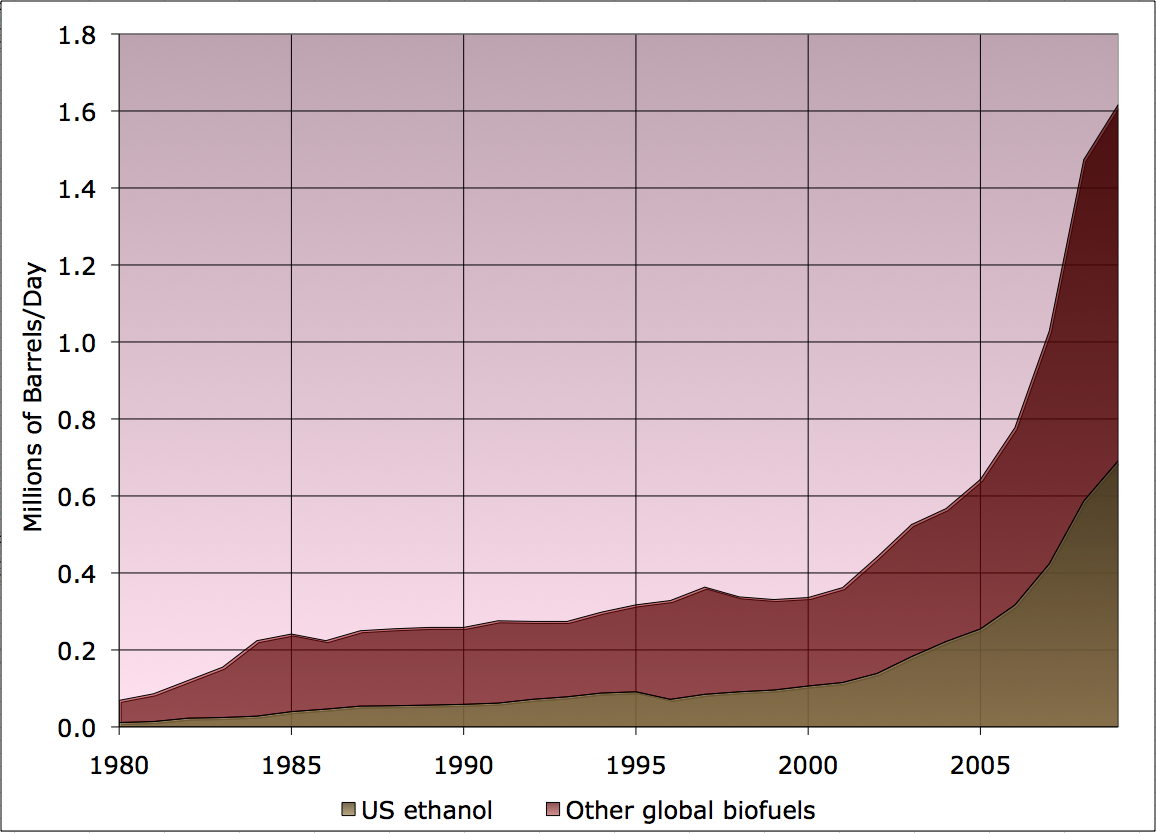
So just bear in mind as you look at these next graphs that biofuel production has expanded by about 2/3 again since 2007. Anyway, to the FAO estimates for total cereal production and feed consumption, I added my estimates from the other day of total cereal equivalent of biofuels, and I got this graph:

Firstly, note that total global cereal production was a little over 2 billion tonnes in 2007 (a number worth remembering in the same way that we know global fuel production is somewhere in the range 85-90mbd). The biofuel wedge is small, but rapidly growing. By comparison, the amount of cereal going to feed is much larger, but growing more slowly.
In fact, if we look at feed and biofuel as a fraction of total cereal production, it looks like this:
Here you can see that the fraction of cereal used for animal production peaked in the early 1970s and seems to have been gradually dropping ever since (probably a good thing for the health of the global citizenry). Biofuels, by contrast, were static as a fraction of cereal production at around 3% in the late eighties and nineties, but have jumped in the last decade, probably to around 10% of global cereal production by now. I think it’s this sudden growth of biofuels that is the main shock to the global food system that has led to a reversal of the decades long fall in prices, and in fact price spikes in the last five years.
Still, it’s worth observing that if people ate a lot less animal products, the global food supply would go a lot further (a point made decades ago by Francis Moore Lappe).