

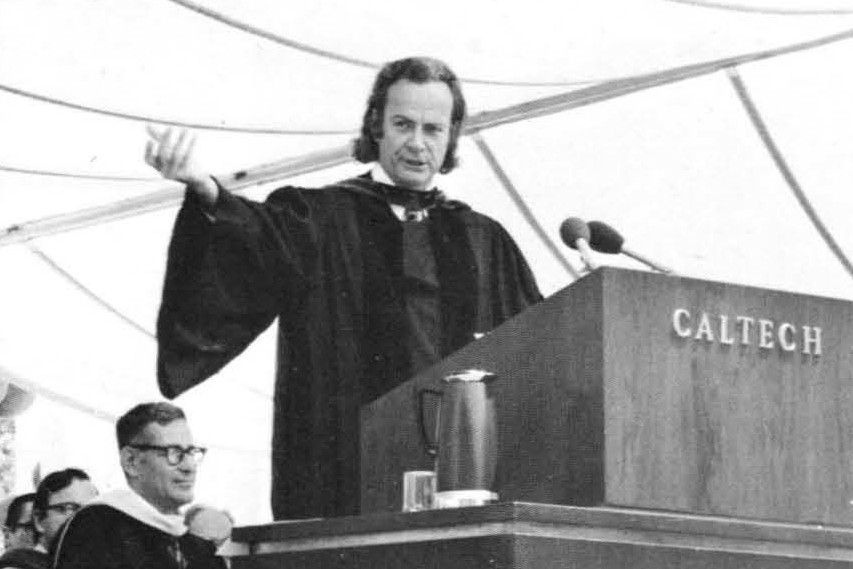
On the second page of the first volume of Richard Feynman’s famous Lectures on Physics (Lecture 1, Section 2), we find the paragraph:
If, in some cataclysm, all of scientific knowledge were to be destroyed, and only one sentence passed on to the next generation of creatures, what statement would contain the most information in the fewest words? I believe it is the atomic hypothesis (or the atomic fact, or whatever you want to call it) that all things are made of atoms—little particles that move around in perpetual motion, attracting each other when they are a little distance apart, but repelling upon being squeezed into one another. In that one sentence, you will see, there is an enormous amount of information about the world, if just a little imagination and thinking are applied.
That sentence exposes another type of sentence: a sort-of prison sentence Feynman was serving—as most of us are—confining us to our cells within modernity. In the Epilogue to my energy textbook, I raised this point and suggested an alternative along the lines of “Treat nature at least as well as we treat ourselves.” It’s sort of a golden rule that extends beyond the usual boundaries of human supremacy. Today I would go further.
As for Feynman, let’s take a look at how one of the broadest thinkers in physics can still be held captive in a narrow rut.
On Feynman
I never knew Richard Feynman personally. He died five years before I reached Caltech. But I can tell you that anecdotes of interactions still rattled about now and again. One that stands out is from my graduate co-advisor (with Tom Soifer), Gerry Neugebauer (hard-G; now also deceased, sadly), who pioneered infrared astronomy as a crackerjack instrument builder and damned-fine scientist. I have nothing but admiration for Gerry, and learned tons from him about all aspects of being a careful scientist, a clearer writer, and a genuine person. He was also a renegade against stuffy authority.
When Feynman taught the undergraduate physics series—from which the published lecture series derived—a team of assistant professors lived up to their title and assisted in the execution of the course. Gerry reports that Feynman was undeniably luminous, and that interactions with him consistently delivered a great deal of insight. But he could also be a bit of a condescending jerk. Gerry was a lowly knuckle-dragging instrument-builder. When Gerry was doggedly trying to grasp some deep principle, Feynman would sigh: “Let’s see. How can I put this such that someone such as yourself might begin to understand?” This is directed to a professor of physics at Caltech, remember. Of course being a mature and well-adjusted adult, Gerry absorbed the treatment without grudge or animosity: it was about the job at hand, not personal grievance.
But we give Feynman some license, because what he produced was like gold. He had a knack for penetrating the essence of a phenomenon and breaking free of old traps that had stymied understanding. He was not bashful about admitting the limits to his (or especially our) knowledge, which is an admirable trait in someone as insightful as himself. He was a fascinating blend of hubris and humility.
Feynman was remarkably broad in his interests and manner of thinking. He always seemed to operate a level or two “above” others, which allowed new connections to be made. He was about as close as it gets to a guru on the mountaintop who could comment meaningfully on just about anything (relating to physics).
An aside, while on the subject of Feynman and his Lectures… Many aspiring theorists hold Feynman as a role model, and I even knew one grad student who seemed desperate to emulate his famous antics. I was more of a Bob Leighton guy. Who the hell is Leighton? Check the cover of the Feynman Lectures: Feynman, Leighton, and Sands. I (once) strove to be in the Leighton (and Neugebauer) mold. But I never worked very hard at emulation or studying others’ routes to success. I just let whatever path unfold before me—which it will always do.
Limits to Breadth
As broad a thinker as Feynman was, nothing in his body of work suggests operation outside the penitentiary of modernity. Indeed, his suggested sentence for transmittal to the future in the event of civilizational failure unambiguously indicates that his values and loyalties rested on modernity and modern science. His apparent goal was to jog humans “back on track” in case some misstep put us off the divine path. My stance was similar when I began this blog in 2011. I did not deem the “track” to be a disastrous and temporary departure from a much older and ecologically proven way of being.
But we can’t really fault Feynman. Like most people, he was entrained in the exhilarating current of modernity, riding the top of a wave at impressive speed. He had a clear path to make big strides and found copious reward in doing so. Hey, if you’ve got it, flaunt it—right?
Feynman (born 1918, died 1988) witnessed loads of exciting—and terrifying—developments in his lifetime. The pace of change was so great as to push concern over hypothetical consequences well off the margins. When the upsides get all the attention; when developments come at a fast-and-furious rate so that it seems pointless to muse about the future; when the costs have not yet become apparent; and when continuing the frenetic pace seems like the surest way to utopia, then of course the sensible reaction is to buckle down and contribute to the thrill ride.
I would say most present-day humans—and especially older generations—still inhabit this thought cage. Since no one 200 years ago could possibly have predicted the technological developments in store, we must humbly accept similar ignorance about the fantastic future—the thinking goes. It’s sloppy; presumptuous. Is the proposal that this will always be true? Is it an unlimited prospect? Will the equivalent of the fossil fuel windfall keep arising every few generations without end and without consequence?
Inside brains—where imaginations may not be limber enough to conceive/admit reversals of “fortune”—the answers to these questions can be a resounding “Yes!” But that means nothing to the actual universe in which we flow. A close cousin to the gambler’s fallacy is the fallacy that a streak is fated to continue because it hasn’t broken recently. The ubiquitous ecological ignorance of modern culture sure helps support this fantasy! It’s so much easier to fall victim to this expression of faith if lacking crucial context. The logic seems solid enough in isolation. Who needs messy context?
Sentencing
When I wrote the Epilogue to my textbook in 2021, I was partway along my journey of falling out of love with modernity. I was beginning to recognize the ugliness of human supremacy, and beginning to acquire greater awareness of matters of ecology and anthropology. My suggestion that we “Treat nature at least as well as we treat ourselves” was a foray into a new sense of wholeness and togetherness: that we share a bound experience with the Community of Life on this planet. However, the wording still carries echoes of a dualist dichotomy separating ourselves from “nature.” I would not today suggest the same sentence—although I still think it represents an important break from the “atoms” transmission.
What would I offer today? I suppose it may have been better if I had started drafting this post with something concrete in mind. Alas, I’m not that “together.” Instead, I’ll try to knock something up on the fly. Perhaps a phrase we already know and use hits close to the mark: “You can’t fool Mother Nature.” Others, inspired by Daniel Quinn, might be “Learn, all over again, to live in the hands of the gods” or “Humans were made for this world: not the reverse.”
I guess the most effort I have put into this direction was in writing the fictional story The Big Question (which has subsequently been published in the Winter 2026 issue of New Maps). While reasonably compact, it doesn’t tuck into a single sentence:
Humans would fare the best, maximize happiness, satisfaction, and longevity of their species by recognizing their forgotten ecological context and moving toward fully-integrated reciprocal, respectful relationships with the Community of Life and the more-than-human, biodiverse world of Evolved Life. Messing about with intensive agriculture, high technology, metals, and artificial intelligence is a devastating path that leads to a sixth mass extinction—including, of course, the termination of humans themselves. Humans are social beings who are happiest in medium-sized autonomous groups working together toward a common goal, wrapped in unconditional support and in pursuit of tasks that have direct [immediate] meaning to their livelihoods.




Comments