

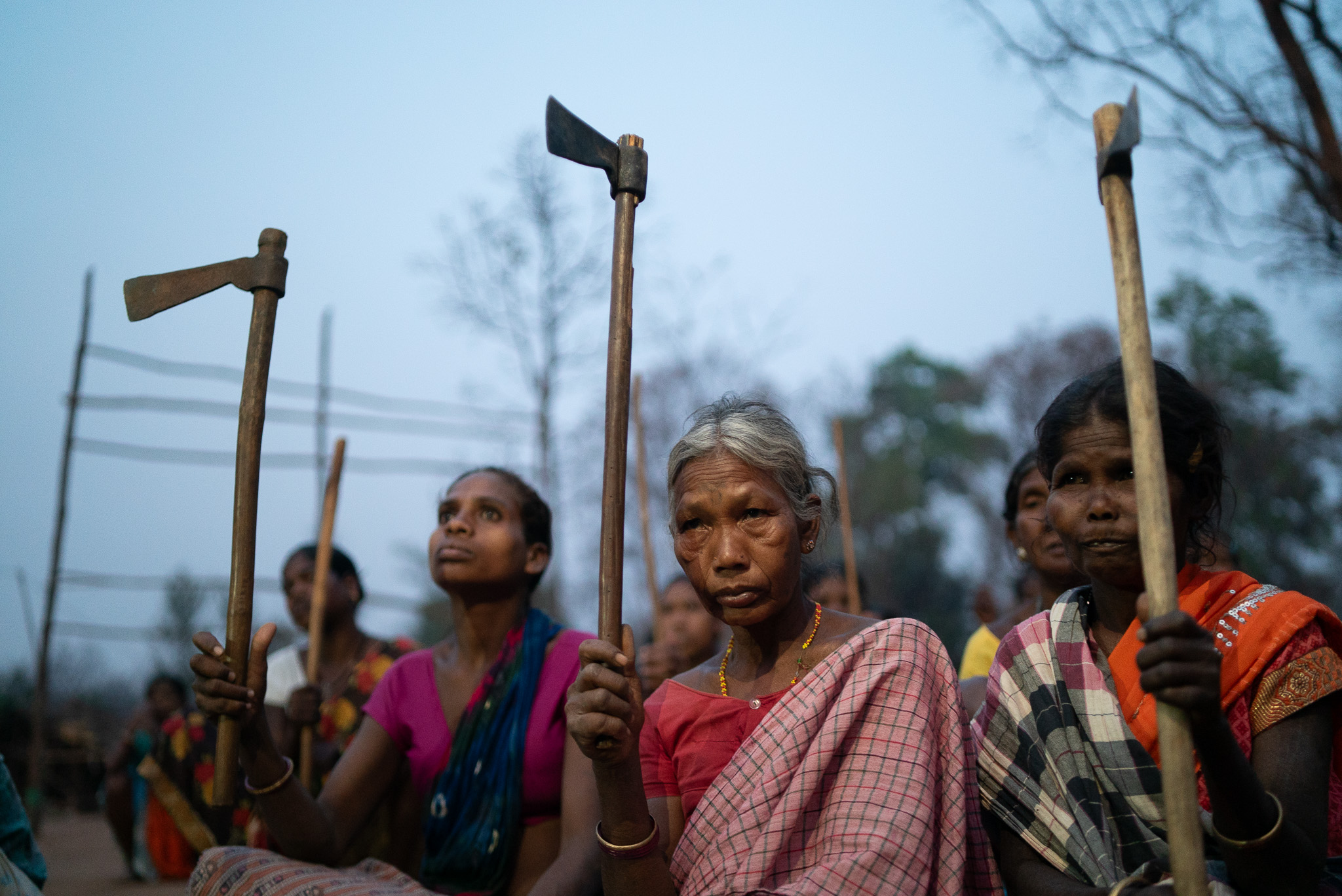
Indigenous rights protest in India. Adivasi women from India’s central state protest against illegal mining and unlawful detention in the region. (Photo: Bhumika Saraswati/Creative Commons)
In light of the planetary polycrisis, it is time to challenge the dominant strand of Western thought that asserts only humans possess rights and that other species exist solely for human benefit. In their contribution to the Deep Democracy series, Shrishtee Bajpai and Ashish Kothari propose an Earth-centered form of governance. This form of democratic self-organization is based on the idea that all species and nature as a whole have rights.
“We sit around the fire and listen to stories. I come from Tharaka – the land of bees. Bees are very wise. Bees know how to select plants. Bees came from the sea and from the deep waters. There is a way we came to the land of bees. Our clans are from animals and our relatives are snakes, elephants, monkeys and trees. They are with us when we make decisions,” says Simon Mitambo, from the Tharaka community in Kenya.
For Simon and his community, along with several other indigenous peoples and other local communities across the world, this points to a deeper, wiser, more life-affirming notion of democracy than the one currently prevalent across the planet. It embeds a notion of earthy governance – a form of decision-making that is not centered on humans alone, but encompasses also the rest of nature.
“We are responsible for our self governance and we need to ensure that all are equally heard including the rest of nature. We can’t have that in a panchayat (elected village council) where everything is motivated through party politics,” says Tsewang Gyalson Lachungpa. He is an elder from Lachung, a village nestled in the eastern Himalayas in India’s state of Sikkim, near the border with Tibet. The village sits at an elevation of about 3,000 meters above sea level at the confluence of the Lachung Chu and Lachen Chu rivers.
Problems of liberal democracy
In making this statement, Tsewang Gyalson highlights the problems of modern day representative or liberal democracy. Such a model of governance relies heavily on elections and party politics, encourages hostility amongst sections of citizenry, favors those with lots of financial and other resources to put into campaigning (who then have to ‘recover’ what they spend through oft-dubious means), and usually ends up centering power in the hands of a few people.
As people like Murray Bookchin and Abdullah Öcalan have highlighted, the nation-state model sustains itself on the logic that nature – and colonized peoples – are things to be conquered, assimilated, dominated, and exploited. This logic was further supported through the capitalist and extractive modernity by asserting that the only way to organize lives is that of a centralized government that could help reach ‘welfare’ to the ‘masses.’ This has been used as a justification for taking over territories of Indigenous peoples and local communities for nationalist goals like ‘development’ and security.
So when someone like Gyalson says “We don’t want to tunnel our ecosystems. We don’t want to dam our rivers. All we have is our rivers, mountains and forests. If we destroy them, we can’t survive. We will be destroyed too” – his worldview comes in direct clash with the dominant, extractive worldview that views nature as a commodity to be destroyed in the pursuit of ‘progress’ (in its modernist, restricted Western sense of increasing material and financial prosperity).
Democratic decentralization
Mohandas (Mahatma) Gandhi and Rabindranath Tagore stressed a lot on the need of Swaraj (self-rule) as a form of democratic decentralization which was a true form of independence. It was not only a political struggle but also a spiritual, economic and ecological struggle.
David Graeber and David Wengrow in their book, The Dawn of Everything, describe how Indigenous peoples across Turtle Island and Abya Yala (the Americas) show remarkable imagination of organizing and governing societies beyond the nation-state logic. What we in this essay demonstrate is that these alternatives continue to be built and nurtured by several communities in India and the rest of the world.
These offer interesting lessons on how democracy and governance can truly look like. We do this following the approach of not idealizing local communities (given especially that many of them have gender and other inequities) but rather highlighting the experimentation, imagination, ecological wisdom and joy, as well as mastery of the ‘art of not being governed.’
Alternatives to liberal, anthropocentric democracy
The fact that we do not have to be stuck with liberal democracy, if we are looking for truly participatory forms of governance, was demonstrated in narrative after narrative told to a gathering of Indigenous peoples, local communities, and civil society movements from over 20 countries, in South Africa, in February 2025.
This Global Confluence on Radical Democracy, Autonomy and Self-determination was organized by the Global Tapestry of Alternatives, Academy of Democratic Modernity, Jineoloji Academy, WoMin, and the Amadiba Crisis Committee. It provided an opportunity for communities to present their concept and practice of radical democracy, with an attempt to widely distribute power for decision-making. They discussed how their foundations were not based on hegemonic power and profits, but rather on justice, equity, and respect among peoples and with the rest of nature.
The host community, the Amadiba people of Xolobeni, gave a glimpse of how their governance works. While it has its structural hierarchies from local sub-chiefs to the king, in practice people have considerable power to take and influence decisions. Political or traditional ‘leaders’ who have tried to align with exploitative outside forces (such as mining companies), have been deposed. For various historical reasons, women have considerably greater say than is the case in many other communities in South Africa. A crucial basis of autonomy here is that all land is held in the commons, and is not privatized.
Several other such examples were presented at the Confluence: the Kuna Indigenous peoples in Panama, the Lachung people in Sikkim, India, the Karen in Burma-Myanmar, the Kurdish in central Asia (especially in Rojava, Syria), the Tharaka community in Kenya, the Sarayaku people in Ecuador, the Tao and other Indigenous peoples in Taiwan, among others. Though not present, the example of the Zapatista autonomous region in Mexico was oft-cited.
In all of these cases, people are not accepting the domination of national governments, nor of capitalist corporations, but are asserting their own systems of governance. But they also realize that there are internal inequities and conflicts (gender-based, ethnic, etc) in their communities, so a crucial part of their initiatives is to enable greater voice for the marginalized sections, and create conditions of greater equality and equity.
Elements of earthy governance
At the core of earthy governance is an intrinsic wisdom, an ethical understanding that since human communities are part of nature, the more-than-human communities who are part of the web of life have to be integral to governance. Listening and following the ways or laws of rivers, mountains, forest deities, among others, the communities are asserting the way of being that is in rhythm and moods of the natural world. This is not just about adjusting to nature, but about recognizing that it is this web that threads life as a connective tissue. What is striking in all the examples mentioned above is the ability of the community to design systems that work in their own autonomous ways, and are based on collaborative design principles, responding to place and ecologically sensible. Several communities design their governance as Designs of Coherence, with a thorough, clear, and non-colonial or (if more recent) decolonial lens which intentionally builds systems that nurture local, enhance moral responsibility, internalize the costs and maintain collective restraint.
What’s interesting in several such examples is the role and nature of power. There is no homogenous way that power operates, but what we can see is that power is broadly rooted with care and on the ground. There is power, but is subordinated to feedback of actions from others in human communities, and from lands, mountains, rivers, and ecosystems that the communities inhabit. There is no authority without responsibility. The vision embedded in several of these practices is of building movement, and of struggling and striving for nature’s sovereignty over state sovereignty, by being custodians for territories of life including all creatures and all beings. It is this recognition that uniquely embodies people’s daily life, collective livelihood and seasonal production activities including their institutions. Ceremonies and rituals become part of restoring/regenerating these relationships continuously. Most of us in modern industrial and urban contexts have lost the relationality that nurtures humans and more than human connections. However, earthy governance can only thrive if this relationality becomes part of everyday living.
In radical democracy and earthy governance, institutions of decision-making have collective, democratic processes of deciding how to manage, use, and conserve the commons. The ethics of commons and custodianship is deeply central to such governance. The communities described above display a plurality or diversity of political representation, beliefs, interests and ways of being (including legal and other forms of institutional pluralism) demonstrating pluriversal radical democracies.
An aesth-ethics of life
Another crucial element one can discern in many such practices and worldviews, is the seamless integration of beauty and ethics – an aesth-ethics of life. An aesthetic gaze on nature, seeing the inherent and incredible beauty in its elements and functioning and rhythms, just as much as we see beauty in human works of art, is intricately connected to treating it with respect. Diversity itself becomes an ethic, one that is found abundantly in Indigenous and community worldviews, quite contrary to the homogenizing tendency of dominant and colonial Western ideology.
That brings us to our last but not the least crucial element: challenging a dominant strand of Western thinking, that humans alone are possessed of rights and that other species exist for human use. Instead, earthy governance is built on the understanding that all species, and nature as a whole, are the subject of ‘rights’, or (to use less formal language) are worthy of respect and equal treatment. This clearly articulates imaginative and radically alternative ways of being in the world.
When the Dongria Kondh adivasi (Indigenous) people in the state of Odisha, eastern India, were asked whether the UK-based company Vedanta could mine their hills, they said such a decision could be made only in conversation with the deity of the forested hills, Niyamraja. In doing so, and eventually rejecting the mining proposal, they practiced a form of earthy governance we can all learn from.



Comments
We changed commenting systems on September 10, 2026 as part of a site-wide functionality and security upgrade. Your past comments have not disappeared, and you can still log in with your old Disqus account credentials if you wish. Contact us with any questions.