

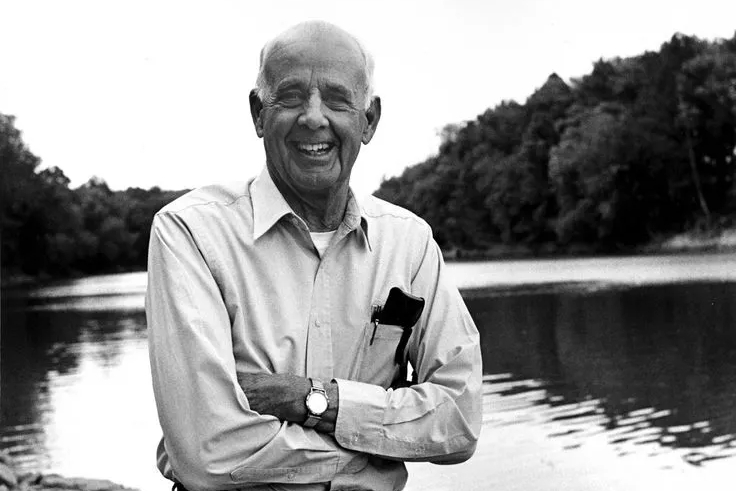
Wendell Berry died on August 31, 2026. He was one of the great men of the world, his greatness being of an entirely different sort than powers and principalities oft recognize. He lived as the kind of person who makes men want to write poetry. He was a man who allowed himself to see. Because he was willing to see, others saw.
Much will be and should be written about his life and work. Some obituaries could simply quote his own words, again and again:
“I dream of a quiet man
who explains nothing and defends
nothing, but only knows
where the rarest wildflowers
are blooming, and who goes,
and finds that he is smiling
not by his own will.”
“You mustn’t wish for another life. You mustn’t want to be somebody else. What you must do is this:
’Rejoice evermore.
Pray without ceasing.
In everything give thanks.’
I am not all the way capable of so much, but those are the right instructions.”
“So, friends, every day do something
that won’t compute. Love the Lord.
Love the world. Work for nothing.
Take all that you have and be poor.
Love someone who does not deserve it.
Denounce the government and embrace
the flag. Hope to live in that free
republic for which it stands.
Give your approval to all you cannot
understand. Praise ignorance, for what man
has not encountered he has not destroyed.”
“There are no unsacred places; there are only sacred places and desecrated places.”
“History overflows time. Love overflows the allowance of the world. All the vessels overflow, and no end or limit stays put. Every shakable thing has got to be shaken. In a sense, nothing that was ever lost in Port William ever has been replaced. In another sense, nothing is ever lost, and we are compacted together forever, even by our failures, our regrets, and our longings.”
“Be like the fox
who makes more tracks than necessary,
some in the wrong direction.
Practice resurrection.”
“If God loves the world, might that not be proved in my own love for it? I prayed to know in my heart His love for the world, and this was my most prideful, foolish, and dangerous prayer. It was my step into the abyss. As soon as I prayed it, I knew that I would die. I knew the old wrong and the death that lay in the world. Just as a good man would not coerce the love of his wife, God does not coerce the love of His human creatures, not for Himself or for the world or for one another. To allow that love to exist fully and freely, He must allow it not to exist at all. His love is suffering. It is our freedom and His sorrow. To love the world as much even as I could love it would be suffering also, for I would fail. And yet all the good I know is in this, that a man might so love this world that it would break his heart.”
“Never forget: We are alive within mysteries.”
“I take literally the statement in the Gospel of John that God loves the world. I believe that the world was created and approved by love, that it subsists, coheres, and endures by love, and that, insofar as it is redeemable, it can be redeemed only by love. I believe that divine love, incarnate and indwelling in the world, summons the world always toward wholeness, which ultimately is reconciliation and atonement with God.”
His words are as meaningful today as they were when he formed them. Long or short, poem or prose, fiction or nonfiction, all these words came because he was able to see, because he was willing to suffer, and because he saw and because he suffered he was able to love and speak truly. His work asks us to change because love, being love, knows we are made to be better than we are. We set out to make ourselves suffer less, becoming more miserable and less able to perceive. He saw us making ourselves into machines, and so he became the one man to ask the question of our time: What are people for?
It was in reading the essays of Wendell Berry in 2010 that I saw a beacon of light, a path away from the culture of reductionism I was struggling to escape. When I read his book Life is a Miracle I marked up every page, perhaps every paragraph. From 2010 to 2014 I read every piece of his nonfiction I could find, sometimes 2 or 3 times, and a few weeks before my marriage we traveled to see him speak at a Front Porch Republic conference in his Kentucky. His light was a godfather to my change of life, a voice crying in the wilderness, and the gratitude and love I have for him is overwhelming. With my six children sleeping, one beside me, I weep for this beloved man, this true hero of the 20th and 21st centuries.
In an age of brutal philosophies, shrieking media, cold arts, lying politicians, and devouring institutions, Wendell Berry was a hero of an entirely human way of being. Wendell Berry was willing to be slow. He was willing to live in quiet. He was willing to be gentle. He was willing to tell the truth. He was willing to refrain from destroying others in order to have more. He was willing to make art which let the soul peek out from hiding in a culture of sarcasm, ensouled art as quiet and fragile as a small bird, seeing and loving. He became a light because he was willing to accept the responsibilities of love.
In all my years of writing, here or anywhere, I realize I have made little allusions to my love of the stories of King Arthur. If one wishes to cry over the sorrows of this world, one can do so without ever stopping, so I am careful with my tears. But for some reason anytime I have cause to think about King Arthur in the last pages of The Once and Future King or the last lines in Le Morte d’Artur I shed tears: “Yet some men say in many parts of England that King Arthur is not dead, but had by the will of our Lord Jesu into another place; and men say that he shall come again, and he shall win the holy cross. I will not say it shall be so, but rather I will say: here in this world he changed his life.”
Wendell Berry summons those lines up from my heart. We turn great (powerful) men into immortal legends, not able to see that in the true great men their greatness was precisely in changing themselves, and then to die. The greatness in Wendell Berry’s life was not his earthly power, his ability to command nations or terraform the land. He built no Babels; he raised no armies. He was a husband, father, grandfather, farmer, and writer who loved Creation, who loved birds and horses and old trees and new trees, and meadows and brooks, old men and old women and small babies, who looked at their faces and testified to their beauty, who stepped into the zeitgeist and changed himself into the sort of person who could step out of it and become a light for others to see by.
As he made King Lear the center of that ode to life as meaning, Life is a Miracle, it is fitting for me to pray for him, remembering the lines he shared again and again:
“Thy life’s a miracle. Speak yet again.”
We look forward to the resurrection of the dead, and the life of the world to come. God bless Wendell Berry.



Comments
We changed commenting systems on September 10, 2026 as part of a site-wide functionality and security upgrade. Your past comments have not disappeared, and you can still log in with your old Disqus account credentials if you wish. Contact us with any questions.