

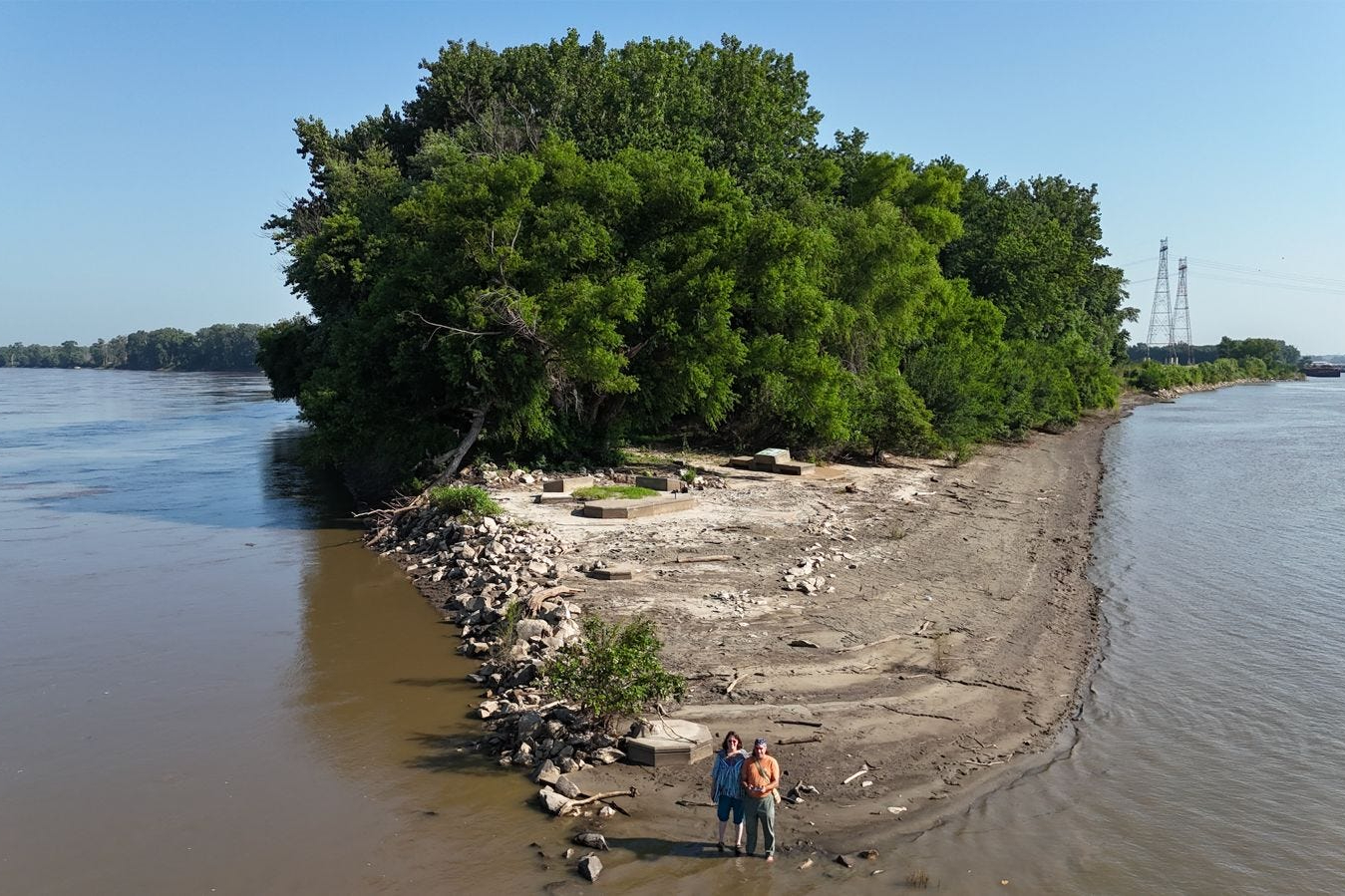
We embarked on a journey of transformation on May 29th, 2026 — traveling to many sacred sites across the interior of the North American continent. Penny and I did this to enact the Dandelion Strategy for Regenerating the Earth by going out into the world to dance with the emergence that is possible. We can say with confidence that our journey has helped seed at least a few more of the 1000 bioregional learning centers that are at the core of this strategy.
Our mission: To seed bioregional learning centers throughout the heart of Turtle Island.
Our route: Visit the major headwaters and confluences of the vast Mississippi River basin.
Our strategy: Learn from the innate intelligence of dandelion seeds and catalyze a phase transition through the intensifying collapse that is unfolding now.
Learn more about the pilgrimage here. Read our update from the first week of travels here. What I want to do today is give you an overview of what has happened along the way now that our pilgrimage has come to an end.
Traveling A Heart-Shaped Path Into the Continent
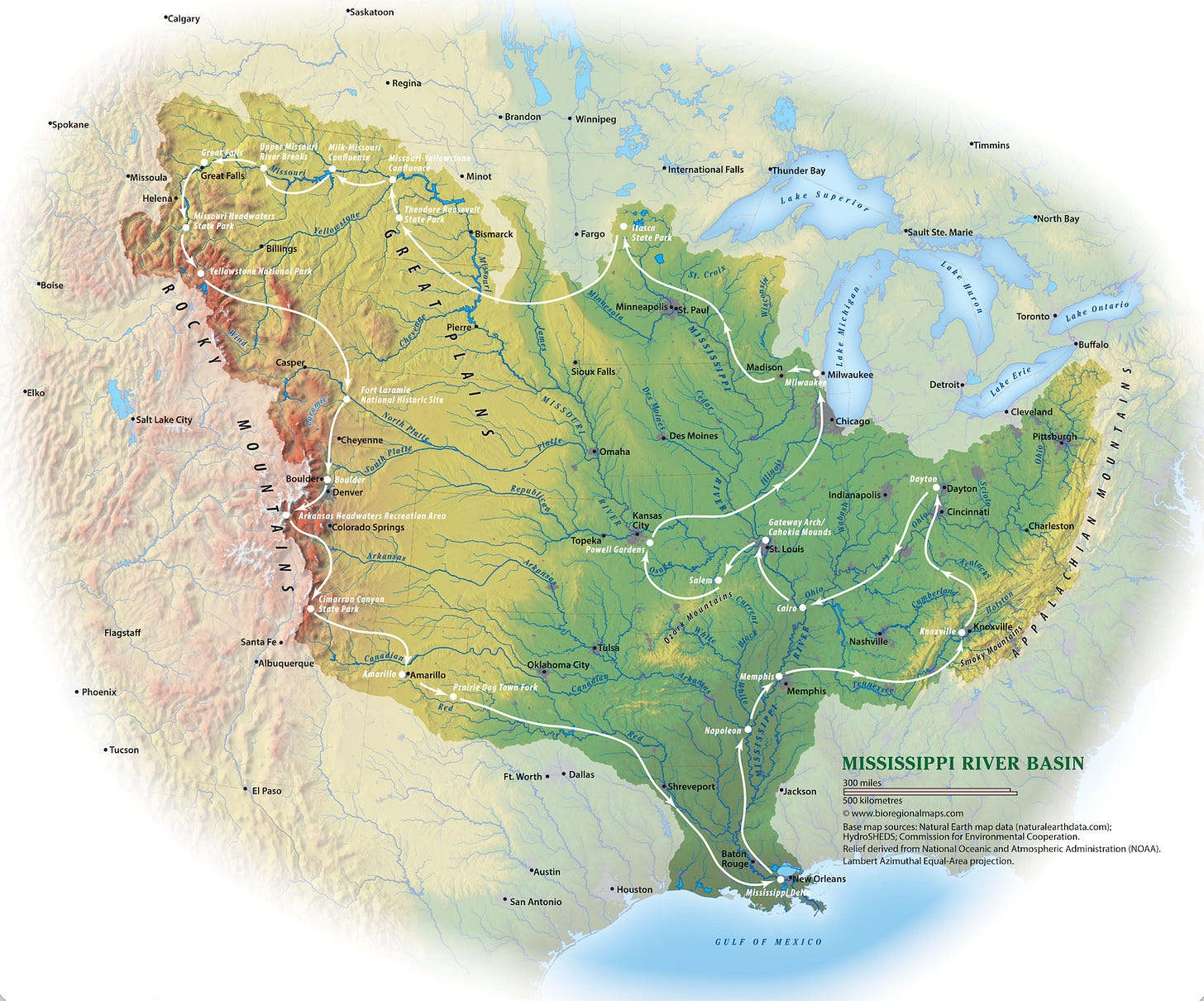
We began and completed our journey at the confluence of two great rivers — where the Missouri and Mississippi become one just north of St Louis, Missouri. We felt how this site (which is also the launching place of the historic William & Clark Expedition) brings unity and coherence to many landscapes as the waters gather from the Rockies to the west and the lake country in the far north.
From there, we visited the historic archeological site of Cahokia Mounds to make visible the deep history of Indigenous peoples on Turtle Island. It was only the first of many “mound” sites that we witnessed throughout the Mississippi Basin during our pilgrimage — though it is the largest and perhaps best known.
Our work to seed the idea of bioregional learning centers really began when we entered the Ozarks, where we spent time with Dianna Bryant and David Haenke. The first bioregional congress was held in the Ozarks and they have remained a constant presence in the world since the late 1970’s. Their 47th annual bioreigonal congress takes place this fall. Check it out here.
Inspired by this deep history, we contributed to gatherings in the Missouri River Valley near Kansas City, along the western shore of Lake Michigan in Milwaukee, in the heartland of Madison, along the front range in Boulder, in the high plains in Amarillo, and up the Ohio River near Dayton. All of these places have local organizers on the ground and the idea of participating in the Dandelion Strategy resonated among all of them.
Along the way, we visited the headwaters and confluences of several rivers. There were the headwaters of the Mississippi, Missouri, Yellowstone, Arkansas, Cimarron, and Tennessee Rivers. Confluences we visited included the meeting of the Minnesota and Mississippi, Missouri and Mississippi, Missouri and Yellowstone, Missouri and Milk, Laramie and North Platte, Cimarron and Canadian, Arkansas and Mississippi… it was amazing to feel all of these connections.

And then there was the delta itself — where all of these waters (and many more) find their way back to the sea. I had to fly the drone to get any kind of perspective on this vast threading of sediments, marshes, estuary flows, and pooled waters.
It was here that we felt the merging of living flows. A gathering of stories. Healing of landscapes. Weaving of places. Returning to the sea from which all life began. It was spiritual. Grounding. A place of depths that helped us sense what it truly means for Mississippi to be the Ojibwe word for “Father of Waters.”
What Is Emerging From This Journey?

Our learning journey in the Design School kicked off just as the pilgrimage was coming to an end. I wrote about it here. We hosted a webinar to share how we will embark on two more pilgrimages in September and October, launch a global community of practice called the BLC Action Network in January, and offer the pathway to join with our first Bioregional Design Certificate course that begins in November.
All of this is part of our pathway to seed at least 1000 bioregional learning centers into being by the year 2035. It is the enactment of our Dandelion Strategy. And we are giving ourselves time to feel what emerged within our bodies as we traveled throughout the Mississippi Basin. Layers of story. Witnessing with our own eyes the destructive fossil fuel infrastructure — oil shipping in the delta, fracking across the Missouri River, mining up high in the Colorado Rockies, and all of it sitting like a veneer on top of profound regenerative patterns of life at the continental scale.
The idea began to emerge — mostly as a feeling at this point — that we need to anchor into the bioregional history and geographic positioning of the Ozarks and weave a tapestry of bioregional learning centers across the entire continent of Turtle Island.
We also gained clarity about what we will need in order to do this. You’ve probably read our Billion Dollar Proposal for Regenerating the Earth and how we are creating a Flow Funding System that Works Like the Living Earth. To create it, we will need three years of stable support. Here is a graphic that captures the core features:

We wrote about what we could do with $1,5 million between 2027 and 2029 to grow this vision and manifest it across the planet. You can read about it here. The important thing is that we need seed funding that we can flow into nascent bioregional learning centers, the capacity to learn-by-doing with our efforts in the Northern Andes, and the ability to continue creating vital infrastructure for the planetary network as it diversifies and expands.
All of this is being catalyzed by what we experienced in June while traveling among the headwaters and confluences of the Mississippi Basin. We experienced many living seeds of regeneration across Turtle Island — so many places that have a lot of regenerative work happening, yet are not organizing up to the bioregional scale. We want to do our part to be sure this happens.
I’d love to hear your thoughts. Please share them in the comment thread below. Also, join us in the Design School for Regenerating Earth where all of this learning is unfolding now.
Let’s grow!
Onward, fellow humans.


Comments
We changed commenting systems on September 10, 2026 as part of a site-wide functionality and security upgrade. Your past comments have not disappeared, and you can still log in with your old Disqus account credentials if you wish. Contact us with any questions.
Beautifully written! I was glad I could meet with you, even so briefly, at the sacred place I've known and loved in the Bdote (Minneapolis-St Paul). You hold the vision well.