

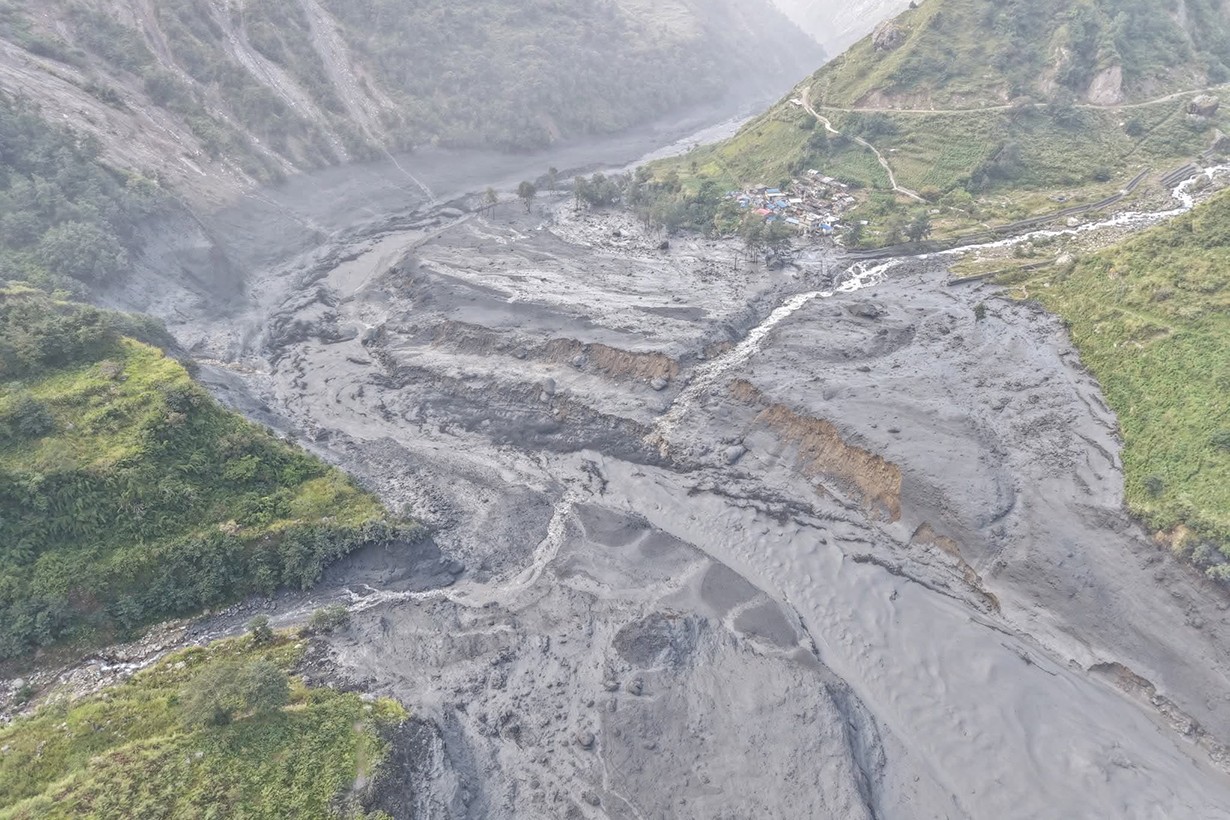
Hurricane Isaias made landfall near Destin, Florida, on Friday night as a Category 2 hurricane with 105 mph winds, after briefly reaching Category 3 that morning as the first major hurricane of the 2026 Atlantic season. It tore roofs off homes and condominiums on the Panhandle, then moved north Saturday, bringing torrential rain and the threat of flash floods and tornadoes across the Southeast. At least four people are dead. Hundreds of thousands are without power across Florida, Alabama, and Georgia. The storm is no longer a hurricane, but several rivers in the Panhandle are expected to crest over the next couple of days.
The wind has passed. The water is still rising.
It made me think of Miss Ivy who has been a neighbor of my family for as long as I can remember.
She’s 83 now, and she still does what she has done her entire life: she doesn’t wait until the storm has passed to start tending to the things that survived.
She doesn’t wait for the all-clear. She doesn’t wait to find out how bad it is. While the rest of us are still inside, she’s already out there, stepping over what the wind brought down, looking for whatever is still rooted. Nothing is in bloom after a storm. What’s left is what held on: a stem bent flat but not snapped, green pushing up through a crack where there wasn’t a crack before, something small that came through because it was low to the ground and tough. That’s where she starts. Whatever made it through gets care. Whatever didn’t gets cleared away so something else can come up in its place. The world could be ending. Sometimes it feels like it is. And Miss Ivy is out there in conversation with the leaves.
I asked her once how she does it. How she keeps tending to small, green things when everything else feels like it’s falling apart.
She looked at me the way old women do when young people ask obvious questions.
“The plants don’t watch the news,” she said. “But they still need water. And I still need them.”
Moments of rupture arrive the way storms do—not as isolated events, but as expressions of deeper atmospheric conditions. When a hurricane comes ashore, when violence erupts in our streets, when war fractures nations, the pull is to respond quickly, loudly, declaratively. To say something. To be seen saying something.
But there’s another way. Slower. Wider. Harder.
It asks us to listen for the patterns moving beneath the surface. To resist the collapse into moral simplicity. To stay when staying is uncomfortable, and to tend what needs tending even when it won’t make the headlines.
This is what a Gaian response looks like. Not passivity. Presence.

The Lie of Separation
Here’s what I’ve come to understand: there is no separation between social crisis and ecological crisis. They’re not parallel tracks. They’re the same wound, expressing itself in different places.
Racism, militarism, extraction, displacement—these aren’t separate from the burning forests and the rising seas and the storm surge pushing across a Florida street. They grow from the same root: a story that taught us we could take without consequence. That some lives matter more than others. That the land is a resource and not a relative.
We’ve been living inside that story so long we forgot it was a story at all. We thought it was just the way things are.
It’s not. It never was.
And the ruptures we’re witnessing—the ones that leave us scrolling, grieving, arguing, going numb—are what happens when a story stops working but we keep trying to live inside it anyway.
Beyond Us and Them
The temptation in times of conflict is to harden. Us versus them. Innocent versus guilty. The ones who understand versus the ones who never will.
I get it. I’ve felt the pull. There’s a certain safety in knowing which side you’re on, in having a clear enemy to point toward. It organizes the chaos. It makes the grief feel useful.
But it’s a trap.
From a Gaian perspective—from an Earth perspective—there is no conflict that doesn’t eventually implicate the whole. Borders divide nations, but rivers don’t recognize them. Wind doesn’t stop at checkpoints. A storm doesn’t check anyone’s politics before it comes ashore. Suffering doesn’t stay neatly contained, no matter how many walls we build.
This doesn’t mean ignoring accountability. It doesn’t mean pretending all sides are equal when they’re not. It means refusing to let grief curdle into dehumanization. It means recognizing that collective punishment—of peoples, of cultures, of ecosystems—only accelerates the collapse we’re trying to prevent.
Solidarity isn’t a performance. It’s a relationship. And relationships require us to stay even when staying is complicated.
What Disaster Reveals
Disasters don’t emerge from nowhere.
The fire that took the town. The flood that swallowed the valley. The hurricane that arrived in October, in a season that had produced no hurricanes at all for four months. These aren’t random. They’re revelations. They expose the fault lines that were already there—climate instability, colonial wounds, economic extraction, infrastructure neglected because the people it served weren’t considered worth protecting.
What looks sudden is almost always the culmination of something long developing.
I think about the communities I come from—Caribbean, Indigenous, African American. We know this in our bones. We’ve always known that disaster is never just natural. That who survives and who doesn’t has everything to do with who was already vulnerable. That the same forces that poison the water are the forces that redline the neighborhood are the forces that decide whose grief gets airtime and whose gets forgotten.
A Gaian response doesn’t rush past grief to get to solutions. It doesn’t treat catastrophe as a branding opportunity for moral clarity. It grieves first. Studies carefully. And only then acts—guided by humility and attention to place.
Restoring land. Restoring memory. Restoring relationship. These aren’t symbolic gestures. They’re prerequisites for anything resembling healing.
The Discipline of Not Performing
Here’s the harder thing: not every crisis requires a statement.
In a world that rewards immediacy—where silence is read as complicity and speed is mistaken for conviction—restraint can feel like failure. Like abdication. Like you don’t care enough to say something.
But there’s a difference between speaking from relationship and speaking about crisis. The former takes time. The latter evaporates as soon as the attention shifts.
I’ve learned this the slow way. Learned that sometimes the most ethical response is to sit with the discomfort of not knowing what to say. To ask questions instead of issuing declarations. To show up in ways that won’t make the feed but might actually matter to the people in the room.
When a Gaian voice does speak, it points beyond the moment—toward the systems that produced it. Climate destabilization. Extractive economies. Racial hierarchies. Cultural amnesia. Anything less is just noise dressed up as concern.
Choosing the Long Work
Gaia doesn’t offer comfort through certainty. She offers steadiness through scale.
We are living in an era of overlapping emergencies. More will come. The storms aren’t stopping. The ruptures aren’t over. If anything, they’re accelerating—layering on top of each other until it becomes hard to remember what we were grieving last month, let alone last year.
The work, then, is not to perfect our response to each eruption. It’s to cultivate the practices that make resilience possible: community, inquiry, ecological literacy, presence, and devotion to something larger than the news cycle.
There is no viable future without a shared future. No justice without ecological repair. No peace without reckoning with what we’ve done and what we’ve allowed.
To walk this path is to accept that responsibility doesn’t end when the headlines move on.
It deepens.
Miss Ivy is still out there most mornings. Still watering. Still in conversation with whatever came through, patient as it decides when to grow back.
I’ve stopped asking her how she does it. I’ve started joining her instead.
Some days that’s all the resistance I have in me—tending to what’s green, what’s growing, what refuses to give up. Trusting that the small faithfulness matters even when I can’t trace its impact. Letting the garden teach me what the news cannot.
The plants don’t watch the news. But they still need water.
And I still need them. More than I used to let myself admit.


Comments