

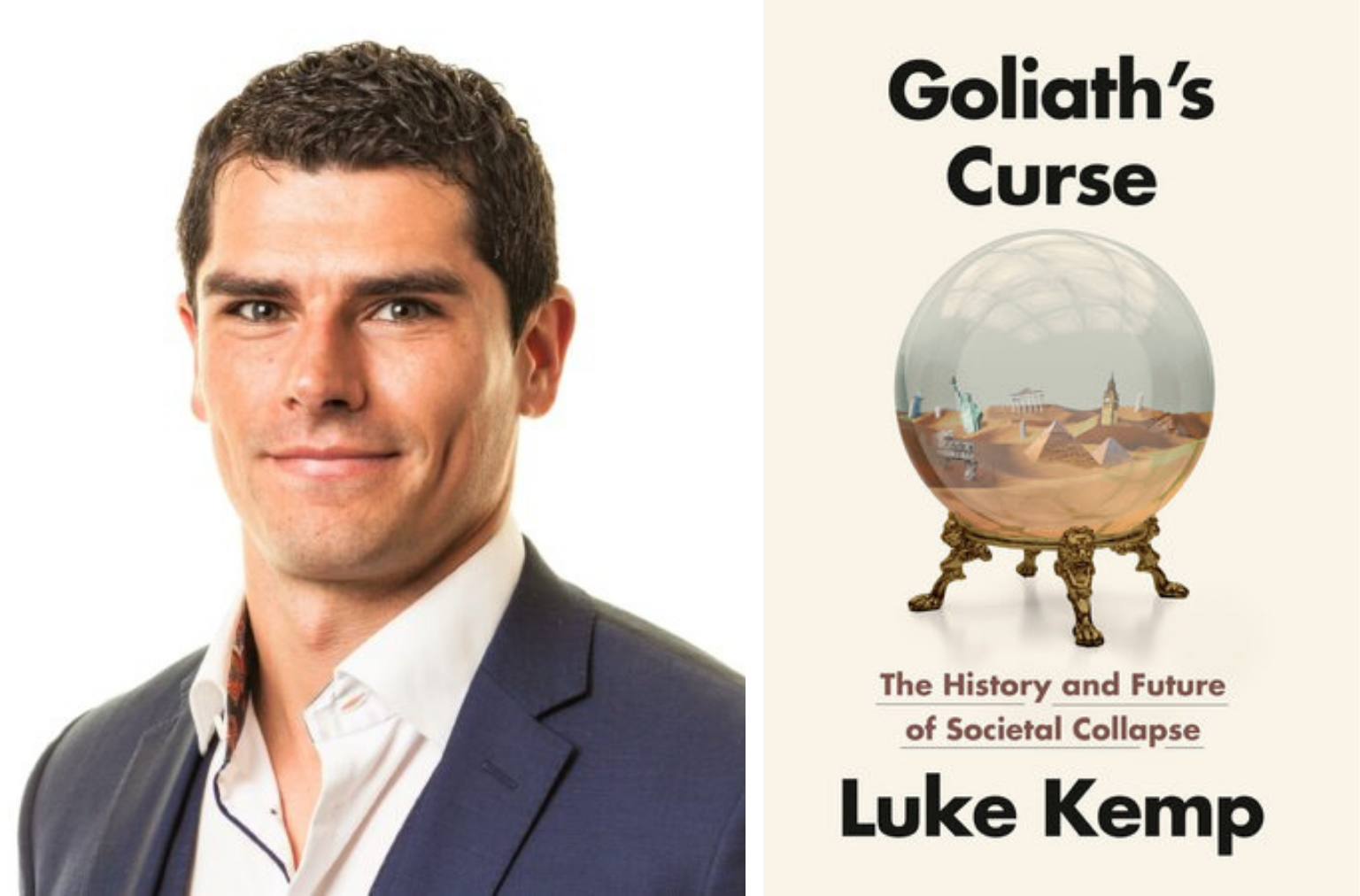
Goliath’s Curse by Luke Kemp offers a detailed and important account of how societies ruled by elites have arisen, triumphed and eventually collapsed, and how we are well into that cycle. Where Kemp’s analysis falls short, however, is in failing to identify the path we urgently need to take.
Kemp focuses on the common tendency of human societies to engender rule by greedy, exploitative, and nasty elites, which increasingly reshape societies to reinforce their own aggrandizement and wealth, and, eventually, cause their own collapse. Domination, Kemp would argue, has been the most common element in “civilization”.
These dynamics were not characteristic of the hunter-gatherer societies we lived in for 300,000 years; they began to appear in the Bronze Age (the period in human history, beginning around 3000 BCE in some regions, marking the first use of metals, like copper). Kemp devotes much space to documenting the merits of hunter-gatherer societies, including superior health and fitness compared with the effects of the conditions farmers later experienced.
Those societies were mostly anarchist, that is, participatory “democracies” of equals without top-down rulers. Sharing was a deeply entrenched custom, extending beyond food to the sharing of power. Various mechanisms maintained this remarkable equality and lack of domination, such as the custom of “insulting the meat”, that is, denigrating the animal the hunter returned with, thereby preventing him from coming to see himself as superior.
Another mechanism occasionally resorted to when a man began asserting himself as the highest-ranking figure in a hierarchy was simply to kill him, with all the tribes members taking turns to stab him. “For most of human history, an attempt to dominate others was more likely to get you an early burial than a place in the history books.”
Kemp writes: “In many modern forager communities, … there are no permanent chiefs or commanders. …When leaders do appear … they are shackled by expectations. They are expected to be modest, generous, and egalitarian, and are kept politically toothless.
“Chiefs had no power to impose decisions on others. They were more like unpaid facilitators. … in the Palaeolithic,… we have no signs of enduring inequality or hierarchy, and modern nomadic-egalitarian groups who have the lifestyles closest to our deep past are especially democratic…” Indeed, more so than the Ancient Greeks, who restricted participation to adult men.
“We are a species that survived the ice age by being intensely social, cooperative across groups, and equal, even during times of need and danger.”
This provides important context for thinking about modern societies where top-down domination, either benign or malicious, is the norm. It contradicts the Hobbesian view that human beings are innately individualistic, competitive, selfish and belligerent, and therefore need a powerful government to control them and maintain order. But that view has been shaped within Western civilization, which, for 10,000 years, has been driven by “Goliaths”. Kemp’s first 100 pages align with the account that authors David Graeber and David Wengrow give in their book The Dawn of Everything (2021), documenting many societies that have functioned as communities of (political) equals. This means we are not condemned to suffer rule by kings, tyrants, patriarchs, ruling classes, or other kinds of Goliaths.
The transition
As the post-Ice Age climate warmed, Kemp writes, societies began to see a “shift towards social relations built on dominance hierarchies,” driven largely by the growing availability of “lootable resources,” such as grain, which allowed “individuals and groups to become not just rich but also powerful.” The other two “sources” of Goliath fuel were “monopolizable weapons” enabling plunder and hoarding, and “caged land,” by which he means resources or people that could not move to escape domination. Groups would often simply flee a rising Gorilla, if they could.
“Warfare emerges as Goliaths develop. In Europe, there are no signs of war during the Palaeolithic.”
The “Dark Triad”
Kemp says Goliaths possess “the dark triad”: psychopathy (callousness and a lack of empathy and remorse), narcissism (an inflated sense of entitlement and self-importance), and Machiavellianism (manipulating others for personal gain). Kemp argues that very few have these traits, but they can lead whole societies to become “Goliath states.”
Kemp also vigorously condemns the state. It was a case of evolutionary backsliding: we began to give up the arrangements that had made us uniquely human. He argues that the state did not emerge because of a need for bureaucracy to manage the complexity of agriculture; it was primarily due to the emergence of a Goliath mentality. Various societies developed top-down rule with and without agriculture.
“All states are empires and empires are about domination. In the simplest terms, empire is just the quest of one society to control the resources and people of another.”
Kemp’s views on the emergence and nature of the state are debatable, but his insistence on the historical significance of the emergence of Goliaths is not. For 10,000 years we have had the rise of Goliaths, their thuggish rule for on average two to three hundred years, and their overreach and self-destruction—Goliath’s curse.
This story is also told by Michael Hudson in Killing the Host (2015). Hudson focused on the role of debt in enabling the rich to acquire wealth, for instance, by taking the land of farmers unable to repay loans for seed grain purchases, or taking them as slaves. Before long, the king finds he has a depleted workforce, tax base, and army. Hudson explained how debt has thereby destroyed whole empires. Often this led rulers to periodically cancel all debts.
Thus, Kemp provides the strong case that we are currently experiencing the playing out of Goliath’s curse, the emergence of a situation in which a super-rich elite is using its wealth to secure political power to increasingly gear society to their interests.
He devotes much space to documenting the accelerating polycrisis and showing how the system driving it serves the interests of capital owners. He examines the mechanisms through which wealth translates into power, including campaign contributions that secure the loyalty of politicians, who in turn pass laws that reduce welfare, outlaw strikes and unions, and keep wages low. Capital owners also own major media outlets and can fund think tanks, lawyers, political campaigns, and other instruments of influence. Over the past forty years, politicians have enacted laws that have kept the incomes of American workers largely stagnant while enabling the wealth of the super-rich to skyrocket.
This process is dismantling the structures and procedures which are crucial for the functioning of society. For instance, it suited capital to wind down manufacturing in the U.S. and relocate it to low-wage regions in Asia. Now the country lacks the capacity to produce the quantity of drones and submarines they need to sustain dominance of their empire. This is what inevitably happens in an economy driven by the profit of the capitalist class rather than the needs of individuals, society, and the environment.
Just as notable is the effect their greed is having on the destruction of social cohesion. Many suffer from poverty, drug and alcohol abuse, depression and mental illness. America is around the bottom of almost all social indicators lists of high-income nations.
Deprived and angry masses are turning to authoritarian leaders who will further impoverish them while gutting the institutions that used to protect them and their society, especially the judicial, scientific, environmental, green energy, health care and regulatory institutions.
Above all, there is the financialization of the economy. As the declining purchasing power of the masses reduces opportunities for capital to be invested in producing more goods to sell, investors have turned to getting hold of assets to rent. For instance, students now have to take out large loans to pay enrolment fees. Such investment does not increase production of anything; it only enables pre-existing wealth to be siphoned out. Nancy Fraser has described this as cannibalism, similar to a hardware store having to sell the corrugated iron from its own roof to make a profit, or the mafia extracting wealth from existing productive enterprises.
Many now agree with Kemp’s diagnosis, especially his conclusion that “we live in uniquely dangerous times.” Unfortunately, his solution is more challengeable.
Kemp writes: “Wealth becoming more unequal may be close to an iron law throughout history, but reversing it is surprisingly easy. The simplest way is through taxation.” Another option, he argues, is “…a global minimum wage, which could be half the median wage of a country to take account of local conditions. Another is a comprehensive debt jubilee – in other words, writing off all debts.” He also proposes breaking “up existing monopolies, specifically in big tech and the media” or “even halt the production of dangerous new technologies and weapons by placing them back under democratic control.”
Thus, I would say that the final pages of the book are stunningly naive and useless. They are akin to what The Beatles might offer as a solution: ”…all we need is love.” Perfectly true, but lacking any suggestions as to how on earth these solutions can be implemented in a society set firmly in the hands of Goliath.
Even if they were achievable, Kemp’s solutions are merely reformist. He barely uses the word “capitalism” and does not identify it as the basic cause of all of our big problems. The capitalist class stole America long ago. As Warren Buffett once said, “There is no class war in America … There was, but my class won it”.
How does Kemp think we can take it back from Musk et al.?
Here I offer an alternative transition vision. The polycrisis is widespread and insoluble. We are, as Kemp details, on a trajectory towards catastrophic global breakdown. There is very little that can be done about it now. If we are lucky, it will be a Goldilocks collapse—not sudden and totally final but sufficient to get rid of capitalism and drive people to develop local communities that are highly self-sufficient and self-governing and committed to The Simpler Way. I believe that transition communities are the only path to sustainability and survival, and the Eco-village, Transition Towns and similar movements are attempting to pioneer this kind of path.
Our task is to work hard in the time remaining to come to the realisation that some kind of simpler way is the only viable answer, so that sufficient alternative communities can be initiated to survive and become the foundations for a new sustainable and just society. The chances of success are obviously not good, but neither were David’s chances against Goliath.





Comments
We changed commenting systems on September 10, 2026 as part of a site-wide functionality and security upgrade. Your past comments have not disappeared, and you can still log in with your old Disqus account credentials if you wish. Contact us with any questions.
Really great to have Ted Trainer review this!
Even if Kemp's solutions are a bit weak, his book does a great service in dispelling the notion that we've come to this pass as the inevitable result of HUMAN NATURE–which many people believe. Hard to see any way out if you think this is the inevitable result of all humans being greedy, selfish, short-sighted creatures. Illuminating that there IS another way humans can live, in harmony with the rest of Creation and–for the most part–with each other, is important even if he hasn't been the one to illuminate a path from here to there. But I also think Trainer is right that local communities setting up to create an alternative–starting now– is the likeliest path, although two big problems are that communities will vary greatly and some will be monstrous, and that one that does a solid job of creating good egalitarian structure and providing for the needs of its people–which means stockpiling surpluses in good years to get through the bad ones–will likely have to deal with marauding gangs who figure robbing such communities will fill their needs easier than settling down and working hard to raise crops.
I really think the central problem, still unsolved after thousands of years, is how to deal with violent, expansionist Goliath cultures. Fleeing to someplace where there wee no Goliaths around and starting anew was a solution for a long time, but this left the Goliaths free to keep expanding, and growing, and expanding some more, until there is no place free of them anymore, plus there are too many humans to subsist well on a planet increasingly ravaged by climate change and other ecological consequences. I think there may be a good world in 200 years, with as many as a billion or two humans–but we will only get there by going through the Valley of the Shadow of Death. The sooner that starts,the better our chances, because the damage just keeps ramping up as mad economists insist on growth.